
 Worksheets
8th Grade Physical Science Midterm Exam Quiz
Total questions: 139
Worksheet time: 5hrs 52mins
What is an atom?
The smallest unit of an element that maintains the properties of that element
A process in which one or more substances form from one or more other substances
A unique particle of matter that is a fundamental building block of matter
A combination of chemical symbols and numbers to represent a substance
What is the difference between an exothermic and endothermic reaction?
An exothermic reaction changes from a liquid to a gas, while an endothermic reaction changes from a gas to a liquid
An exothermic reaction changes from a solid to a gas, while an endothermic reaction changes from a gas to a solid
An exothermic reaction releases energy, while an endothermic reaction requires energy
An exothermic reaction requires energy, while an endothermic reaction releases energy
What is the difference between a synthesis reaction and a decomposition reaction?
A synthesis reaction requires heat, while a decomposition reaction releases energy
A synthesis reaction changes from a solid to a gas, while a decomposition reaction changes from a gas to a solid
A synthesis reaction is a reaction in which a single compound breaks down into simpler substances, while a decomposition reaction is a reaction in which two or more substances combine to form a new compound
A synthesis reaction is a reaction in which two or more substances combine to form a new compound, while a decomposition reaction is a reaction in which a single compound breaks down into simpler substances
What is the Law of Conservation of Matter?
A reaction that requires heat
A process in which two or more substances combine to form a new compound
The mass of the reactants and products are equal
Matter can neither be created nor destroyed
What is a chemical formula?
The smallest unit of an element that maintains the properties of that element
A unique particle of matter that is a fundamental building block of matter
A combination of chemical symbols and numbers to represent a substance
A process in which one or more substances form from one or more other substances
What is the property of viscosity?
The resistance of a fluid to a change in shape or movement of neighboring portions
The amount of force exerted over a certain area
The measure of the average kinetic energy of the particles of a substance
The total energy related to the motion of the atoms and molecules in an object or sample of matter
If you look at a crystal of table salt with a magnifying glass it looks like a tiny cube. This is because _______________.
the molecular structure of sodium chloride is destroyed when it is formed
salt is formed by forcing it through a screen with square holes
the molecular structure of sodium chloride forms natural cubes
salt blocks are cut by machine into tiny square blocks
Salt and sugar appear similar, but their crystals look different at the atomic level. What does this say about the molecular structures of salt and sugar?
Salt and sugar molecules contain the same atoms arranged in different patterns.
Salt and sugar molecules are made of different atoms arranged in the same pattern
Salt and sugar molecules contain different atoms arranged in different patterns.
Salt and sugar molecules are made of the same atoms arranged in the same patterns.
A(n) ____________ bond is when atoms share electrons.
covalent
polar
ionic
metallic
proton
Negatively charged particle that moves around the outside of the atom
Identifies the number of protons in an atom
positively charged particle
Measures the total mass of all subatomic particles
electron
Negatively charged particle that moves around the outside of the atom
Positively charged particle
Identifies the number of protons in an atom
Can be a unique or common characteristic of an object or substance
atomic number
Negatively charged particle that moves around the outside of the atom
Positively charged particle
Measures the total mass of all subatomic particles
Identifies the number of protons in an atom
mass
Anything that has mass and volume, cannot be an idea
Measurement of the amount of space an object takes up
Measurement of the amount of particles an object has
Purest type of matter. There are 118 existing in the world, can only be broken down into an atom of that particular material
volume
The amount of space an object takes up
the connection between atoms in more complex particles
the specific way in which the bonds and atoms are arranged within the molecules of a substance
A mixture in which substances are evenly distributed throughout the mixture
extended structure
a structure whose subunits occur in a constant ratio and are arranged in a repeating pattern; the subunit can be individual atoms or a molecule
A mixture in which different materials can be distinguished easily
anything that has mass and takes up space
a representation of an object which makes important aspects easier to see
compound
A substance made up of atoms of two or more different elements joined by chemical bond
A combination of two or more substances that are not chemically combined; can be separated physically
a group of two or more atoms that are held together by chemical bonds; a molecule has a unique composition and structure
a representation of an object which makes important aspects easier to see
polymer
a type of extended structure that is made of many smaller, repeating subunits in a chain; the repeating subunit is a unique molecule. Can only be moleules
a solid structure whose atoms or molecules are arranged in a repeating, three-dimensional pattern
a structure whose subunits occur in a constant ratio and are arranged in a repeating pattern; the subunit can be individual atoms or a molecule
a shorthand notation of one, two, or three letters that represent the name of the element

The table above lists some information about certain elements in group 17. Which statement describes what happens to these elements as atomic number increases?
Both melting point and boiling point decrease.
Melting point increases and boiling point decreases.
Melting point decreases and boiling point increases.
Both melting point and boiling point increase.
A property that is observed during a reaction where the chemical composition is changed.
Ex: Heat of combustion, flammability
atom
element
chemical property
physical property
Can be observed or measured without changing the composition of the matter.
EX: appearance texture, color
physical property
chemical property
element
atom
If an atom had a mass of 20, and 5 protons, how many neutrons does it have?
20
5
15
25
If I had an atom with 5 electrons and 5 protons, what is its atomic number?
5
10
15
20

When elements are in the same ROW they are all in the same-
Chemical Symbol
Period
Family

When elements are in the same COLUMN they are all in the same-
Chemical Symbol
Period
Family

What do we call the one or two letter abbreviations for elements on the Periodic Table?
Chemical Symbol
Period
Family

What is an isotope?
version of an element with different numbers of protons but the same number of neutrons
version of an element with different numbers of protons and neutrons
version of an element with the same numbers of protons but different number of neutrons
version of an element with the same numbers of protons and neutrons

What do we call the electrons that are involved in chemical reactions and are in the outermost shell?
Valence Electrons
Isotopes
Atomic Numbers
What type of bond is formed when one atom DONATES electrons to another atom (between one metal and one non-metal)?
Ionic
Covalent
Sharing
Donating


Will a chlorine atom gain or lose electrons?
gain
lose
T/F All matter is made of atoms.
T
F
What is an atom or molecule with a net charge due to the loss or gain of one or more electrons?
Isotope
Ion
Electron
Proton
What is the atomic mass of Chlorine?
34
35
36
37
The number of outer shell electrons in Helium:
1
2
6
8
How many neutrons will Carbon-15 have?
12
6
8
9
Chemical formula for ionic compound of Li+1 and O-2.
Li-2O1
Li2O
LiO
Li1O-2

According to the Octet Rule, atoms want ____ electrons in their outermost energy level or shell.
2
4
6
8
Why does the middle element in a specific group of similar elements act as an intermediate between the other two?
Because the middle element is closer to the average than the other two
Because they all share the same properties
The reactivity of the elements equal the middle element
NOTA
T/F Elements within a group do not tend to have similar properties.
T
F
What determines a molecule's characteristics?
Composition
Number
Structure
Size
Capability
Atomic level structure of extended structure results in what? (Ex when water freezes, crystals form with 6 sides, and similarly, snowflakes always have 6 sides.)
Atomic Patterns you can see
characteristics
color
Components and Characteristics of different molecules.
Which of the following represents the amount of space and object takes up?
density
volume
mass
Which of the following is NOT a physical property?
flammability
melting point
density
luster
A property that can only be observed when a substance reacts or does not react with another substance
chemical property
physical property
Dakota took a cube and measured the mass and volume of a cube. He discovered the mass to be 36 g and the volume to be 6 mL. What is the density of the cube?
(a)
The temperature at which a liquid turns into a gas
melting poing
boiling point
Pure substance
Characteristics that can be observed or measured without changing the substance, such as color, melting point, or conductivity
Has mass and takes up space and occurs as elements, compounds, and mixtures
A single substance, either an element or a compound, with definite composition and properties
Large quantities
Oil and water separating into layers is an example of –
The physical property of volume
The chemical property of volume
The physical property of density
The chemical property of density
Which of the following is good evidence that an unknown sample is a pure substance?
After leaving a liquid to settle, it separates.
After leaving a liquid to settle, it does not separate.
Multiple samples of the unknown substance melt at the same temperature.
Multiple samples of the unknown substance melt at different temperatures.

The following liquids are poured into a glass jar. Which is the correct order, from top to bottom, of the column that would form?
(See attached table)
Liquid C, Liquid A, Liquid B
Liquid C, Liquid B, Liquid A
Liquid B, Liquid A, Liquid C
Liquid B, Liquid C, Liquid A

A table comparing four metals is provided.
(See attached table)
A sample known to be one of the four listed in the table was heated to a temperature of 350oC but remained a solid. The sample was found to have a density greater than 6 g/cm3 and to be a good conductor of electricity. Burning the sample produced a blue flame. Based on this information, what is the identity of this sample?
Zinc
Lead
Tin
Iron
A heterogeneous mixture is:
A substance that is only made up of one type of molecule
A non-uniform mixture of two or more smaller parts
A uniform mixture where the component parts are evenly distributed throughout
All of the above
A homogeneous mixture is:
A substance that is made up of one type of atom or molecule
A non uniform mixture that can be separated into component parts
A uniform mixture that cannot be separated into component parts
A non-uniform mixture made up of two or more substances
A solution
Density Formula:
volume/mass
volume*mass
mass/volume
weight/volume
T/F Ice has a density less than water.
T
F
Choose the example of a chemical property:
Baking soda has the ability to react with vinegar
shiny metal
water freezes at 32 degrees Fahrenheit
Gold is yellow
Students were asked to separate a mixture of sand and salt. One group decides to put the mixture into a beaker of water first. Which of the following should they do next to separate out the sand and the salt?
Pour the mixture through the filter to remove the sand and then evaporate the water
use a colander to catch the the sand and then a filter to catch the salt
use a magnet to extract the sand, then freeze the water
Let the water stand until the sand settles to the bottom and the salt floats to the top

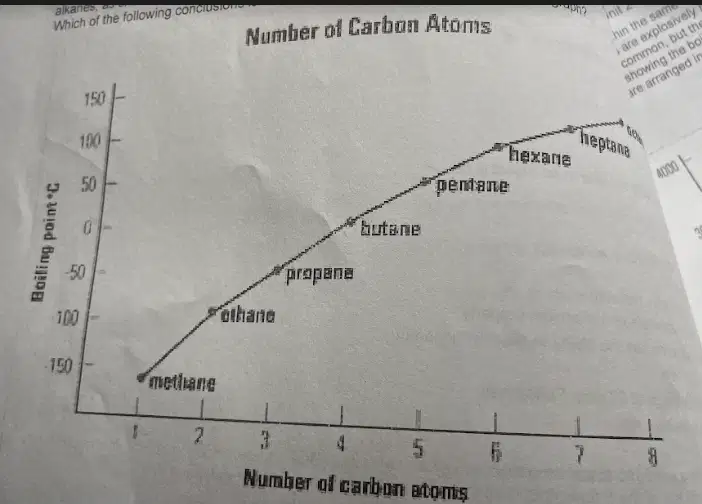
Alkanes are a group of molecules made entirely from carbon and hydrogen atoms. They have many uses; butane (C4H10) is used in gas stoves and octane (C8H18) is used in car gasoline. A scientist is interested in seeing the properties of alkanes depend on their size. She experimentally determines the boiling points for the first eight alkanes, as shown in the graph provided below. Which of the following conclusions is best supported by the data in the provided graph?
The more carbon atoms, the lower boiling point
The more carbon atoms, the higher the boiling point
The number of carbon atoms in alkane does not affect boiling point
NOTA
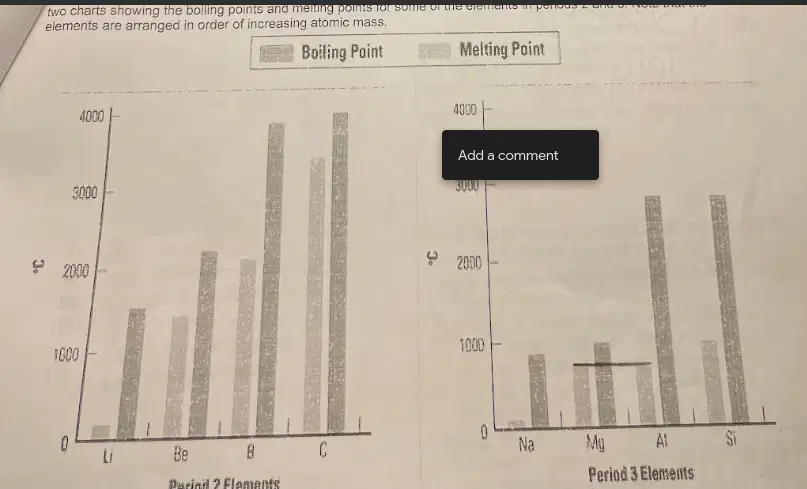
Elements within the same column of a periodic table tend to share similarities, such as all alkali metals are explosively reactive with water! Elements within the same row of the periodic table do not have as much in common, but there are some interesting trends in their properties that can be observed. Provided are two charts showing the boiling points and melting points for some of the elements in periods 2 and 3. Note that the elements are arranged by increasing atomic mass. Based on the provided charts, how do the melting points and the boiling points of elements within the same period change as their atomic mass increases?
Scientists use the term (a) to refer to a macroscopic amount of a atom, molecule, or extended structure. (lowercase answer plz!)
DO all objects of a substance have the same odor?
Yes
No
T/F Density is the concentration of mass in an object + is a property that does not depend on the shape or size of an object, so we can use this property to identify a substance.
T
F
T/F Melting or boiling point is a property that doesn't change on the amount you have.
T
F
What is solubility?
The ability of a substance to dissolve in another substance
What is the burning splint test?
A test used to determine different types of flammable and non-flammable gases
T/F Not everything is a pure substance; many of the objects you interact with are mixtures of pure substances.
T
F

What state of matter does the picture below represent?
solid
liquid
gas
plasma

The particles in the picture are tightly held together with very tiny movement. They have shape and fixed volume. Therefore, the picture represents _________.
solid
liquid
gas
plasma
Matter is made up of particles. Which of the following statements is true about these particles?
The particles that make up solids do not move
The particles that make up liquids do not move
The particles that make up all matter are constantly in motion
Only the particles that make up gases are constantly in motion
The forces that keep particles together in a gas are
weak
medium
strong
loosely packed
_________ energy is a measure of how fast particles in a substance are moving. More thermal energy = faster particles!
Thermal
Thermos
Thanos
Thermometer

What are the 3 main states matter?
Light, Solids, Gas
Solids, Liquids, Gas
How do particles move?
In a straight line until they hit something.
They move in a circular pattern.
They move in an elliptical pattern.

What has more thermal energy, an iceberg or a hot cup of coffee?
Iceberg
Hot cup of coffee
T/F A phase change is a type of chemical change that cannot be done.
T
F
Condensation
When particles in a gas lose enough thermal energy to turn a liquid.
Sublimation
Solid 2 gas
gas 2 solid
solid 2 liquid
NOTA
T/F Thermal energy is the internal energy of an object due to kinetic energy of its atoms and/or molecules
T
F
Which of the following statements best describes the relationship between temperature and kinetic energy of particles in a substance?
What is Freezing?
Which of the following changes made to a sample of liquid would result in an increase in distance between the individual molecules of the substance?
Decreasing heat energy
Increasing heat energy
A state of matter is the physical form matter takes on as determined by the:
arrangement and motion of its atoms or molecules.
number of atoms or molecules in a particular substance.
shape of the container holding the atoms or molecules.
volume of the container surrounding the atoms or molecules.
Why can liquid take the shape of the container holding it?
Liquid molecules take on the characteristics of the solids with which they interact.
Liquid molecules easily vibrate and only appear to change shape in the container.
Liquid molecules are able to slip around each other and fill in gaps between them.
Liquid molecules are not closely packed and are able to fill in gaps between them.
What would happen to the air in an empty container if you crumpled the container into a smaller shape?
The gas changes shape to fit the container, but not its volume.
The gas changes shape and volume to fit the container.
The gas does not change shape or volume to fit the container.
Atoms in water have stronger bonds than atoms in hydrogen peroxide.
How does a decrease in pressure affect the boiling point of a substance?
It increases the boiling point.
It decreases the boiling point.
It affects different substances in different ways.
It has no effect on the boiling point.
To predict which state of matter a substance will take, you can find:
the elevation where a substance is located.
either the temperature or the pressure surrounding a substance.
both the temperature and pressure surrounding a substance.
either the elevation or the temperature where a substance is located.
A chemist finds several unlabeled bottles, each containing a clear liquid. Unsure if the liquids in the bottles are different or not, she decides that she should perform a quick investigation of the liquids’ properties.
What property should she measure for each liquid to determine if they are different substances?
Mass
Volume
Pressure
Boiling point
A student visiting his grandmother in the mountains decides to make pasta for lunch. He boils the pasta according to the directions on the package, but when his grandmother tastes the meal she complains that the pasta is undercooked! The student suspects that the mountain’s high elevation has something to do with his cooking disaster.
Which statement best explains why the pasta was undercooked?
Lower air pressure caused the cooking water to boil at a lower temperature.
Lower air pressure caused the cooking water to boil at a higher temperature.
Higher air pressure caused the cooking water to boil at a lower temperature.
Higher air pressure caused the cooking water to boil at a higher temperature.

Mercury is a fascinating element. Of all the metal elements, mercury is the only one that is liquid at room temperature; the rest are all solid. However, mercury is also capable of existing in the solid state.
Which set of conditions would most likely cause mercury to exist in the solid state?
Low pressure and low temperature, because the particles will be spread far apart.
High pressure and high temperature, because the particles will be forced close together.
High pressure and low temperature, because the particles will be forced close together.
Low pressure and high temperature, because the particles will be spread far apart.

Chefs can use a pressure cooker (InstaPot) to cook food up to three times faster! A basic pressure cooker seals in steam while food is cooking inside the pot, which causes the pressure inside the pot to build up.
A graph constructed from pressure cooker data is shown. Note that pressure is plotted on the x-axis (horizontal) and temperature is plotted on the y-axis (vertical).
The maximum setting on a standard pressure cooker causes water to boil at over 120℃. According to the provided graph, how much pressure is the maximum setting on a standard pressure cooker?
Below 100 kPa
Between 100 kPa and 150 kPa
Between 150 kPa and 200 kPa
Above 200 kPa
What happens when there is an equal amount of energy that is transferred to and from two objects?
The temperature of the objects will stay the same.
The temperature of the objects will continue to rise.
The temperature of the objects will continue to cool.
The temperature of one object will cool, while the other will rise.
Which of these is an example of a substance depositing?
molten metal cooling from a liquid into a solid
water droplets transforming into hail during precipitation
water vapor transforming into crystals in the atmosphere
carbon dioxide solid (dry ice) transforming into carbon dioxide gas
Fast-moving particles have:
less thermal energy and higher temperatures than slow-moving particles.
less thermal energy and lower temperatures than slow-moving particles.
more thermal energy and lower temperatures than slow-moving particles.
more thermal energy and higher temperatures than slow-moving particles.
Why does a cup of boiling water have more kinetic energy than a bowl of water, but less thermal energy?
The speed of molecules in the cup is slower, and there are fewer total molecules.
The speed of molecules in the cup is faster, but there are fewer total molecules.
The speed of molecules in the cup is faster, and there is a greater amount of molecules.
The speed of molecules in the cup is slower, but there is a greater amount of molecules.
What determines the amount of thermal energy that is needed in order for a substance to change state?
the source that is being used to heat a substance
the difference in energy transferred between two substances
the strength of attraction between particles in a substance
the number of atoms and molecules in a sample of a substance
How is thermal energy transferred between two objects?
The particles that make up the objects collide and transfer their energy.
Two objects must be covered with a liquid in order to transfer their energy.
The temperatures of the two objects must be the same in order to transfer their energy.
The particles in the objects must reach a certain temperature before energy is transferred.
What happens to a substance with very weak attractions between atoms and molecules?
It may not be possible for the substance to evaporate at atmospheric pressure.
The atoms and molecules in the substance break apart and dissolve.
The atoms and molecules in the substance become attracted to other substances.
It may not be possible to freeze the substance at atmospheric pressure.
What usually happens to a liquid when its particles gain enough energy to break away?
The liquid begins to cool.
The liquid begins to condense.
The liquid begins to evaporate.
The liquid begins to sublimate
Kemal is stuck at home on a hot day. The air conditioning system in his home is broken, so he does online research to find another way to cool down the house. One source advises that he open all of the house’s windows, although it also warns him that this idea may not always work. In which of the following situations would it be most recommended to open all of the house’s windows?
When the temperature outside is higher, since heat flows from warmer to cooler areas.
When the temperature outside is higher, since heat flows from cooler to warmer areas.
When the temperature inside is higher, since heat flows from warmer to cooler areas.
When the temperature inside is higher, since heat flows from cooler to warmer areas.
Although regular ice (H2O) and dry ice (CO2) may look similar at first glance, they behave very differently at room temperature: regular ice melts, whereas dry ice sublimates. Which of the following statements best explains this observation?
Regular ice particles have stronger attraction for each other than dry ice particles.
Regular ice particles have weaker attraction for each other than dry ice particles.
Regular ice particles have the same attraction for each other as dry ice particles.
It is not possible to determine the strength of the attraction between regular ice particles and dry ice particles based on observation only.
A scientist measures the temperature of her chemical sample to be 75℃. She then realizes that she needs to add water to her sample, and so adds a liter of water that is at 25℃. Which of the following events occurred when the water was added to the chemical?
The temperature of the sample increased, and the thermal energy of the sample increased.
The temperature of the sample decreased, and the thermal energy of the sample decreased.
The temperature of the sample increased, but the thermal energy of the sample decreased.
The temperature of the sample decreased, but the thermal energy of the sample increased.
Which description best describes the concept of temperature?
It is the measure of the AVERAGE kinetic energy of the particles of a substance, it is measured with a thermometer when equilibrium is reached and measured in degrees.
It is the measure of the TOTAL kinetic energy of the particles of a substance, it is measured with a thermometer when equilibrium is not reached and measured in degrees
It is the measure of the AVERAGE kinetic energy of the particles of a substance, it is measured with a thermometer when equilibrium is reached and measured in inches.
Which state change processes have an increase or gain in thermal energy?
Subliming, Evaporating and Depositing
Evaporating, Subliming and Melting
Melting, Subliming and Condensation
Evaporating, Melting and Freezing
Which is the best description of the concept of thermal energy?
Is the AVERAGE energy of the motion of particles, it depends on the average number of particles and is transferred by particle collision.
Is the TOTAL energy of the motion of particles, it depends on the TOTAL number of particles but does NOT get transferred.
Is the TOTAL energy of the motion of particles, it depends on the TOTAL number of particles and it gets transferred by particle collision.
Is the AVERAGE energy of the motion of particles and depends on the TOTAL number of particles.
Name the phase changes
Fusion
Evaporation
Condensation
Freezing
Sublimation+ Deposition
a cube with the width of 10cm and a mass of 4000kg has a density of
What can cause chemical reactions?
Cooling
Heating
Mixing
how can scientists test properties to confirm chemical changes?
By conducting experiments by solubility, melting and boiling point, and density
Also, flammability test
To tell the difference between reactants and products in a chemical reaction, scientists:
By comparing the properties of the products to the properties of the reactants.
T/F Any chemical reaction that requires a continuous source of energy in order to keep changing reactants to products is an endothermic reaction.
T
F
N2+O2--> _NO
What law governs the balancing of chemical equations?
Law of Energy
Law of Conservation of Matter/Mass
Law of Gravity
Law of Matter Movement
What are the coefficients that would properly balance this equation?
__Ca + __H2O --> __Ca(OH)2 + __H2
2,1 --> 2,1
1,2 --> 1,1
1,2 --> 2,4
1,2 --> 2,1
Chemical reactions happen when:
the bonds between atoms in reactants break and reform to make new substances
Electrolysis of water produces which two substances:
what is a chemical equation?
Which of these statements are true regarding chemical reactions where atoms swap places?
When atoms of two or more substances swap, they form two or more new substances
When atoms of two or more substances swap, the equation is invalid
Why is flammability considered a chemical property?
Flammability is considered a chemical property because it is only noticeable when a substance undergoes a chemical reaction and burning
Flammability is considered a chemical property because fire is only produced by chemical reactions.
The small number written after an element is a
system
superscript
subscript
coefficient
The number written before a compound or element is a
Which of the following would provide the evidence that the number of atoms present before a chemical reaction is equal to the number of atoms present after the chemical reaction?
In a chemical reaction, what will happen to the mass of the product if I double the mass of the reactants?
Investigators at a crime scene will often use a substance known as luminol to detect trace amounts of blood. When a luminol mixture is sprayed onto a surface, any blood that is present on the surface will start glowing blue! Which of the following best describes the blue glow?
It is a condition for a reaction to occur between
luminol and blood.
It is a physical property of luminol.
It is a product of the reaction between luminol and
blood.
A student is visiting his grandmother's house and notices that she has lactose-free milk in her refrigerator. He does some research on lactose-free milk and finds out that it is just milk that contains the lactase enzyme. He hypothesizes that the lactase causes the milk to undergo a chemical reaction in order to make it lactose-free.
Which of the following observations best supports the student's hypothesis? There are 2.
Lactose-free milk expires before regular milk
When lactase is added to milk, it breaks down the lactose into glucose and galactose, making the milk lactose-free.
The lactose-free milk has a different taste from
regular milk.
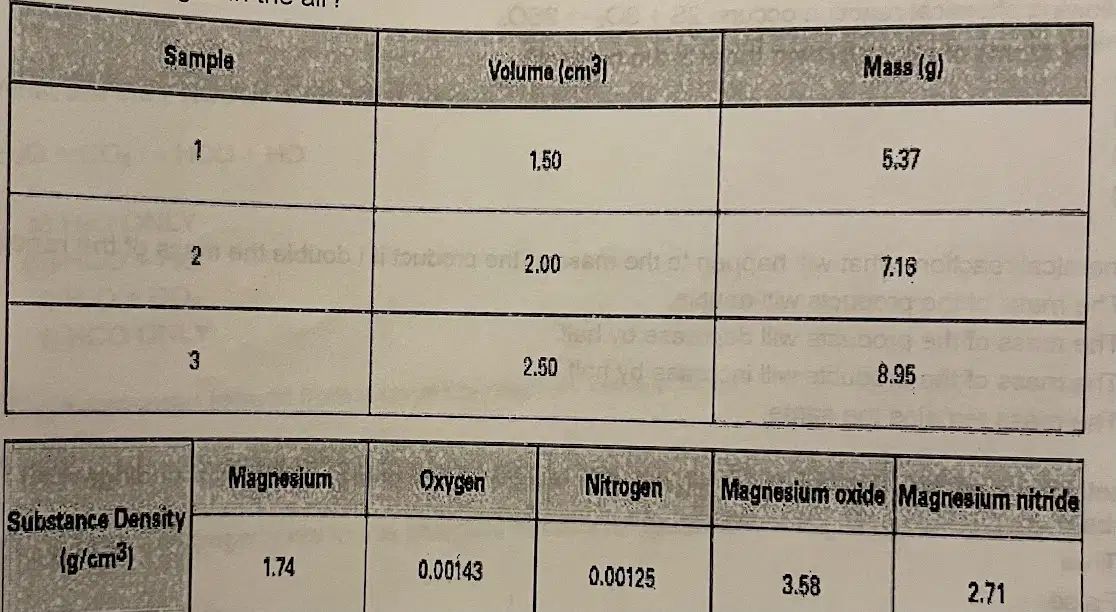
Magnesium metal burns white when used in fireworks. It can react with oxygen gas and nitrogen gas in the air to produce magnesium oxide and magnesium nitride respectively. A fireworks engineer wants to determine which substance is the major product, and so she collects multiple samples of the powdered product that is left behind after a magnesium firework explosion. She records the volume and mass of each sample in the data table provided below. Also provided below are the densities of each substance involved in this reaction.
Based on the provided data tables, what is the major product when magnesium reacts with oxygen gas and nitrogen gas in the air?
oxygen+ nitrogen
magnesium nitride
The common state of matter that does not have a definite shape or a definite volume is a(n) (a) .

