
 Worksheets
Wave Interaction Worksheet Review
Total questions: 139
Worksheet time: 5hrs 9mins

Label the type of wave interaction:
Reflection
Interference
Diffraction
Refraction

Label the type of wave interaction:
Reflection
Interference
Diffraction
Refraction

Label the type of wave interaction:
Reflection
Interference
Diffraction
Refraction

Label the type of wave interaction:
Reflection
Interference
Diffraction
Refraction

When a wave diffracts, what two properties determines the amount of bending as the wave passes the barrier/opening?
wavelength and frequency
amplitude and size of opening
size of opening and energy
wavelength and size of opening/barrier

Sound waves travel the FASTEST through which medium?
Solid
Liquid
Gas
Plasma

Light waves travel the fastest through which medium?
Solid
Liquid
Gas
Vacuum

Why can you hear around a corner, but not SEE around a corner?
Light waves can diffract easily, while sound waves can not diffract since they only travel in straight lines
Sound waves can diffract easily, while light waves can not diffract since they only travel in straight lines
Light waves can refract easily, while sound waves can not refract since they only travel in straight lines
Sound waves can refract easily, while light waves can not refract since they only travel in straight lines

Using the diagram, what type of wave interaction is this?
Constructive Interference
Deconstructive Interference
Refraction
Diffraction

Using the diagram, what type of wave interaction is this?
Constructive Interference
Deconstructive Interference
Refraction
Diffraction
Light waves travel the SLOWEST through which medium?
Solid
Liquid
Gas
Vacuum
Sound waves travel the SLOWEST through which medium?
Solid
Liquid
Gas
Vacuum
Which medium can sound waves NOT travel through at all?
Solid
Liquid
Gas
Vacuum

Occurs when a wave bounces back after hitting a barrier or surface
Reflection
Refraction
Diffraction
Interference
Bending of a wave as the wave passes from one medium to another medium
Reflection
Refraction
Diffraction
Interference
Bending of a wave around a barrier or through an opening
Reflection
Refraction
Diffraction
Interference
Combination of two or more waves to form a single wave
Reflection
Refraction
Diffraction
Interference
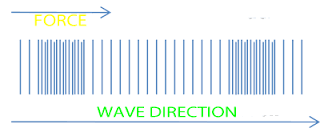
When particles move parallel to the motion of the wave, the wave is called....
Transverse
Longitudinal
S-wave
EMR wave

Which wave has the shortest wavelength?
1
2
3
4

Which wave has highest frequency?
A
B
C
D

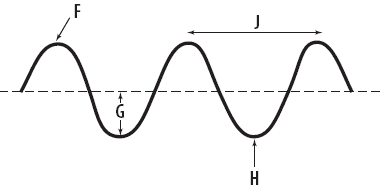
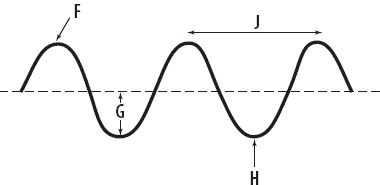
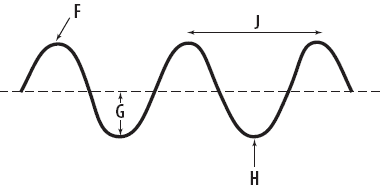
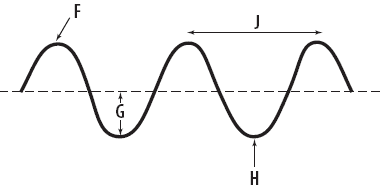
Letter G represents...
Compression
Rarefaction
Wavelength
Amplitude.

Which of these waves has the smallest amplitude?
P
Q
S
T

Which of these waves has the longest wavelength?
P
Q
R
S

Letter B represents...
rarefaction
compression
wavelength
amplitude
Sound waves are an example of
S-waves
transverse waves
longitudinal waves
EMR waves
When a wave has increased frequency...
the wavelengths become shorter.
the wavelengths become longer.
amplitude must increase.
amplitude must decrease.
Electromagnetic Waves do need a medium.
False.
True.
Transverse waves are.
Particles move parallel to wave.
Particles move perpendicular to wave.
Compressional waves are.
Particles move parallel to wave.
Particles move perpendicular to wave.


What type of wave interaction is this?
reflection
refraction
diffraction
black magic

WAVE THAT REQUIRES A MEDIUM TO TRAVEL:
(a)
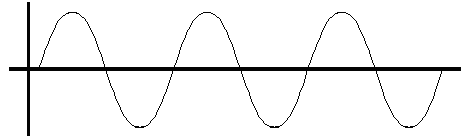


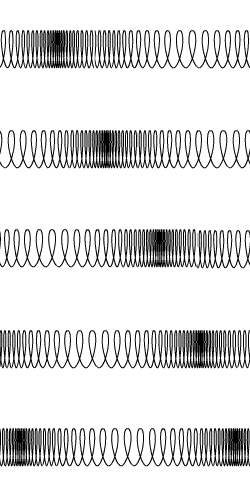
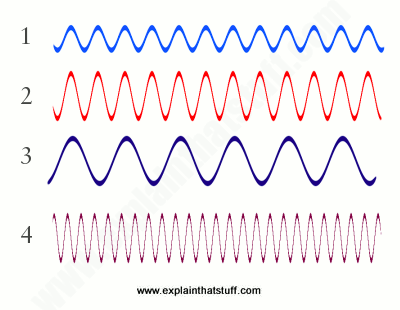




What type of waves are these?
Transverse waves
Longitudinal waves

#4 refers to the
wavelength
amplitude
crest
trough
A wave is a disturbance that transfers ________ from one place to another.
Matter
Mass
Energy
What types of waves can travel through empty space AND mediums?
Longitudinal
Mechanical
Electromagnetic
Which 2 types of waves require a medium to travel?
Electromagnetic
Mechanical
Light
Sound
What medium do sound waves travel fastest through?
Solids
Liquids
Gases

The length of a wave, from crest to crest or trough to trough. (D)
Frequency
Wave speed
Wavelength
Amplitude
If a wave has a small amplitude, do you think it has low energy or high energy?
Low energy
High Energy

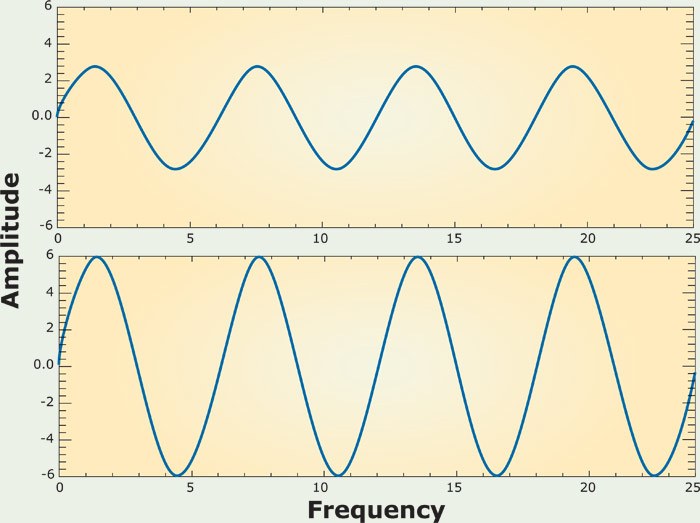
Which wave carries more energy?
Wave A
Wave B

The waves are traveling at the same speed.
Which wave has the greater amplitude?
Wave on the Left
Wave on the Right
Both amplitudes are the same

The waves are traveling at the same speed.
Which wave has the greater frequency?
Graph on the Left
Graph on the Right
Both have the same frequency

Which graph shows the wave with the highest amplitude, greatest frequency and shortest wavelength?
Graph on the Left
Graph on the Right
Both waves have the same

Which statement is true about the two waves?
Both waves have the same amplitude, but the bottom wave has greater energy because of a greater frequency.
The top waves has greater energy because it has greater amplitude.
Both waves have the same frequency, but the top wave has a greater amplitude.

Which graph shows shorter wavelengths?
Graph on the Left
Graph on the Right
Both have the same wavelengths

The waves are traveling at the same speed.
Which wave has the LEAST amount of energy?
Wave on the Left
Wave on the Right
Both have the same energy level

Both graphs show the number of waves that passed during a 5 second period. Which graph shows the faster waves?
Graph on the Left has faster waves
Graph on the right has faster waves
Both graphs have waves with the same speed.

Based on wavelength, which graph shows a wave with greater energy and why?
Graph on the Left has more energy because the wavelength is shorter.
Graph on the Right has greater energy because the wavelength is shorter .
Graph on the Right has more energy because the wavelength is longer.

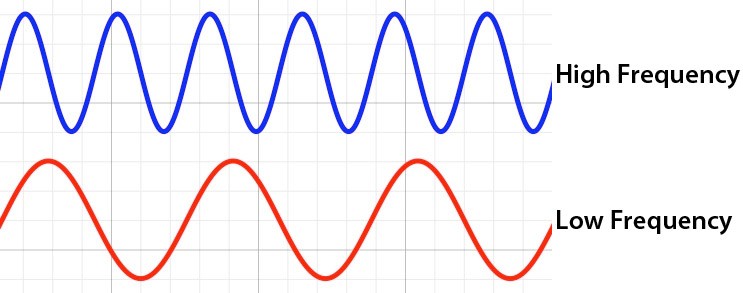
Which statement is true about the blue and red waves?
Both waves have the same amplitudes, but different wavelengths and frequencies.
Both waves have the same frequencies and wavelengths but different amplitudes.
Same amplitudes, wavelengths and frequencies.

Of the two waves presented, which wave has the greatest energy?
Top wave (higher frequency/shorter wavelength)
Bottom wave (lower frequency/longer wavelength)
Both waves have the same amplitude, therefore the same energy.

What word means the bouncing back of an object or wave when it hits a surface through which it cannot pass?
refraction
reflection
node
resonance

Which word means the bending of waves as they enter a new medium at an angle , caused by a change in speed?
reflection
standing wave
node
refraction

Which word means the bending or spreading of waves as they move around a barrier or pass through an opening?
interference
node
diffraction
antinode

Which word means the interference that occurs when two waves combine to make a wave with an amplitude larger than the amplitude of either of the individual waves?
constructive interference
control rod
node
standing wave

Which word means the interference that occurs when two waves combine to make a wave with an amplitude smaller than the amplitude of either of the individual waves.
constructive interference
node
destructive interference
antinode

TRUE OR FALSE
A wave is a repeating pattern of motion caused by a disturbance
TRUE
FALSE

What do all waves transfer?
Matter
Heat
Electricity
Energy

Which of the following can waves transfer energy through?
solid
liquid
gas
empty space
all of the above

What are the two types of waves?
longitudinal and transverse
sound and light

What is the number of complete waves passing a fixed point in a given amount of time?
Amplitude
Intensity
Wavelength
Frequency

What is the frequency of this wave? You must count the number of complete waves.
1 Hz
5 Hz
10 Hz

What is frequency measured in?
Milliseconds
Miles
Hertz
Kilograms

Which type of waves have the longest wavelength?
Visible light
Radio waves
X-rays
Gamma-Rays

Wavelengths are usually measured in ....
seconds
Hz
inches
meters

Shorter wave lengths can carry more energy. Which of these probably carries the MOST energy:
Infrared light
Visible light
X-rays
UV light

What is the distance between the calm sea and the highest wave called?
Wave
Frequency
Amplitude
Magnitude

What does #1 represent?
Period
Frequency
Wavelength
Amplitude

What does #2 represent?
Period
Frequency
Wavelength
Amplitude

Which letter is represents the crest?
A
B
C
D
E
Which letter is represents amplitude?
A
B
C
D
E
A wave with a high frequency has...
a long wavelength
a short wavelength
Waves with the highest energy have...
short wavelength, high frequency, and large amplitude
long wavelength, low frequency, and short amplitude

The _______ of a wave is how many waves pass a given point every second.
Frequency
Wavelength
Amplitude

In a longitudinal wave, a ____ is an area where the particles are spread apart and a ____ is an area where the particles are close together.
crest, trough
compression, rarefaction
rarefaction, compression
trough, crest

Examples of ________ waves include visible light, xrays, ultraviolet, and radio waves.
transverse
longitudinal

In the diagram of a compressional wave, A is showing a ___ while B is showing a ___.
compression, rarefaction
trough, crest
rarefaction, compression
crest, trough

In this diagram of a transverse wave, A is showing the wave's _____ and B is showing the wave's _____.
amplitude, trough
amplitude, crest
wavelength, trough
wavelength, crest

In this diagram of a transverse wave, C is showing the wave's _____ and D is showing the wave's _____.
crest, amplitude
trough, amplitude
crest, wavelength
trough, wavelength

What is the letter a showing?
crest
trough
wavelength
amplitude

Which wave has the lowest frequency?
A
B
C
D

Which electromagnetic radiation has the longest wavelength?
infrared
gamma
radio
ultraviolet

Which is an example of a longitudinal wave?
x ray
microwave
sound wave
water wave
Which electromagnetic radiation has the shortest wavelength?
infrared
gamma
microwave
ultraviolet

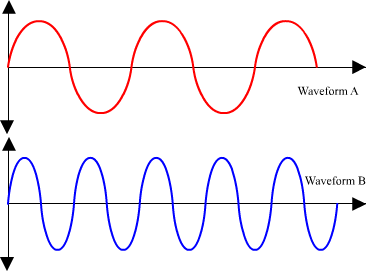
The two waves have different...
amplitudes
speeds
wavelengths
frequencies


