
 Worksheets
Honors 1st semester 2025
Total questions: 146
Worksheet time: 5hrs 16mins

stopper
forceps
tripod stand
test tube holder

hat rack
scale
thingamabob
test tube rack


The person is wearing shoes and socks
observation
inference

The person pictured has less than 20/20 vision
observation
inference

The person is injured
observation
inference

The door jam is broken
Observation
Inference
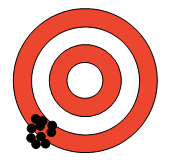
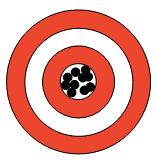


When you use your 5 senses to gather information, you are making a/an
Observation
Inference
Scientific Wondering
None
These type of observations are described, not measured.
QUALitative
QUANtitative
None
Both
The leaf is 5mm wide.
QUALitative
QUANtitative
both
none
The temperature of the room is decreasing by 4 degrees Celsius
QUALitative
QUANtitative
both
none
The liquid is a pink color.
Qualitative
Quantitative
Neither
Both

Based on the cartoon, (a) is a Quantitative Observation.
A custodian notices some dirty tables and wants to know which cleaner is the best to use. He tests three different cleaners and looks at how well they clean compared to tap water. What is the independent variable?
type of cleaner
tap water
An experiment is being done to determine how light affects the growth of small zinnia plants. One plant is placed in full sunlight, the second in a shaded area, the third in an unlit closet. What is the independent variable in the experiment?
the amount of light
plant in the closet
A custodian notices some dirty tables and wants to know which cleaner is the best to use. He tests three different cleaners and looks at how well they clean compared to tap water. What is the control group?
type of cleaner
tap water
An experiment is being done to determine how light affects the growth of small zinnia plants. One plant is placed in full sunlight, the second in a shaded area, the third in an unlit closet. What is the control group in this experiment?
the amount of light
the plant in the closet
The factors that stay the same or are constant throughout the experiment.
Controlled Variable
Dependent Variable
Independent Variable
In a controlled experiment, how many independent variables can be tested at a time?
one
none
two or more
how ever many makes sense.
Why is it important to have only one independent variable and to control the other variables when performing science experiments?
So you can tell which factor is causing the change in the experiment.
It does not matter, you can have as many independent variables as you want.
Ben makes five paper helicopters with different wing lengths. He drops them the same way from a height of two meters for five trials each. He records the amount of time it takes for each helicopter to fall to the ground.
What are two controlled variables? (Select 2 answers)
Dropping the same way
Wing Length
Amount of time it takes the helicopter to hit the floor
Dropping from the same height
350.540
0.0005
What is the answer? 12.50 * 2.0
25
25.0
21
20
1.245 x 10³
What is the correct answer to: 6.201 cm + 7.4 cm + 0.68 cm +12.0 cm =
26.281
26.28
26.2
26.3
What is the correct answer for: 1.31 cm x 2.3 cm
3.013
3.01
3.02
3.0
What is the correct answer for: 20.2 cm ÷ 7.41 s
2.726045884
2.72604
2.73
2.7
3.05 + 0.013
3.063
3.06
3.1
3
5.9 x 6.01
35.459
35.46
35.5
35
405.4 x 607 = ?
60.3 + 43.22 + 55.709
Solve the following problem to significance:
1.085 mL + 2.32 mL
3.405
3.41
3.4
3

If each step is approximately 22 inches, how many steps will it take to walk down Main Street (a length of 0.25 miles)? Round your final answer to 2 sig figs.
680 steps
750 steps
940 steps
720 steps

On Dr. Davis' bookshelf, there are 23 science textbooks, each with an average of 31 chapters. If each chapter contains 5 pages, how many total pages are there? (Round your answer to 2 sig figs)
3.6 x 10⁴ pages
36 pages
3.6 x 10² pages
3600 pages

Two forces are applied to a 2.0-kilogram block on a frictionless, horizontal surface, as shown in the diagram below. What is the acceleration of the block?
5.0 m/s2 to the left
3.0 m/s2 to the right
3.0 m/s2 to the left
5.0 m/s2 to the right
A 50kg cart will accelerate at 4 m/s2 when pushed with a force of 200N. This relationship demonstrates which of Newton's Laws of Motion?
Newton's 1st Law of Motion
Newton's 2nd Law of Motion
Newton's 3rd Law of Motion
Newton's 4th Law of Motion
For an object to be in equilibrium (balanced), the forces acting upon it must be
in one direction, only.
equal in magnitude and opposite in direction.
both balanced and unbalanced.
equal in magnitude and identical in direction

An inflated balloon released from rest moves horizontally.
The law that best explains this event is
Newton's 1st Law
Newton's 2nd Law
Newton's 3rd Law
Law of Gravity
What is Newton's 3rd Law?
For every action there is an equal and opposite reaction.
Acceleration depends on two variables, the mass of the object and the amount of force.
What explains why objects resist changes in their state of motion?
gravity
inertia
force
friction
The force of an object, with a certain mass accelerating at a certain rate, can be determined by the equation below:
force = mass x acceleration
Which object would have the greatest force?
a 5-kg object accelerating at 100 m/s
a 5-kg object accelerating at 20 m/s
a 20-kg object accelerating at 4 m/s
a 20-kg object accelerating at 3 m/s


A push or a pull is called a
Gravity
Force
Johnpal punched his wall. his wall punched him back in the opposite direction. Which one f Newtons laws is this
2nd law
3rd law
1st law
4th law
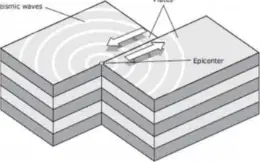
The image below shows what happens between Earth's tectonic plates during an earthquake. Forces build up, and when the plates finally move, tension is released, as shown below. The sudden movement of the plates is caused by-
the mass of the plates
the weight of the plates
unbalanced forces
gravitational force
A large rock is motionless on a flat sidewalk. Which statement best explains why the rock remains motionless?
There are no forces acting on the rock.
The only force acting on the rock is directed toward the sidewalk.
The forces acting on the rock are all balanced.
The sidewalk exerts an unbalanced force on the rock.
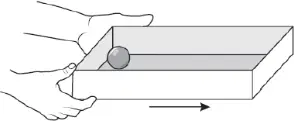
A steel ball is at one end of a box that is moving forward as shown. The box suddenly stops. According to Newton's first law, what happens to the steel ball just after the box stops?
Because of friction, the ball continues rolling forward at the same speed.
Because of friction, the ball rolls forward at an increased speed.
Because of inertia, the ball continues rolling forward at the same speed.
Because of inertia, the ball rolls forward at an increased speed.
When a coin is tossed in the air, it travels upward, gradually slows down, momentarily reaches zero speed, then moves back downward with increasing speed. Which statement best explains this change in the coin's motion?
The force of gravity causes the coin to change its velocity.
The coin's inertia decreases on the way up and increases on the way down.
The action-reaction force pair of gravity and the applied force cancel each other out.
The coin remains in its state of upward motion until the force of friction acts upon it.

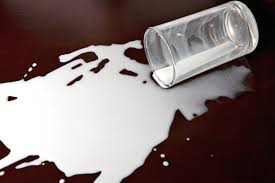
You are carrying a lunch tray when you bump into the edge of a table. Although the tray did not tip, your milk falls off of the front of the tray.
Newton's
1st
Law of Motion
Newton's
2nd
Law of Motion
Newton's
3rd
Law of Motion
When you double the mass the acceleration
decreases by 1/2
doubles
triples
decreases by 1/3
What is mass?
How much matter or stuff something has
How much space something takes up
How big something is
How long something is
Acceleration is which of the following
A high speed
Changing direction
Speeding up
Slowing down
It's easier to push a empty shopping cart than a full one
1st Law
2nd Law
3rd Law
Two cars collide, the force of car A on car B is equal to the force of car B on car A
1st Law
2nd Law
3rd Law

A dog and a cat are about to fight, running towards each other, both at 12 m/s. What are their velocities relative to each other?
12 m/s
24 m/s
0 m/s
6 m/s
What is acceleration defined as?
Change in velocity divided by the time for the change to occur
Change in speed divided by the distance covered
Change in direction divided by the time for the change to occur
Change in velocity multiplied by the time for the change to occur
When does acceleration occur?
Only when there is a change in speed
Only when there is a change in direction
When there is a change in speed, direction, or both
Only when there is no change in speed or direction
Dorothy was initially at rest. She sped up to 9 m/s in 24 seconds. What was her acceleration?
2.7 m/s2
-2.7 m/s2
-0.375 m/s2
0.375 m/s2
Speeding up and slowing down are changes in
Choose all that apply.
velocity
speed
acceleration
motion
Which phase comes immediately after the New Moon?
Waning Crescent
Full Moon
Last Quarter
Waxing Crescent
What causes the different phases of the moon as seen from Earth?
Earth's shadow on the moon
The moon's rotation on its axis
Changes in the moon's distance from Earth
The relative positions of the Sun, Earth, and moon

During which season in the Northern Hemisphere is Earth closest to the Sun?
winter
spring
summer
fall

Using the following diagram, at which position is Earth located on December 21?
A
B
C
D

On which date does New York State experience equal amounts of daylight and darkness hours?
Dec 21
May 21
Jun 21
Sep 21

At which location are direct sun rays striking Earth in the following diagram?
A
B
C
D

Which diagram represents the sun in winter (indirect heat energy)?
Diagram A
Diagram B
neither diagram
both diagrams
The reason we have seasons on our planet is because...
we are closer to the sun during the winter and further during the winter.
the tilt of Earth's axis allows for more direct sunlight in the summer and less direct sunlight in the winter.
seasonal wind patterns carry warmer winds during the summer and colder winds during the winter.
the Earth's orbit becomes more like an oval to give us different seasons.

Which of the following best describes the tilt of the earth during the spring and fall equinoxes?
The earth is tilted away from the sun (Northern hemisphere)
The earth is tilted neither toward or away from the sun (tilt is side to side)
The earth is tilted toward the sun (Northern hemisphere)
The earth is not tilted during spring and fall

How often do we experience new seasons?
Monthly
Yearly
Every 3 months
Every 6 months

With the Earth in the position shown, is there anywhere that would receive no sunlight for more than a 24 hr period?
No, everywhere will get sunlight over a 24 hour period
Yes, the North Pole will be dark for more than 24 hrs.
Yes, the South Pole will be dark for more than 24 hrs.
Yes, the left side of Earth by the Equator will be dark for more than 24 hrs.


This model is showing us a...
lunar eclipse
solar eclipse
phases of the moon
earth eclipse

If you are looking up at the sky and see this, you are looking at a....
solar eclipse
total eclipse
lunar eclipse
jupiter

If you look up at the sky and see this, you are witnessing a....
solar eclipse
total eclipse
lunar eclipse
jupiter
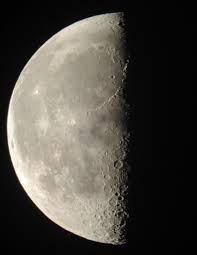


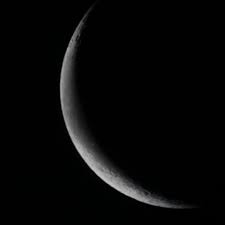

What is the current accepted theory for how our Moon formed?
Captured from an asteroid
Big collision from a Mars-sized object with Earth
formed simultaneously with Earth from space debris
Pieces of Mercury entered our orbit
The Moon has more surface craters than Earth does because the Moon has
a smaller diameter than Earth
no significant atmosphere
a surface more sensitive to impacts
a stronger gravitational force

Based on the data, the next high tide occurred at approximately
4 pm on July 13
4 pm on July 14
10 pm on July 13
10 pm on July 14
What is the term for the dark central part of a shadow during an eclipse?
Penumbra
Umbra
Axis
Terrae
What is the term for the Moon's surface features that are highlands?
Maria
Terrae
Craters
Sunspots
Match the following lunar vocabulary word with information about the word
crater
made by space object impact
maria
solid, flat areas of basaltic lava
terrae
lunar highlands
meteor
burns up in space
meteorite
lands on the surface of another planetary object
Why doesn't a Solar/Lunar Eclipse occur during every New Moon and Full Moon?
Because there are clouds obstructing your view
Because the Moon is too far away; it only gets close enough on occasion
Because the Moon's orbit is tilted
About how often does a Solar/Lunar Eclipse occur?
Once every New Moon and Full Moon
Once a month
Once every other month
A few times per year
Once every other year

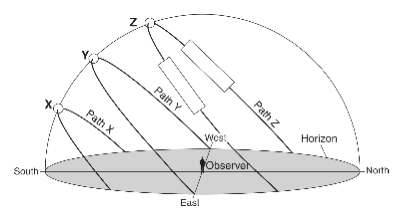

The diagrams represent the position of the noon Sun along its apparent daily path as seen by an observer on the first day of three consecutive months (X, Y, and Z). The observer was located in Utica, New York.
Which dates are represented by months X, Y, and Z?
X-February 1
Y-March 1
Z-April 1
X-May 1
Y-June 1
Z-July 1
X-August 1
Y-September 1
Z-October 1
X-November 1
Y-December 1
Z-January 1

This apparent path of the Sun through the sky is caused by
Earth's revolution around the Sun
Earth's rotation on its axis
the Sun's revolution around Earth
the Sun's rotation on its axis

The model below shows the apparent path of the Sun as seen by an observer in New York State on the first day of one of the four seasons.
This apparent path of the Sun was observed on the first day of
Spring
Summer
Fall
Winter

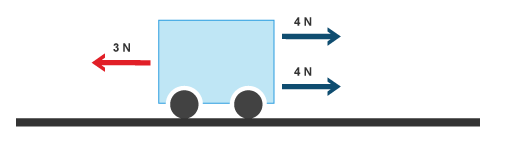
What is the net force on the object pictured?
3 N
5 N
4 N
8 N


What is the net force of an object that is moving at a constant speed?
What is the effect of gravity on falling objects?
All objects fall at the same rate regardless of their mass, in the absence of air resistance.
Heavier objects fall faster than lighter objects due to their mass.
Objects fall at different rates depending on their shape and size.
Gravity has no effect on the rate of falling objects.
In a free-body diagram, the normal force is represented by a vector:
Pointing upwards
Pointing downwards
Pointing sideways
Pointing in the direction of motion

Which of the following is required for planets to stay in orbit around the Sun?
Gravity
Inertia
Friction
Gravity AND Inertia
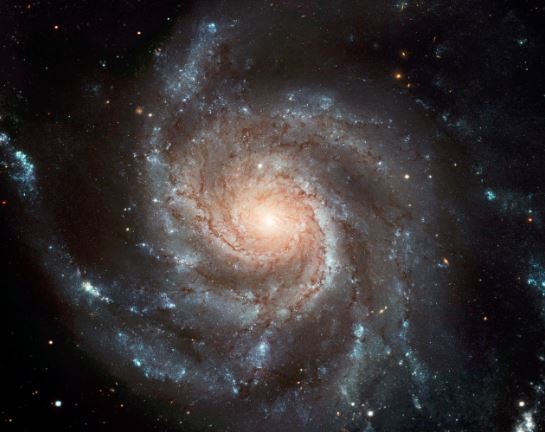
Without gravity, the stars, planets and all objects in the universe would _______.
continue to orbit each other
move in a random direction
move in a straight line
stop moving

