
 Worksheets
STAAR Science Review - Texas
Total questions: 143
Worksheet time: 2hrs 39mins
Basic building block of matter
protons
neutrons
nucleus
atom
3 subatomic particles
protons
atom
neutrons
electrons
Number of molecules (large #) 2NaCl
chemical formula
coefficient
subscript
electrons
Push or pull
speed
acceleration
force
mass
Name of group 2 on the periodic table
noble gases
alkali metals
halogens
alkaline earth metals
Name of group 18 on the periodic table
noble gases
alkali metals
alkaline earth metals
halogens
Center of atom
nucleus
atom
valence electrons
electron cloud
Located outside of the nucleus; has energy levels
valence electrons
electron cloud
atom
nucleus
Can be hammered into thin sheets
period
protons
malleable
ductile
Same as period number
valence electron
group
protons
energy levels
Speed in a certain direction
acceleration
speed
velocity
distance
Shows that a reaction has taken place
arrow
chemical formula
chemical equation
reactant
Change in position
motion
speed
acceleration
distance
Acceleration is
speeding up
standing still
slowing down
changing direction
How can you determine the number of neutrons in an atom if you know its atomic number and mass number?
Subtract the atomic number from the mass number
Add the atomic number to the mass number
Multiply the atomic number by the mass number
Divide the mass number by the atomic number
The mass number of an atom is determined by the sum of which subatomic particles?
Protons and electrons
Neutrons and electrons
Protons and neutrons
Electrons only
What does the atomic number of an element represent?
The number of protons in the nucleus
The number of neutrons in the nucleus
The total number of protons and neutrons in the nucleus
The total number of protons and electrons in an atom
Name of group 1 on the periodic table
noble gases
halogens
alkali metals
alkaline earth metals
Can be drawn into thin wires
ductile
malleable
shiny
dull
Name of groups 3-12 on the periodic table
lanthanides
transition metals
actinides
noble gases
Identifies the atom; number of protons
atomic number
atomic mass
mass number
proton number
Name of group 17 on the periodic table
halogens
transition metals
alkali metals
noble gases
Number of atoms (little #) H2O
subscript
coefficient
number
formula
Anything that has mass and takes up space
mass
volume
density
matter
distance divided by time
acceleration
speed
mass
time
tendency to stay at rest or stay in motion
acceleration
speed
motion
inertia
Force = mass x acceleration
Newtons 1st Law of Motion
Newtons 2nd Law of Motion
Newtons 3rd Law of Motion
Newtons 4th Law of Motion
Cannot be broken down into simpler substances
atomic number
element
proton
atomic mass
Examples of speed
20 m/h
30 m
40 m/s
32 ft/s
Examples of velocity
20 m/h South
20 m/h
11 ft/s East
5 m/h
The periodic table arranges all known elements in order of increasing ______ ______.
(a)
(a) contain 2 or more different elements, chemically bonded together.
Elements that have properties of metals and nonmetals; located on zig-zag line.
metals
elements
nonmetals
metalloids
Subatomic particle with positive charge; in nucleus
protons
electrons
neutrons
photons
Subatomic particle with negative charge; in electron cloud
protons
electrons
neutrons
photons
Dull, brittle, poor conductors
metalloids
metals
nonmetals
alkali metals
Shiny, malleable, ductile, good conductors
metalloids
metals
nonmetals
halogens
Examples of metals
K
Au
O
Ne
Examples of nonmetals
Be
H
S
Ag
Metals are on the (a) side of the zig-zag line.
Nonmetals are on the (a) side of the zig-zag line.
Electrons in the outermost energy level
valliant electrons
victory electrons
valence electrons
electron cloud
Same as the group number
valence electron
period
group
mass
Vertical columns of elements (18)
periods
mass
groups
rows
Horizontal rows of elements (7)
seats
groups
periods
columns
Starting materials in a chemical reaction (left side)
reactant
product
arrow
mineral
final materials in a chemical reaction (right side)
reactants
products
arrow
mineral
The law that says for every reaction, there is an equal and opposite reaction
Newtons 1st Law
Newtons 2nd Law
Newtons 3rd Law
Newtons 4th Law
The law that says matter can neither be created nor destroyed, just rearranged
Newtons 1st Law
Newtons 2nd Law
Newtons 3rd Law
Law of Conservation of Mass
Smallest of the 3 subatomic particles
protons
neutrons
electrons
What is the primary difference between a proton and an electron?
Mass
Charge
Location in the atom
All of the above
What is the main difference between the mass number and the atomic number of an atom?
The mass number includes the number of protons and electrons, while the atomic number includes protons and neutrons.
The mass number includes the number of protons and neutrons, while the atomic number is just the number of protons.
The atomic number includes the number of protons and electrons, while the mass number includes protons and neutrons.
There is no difference; they are the same.

How many protons are present in this Carbon atom?
4
5
6
7
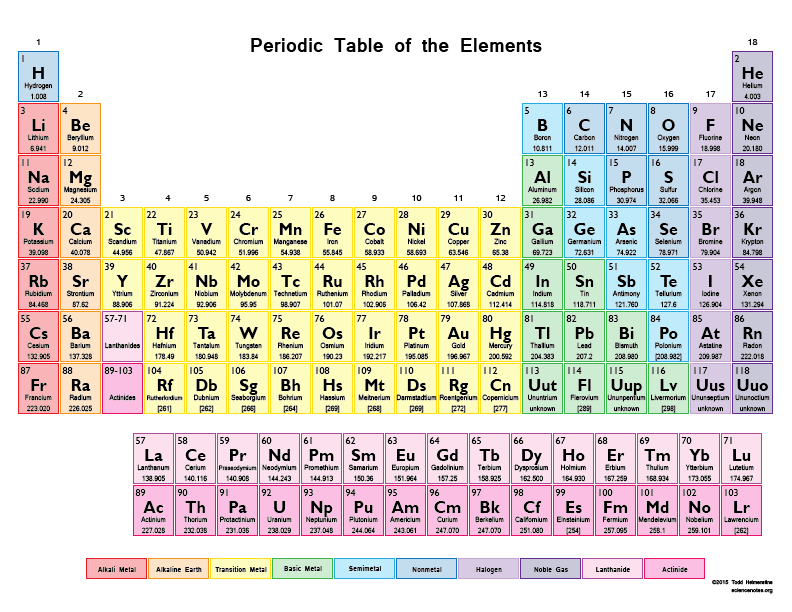
What is the atomic number of Barium, Ba? (enlarge the periodic table)
20
38
56
88
Most reactive metals
group 1
group 3-12
group 17
group 18
The overall forces actin on an object; measured in Newtons
big force
net force
small force
line force
The law that says an object will stay at rest or stay in motion unless acted on by an outside force
Newtons 1st Law
Newtons 2nd Law
Newtons 3rd Law
Law of Conservation of Mass
No new substance is formed
chemical change
physical change
Evidence of a physical change
change in size
gas given off
change in shape
change in state
A new subtance is formed
physical change
chemical change
Evidence of a chemical change
candle burning
cutting a cake
ice melting
bubbles forming in the bag
A combination of symbols and chemical formulas used to describe what happens in a chemical reaction
chemical formula
chemical product
chemical reactant
chemical equation
Group of stable elements that do not react
group 1
group 2
group 17
group 18
A combination of symbols and numbers that represent the number and types of elements present in a compound
chemical formula
chemical equation
chemical group
chemical period
Resistance when one surface of an object moves over another surface
friction
power
mass
distance
2 subatomic particles that have a mass of 1 AMU
electrons
protons
neutrons
photons
Overall charge of nucleus
positive
negative
neutral
Determines chemical properties
periods
atomic number
valence electrons
protons
In the chemical formula for glucose, C6H12O6 , how many oxygen atoms are present?
6
12
18
24
Which of the following is a compound?
Oxygen
Water
Neon
Iron
What does the chemical formula H2O represent?
Two hydrogen atoms and one oxygen atom
One hydrogen atom and two oxygen atoms
Two hydrogen molecules and one oxygen molecule
One hydrogen molecule and two oxygen molecules
Which of the following is NOT a characteristic of a chemical change?
Change in color
Formation of a gas
Change in shape
Production of heat
Potential energy is the energy that is:
Stored
Lost
Used
Generated
Kinetic energy is energy of
stored
motion
generated
still
Plate boundary where the plates slide past each other
convergent
divergent
transform
Plate boundary where two plates connect or collide
convergent
divergent
transform
Plate boundary where two plates divide
convergent
divergent
transform
Where one plate slides beneath another plate
convergent
divergent
subduction zone
transform
Landforms that are formed at a transform boundary
earthquakes
rift valley
mid-ocean ridge
faults
Landforms formed at a divergent boundary on land
rift valley
mid-ocean ridge
volcano
faults
Landforms formed at a divergent boundary in the water
rift valley
mid-ocean ridge
mountains
earthquakes
Landform that forms on land at a convergent boundary
rift valley
mid-ocean ridge
mountains
trenches
Landforms that form at a convergent boundary, (subduction zone) either at ocean-ocean or ocean-land
rift valleys
volcanoes
trenches
mountains

cold front
warm front
high pressure
low pressure

cold front
warm front
high pressure
low pressure

cold front
warm front
high pressure
low pressure

cold front
warm front
high pressure
low pressure
cold air moving into an area
warm air moving into an area
humid air over an area
dry air over an area

cold air moving into an area
warm air moving into an area
humid air over an area
dry air over an area

Cold air is approaching Location A
Warm air is approaching Location A
Cold air is approaching Location B
Warm air is approaching Location B

Cold air is approaching Location A
Warm air is approaching Location A
Cold air is approaching Location B
Warm air is approaching Location B

Location A would produce the strongest storms
Location B would produce the strongest storms
Location C would produce the strongest storms
Location D would produce the strongest storms


sort of cool, dim (not too much light), and red?


In the diagram given, what happens as we move to the left?
Stars Get Larger
Stars get Colder
Stars get hotter

Which star is hotter than Deneb
Procyon
Sun
Regel
Banard's Star

Which star is brighter than the sun?
Sirius B
Procyon B
Van Maanan's Star
Aldebaran

Which star is brighter than Alpha Centauri B, but dimmer than the sun?
Pollux
Spica
Tau Ceti
Mira
The Sun and Moons gravity causes the tides. Why does the Moon have the greater impact on the tides
Even though the moon is larger than the Sun, it is farther away from Earth
Even though the moon is smaller than the Sun, it is closer to Earth
Even though the Sun is larger than the Moon, it is closer to the Earth.
The Moon and the Sun are the same size and have the same gravitaitonal pull.

How many days does it take to travel from new moon to first quarter?
1 day
7 days
9 days
14 days

How many weeks pass between position 1 and position 7?
1 week
2 weeks
3 weeks
4 weeks

What is the name of this phase?
Waxing Crescent
Waning Gibbous
Full Moon
New Moon

What number represents a Full Moon
1
3
5
7

What number represents a third quarter moon?
1
4
6
7

What is the name of this phase?
Waxing Gibbous
Waning Gibbous
Full Moon
New Moon

How many weeks does it take for the moon to travel from New Moon to Full Moon?
1 week
2 weeks
3 weeks
4 weeks

What is the name of this phase?
Full Moon
New Moon
Waxing Crescent
Waning Crescent
Which of the following are WAXING phases?


Which of the following are WANING phases?


What is the name of this phase?
Full Moon
Waning Crescent
Waxing Gibbous
New Moon
Light on the left and decreasing
waxing
waning
full
new
Light on the right and increasing
waxing
waning
new
full
Causes night and day
rotation
revolution
revolution + tilt
Causes the seasons
rotation
revolution
revolution + tilt
Number of total moon phases
1
3
4
8
Eats only plants
omnivore
herbivore
carnivore
producer
Eats only meat
omnivore
herbivore
carnivore
producer
Eats plants and animals
omnivore
herbivore
carnivore
producer
Eats dead plants and animals
omnivore
decomposers
scavengers
carnivores
Breaks down dead organisms
omnivore
decomposers
scavengers
herbivores
Neap tide happens at what phases
NM
FM
1Q
3Q
Spring tide happens at what phases
NM
FM
1Q
3Q
Causes highest tides, S-M-E are in a straight line
Spring tide
Neap tide
Causes lowest tides, S-M-E are 90 degree angle
spring tide
neap tide
Made up of one cell
multicellular
eukaryotic
prokaryotic
unicellular
Made up of many cells
multicellular
prokaryotic
eukaryotic
unicellular
Has NO nucleus
multicellular
prokaryotic
eukaryotic
unicellular
Has a nucleus
biotic
abiotic
eukaryotic
prokaryotic
Can make its own food
autotroph
heterotroph
biotic
abiotic
Has to hunt for its food
autotroph
heterotroph
multicellular
unicellular
An organism in a food chain that is able to make its own food and represents level 1 on the food chain .
Consumer
Producer
Herbivore
Omnivore
An organism in a food web that eats other consumers to obtain energy and is not eaten by another organism.
Producer
Top Consumer
Prey
Scavenger

What type of front could cause rain for several days
stationary
cold
warm
What elements have similar chemical properties of Na
Li
Au
Ag
Cs
What elements have similar chemical properties of Br
F
Cl
B
Be

