
 Worksheets
SP84 Waves Unit Assessment (Fall 25 Final)
Total questions: 140
Worksheet time: 2hrs 30mins
One way to categorize waves is based on the direction of movement of the individual particles of the medium relative to the direction that the wave energy is transported. One type of wave is transporting energy from left to right. The particles of the medium are moving back and forth in a left and right direction. What type of wave is this?
electromagnetic
light
longitudinal
transverse
Have you ever done the wave at a stadium during sporting event or concert? One group of fans stands up and waves, then sits down. This continues around the stadium. The stadium wave is a ____________ wave because the wave energy is moving ________________ to the people.
transverse, perpendicular
longitudinal, parallel
surface, circular
mechanical, diagonal
Which of these is NOT an example of a mechanical wave?
sound wave
ocean wave
radio wave
compression wave
How are the voices of astronauts transmitted back to Earth?
sound waves
transverse waves
mechanical waves
longitudinal waves
The sun's energy comes in many different forms of electromagnetic radiation, as shown. Which form of solar radiation has a longer wavelength than white light?
A. Infrared
B. Gamma rays
C. Ultraviolet
D. Visible light
What is the name for a rainbow of colors that results when white light shines through a prism?
radio waves
thermal energy
visible spectrum
electromagnetic radiation
Describe the relationship between wavelength, frequency and wave energy.
As wavelength decreases frequency and wave energy increase.
As wavelength increases frequency decreases but wave energy increases.
There is a direct relationship: as wavelength increases so does frequency and wave energy.
There is an inverse relationship between wavelength and frequency. But as wavelength increases wave energy also increases.
Exposure to UV waves may cause skin cancer and gamma waves cause DNA mutations because:
Both UV and gamma waves have high energy that can damage cellular DNA.
UV waves are harmless while gamma waves are beneficial.
UV waves only affect the skin surface and gamma waves do not affect DNA.
Both UV and gamma waves are low energy and cannot damage cells.
Without light, we would not be able to process all the things we see in our world. Light allows our eyes and brains to process information about things around us. Light allows us to explore colors, shadows, reflections, and many other things in the world. Think about what light is made of and how it travels. Which three statements are true about light?
Light from stars can be seen from Earth because light can travel through space.
Light is not a form of energy because it cannot be measured.
Light is a form of electromagnetic waves, which do not need any medium to travel.
Electromagnetic waves are a form of energy, therefore light is also a form of energy.
Light is made of heat and tiny particles.
Place the following types of electromagnetic waves in order from the largest wavelength to the shortest wavelength.
Radio waves, Infrared, Visible light, Gamma rays
Gamma rays, Visible light, Infrared, Radio waves
Visible light, Infrared, Radio waves, Gamma rays
Infrared, Radio waves, Gamma rays, Visible light
Which example best illustrates the transfer of energy between two waves?
A. A buoy rises in the water as a boat speeds past.
B. A basketball rebounds from the backboard during a missed shot.
C. An egg that rolls off the counter falls and breaks on the floor.
D. A car that rear ends another car causes damage to both vehicles.
The electromagnetic spectrum is shown here with relative frequencies, wavelengths, and energy levels associated with each type of radiation. Humans use remote controls to change the channel on the television from a distance of ten to twenty feet. The radiation in the remote control does not cause ionizing damage to the human who is using it, but it is not visible to the naked eye. If the wavelength is smaller than that of microwaves, identify the most likely type of electromagnetic radiation that is used in remote controls.
green light
radio waves
infrared waves
ultraviolet light
Other waves in the electromagnetic spectrum are utilized in the medical field. One type of wave, considered a mutagen, is used in cancer therapy. What is that electromagnetic wave?
microwaves
gamma waves
infrared waves
ultraviolet waves
A thermographic camera or thermal imaging camera is a device that forms an image using radiation other than visible light. This is a thermal image of a chihuahua taken in thermal or infrared light. Notice this method detects changes in temperature throughout the chihuahua. An application of thermal imaging using infrared light has been developed to help homeowners save money. What is this application?
Thermal images can be used to locate household pests by an exterminator.
Thermal images pick up body heat and can locate where people are in the home.
Using thermal imaging to detect heat energy loss through the roof and windows.
Using thermal imaging to detect exposure to radon being emitted from the ground.
Part A: Sound waves are compression or longitudinal waves that travel through matter. Sound travels through all three mediums, solids, liquids, and gases, at different speeds. Which statement BEST explains why sound travels fastest through solids and slowest through gases?
A. It is easier for waves to pass through gases, then liquids, then solids.
B. Hard surfaces of solids cause sound waves to bounce off more quickly than in gases.
C. Tightly-packed molecules of solids vibrate more quickly than loosely-packed gas molecules.
D. Molecules in solids are spread apart while molecules in air are grouped together in clusters.
Part B: If radio waves can travel through space, which answer choice does NOT correctly explain why we can't hear sounds in space as well?
A. Sound waves are compression waves and require a medium.
B. Sound waves are transmitted via particles called photons.
C. Radio waves are electromagnetic waves and do not require a medium.
D. Because space is relatively empty, sound waves have no way to travel.
Question 14: Drag and drop the terms to correctly complete the prompt. When light is reflected upon different surfaces, it is considered either __________ (or clear) or __________. In specular reflection, light is reflected upon a smooth, shiny surface, giving a clear reflection. The best example of specular reflection is a __________. A mirror displays the Law of __________ reflection perfectly. This law states that the angle of incidence = __________. In other words, light gets reflected at the same angle it hits the surface.
specular; diffuse; mirror; reflection; angle of reflection
diffuse; specular; window; absorption; angle of incidence
specular; opaque; glass; transmission; angle of refraction
diffuse; transparent; lens; refraction; angle of deviation
In contrast, [__________] surfaces have a diffuse reflection. These reflections scatter light in [__________] directions.
rough or dull, different
smooth or shiny, same
transparent, parallel
opaque, identical
A student looks at a straw placed in a glass of water. The straw appears bent at the water’s surface, even though it is straight. Which of the following explains what happened to the light?
The light was reflected
The light was refracted
The light was absorbed
The light was scattered
On a sunny day, a student notices that wearing a black shirt makes them feel warmer than wearing a white shirt. (Image: Sunlight shining on a black shirt) Which of the following best explains this observation?
The black shirt reflects most of the light.
The black shirt refracts most of the light.
The black shirt absorbs most of the light.
The black shirt concentrates the light.
Order the speed of sound through these materials from the slowest to the fastest.
Gas, Liquid, Solid
Solid, Liquid, Gas
Liquid, Gas, Solid
Gas, Solid, Liquid
A student was researching how different materials affect the speed of sound waves moving through them. The student found the following table detailing the speed of sound in various solids, liquids, and gases. Which predictions can be made based on the information shown in the table?
The speed of sound generally increases as it moves from solids to liquids to gases.
The speed of sound generally increases as it moves from gases to liquids to solids.
The speed of sound generally increases as it moves from liquids to gases to solids.
As the density of a material increases, the speed of sound increases.
Scott needs to determine the density of a metallic rod. First, he should determine the ________ of his sample. Second, he should measure the ________ of his sample. Finally he can calculate the ________ by dividing ________.
mass, volume, density, mass by volume
volume, mass, density, volume by mass
mass, density, volume, mass by density
density, mass, volume, density by mass
A student is using a microscope to view microscopic bacteria that cannot be seen by the unaided eye. A microscope works by stacking lenses in a tube. How does the microscope enable the student to see the microscopic bacteria?
The light is reflected in between the lenses, making the image look larger
Each lens refracts the light more, making the image look larger
Drag and drop each term to correctly complete the prompt. Sound waves transmit __________ through a __________ by vibrating the particles in that medium. The particles vibrate and then return to their __________. Ultrasound is used to break up kidney stones in some patients. It allows treatment without a need for surgery. Because sound __________ do not transmit any __________. The sound wave transmits only energy into and through the body. This energy breaks up the kidney stones allowing the patient to pass them.
energy, medium, original position, waves, matter
matter, energy, original position, waves, medium
energy, waves, medium, position, matter
energy, medium, position, waves, energy
A student is using a microscope to view microscopic bacteria that cannot be seen by the unaided eye. A microscope works by stacking lenses in a tube. How does the microscope enable the student to see the microscopic bacteria?
The light is reflected in between the lenses, making the image look larger
Each lens refracts the light more, making the image look larger
The lenses increase the actual size of the bacteria so they can be seen
The lenses catch light and brighten the image so it can be seen
The student observes the following when using a magnifying glass to look at money:
Tiny details and patterns become visible.
The money changes color.
The money appears to shrink.
The money becomes transparent.
Which of the following best explains what causes the money to appear larger?
The curve of the lens causes the light to be more refracted.
The circular shape of the lens causes the light to be more refracted.
The curve of the lens causes the light to be more reflected.
The circular shape of the lens causes the light to be more reflected.
Lenses work because of the way they interact with light waves. No matter what the shape of the lens when light waves pass through the lens, they ________, and in this case they ________ on the focal point.
A. bend, diverge
B. reflect, converge
C. refract, converge
D. resonate, diverge
Microscopes can be used to magnify specimens that would otherwise be too small to see. Light passes through a series of lenses and a magnified image is observed by the viewer. Which model best represents the types of lenses used in a microscope to create a magnified image?
Converging lenses are used to create a clear image at the focal point beyond the lens.
Diverging lenses are used to disperse the light to form a larger image by scattering the light.
A diverging lens is used to magnify the image and a converging lens is used to focus the image.
A single diverging lens is used to magnify the image, followed by a mirror to reflect the image towards the eye.
A near-sighted person uses glasses to create an image that is clearer for them to see. Which model of a lens best represents how glasses works and is matched with the appropriate description?
Diverging lenses will magnify the object by scattering the light behind the lens.
Converging lenses will magnify the image so the nearsighted person can see the object.
How do mechanical waves compare with electromagnetic waves?
Mechanical waves require a medium to travel through.
Mechanical waves can travel through a vacuum.
Electromagnetic waves do not require a medium to travel through.
Electromagnetic waves travel fastest through a vacuum.
Mechanical waves travel fastest through a vacuum.
Why does sound travel fastest through a solid?
Because particles in a solid are closer together, allowing sound waves to travel more quickly.
Because solids are always colder than liquids and gases.
Because sound cannot travel through liquids or gases.
Because solids have more color than liquids or gases.
Several forms of electromagnetic waves are used in communication. Which of these does not correctly pair the type of EM wave and its use in communication?
Gamma rays are used in cell phone communication.
Microwaves are used to transmit satellite television.
Radio waves are used to transmit television and radio programs.
Infrared waves are used to transmit information from remote controls.
Anyone with a receiver can tune it to pick up the radio waves so they are suitable for broadcasting radio and TV programs to large numbers of people. An advantage is that this method of communicating is that it does not require wires to transmit information. A disadvantage is that radio stations using similar transmission frequencies sometimes interfere.
Radio waves are the lowest-energy electromagnetic waves.
Radio waves can be converted to sound waves by the human ear.
Radio waves are the lowest-frequency and longest-wavelength electromagnetic waves.
Medium wavelength radio waves are reflected from the ionosphere so they can be used for long distance communication.
Which of the following statements is most accurate?
The speed of sound decreases as density of a substance increases.
The speed of sound increases as density of a substance decreases.
The speed of sound increases as density of a substance increases.
There is no relationship between the density of a substance and the speed of sound.
Consider the transverse wave seen here. Identify the appropriate wave part that also helps us to determine the wave frequency.
crest
trough
wavelength
amplitude
Consider the image of the electromagnetic spectrum. What is the relationship between wavelength, frequency and energy?
Wavelength and wave energy decrease as frequency increases.
As wavelength decreases frequency and wave energy increases.
The is a direct relationship between wavelength frequency and wave energy.
As wavelength increases frequency decreases while energy remains constant.
Match the characteristic of sound with the correct description.
Pitch is how high or low a sound is.
Pitch is how loud a sound is.
Pitch is how fast a sound travels.
Pitch is how long a sound lasts.
Sound waves are some basic characteristics that we experience in everyday life. The characteristics of sound waves depend on the behavior of these compression waves. Bats use this for location. This characteristic is: ________
Reflection
Refraction
Diffraction
Absorption
Sound waves are some basic characteristics that we experience in everyday life. The characteristics of sound waves depend on the behavior of these compression waves. This changes as the frequency of the wave changes. This characteristic is: ________
Pitch
Amplitude
Echo
Timbre
Sound waves are some basic characteristics that we experience in everyday life. The characteristics of sound waves depend on the behavior of these compression waves. Measured in decibels. This characteristic is: ________
Loudness
Pitch
Wavelength
Frequency
Sound waves are some basic characteristics that we experience in everyday life. The characteristics of sound waves depend on the behavior of these compression waves. An echo. This characteristic is: ________
Reflection
Refraction
Diffraction
Absorption
Sound waves bounce off a surface. This characteristic is: ________
Reflection
Absorption
Diffraction
Transmission
The amplitude of a sound wave. This characteristic is: ________
Loudness
Pitch
Quality
Frequency
Sound waves are some basic characteristics that we experience in everyday life. The characteristics of sound waves depend on the behavior of these compression waves. This is when we describe a sound as high or low. This characteristic is: ________
Pitch
Amplitude
Frequency
Wavelength
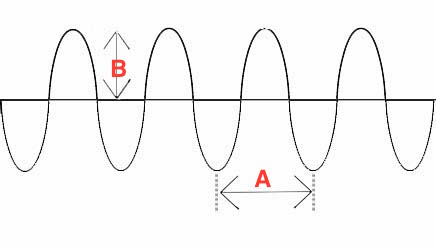
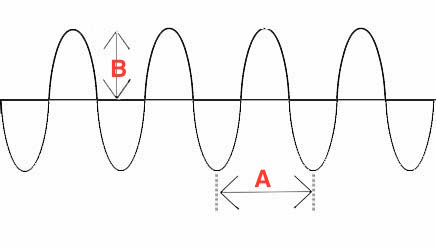
What property of this wave is represented by the letter "A"
amplitude
crest
trough
wavelength


Wavelengths are usually measured in ....
seconds
Hz
inches
meters


Period of a wave refers to...
how long it takes for the event to repeat.
how strong a wave is.
how long a wave is.
how much energy a wave has.

The _______ of a wave is how many waves pass a given point every second.
Frequency
Wavelength
Amplitude

The two waves have different...
amplitudes
speeds
wavelengths
frequencies

What does point A represent?
Amplitude
Wavelength
Crest
Trough
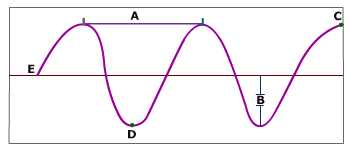


What is the amplitude of this wave?
4
8
2
6.3
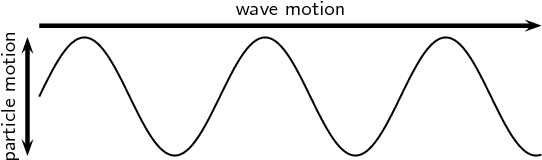

Examples of ________ waves include visible light, xrays, ultraviolet, and radio waves.
transverse
longitudinal

What travels through a wave?
mass
energy
mass and energy
neither mass nor energy

A wave can travel through space and ______ transferring energy from one place to another.
Matter
Air
Time
Ears


What type of wave is this?
Electromagnetic
Mechanical
Both Electromagnetic and Mechanical
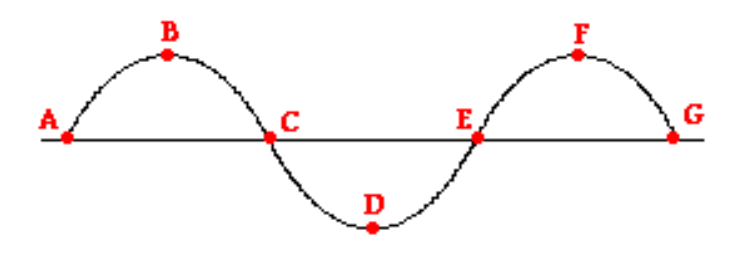

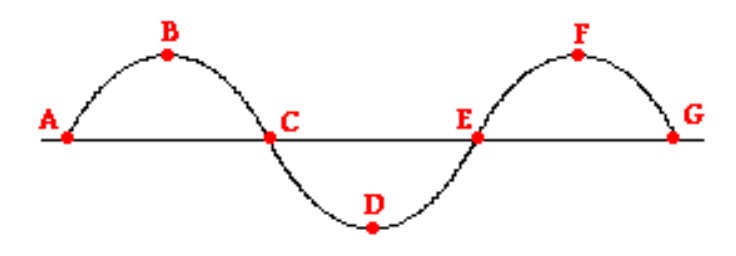

Does this wave demonstrate a TRANSVERSE WAVE or a COMPRESSIONAL/LONGITUDINAL WAVE?
(Look at particle motion compared to energy motion!)
Transverse Wave
Compressional/Longitudinal Wave

Does this wave demonstrate a TRANSVERSE WAVE or a COMPRESSIONAL/LONGITUDINAL WAVE?
(Look at particle motion compared to energy motion!)
Transverse Wave
Compressional/Longitudinal Wave


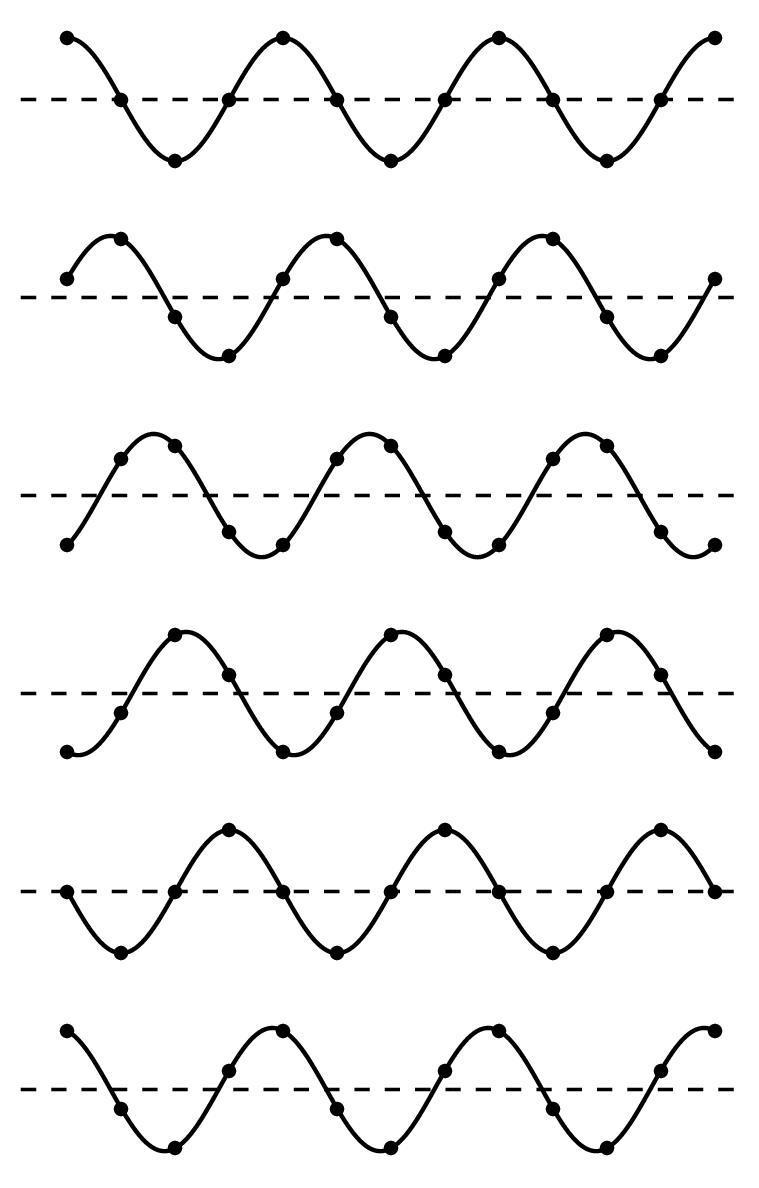


Transverse Wave
Longitudinal Wave


This is an example of a ...
Longitudinal Wave
Wiggly Wave
Transverse Wave
Standing Wave


What kind of wave is pictured below?
compressional wave
transverse wave
sound wave
mechanical wave


Is this wave transverse or longitudinal?
transverse
longitudinal

The student with the slinky is demonstrating how to create
a wave pulse
a transverse wave
a longitudinal wave
a wave front

The diagram represents what type of wave
Transverse wave
Compressed wave
Longitudinal wave
Mechanical wave

This is an example of __________.
light wave
sound wave
vocal chord wave
electromagnetic wave

Sound waves are ___________.
longitudinal waves
transverse waves
surface waves
Sound waves are ___________.
longitudinal waves
transverse waves
surface waves
This is an example of __________.
light wave
sound wave
vocal chord wave
electromagnetic wave

Which of the following is an example of Longitudinal waves?
Water Wave
Seismic Waves
Sound Waves
Light Waves


This illustration best depicts which of the following behaviors?
Reflection
Refraction
Diffraction
Resonance

This image best depicts which of the following wave behaviors?
Reflection
Refraction
Diffraction
Resonance


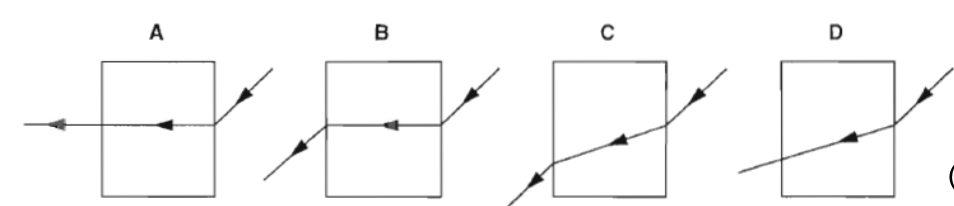
A ray of light travels from air into a glass block.
Which diagram correctly shows the path of the ray through the glass block?
A
B
C
D


Which object refracted the laser beam?
Silver locket
Picture frame
Glass marble
Notebook
Which object refracted the laser beam?
Silver locket
Picture frame
Glass marble
Notebook


What is happening in this picture?
Reflection
Refraction
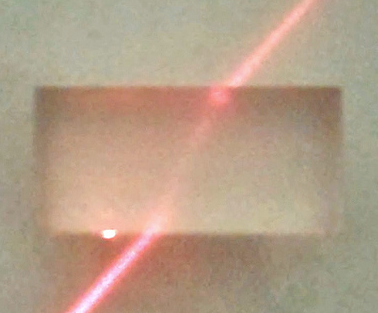
this is an example of
refraction
diffraction
infraction
reflection


Students often use a hand lens to make small objects appear larger. A hand lens makes objects appear larger because the lens-
increases the light’s strength
changes the color of the light
bends light passing through it
converts light energy to heat
Students often use a hand lens to make small objects appear larger. A hand lens makes objects appear larger because the lens-
increases the light’s strength
changes the color of the light
bends light passing through it
converts light energy to heat


Which of the following will occur when light is refracted by the lens?
A
B
C
D

