
 Worksheets
Understanding Earth's Movements and Seasons
Total questions: 145
Worksheet time: 2hrs 27mins
How does the tilt of the Earth's axis affect the seasons experienced in the Northern and Southern Hemispheres?
It causes the Northern Hemisphere to experience summer when the Southern Hemisphere experiences winter, and vice versa.
It causes both hemispheres to experience the same season at the same time.
It has no effect on the seasons; they are determined by the Earth's distance from the Sun.
It causes the equator to experience extreme seasonal changes.
Explain why the equator experiences relatively consistent weather patterns throughout the year compared to the poles.
The equator is closer to the Sun, receiving more direct sunlight year-round.
The equator is not affected by the Earth's axial tilt, receiving consistent sunlight throughout the year.
The equator is shielded by the Earth's atmosphere, preventing seasonal changes.
The equator is at a higher altitude, which stabilizes its climate.
During which event does the Northern Hemisphere experience the longest day of the year, and why does this occur?
Winter Solstice; because the Earth is closest to the Sun.
Summer Solstice; because the North Pole is tilted towards the Sun.
Vernal Equinox; because the Sun is directly above the equator.
Autumnal Equinox; because the Sun is directly above the equator.
How would the seasons be affected if the Earth's axial tilt were increased to 45 degrees?
Seasons would become more extreme, with hotter summers and colder winters.
Seasons would become less extreme, with milder temperatures year-round.
There would be no change in the seasons.
The equator would experience more pronounced seasonal changes.
What is the primary reason for the occurrence of equinoxes?
The Earth's orbit is elliptical, causing varying distances from the Sun.
The Earth's axial tilt causes the Sun to be directly above the equator.
The Earth's rotation speed changes, affecting sunlight distribution.
The Earth's magnetic field aligns with the Sun.
If the Earth's axis were not tilted, how would this affect the occurrence of seasons?
There would be no seasons; the climate would be the same year-round.
Seasons would occur more frequently, with shorter durations.
Seasons would be more extreme, with greater temperature variations.
Seasons would occur only at the poles.
Describe the relationship between the Earth's axial tilt and the intensity of sunlight received at different latitudes.
The axial tilt causes the equator to receive the most intense sunlight year-round.
The axial tilt causes varying sunlight intensity, with higher latitudes receiving less intense sunlight.
The axial tilt has no effect on sunlight intensity; it is determined by the Earth's distance from the Sun.
The axial tilt causes the poles to receive the most intense sunlight during solstices.
How does the Earth's axial tilt influence the length of daylight experienced at different times of the year?
It causes equal daylight hours year-round at all latitudes.
It causes varying daylight hours, with longer days in summer and shorter days in winter.
It causes longer days at the equator and shorter days at the poles year-round.
It causes the same length of daylight at the poles year-round.
What would be the impact on global climate if the Earth's axial tilt were to decrease to 10 degrees?
The climate would become more uniform, with less variation between seasons.
The climate would become more extreme, with greater seasonal differences.
The climate would remain unchanged.
The equator would experience more extreme seasonal changes.
Why do the poles experience continuous daylight or darkness during certain times of the year?
The Earth's distance from the Sun causes this phenomenon.
The axial tilt causes the poles to be tilted towards or away from the Sun for extended periods.
The Earth's rotation speed causes this phenomenon.
The equator's position affects the poles' daylight.
How does the axial tilt of the Earth affect the distribution of solar energy across the planet?
It causes solar energy to be distributed evenly across the planet.
It causes solar energy to be concentrated at the poles.
It causes solar energy to be distributed unevenly, with more energy at the equator.
It causes solar energy to be concentrated at the equator during solstices.
What role does the Earth's axial tilt play in the occurrence of solstices?
The axial tilt causes the Sun to be directly above the equator during solstices.
The axial tilt causes the Sun to reach its highest or lowest point in the sky at noon.
The axial tilt has no role in solstices; they are caused by the Earth's orbit.
The axial tilt causes the equator to experience the longest day during solstices.
Predict the changes in seasonal patterns if the Earth's axial tilt were reversed, with the North Pole pointing towards the Sun during the current Southern Hemisphere summer.
The Northern Hemisphere would experience summer during the current Southern Hemisphere winter.
The Southern Hemisphere would experience more extreme winters.
The equator would experience more extreme seasonal changes.
There would be no change in seasonal patterns.
How does the axial tilt of the Earth contribute to the variation in temperature between summer and winter?
The axial tilt causes the Earth to be closer to the Sun in summer.
The axial tilt causes the Sun's rays to strike the Earth at different angles, affecting temperature.
The axial tilt causes the Earth's rotation speed to change, affecting temperature.
The axial tilt has no effect on temperature variation.
Analyze how the Earth's axial tilt affects the climate zones on Earth.
The axial tilt causes all climate zones to experience the same weather patterns.
The axial tilt causes distinct climate zones, with varying temperatures and precipitation.
The axial tilt causes the poles to have tropical climates.
The axial tilt causes the equator to have polar climates.

How does the tilt of the Earth's axis affect the seasons?
It changes the amount of direct solar energy reaching the Earth's surface.
It influences the rate of chemical reactions occurring in the atmosphere.
It deflects the amount of harmful rays emitted from the Sun.
It changes the speed of rotation of Earth.
Where is the sun directly overhead on June 21?
The Tropic of Capricorn (23.5 degrees S)
The north pole
The Tropic of Cancer (23.5 degrees N)
The equator
Because the tilt of Earth’s axis always points in the same direction, the seasons in the Northern Hemisphere and the Southern Hemisphere are always ______.
A) the same
B) opposite
C) three months apart
D) six months apart
In either one of Earth’s hemispheres, winter happens when the direction of Earth’s axis tilts that hemisphere _________.
towards the moon
towards the sun
away from the sun
Winter and Summer seasons happen when the sun is farthest north or south of the equator. During these seasons, different places on Earth experience the longest days and the longest nights. It is known as the ______.
solstice
equinox
(a) are days on which the hours of (b) are longest or shortest at the (c) of summer or winter.
A solstice event occurs when
the sun's rays reach their highest or lowest point in respect to the equator
the sun's rays shine most directly at the equator
the Earth has it's longest period of daylight hours
What is an equinox?
The longest day of the year
The shortest day of the year
When day and night are of equal length
When the Earth is closest to the Sun
The _____ is the longest day of the year.
fall equinox
winter solstice
summer solstice
spring equinox
During which month does the summer solstice occur in the Northern Hemisphere?
December
June
March
September
What happens during a solstice?
the Sun reaches an equal distance between the north and south poles
The Sun is directly over the equator
the sun reaches its greatest distance north or south of the equator
The Sun is directly over the north or south pole
What is the winter solstice?
The day with the most sunlight
The day with the least sunlight
The start of spring
The end of winter
When the sun reaches its highest or lowest point in the sky, at noon, marked by the longest and shortest days
Solstice
Equinox
Twilight
Equator


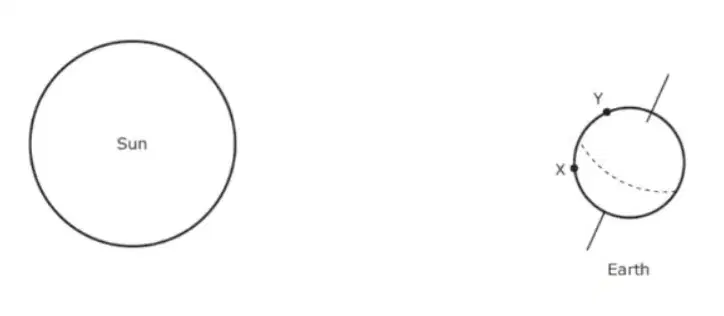
Which location is experiencing more hours of daylight?
Location X
Location Y
Locations X and Y
none of these locations
How many hours does it take for the Earth to make a full rotation? (This causes day and night).
12
48
24
29

Which part of Earth is experiencing daytime in the image?
The Earth is constantly rotating on its axis causing Day and Night. How long does Earth takes to complete one rotation?
12 hours
13 hours
365 days
24 hours
What is the rotation of the Earth and how does it affect day and night?
The rotation of the Earth causes the seasons to change.
The rotation of the Earth causes the tides to rise and fall.
The rotation of the Earth causes earthquakes and volcanic eruptions.
The rotation of the Earth causes day and night.
Explain the revolution of the Earth and its impact on the change of seasons.
The Earth's rotation on its axis causes the change of seasons.
The Earth's distance from the sun causes the change of seasons.
The Earth's magnetic field causes the change of seasons.
The Earth's revolution around the sun causes the change of seasons.
Describe the precession of the Earth's axis and its significance.
The precession of the Earth's axis causes the position of the North Celestial Pole to change over time, which affects the orientation of the Earth's axis and the timing of the seasons.
The precession of the Earth's axis only affects the Southern Hemisphere
The precession of the Earth's axis causes the Earth to stop rotating
The precession of the Earth's axis has no significance
How does the tilt of the Earth's axis contribute to the variation in daylight hours throughout the year?
The tilt of the Earth's axis causes different parts of the Earth to receive varying amounts of sunlight throughout the year.
Daylight hours remain constant throughout the year regardless of the Earth's axis tilt
The tilt of the Earth's axis has no impact on daylight hours
The tilt of the Earth's axis only affects the temperature, not the amount of sunlight received
Discuss the relationship between the Earth's movements and the occurrence of seasonal changes.
The Earth's movements cause changes in the angle and intensity of sunlight, leading to seasonal changes.
The occurrence of seasonal changes is purely random
Seasonal changes are caused by changes in the Earth's magnetic field
The Earth's movements have no impact on seasonal changes
What is nutation and how does it influence the Earth's movements?
Nutation is the Earth's orbit around the Sun, influencing the distance between the Earth and the Sun.
Nutation is the process of the Earth's rotation on its axis, influencing the length of the day and night.
Nutation is a slight wobbling or rocking motion of the Earth's axis. It influences the Earth's movements by causing small variations in the tilt and orientation of the Earth's axis, which in turn affects the position of the celestial poles and the length of the seasons.
Nutation is the Earth's magnetic field, influencing the direction of the Earth's magnetic poles.
Explain the concept of precession and its effect on the Earth's orientation in space.
Precession causes the Earth's orientation in space to change over time.
Precession only affects the Earth's rotation speed.
Precession has no effect on the Earth's orientation in space.
Precession causes the Earth's orientation in space to remain constant.
What is the barycenter of the Earth and how does it affect the motion of the Earth and the moon?
It causes the moon to orbit around the Earth
It affects the motion of the Earth and the moon by causing both bodies to orbit around this common center of mass.
It has no effect on the motion of the Earth and the moon
It causes the Earth to rotate on its axis
How do the Earth's movements and their effects contribute to the concept of time?
The Earth's movements have no impact on the concept of time
Time is only determined by human-made clocks and has no relation to the Earth's movements
The concept of time is solely based on the position of the stars and has nothing to do with the Earth's movements
The Earth's movements create the concept of day, night, and seasons, which are essential for measuring time.
Discuss the significance of understanding the Earth's movements and their effects in the field of astronomy.
Understanding the Earth's movements helps astronomers predict celestial events and study the effects of these movements on the universe.
Astronomy does not rely on understanding the Earth's movements
Understanding the Earth's movements has no significance in the field of astronomy
The Earth's movements have no effects on celestial events
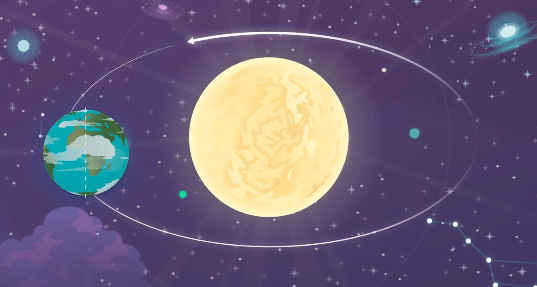
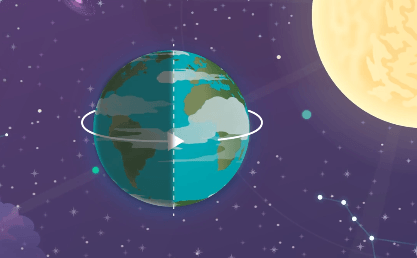

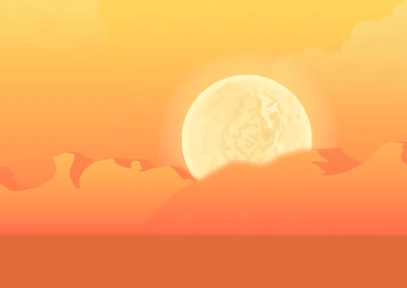
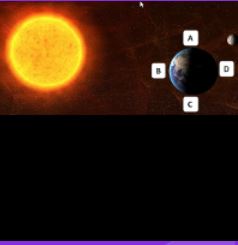
Which part of Earth is experiencing night?
A
B
C
D

Which season(s) have the same amount of daylight hours as nighttime hours?
More hour of light during winter, less in summer
More hours of light during summer, less in winter
None of the seasons have equal daylight hours
All are equal


As viewed from Earth, most stars appear to move across the sky each night because
stars orbit around Earth
Earth rotates on its axis
stars revolve around the center of the galaxy
Earth revolves around the Sun


Why do we see different constellations during different seasons?
Because of Earth's rotation on it's axis
Because of Earth's revolution around the sun
Because Earth is an inner planet
Because the stars move across the sky
During what season of 2020 will I be able to see the same stars and constellations that I did in spring of 2019?
Spring
Summer
Winter
Fall
Why does Earth's revolution around the Sun cause us to see different patterns of stars in the night sky?
Because at different times of the year, the Earth's rotation changes direction
Because at different times of the year, the Earth experiences more daylight hours than nighttime hours
Because at different times of the year, the side of Earth that experiences night is pointing to a different place in space
Because my teacher told me that and she's just so smart
Which month marks the start of winter in the southern hemisphere?
August
February
December
June
Which of the following does your location on Earth determine?
the times of the year you experience seasons
how long the sun stays in the sky during summer
the direction of the sunrise during winter
all of the above
Which of these describes the behavior of the sun during winter?
It rises earlier in the morning and sets earlier in the evening.
It rises later in the morning and sets earlier in the evening.
It rises later in the morning and sets later in the evening.
It rises earlier in the morning and sets later in the evening.
Which of these best describes a seasonal pattern?
leaves falling off trees in autumn for 10 years
the sun rising and setting in the same directions for 1 week
a cold storm in the middle of summer once in 100 years
the sun staying longer in the sky during summer compared to winter for 1 year
If you were to shine a flashlight on a piece of paper, at which angle would you expect to have a more concentrated amount of light?
90°
100°
120°
135°
How does Earth’s shape affect the way that sunlight hits it?
Sunlight never hits Earth at different angles.
Sunlight always hits Earth at the same angle.
Sunlight only touches some parts of Earth and not others.
Sunlight always hits different parts of Earth at different angles.
What happens when sunlight hits Earth’s surface near the equator?
Sunlight transfers a small amount of energy to each spot it hits.
Sunlight transfers a large amount of energy to each spot it hits.
Sunlight transfers a large amount of energy in some places it hits and a small amount in others.
Sunlight transfers a larger amount of energy slightly above the equator and a smaller amount below.

In this image, at which location(s) does light hit the Earth’s surface at a non-perpendicular angle?
the equator
Tropic of Cancer
Tropic of Capricorn
northern latitudes
What is a system?
a tool to predict seasonal patterns
a set of connected parts that form a complex whole
a method for detecting the amount of energy projected by the sun
a map that tracks the sun’s movement through the sky
During which month is the sun more likely to directly hit one of the tropics?
February
December
May
September
Earth’s axis is not perpendicular to its orbital plane, which means that
northern latitudes receive more sunlight throughout the year.
southern latitudes receive more sunlight throughout the year.
the same latitudes receive the same amounts of sunlight throughout the year.
different latitudes receive different amounts of sunlight throughout the year.
At which latitude north and south are the Tropics of Cancer and Capricorn located?
20°
23.5°
45.2°
90°
Which of these marks the first day of spring in the northern hemisphere and the first day of autumn in the southern hemisphere?
March Equinox
September Equinox
Capricorn Equinox
Cancer Equinox
Which of these statements is NOT true regarding an equinox?
The equator receives the most energy from the sun.
Places on the equator experience sunlight at a 23.5° angle.
The North and South Poles are an equal distance from the sun.
The sun is directly overhead at the equator during noon.
Which statement is true regarding the December Solstice?
The South Pole is titled away from the sun.
Sunlight hits the Tropic of Cancer at a 90° angle.
The equator is experiencing sunlight perpendicularly.
The southern hemisphere is experiencing summer.
Which statement is NOT true regarding the September Equinox?
Sunlight hits the equator at a 90° angle.
The weather is cooling in the northern hemisphere.
Sunlight hits the Tropic of Capricorn at a perpendicular angle.
Neither the North Pole nor the South Pole is tilted toward the sun.
What change(s) might occur in the sun with the changes in seasons?
the length of time the sun stays in the sky
the place where the sun rises and sets
the height of the sun traveling through the sky
all of the above
In which month in the northern hemisphere might you expect to see the sun arc high in the sky and remain there for about 15 hours?
April
January
June
November


1. Based on the model above, which season is point X most likely experiencing?
spring
summer
winter
fall or autumn

Which location has the greatest number of hours of daylight?
A
B
C
D
E
Why do we experience the changing of the season on the earth? (choose 2 answers)
distance from the sun
rotation of the earth
revolution around the sun
tilt of the earth's axis

At position A, what season is the Northern hemisphere experiencing?
Summer
Winter
Spring
Fall

What happens when the area in which you live tilts away from the sun?
It is summer.
It is spring.
It is winter.
It is fall.
Day and night is caused by the _____________ of earth on its axis.
revolution
rotation
What is the earth's tilt in degrees?
205
22.5
23.5
24.5
What is an Equinox?
Full tilt toward sun
Full tilt away from sun
Shortest day
Equal day and night
What is the name of the first day of summer
Autumnal equinox
Winter solstice
Vernal equinox
Summer solstice
What is the name of the first day of winter
Winter solstice
Vernal equinox
Autumnal equinox
Summer solstice
What is the name of the first day of spring
Autumnal equinox
Vernal equinox
Winter solstice
Summer solstice
What is the name of the first day of fall
Winter solstice
Summer solstice
Autumnal equinox
Vernal equinox
Which season has the longest day?
Vernal equinox
Autumnal equinox
summer solstice
Winter solstice
Name the season with the shortest day
Winter solstice
Summer solstice
Vernal equinox
Autumnal equinox
When the Northern Hemisphere is pointing towards the Sun, what season is the Southern Hemisphere experiencing?
Summer
Spring
Winter
Fall
How long does it take the Earth to make one REVOLUTION around the Sun?
12 hours
24 hours
29.5 days
365.25 days or one year

When is Earth the closest to the sun?
January
July
In which direction does the Earth rotate and revolve around the sun?
clockwise
counter-clockwise
Which is correct?
sun sets in the east and rises in the west
sun sets in the west and rises in the east
sun sets in the east and rises in the north
sun sets in the south and rises in the north

What type of eclipse is shown in the picture?
Solar
Lunar

What type of eclipse is shown in the drawing?
Solar
Lunar
Which of the following is true for a solar eclipse?
The Earth is casting a shadow on the moon.
The moon is casting a shadow on the Earth.
The sun is casting a shadow on the moon.
The Earth is casting a shadow on the sun.
Which of the following is true for a lunar eclipse?
The Earth is casting a shadow on the moon.
The moon is casting a shadow on the Earth.
The sun is casting a shadow on the moon.
The Earth is casting a shadow on the sun.
Solar eclipses can only happen during which moon phase?
Waxing gibbous
New moon
Full moon
Waning crescent
Lunar eclipses can only happen during which moon phase?
Waxing gibbous
New moon
Full moon
Waning crescent

How many parts does an eclipse shadow have?
1
2
3
4
Which of the following are parts of an eclipse shadow?
Perinumbra
Hyperumbra
Penumbra
Umbra
What is the center, darker part of an eclipse shadow called?
Perinumbra
Hyperumbra
Penumbra
Umbra
What is the lighter part of an eclipse shadow, where the light is only partially blocked, called?
Perinumbra
Hyperumbra
Penumbra
Umbra
Total lunar eclipses are visible when the moon is in which part of an eclipse shadow?
Umbra
Penumbra
Partly in the umbra
Partly in the penumbra
Total solar eclipses are visible when Earth is in which part of an eclipse shadow?
Umbra
Penumbra
Partly in the umbra
Partly in the penumbra
Partial solar eclipses are visible when the Earth is in which part of an eclipse shadow?
Umbra
Penumbra
Partly in the umbra
Partly in the penumbra
Partial lunar eclipses are visible when the moon is in which part of an eclipse shadow?
Umbra
Penumbra
Partly in the umbra
Partly in the penumbra

Which letter or letters in the picture identify the umbra?
A
B
C

Which letter or letters in the picture identify the umbra?
A
B
C
Which letter or letters in the picture identify the penumbra?
A
B
C

Which letter or letters in the picture identify the penumbra?
A
B
C

The shaded area between the red lines in the picture shows the portion of Oregon that could see the total solar eclipse in 2017. Based on this information, which part of the eclipse shadow was Portland in?
Umbra
Penumbra

