
 Worksheets
Cells and Heredity Unit 3
Total questions: 144
Worksheet time: 1hrs 13mins
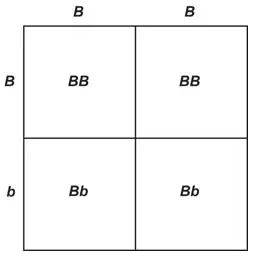
Look at the diagram. Which of these gives the correct ratio for the offspring predicted by the diagram?
2 BB : 1 Bb
1 BB : 1 BB
1 BB : 1 Bb
1 BB : 2 Bb
Alleles carry the codes for producing which of these types of large molecules?
lipids
proteins
nucleic acids
carbohydrates
A scientist crossed a white-flowered plant with a blue-flowered plant. Which of these outcomes would show that blue flower color is dominant to white flower color?
All of the second generation is blue.
All of the second generation is white.
One-fourth of the second generation is blue.
One-fourth of the second generation is white.
A scientist crosses a rabbit with short fur and a rabbit with long fur. Which of these outcomes would show that the trait for fur length is an example of incomplete dominance?
All the offspring have no fur.
All the offspring have long fur.
All the offspring have short fur.
All the offspring have medium-length fur.
A botanist crosses a pea plant that produces smooth seeds with a pea plant that produces wrinkled seeds. The resulting plants all produce smooth seeds. What can be determined from the results of the experiment?
Smooth shape and wrinkled shape are both recessive traits.
Smooth shape and wrinkled shape are both dominant traits.
Smooth shape is a dominant trait, and wrinkled shape is a recessive trait.
Smooth shape is a recessive trait, and wrinkled shape is a dominant trait.
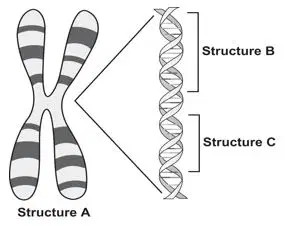
The diagram shows several structures located within a cell. Which statement best describes the relationship among the structures?
Structures B and C are located within Structure A and code for inherited traits.
Structures B and C come together to form a new organism during fertilization.
Structure A is a small part of Structures C and B, and codes for a single inherited trait.
Structure C is located within Structure B, which is located within Structure A, and all three code for different versions of the same trait.
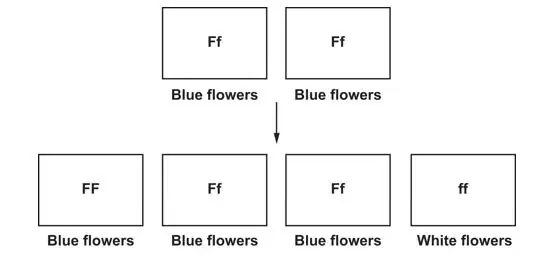
The diagram shows a cross that is similar to one of Mendel’s pea plant crosses. What is the dominant phenotype of the offspring in the cross shown?
Ff
FF
blue
white
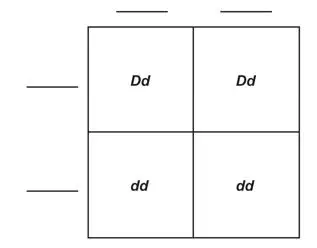
Look at the diagram shown. The alleles for the parents are missing. The parents in the diagram have which of these alleles?
DD and Dd
Dd and Dd
Dd and dd
DD and dd
Carrie is studying the genes of two fruit flies in her lab. She knows what alleles they have. She wants to know the potential combinations of alleles their offspring could inherit. Which of these would help Carrie identify the potential combinations?
allele
carrier
pedigree
punnett square
Which of these choices describes a segment of DNA that determines a specific trait in a person, such as attached earlobes?
a gene
a phenotype
a chromosome
a characteristic
The different forms of characteristics are called ______.
traits
characteristics
chromosomes
genes
Mendel crossed two parent plants. What does this mean?
He let them self-pollinate.
He fertilized one parent plant with pollen from the other parent plant.
He used a method of scratching out genes
When Mendel crossed the purple-flowered and white-flowered plants, all first generation plants had purple flowers. Mendel called this the _______ trait.
recessive
dominant
When Mendel crossed the purple-flowered and white-flowered plants, the white-flower trait seemed to recede or fade away. Mendel called this the ______ trait.
recessive
dominant
____ contains instructions that determine an organism's traits and coordinate the growth and development of an organism.
Chromosomes
Genes
Alleles
DNA
DNA is organized into structures called ______.
chromosomes
genes
alleles
proteins
A ____ is a segment of DNA located on chromosomes of cells.
gene
allele
protein
base
Each individual has ______.
a single gene
pairs of genes
Each individual has _______.
single chromosomes
pairs of chromosomes
Each parent contributes ____ set(s) of genes to its offspring.
one
two
three
four
The different gene forms are called _____.
DNA
chromosomes
alleles
proteins
Alleles carry the codes for producing various _____, which are large molecules that do much of the work in a cell and also make up much of the cell's structure.
chromosomes
genes
DNA
proteins
A molecule of DNA is shaped like a twisted ladder, a shape that is called _____.
single helix
circular
double helix
rectangular prism
The instructions of DNA are coded in specific sequences of _______.
chromosomes
alleles
base pairs
cells
Changes in a section of DNA are known as ______.
disease
mutations
resistance
traits
Mutations might have a beneficial or harmful outcome.
true
false
All traits are passed on from parent to offspring.
true
false
Traits such as the ability to ride a bike are ____.
learned
passed from parent to offspring
acquired
Traits such as hair dyed blue is _____.
an acquired trait
a learned trait
an inherited trait
______ is the passing of genes from parents to offspring.
Inheritance
Acquired traits
Learned traits
Mutations
When offspring inherit all of their genes from one parent, the offspring is ____ to the parent.
still different
identical
When two parents contribute genetic material to the offspring, the offspring are genetically ______ as well as each other.
identical to the parents
different to the parents
A _______ is a model used to predict the possible genotypes of offspring in a given cross.
family tree
punnett square
Each square of a punnett square shows a possible _____ combination for potential offspring.
chromosome
allele
DNA
base
Punnett squares give exact genotypes for the offspring of a cross.
true
false
_______ is the mathematical chance of a specific outcome in relation to the total number of possible outcomes.
Ratio
Probability
Crossing
A _____ is an expression that compares two quantities.
probability
ratio
change
base
DNA is made up of chemical compounds called ______.
nucleotides
adenines
alleles
chromosomes
Which of the following create a nucleotide?
a sugar
a phosphate
a base
a double helix
The amount of adenine in a nucleotide is equal to the amount of ______.
thymine
cytosine
guanine
The amount of guanine in a nucleotide is equal to the amount of ______.
adenine
thymine
cytosine
Which of these organisms can reproduce by budding?
hydra
dolphin
manta ray
salamander
Which of these lists includes three types of asexual reproduction?
budding, spore formation, fertilization
binary fission, budding, spore formation
fertilization, vegetative reproduction, binary fission
spore formation, fertilization, vegetative reproduction
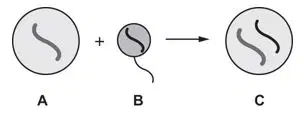
Look at the diagram of sexual reproduction. Which of these statements correctly describes the genetic information in the diagram?
Cell A is genetically identical to cell C.
Cell B contains the same genetic material as cell C.
Cell C has genes from cell A and genes from cell B.
Cells A and C contributed genetic material to cell B.
Which of these choices describes a zygote?
a structure or organ within an organism that produces gametes
a specialized cell that contains half the number of chromosomes found in other cells of an organism
a spore-like cell that is produced during asexual reproduction and that can grow into a new organism
a cell that forms as the result of fertilization and has the same number of chromosomes as the parent cells
Which type of reproduction involves two parents and results in offspring that are not genetically identical to either parent?
binary fission
spore formation
sexual reproduction
vegetative reproduction
Which of these statements correctly describes one way that asexual and sexual reproduction are different?
Asexual reproduction increases genetic diversity, but sexual reproduction does not.
Asexual reproduction involves one parent, and sexual reproduction involves two parents.
Asexual reproduction increases a species’ chances of surviving unfavorable conditions, but sexual reproduction does not.
The offspring produced by asexual reproduction are not identical to each other, but those of sexual reproduction are identical to each other.
Which of these statements is true for organisms that reproduce asexually?
Compared to organisms that reproduce sexually, organisms that reproduce asexually are more likely to expend energy to find a mate.
Compared to organisms that reproduce sexually, organisms that reproduce asexually are less likely to expend energy caring for their offspring.
Compared to organisms that reproduce sexually, organisms that reproduce asexually are less likely to require only one parent for reproduction to take place.
Compared to organisms that reproduce sexually, organisms that reproduce asexually are more likely to have offspring genetically different from themselves.
Which type of cell division is a part of asexual reproduction?
meiosis
mitosis
both meiosis and mitosis
neither meiosis or mitosis
Marmosets usually give birth to fraternal twins, two offspring that grow from two different fertilized eggs. Marmoset twins are genetically _______.
identical
not identical
What advantage does the white-faced marmoset gain by its method of reproduction?
The marmoset population has genetic variation.
The marmoset can reproduce without a mate.
The marmoset can reproduce many offspring at a time.
The marmoset can reproduce by budding.
What is the process by which organisms generate a new individual of the same species?
reproduction
generation
populating
speciation
In which type of reproduction is a single individual the parent?
sexual reproduction
asexual reproduction
In _____ reproduction, the offspring are genetically identical to the parent unless gene mutations occur.
sexual
asexual
Most unicellular organisms reproduce _____.
sexually
asexually
_______ reproduction allows an organism to reproduce quickly and can produce a large number of offspring in a short period of time.
Sexual
Asexual
In which type of reproduction are there two parents?
Sexual
Asexual
Most multicellular organisms reproduce _____, including plants and animals.
sexually
asexually
_______ reproduction usually takes more time and produces fewer offspring.
Sexual
Asexual
_____ reproduction increases genetic variation, which increases the chance that some offspring will have new traits that will help them survive a changing environment.
Sexual
Asexual
Some organisms can reproduce sexually and asexually.
true
false
A bud begins to grow on an adult's body and eventually breaks off from the adult. What time of reproduction is this?
budding
binary fission
fertilization
duplication
What type of reproduction results in two unicellular organisms that are genetically identical to the parent?
budding
binary fission
fertilization
duplication
Having offspring that are genetically ______ the parent ensures that any favorable traits that the parent has are passed on to the offspring.
different from
identical to
Sexual reproduction requires two parents. Each parent produces ______, or sex cells.
gametes
eggs
sperm
cells
Gametes have ____ the total number of chromosomes, one copy of each chromosome.
twice
half
During sexual reproduction, a sperm cell and an egg join in a process called _______.
binary fission
budding
gametes
fertilization
A new genetically different cell formed during fertilization is called a ______.
fetus
zygote
gamete
bud
Scientists can classify plants into two major groups based on reproductive structures of the plants. What are these two groups called?
seedless and seed plants
hybrid and heirloom plants
water plants and land plants
flowering and nonflowering plants
Many plants can reproduce asexually. Which of these is an example of asexual reproduction in a plant?
pine cones forming on a tree
cross-pollination in a tomato
roots sprouting from a potato
night-blooming jasmine flowers
Where would you expect to see seedless plants, such as ferns and mosses?
in a botanical museum, because they are all extinct
low and close to the ground in a moist environment
climbing high while circling the branches of another plant
deeply rooted in a forest with a trunk that reaches 20 meters or more
Henry designs an experiment to find out why plants without flowers tend to be wind-pollinated and not animal-pollinated. He takes samples from a variety of plants and studies them in the field. He finds that the evidence supports his hypothesis. Which of these was the hypothesis Henry was testing?
Nonflowering plants make less pollen than flowering plants.
Nonflowering plants lack the structures to attract animal pollinators.
Nonflowering plants grow close to the ground and capture fewer pollinators.
Nonflowering plants grow close to the ground because they have no pollen grains.
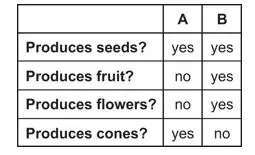
The table shows characteristics of two plants, Plant A and Plant B. What plant could be a spruce tree?
Plant A
Plant B
Plants A and B
neither Plant A nor Plant B

The chart describes several different parts of flowering plants. Which of these gives the correct labels for columns A, B, and C?
A is pistil; B is stamen; C is flower.
A is stamen; B is pistil; C is flower.
A is stigma; B is flower; C is fruit.
A is stamen; B is seed; C is pedicel.
Which type of plant makes up the largest group in the Plantae kingdom?
land plants
water plants
flowering plants
nonflowering plants
Many cacti are adapted to live in dry habitats that have very little shade. Which of these environmental factors might be harmful to the growth of a cactus?
very few other plants near by
several weeks of sunny weather
hot and dry summer temperatures
more than average rainfall for the area
Which of these statements best describes what happens during vegetative reproduction?
A single-celled organism divides into two new organisms.
A parent plant produces spores, which grow into new plants.
A new plant develops from a stem or root of its parent plant.
Pollen from one plant fertilizes another plant and produces offspring.
How do flowering plants contribute to the reproductive success of the plant?
The shape of the flower's petals attracts pollinators.
The flower attracts bees that think they are meeting a mate.
The flower scares away birds looking for a meal.
All plants can reproduce sexually.
true
false
A _____ of a seedless plant is a tiny structure that is dispersed from the parent plant and can grow into a new plant body.
spore
sperm
egg
stalk
Many seedless plants live in ____ environments because a sperm from one plant must swim through water to fertilize the egg of another plant.
dry
moist
In seed plants, sperm are carried in a microscopic structure called _____.
seeds
pollen
embryo
cones
In seed plants, eggs develop inside a structure called a(n) ______.
pollen
ovule
spore
cone
In seed plants, when pollen reaches and fertilizes an egg, ______ occurs.
pollination
budding
binary fission
dispersion
In seed plants, the ovule becomes the ____, the structure that contains the embryo inside a protective coating.
cone
pollen
spore
seed
______ plants can be classified as flowering or nonflowering plants.
Seedless
Seed
_____ plants produce seeds that are not enclosed in a fruit.
Flowering
Nonflowering
Most nonflowering seed plants produce seeds enclosed in a structure called a ______.
seed
ovule
embryo
cone
______ plants produce flowers and fruit.
Flowering
Nonflowering
_____ are tiny plants that grow along the edges of a plant's leaves.
Plantlets
Tubers
Stems
Ovules
When a plant _______, pollen is transferred to the egg of the same plant.
cross-pollinates
self-pollinates
When a plant _______, the pollen from one plant is transferred to the egg of another plant.
self-pollinates
cross-pollinates
The _____ is a flower's male reproductive structure.
stamen
pistil
pollinator
petal
The _____ is the female reproductive structure of a flower.
stamen
pistil
pollinator
pedicel
______ cover and protect the flower while it is budding.
sepals
petals
______ are often colorful and can help attract animal pollinators.
sepals
petals
pedicel
receptacle
The ______ is part of the stem that supports the flower.
sepal
petal
pedicel
receptacle
At the end of the pedicel is the _______, which forms the base of the flower.
petal
sepal
receptacle
style
The seeds of different plants may have different requirements to ______, or develop from a seed into a small plant.
fertilize
germinate
reproduce
pollinate
Seeds can delay germination, or go ______, until conditions are right for plant growth.
dormant
produce
pollinate
rest
Which of these is not a factor that influences animal growth?
inherited diseases
gravitational force
genetic information
availability of food
Which behavior most directly increases reproductive success in animals?
A male ostrich performs a dance to attract females.
An animal deposits chemicals to mark its territory.
A female butterfly flaps her wings to reject a courting male.
A bird pretends to have a broken wing to lure away predators.
Which parenting behavior does not increase the probability that offspring will survive?
producing milk to feed young
guarding young from predators
protecting young from cold weather
abandoning young before eggs are hatched
Which of these best describes successful animal behaviors?
They are only instinctive and genetic.
They are influenced by genes and experience.
They are beneficial for survival and reproduction.
They involve thinking, reasoning, and problem solving.
Which of these is a courting behavior that can increase a male’s probability of reproductive success?
A male gorilla displays strength and vocalizations to females.
A group of birds flies to a new location with more food resources.
A chimpanzee learns to use a tool by watching another chimpanzee.
Male and female robins sit on their eggs to keep them warm until they hatch.
Which of these behaviors is most likely to result in an organism attracting a mate?
A dog urinates on fire hydrants and several trees.
A bird decorates its nest with colorful forest items.
An adult teaches its offspring how to eat scorpions.
A sea turtle lays large quantities of eggs deep in the sand.
Heavier female black bears produce more offspring. Which statement describes a genetic factor that might negatively affect a female black bear's reproductive success?
Binocular vision gives the bear excellent depth perception.
The bear can digest fruits easily, but has difficulty digesting fats.
Powerful legs allow the bear to chase prey at speeds up to 30 miles per hour.
Long, curved claws help the bear climb tree trunks and dig open insect mounds.
Why are animals considered consumers?
because they do not require food
because they use sunlight to make food
because they eat other organisms to get food
because they decompose other organisms to get food
The male midwife toad will carry the eggs he fertilized until they are ready to hatch. This male midwife toad most likely reproduces ______.
asexually
sexually
What type of behavior is shown by a pig-tail macaque grooming its offspring?
offspring
courtship
parenting
_____ reproduction is the dominant form of reproduction of animals.
Sexual
Asexual
When a female lays eggs and the male fertilizes them outside the female's body, fertilization is ______.
internal
external
When a male and female mate and fertilization occurs inside the female's body, fertilization is _____.
internal
external
______ is the ability to produce offspring that are healthy and that survive.
Reproductive success
Reproductive chance
Fertilization success
Courtship success
_____ are attempts by animals to attract mates.
Courtship behaviors
Parenting behaviors
Reproductive behaviors
Offspring behaviors
_______ are attempts by animals to ensure their offspring's survival.
Courtship behaviors
Parenting behaviors
Offspring behaviors
Reproductive behaviors
Growth and survival of animals depends on complex interactions between genetic and environmental factors.
true
false
A gardener wanted to grow pumpkins to show in the state fair. She planted a variety of pumpkin seeds in several locations throughout her yard. At the end of the growing season, she had some pumpkins that were small and some that were giant. Which factor could not have contributed to the variety of size between pumpkins?
The pumpkin seeds were all planted on the same day.
The pumpkin seeds were planted in different locations.
The pumpkin seeds came from pumpkins with different genes.
Some pumpkins were grown in the shade and some in the sun.
Many factors can affect the growth of crops. Which of these examples describes how a genetic factor can influence the growth of crops?
Farmers notice that many strawberry plants have died after a late frost.
Farmers have found a way to grow oranges that are resistant to disease so that more make it to harvest.
Farmers have found that aerating, or adding more oxygen to the soil, helps their peanut crops grow better.
Farmers find that their potatoes grow larger when the water that they use to irrigate with has a higher acidity.
In cattle, the allele for solid coat color is dominant (R) and the allele for white-spotted coat is recessive (r). A rancher crossed two cows, both solid color. What combination of genes in the solid-coat parents could result in offspring with the white-spotted phenotype?
rr and rr
Rr and Rr
RR and rr
RR and RR
Many plants can reproduce both sexually and asexually. For example, rose bushes reproduce asexually when cuttings planted in the ground grow roots and become a new rose bush. They can also reproduce sexually when their flowers are pollinated. What is the primary advantage of sexual reproduction in roses?
Roses reproduce more quickly when reproducing sexually.
Roses produced through sexual reproduction have more genetic variation.
Roses can produce more offspring in sexual reproduction.
Roses can reproduce sexually without the use of gametes.
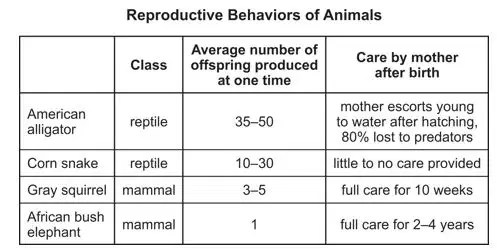
The table gives information about the reproductive behaviors of various animals. Based on the table, which statement best describes a relationship between parental care and reproductive success?
Mammals are less likely to care for their young after birth than reptiles.
American alligators rely on protecting their young for reproductive success.
Elephants are more likely to reach adulthood than alligators due to extended parental care.
Reptiles rely on producing a large number of offspring at one time for reproductive success.
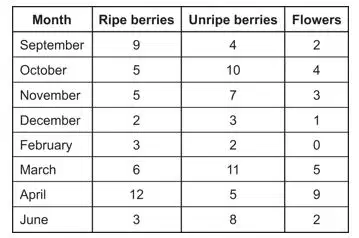
A beautyberry is a type of shrub that grows well in the southern United States. Some students have a small beautyberry shrub that is growing near their school. They record the number of berries, ripe or unripe, and the number of flowers at different times throughout the year. Which statement best explains what is shown in their data?
The beautyberry relies on wind to spread its seeds.
The beautyberry relies on one type of animal to eat the berries.
The beautyberry uses asexual reproduction to make new plants.
The beautyberry increases its chances of reproduction because its berries do not all become ripe at the same time.
Which of the following shows offspring that is genetically different from the parent?
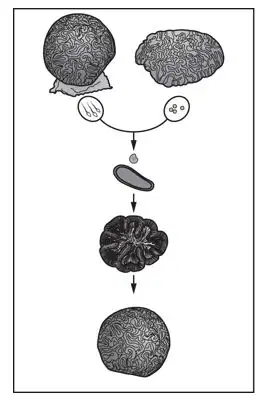
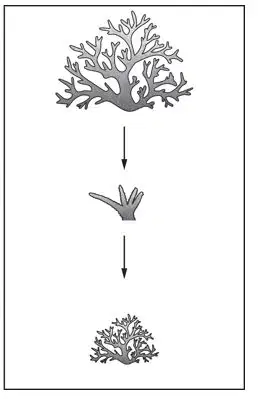
Which of the following shows offspring that is genetically identical to the parent?
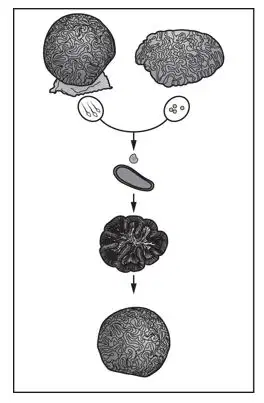

Which statements are examples of sexual reproduction?
Potatoes reproduce by growing new plants from tubers.
Bluegill fish reproduce when males fertilize eggs laid by female fish.
Some queen ants produce worker ants by laying eggs that are not fertilized.
Jellyfish reproduce when males and females release gametes into the water.
Which statements are examples of asexual reproduction?
Potatoes reproduce by growing new plants from tubers.
Bluegill fish reproduce when males fertilize eggs laid by female fish.
Some queen ants produce worker ants by laying eggs that are not fertilized.
Jellyfish reproduce when males and females release gametes into the water.
What is the advantage for strawberries of producing seeds that are attached to edible fruit?
When the fruit decomposes, the nutrients will fertilize the soil for the seeds.
The red fruit makes the seeds more visible, so people pick the fruit more often.
When animals eat the fruit, they disperse the seeds to new locations away from the parent plant.
Having seeds attached to fruit means a large cluster of seeds will be deposited in the same place.
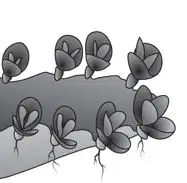
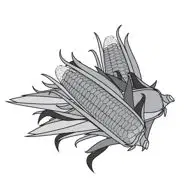
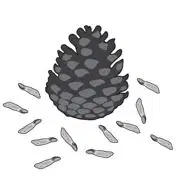
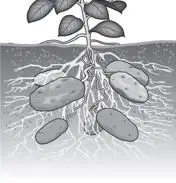
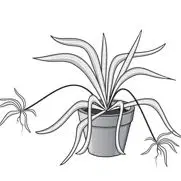
Which of the following are examples of asexual reproduction in plants?
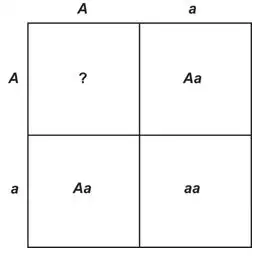
The diagram shows a Punnett square for one trait. Which of these should be placed in the box with the question mark?
aa
Aa
AA
AA or aa
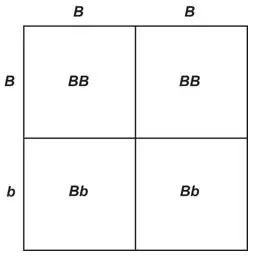
Examine the Punnett square. Which of these choices gives the alleles of the parents shown in the Punnett square?
BB and BB
BB and Bb
Bb and Bb
Bb and bb
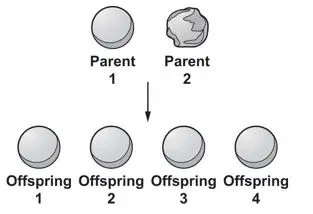
A pea plant with round seeds is crossed with a pea plant with wrinkled seeds. The figure shows the results of this cross. What can be concluded about wrinkled seeds?
The wrinkled shape is a recessive trait.
The wrinkled shape is a dominant trait.
The wrinkled shape is an acquired trait.
The wrinkled shape is an incomplete trait.
Vegetative propagation is a form of asexual reproduction because it does not involve _____.
insects
budding
fertilization
cellular reproduction
Vegetative propagation is an efficient method of reproduction because the species can reproduce even when ______.
the plant is old
its cells cannot divide
there are no pollinators around
the soil and water conditions are unfavorable
Asexual reproduction does not give the species a chance to __________, which is disadvantageous.
produce offspring
evolve into new species
produce flowers and fruit
increase genetic diversity
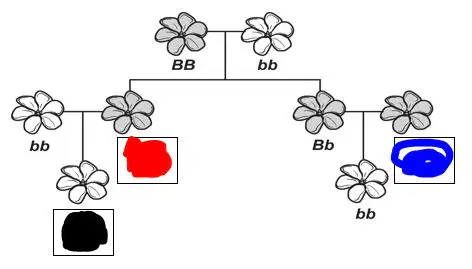
Which alleles belong in the red square?
BB
Bb
bb
Which alleles belong in the black square?
BB
Bb
bb
Which alleles belong in the blue square?
BB
Bb
bb
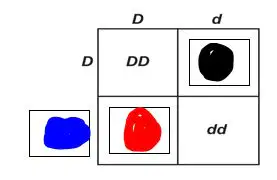
What letter(s) belong in the blue square?
D
d
DD
dd
What letter(s) belong in the black square?
D
d
DD
Dd
What letter(s) belong in the red square?
D
dd
DD
Dd
A species of plant has one gene for berry color that can produce either blue or purple berries. The allele B for blue-colored berries is dominant over the allele b for purple-colored berries. Two heterozygous plants with blue berries are crossed. What percentage of offspring will have the genotype BB?
0
25
50
75
100
A species of plant has one gene for berry color that can produce either blue or purple berries. The allele B for blue-colored berries is dominant over the allele b for purple-colored berries. Two heterozygous plants with blue berries are crossed. What percentage of offspring will have the genotype Bb?
0
25
50
75
100
A species of plant has one gene for berry color that can produce either blue or purple berries. The allele B for blue-colored berries is dominant over the allele b for purple-colored berries. Two heterozygous plants with blue berries are crossed. What percentage of offspring will have the genotype bb?
0
25
50
75
100

