
 Worksheets
Spring Semester Review
Total questions: 149
Worksheet time: 4hrs 48mins

A cell with nucleus is
Autotrophic
Prokaryotic
Eukaryotic
Heterotrophic

What kingdoms have organisms that are prokaryotic? (hint: 2 correct answers)
animalia
fungi
eubacteria
archeabacteria

A pine tree is a member of the kingdom
Animalia
Protista (Protists)
Fungi
Plantae (Plant)

Protista
All of the following have a nucleus except...
Bacteria
Animalia
Plantae (Plant)
Protista (Protist)
What kingdom has organisms that feed off dead or decaying organisms?
Plantae (Plant)
Fungi
Protista (Protist)
Archaebacteria
Which 2 kingdoms has organisms that are all multicellular and eukaryotes?
Animal and Plant
Fungi and Animal
Eubacteria and Plant
Fungi and Plant

What are the kingdoms that are eukaryotic? (select all that apply)
animalia
Fungi
Protista
Plantae
Eubacteria
What kingdoms are prokaryotic?
select 2
animalia
fungi
eubacteria
archeabacteria
True or False?
Bacteria can live in soil, water and in/on human bodies.
True
False
True or False?
All protists are single-celled.
True
False
Which of the following is not true about the Kingdom Animalia?
they are multicellular
they reproduce with a partner
they use photosynthesis to produce food
they can move from place to place
True or False: Archaea Kingdom organisms can live in harsh environments like hot springs and hot ocean vents?
True
False

True or False?
All life on earth can be placed into one of six groups based on their similarities.
True
False

True or False?
Bacteria are single-celled organisms that pretty much live everywhere.
True
False
How much energy gets transferred from one level of an energy pyramid to the next?
10%
5%
90%
50%
What does the arrow in a food chain mean?
The direction of energy flow
Which animal is eaten
The exchange of oxygen and carbon dioxide
How energy gets broken down
A rabbit eats grass. What is true of both the rabbit and the grass?
The rabbit and the grass are both producer
The rabbit and the grass are both consumers
The rabbit is a producer and the grass is a consumer
The rabbit is a consumer and the grass is a producer

Which is possible based on the diagram?
Sun → grass → robin
Plant seeds → field mouse → robin
Eagle → deer → plant seeds
Grass → deer → mountain lion
What first gets the energy from the sun?
decomposers
producers
carnivores
primary consumers
Where does most energy come from
primary consumers
decomposers
the moon
the sun

What does the arrow between the mouse and the owl represent?
Energy flowing from the producer to consumer
Energy flowing rom consumer to producer
Energy flowing from the owl to the mouse
Energy flowing from the mouse to the owl
Breaks down plant and animal remains and waste into molecules that producers reuse to make energy
Producer
Decomposer
Omnivore
Carnivore
Which of the following would be a primary consumer?
hawk
cheetah
rabbit
grass
A consumer that eats only plants is a(n) ____.
carnivore
omnivore
herbivore
tertiary consumer
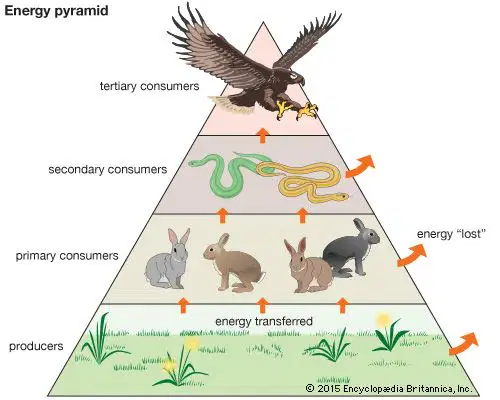
What type of consumer would be at the top of an energy pyramid?
Primary
Secondary
Tertiary
Snakes can eat rabbits. What would happen to the rabbit population if the snake population doubled?
The rabbit population would stay the same
The rabbit population would go down
The rabbit population would go up.
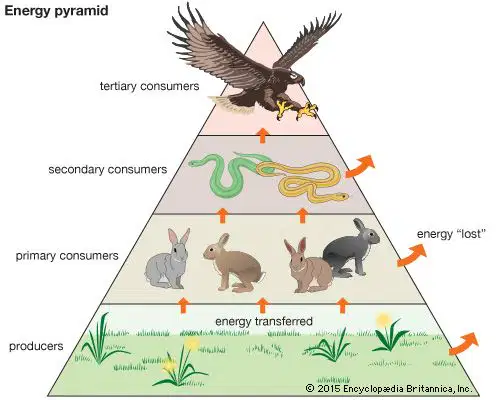
What level would you expect to find at the bottom of an energy pyramid?
tertiary consumer
primary consumer
secondary consumers
Autotrophs/ producers
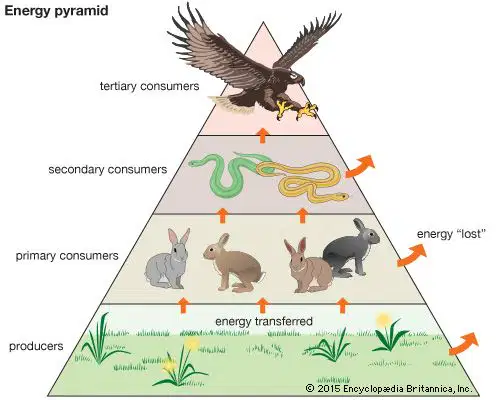
A consumer that eats only producers.
Primary Consumer
Secondary Consumer
Carnivore
Omnivore
An organism that makes its own food.
Autotroph
Heterotroph
Herbovore
Carnivore
This shows the total energy available at each trophic level of an ecosystem.
Energy Pyramid
Food Chain
Food Web
This organism is always first on a food web.
Plants
The Sun
Apex Predator
Primary Consumer
The energy organisms need to live and grow first enters the ecosystem when-
decomposers break down dead organism
plants take in light energy from the sun
primary consumers eat plants for food
secondary consumers eat primary consumers
Which sequence describes the levels of organization from MOST organized to LEAST organized?
Organism, Organ, Tissue, Cell
Cell, Tissue, Organ, Organ System, Organism
Cell, Organ, Tissue, Organ System
Organism, Organ System, Organ, Tissue, Cell


Farmers can best reduce negative effects on the water quality of nearby streams and lakes by planting crops that
produce less oxygen
produce less carbon dioxide
need less fertilizer
need less solar energy
Protects the body, regulates body temperature
Integumentary
Nervous
Skeletal
Muscular
Carries oxygen and nutrients to all parts of the body.
Integumentary
Nervous
Circulatory
Respiratory
Allows movement in the body
Integumentary
Nervous
Skeletal
Muscular
Receives stimuli and transports impulses, coordinates actions and reactions in the body
Integumentary
Nervous
Circulatory
Respiratory
Supports and provides structure for the body
Skeletal
Muscular
Circulatory
Respiratory
Supplies blood with oxygen and rids the body of carbon dioxide
Integumentary
Nervous
Circulatory
Respiratory
Main Organs: Skin
Integumentary
Nervous
Skeletal
Muscular
Main Organs: Heart and blood vessels
Integumentary
Nervous
Circulatory
Respiratory
Main Organs: Muscles
Integumentary
Nervous
Skeletal
Muscular
Main Organs: Brains, spinal cord, nerves
Integumentary
Nervous
Circulatory
Respiratory
Main Organs: Bones and joints
Skeletal
Muscular
Circulatory
Respiratory
Main Organs: Lungs
Integumentary
Nervous
Circulatory
Respiratory
What is the smallest unit of life in the human body
Tissue
Organ
Cell
Organism
What is the main function of the Digestive System?
Support/Protection
Breaks down food
Protect against germs
Remove waste
What is the main function of the Circulatory/Cardiovascular System?
Moves materials
Movement
Control
Support/Protection
What is the main function of the Nervous System?
Breaks down food
Protect against germs
Exchange gasses/remove waste
Send and Receive information
What is the main function of the Excretory System?
Breaks down food
Moves materials
Remove waste
Exchange gasses/remove waste
What is the main function of the Respiratory System?
Support/Protection
Exchange gasses/remove waste
Breaks down food
Movement
What is the main function of the Skeletal System?
Send and Receive information
Protect against germs
Breaks down food
Support/Protection
What is the main function of the Muscular System?
Remove waste
Movement
Exchange gasses/remove waste
Control
What is the main function of the Immune System?
Movement
Breaks down food
Moves materials
Protect against germs
1. What body systems are mainly being used while running?
Immune and Respiratory
Respiratory and Muscular
Nervous and Digestive
Digestive and Skeletal
What body Systems are mainly being used while sitting at lunch eating?
Digestive and Immune
Skeletal and Muscular
Digestive and Muscular
Nervous and Immune

Which Body System is this?
Skeletal
Cardiovascular
Nervous
Digestive

Which body system is this?
Nervous
Cardiovascular
Immune
Respiratory

Which Body System is shown here?
muscular
Digestive
Cardiovascular
Respiratory

Which body system is shown here?
Cardiovascular
Immune
Digestive
Nervous

Which Body System is shown here?
Digestive
Respiratory
Cardiovascular
Nervous
is a type of reproduction that requires only one parent. The resulting offspring are
identical to the parent.
Asexual reproduction
Sexual Reproduction
Nonsexual Reproduction
none of these answers
can be easily wiped out by disease
advantage of sexual reproduction
advantage of asexual reproduction
disadvantage of sexual reproduction
disadvantage of asexual reproduction
more energy is required to produce offspring and for that offspring to reach maturity
advantage of sexual reproduction
advantage of asexual reproduction
disadvantage of sexual reproduction
disadvantage of asexual reproduction
takes longer to reproduce offspring
sexual reproduction advantage
asexual reproduction advantage
sexual reproduction disadvantage
asexual reproduction disadvantage
Allows for diversity and evolution of a species
sexual reproduction advantage
asexual reproduction advantage
Increases genetic variation within a species
Sexual Reproduction Advantage
Asexual Reproduction Advantage
Can adapt easier to an environmental change
Sexual Reproduction Advantage
Asexual Reproduction Advantage
Which is not a type of asexual reproduction?
budding
fission
fertilization
regeneration
Organisms produced asexually have (the same/half) the number of chromosomes as
the parent organism.
the same
half
Organisms produced asexually are (identical/similar) to parent organisms.
identical
similar
(Plants) uniform
offspring grow from
runners that take root in
the ground and reproduce
through mitosis
Binary Fission
Budding
Fragmentation/ Regeneration
Vegetative Propagation
Offspring grows from a
piece of its parent
through mitosis
Binary Fission
Budding
Fragmentation/ Regeneration
Vegetative Propagation
Bud grows from the body
of parent organism
through mitosis
Binary Fission
Budding
Fragmentation/ Regeneration
Vegetative Propagation
How do the number of chromosomes in an asexually reproducing plant compare to its parents?
They are double the number.
They are the same.
They are half the number.
They are one-fourth the number.
Bacteria reproduce by dividing through a process called binary fission. Which type of
reproduction is described above?
Sexual
Asexual
Meiosis
Fertilization
How does the DNA of an asexually reproducing plant relate to its parent(s)?
Its DNA is a combination of two parent’s DNA.
Its DNA has mutations.
Its DNA is identical to its parent.
only need 1 parent to reproduce
advantage of sexual reproduction
advantage of asexual reproduction
disadvantage of sexual reproduction
disadvantage of asexual reproduction
Describe the difference between sexual and asexual reproduction.
Sexual reproduction requires one parent, but asexual requires two.
Sexual reproduction produces identical offspring, but asexual produces offspring that are
a combination of both parents.
Sexual reproduction requires two parents, but asexual requires one.
Sexual reproduction is faster than asexual reproduction.
Which process produces offspring from two parents?
Asexual Reproduction
Sexual Reproduction
Binary Fission
Budding
genetically identical and less able to survive environmental changes
advantage of sexual reproduction
advantage of asexual reproduction
disadvantage of sexual reproduction
disadvantage of asexual reproduction
produces new organisms from the combined DNA of two parents. In __________, gametes (sex cells: sperm cells from father and egg cells from mother) formed during
meiosis combine during a process called fertilization.
Asexual Reproduction
Sexual Reproduction
Nonsexual Reproduction
None of these answers
must locate a mate to reproduce
advantage of sexual reproduction
advantage of asexual reproduction
disadvantage of sexual reproduction
disadvantage of asexual reproduction
requires less energy to reproduce
advantage of sexual reproduction
advantage of asexual reproduction
disadvantage of sexual reproduction
disadvantage of asexual reproduction
can reproduce quickly
advantage of sexual reproduction
advantage of asexual reproduction
disadvantage of sexual reproduction
disadvantage of asexual reproduction
A species can better adapt if it is (genetically identical/genetically diverse).
genetically identical
genetically diverse
genetically similar and less able to survive environmental changes
advantages of sexual reproduction
advantages of asexual reproduction
disadvantages of sexual reproduction
disadvantages of asexual reproduction
can easily be wiped out by disease
advantages of sexual reproduction
advantages of asexual reproduction
disadvantages of sexual reproduction
disadvantages of asexual reproduction
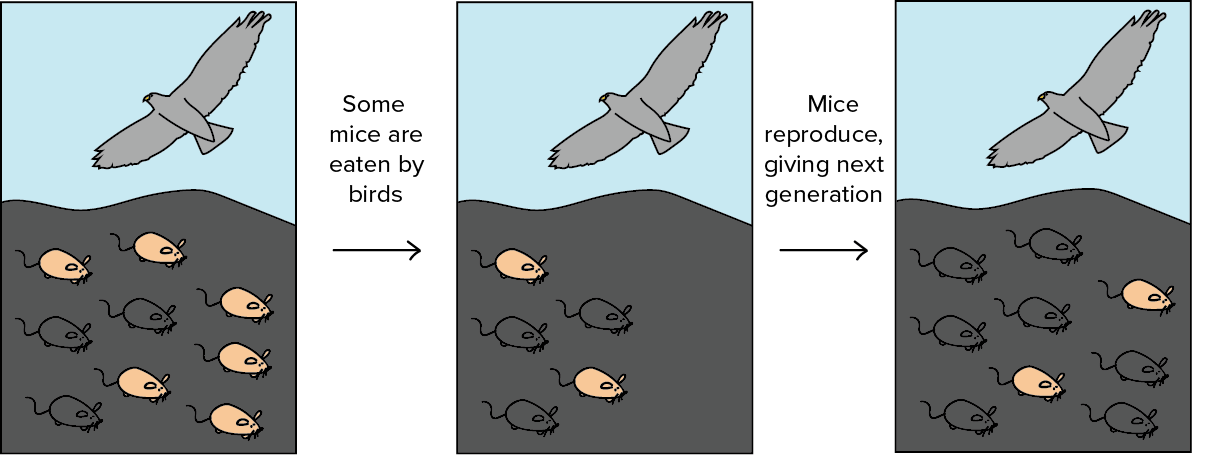
Natural selection
organisms better adapted to their environment tend to survive and produce more offspring
process used by humans to develop new organisms with desirable characteristics
Selective breeding
organisms better adapted to their environment tend to survive and produce more offspring
process used by humans to develop new organisms with desirable characteristics
"Survival of the fittest" describes which theory
Natural selection
Selective breeding

Which is an example of selective breeding?
A giraffe's long neck.
Clipping a horse's tail so it's not too long.
Training a horse to run faster.
Cross breeding a labrador retriever with a poodle .
Which organisms are most likely to survive?
The strongest
The best adapted
The fittest
The most athletic

The long and sharp beak of a woodpecker is an example of
natural selection
selective breeding

Natural selection is where ___________ decides which traits should be passed on.
nature
a human
traits
evolution

Selective breeding is where _____________ decides which traits should be passed on.
nature
a human
traits
evolution
Which statement best describes natural selection?
A lion eating another animal.
A farmer selecting the cows that will breed.
A dog breeder.
A botanist creating a new colored flower.
Which statement best describes selective breeding?
Survival of the fittest.
Evolution.
Breeding for a desired trait.

How can farmers best use selective breeding to increase apple production?
By limiting the number of trees growing so they can have more space.
By choosing trees that are the largest in size.
By increasing the amount of water and fertilizer the trees receive.
By choosing trees that consistently have the most apples.

Over time, honey suckle flowers develop a sweet smell to attract pollinators. This is an example of
selective breeding
extinction
natural selection
evolution
What word describes the process of having the advantageous traits that helps an organism survive and reproduce?
Natural selection
Selective breeding
Selective breeding is where ___________ decides which traits should be passed on
Nature
A human
The organism
The cells
When farmers breed specific plants to produce fruits with specific traits
Natural Selection
Selective Breeding

All these birds are finches but they have developed different beaks due to the type of foods available to them, this is because of
Natural Selection
Selective Breeding

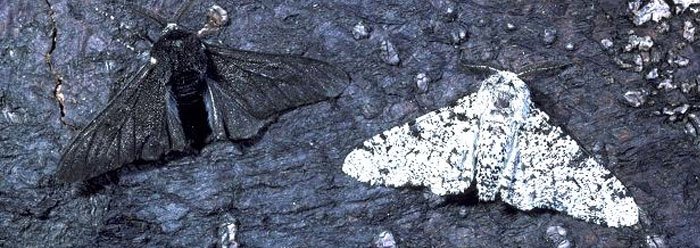
Note: a population is a group of individuals of the same species.

How do biodiversity and stability work together?
The lower the biodiversity the greater the stability of an ecosystem.
The higher the biodiversity, the less stable the ecosystem
The higher the biodiversity, the greater the stability of the ecosystem.
Biodiversity has nothing to do with ecosystem stability.


Which ecosystem is more likely to survive a change in the environment?
One with High biodiversity
One with Low biodiversity

Which shows more biodiversity Image A or Image B. Why?
Image B is more biodiverse, because shows more different species than image A.
Image A is more biodiverse, because shows a greater number of organisms that image B
Both images show the same biodiversity

Which statement best describes an example of high biodiversity?
A pond ecosystem is populated by a single species of frogs
A state park that includes multiple forest and freshwater ecosystems with many different species of fish, birds and frogs in a variety of colors
A desert ecosystem is populated by organ pipe cacti, camels, and armadillo lizards
Why is biodiversity important to ecosystems?
It helps populations adapt to ecological changes.
It increases at each level of the food chain.
One body of water that drains into a larger body of water
A collection of water underground that can be used as a water supply
An area of land that drains into a specific body of water
How do most pollutants get into our watershed?
Factories dump pollution into creeks and rivers
Runoff from heavy rain carries it into creeks and rivers
Oil spills leak into creeks and rivers
Why should we be concerned with runoff water from neighborhood and city streets that goes into storm drains?
It can host alligators and other dangerous animals
It can get into water pipes and flood houses and businesses
It isn't filtered or cleaned and empties directly into creeks
Sediment or dirt
Oil and chemical spills
Overuse of fertilizers
High levels of sediment in the water can be harmful to aquatic plants and animals. Which of these human activities can lead to soil erosion?
Applying fertilizer on lawns and crops
Allowing pet waste to wash into the watershed during rains
Construction sites for new neighborhoods and businesses
It reduces the bacteria and nutrients that get into our water
It keeps the water from getting muddy
It helps the water smell clean
Excess nutrients in the water can be harmful, because they lead to -
High levels of sediment in the water
Pathogenic (disease causing) bacteria in the water
Algae blooms and low oxygen levels in the water
A positive way to improve watershed is
Leave trash in the water ways
Spray fertilizer on the soil
Plant grasses, shrubs, and trees near water
How could liquid pollution on the surface often end up polluting the groundwater deep underground?
It can percolate through the soil and reach the groundwater
Strong winds can blow it into the cracks of rocks
It can enter the water cycle and go into caves

