
 Worksheets
6th Grade Science Semester 1
Total questions: 148
Worksheet time: 2hrs 32mins
What is the process by which rocks and minerals break down into smaller pieces?
weathering
solidification
melting
erosion
Which of the following is an example of physical weathering?
Chemical weathering
Freeze-thaw weathering
Biological weathering
Erosion
What is the process by which weathered rock and soil are moved from one place to another?
erosion
deposition
weathering
sedimentation
Which of the following is an example of chemical weathering?
Erosion of a riverbank
Reaction of limestone with acid rain
Formation of a sand dune
Melting of a glacier
What is the process by which eroded materials are dropped off in a new location?
erosion
deposition
weathering
transportation
Which of the following is an example of erosion?
Wind blowing sand dunes
Tree growing taller
River carving out a canyon
Volcano erupting
What is the process by which eroded materials are transported from one place to another?
weathering
deposition
sedimentation
erosion
Which of the following is an example of both weathering and erosion?
Water wearing away at a rock
A river carving a canyon
Wind blowing sand dunes
A volcano erupting
What is the main agent of erosion?
gravity
wind
water
plants
Which of the following is an example of deposition?
Water vapor turning into frost
Water vapor turning into steam
Water vapor turning into clouds
Water vapor turning into rain
Earth's atmosphere is made up mostly of which elements? (6.5B)
Carbon dioxide and oxygen
nitrogen and helium
helium and carbon dioxide
nitrogen and oxygen

The process by which rocks are broken down
Weathering
Deposition
Erosion
Sedimentation
The process by which rocks are broken down
Weathering
Deposition
Erosion
Sedimentation

The process in which wind, water, ice or gravity transport rock fragments from one location to another
Weathering
Sedimentation
Erosion
Deposition

The process in which sediment settles out (drops to the bottom) of the water or wind that is carrying it
Weathering
Erosion
Sedimentation
Deposition

Fragments of weathered rocks are known as ____.
sediments
deposits
limestones
sandstones

The MECHANICAL breaking down of rocks into smaller pieces is...
Physical weathering
Chemical weathering

The breakdown and decomposition of rocks as a result of chemical reactions and processes
Physical weathering
Chemical weathering

Water gradually wearing down and smoothing rocks over a long period of time is an example of...
physical weathering
chemical weathering
deposition
erosion

When iron in rocks reacts with oxygen, it forms iron oxide (rust), which weakens rocks and causes them to break apart. This is an example of...
physical weathering
chemical weathering
erosion
deposition

Rain washing away soil from a hillside is an example of...
physical weathering
erosion
deposition
chemical weathering

Waves dropping sand onto land until a beach is formed is an example of...
physical weathering
erosion
deposition
chemical weathering

Acid rain slowly wearing away rock over time is an example of...
chemical weathering
physical weathering
erosion
deposition

Water getting into cracks, freezing, and breaking rocks or pavement apart is an example of...
chemical weathering
physical weathering
deposition
erosion

An avalanche is an example of...
physical weathering
chemical weathering
erosion
deposition

Over long periods of time, deposition may change the Earth's surface by...
forming new land features.
washing away beaches.
breaking down large rocks in to smaller ones.
moving topsoil.

What causes the greatest amount of erosion on beaches?
Waves
Glaciers
Wind
Gravity

Muddy water being carried away by a fast-moving river is an example of...
physical weathering
chemical weathering
erosion
deposition

What is an enormous mass of ice moving over land, causing weathering of rock and soil?
A glacier
An iceberg
An ice wedge
A sand dune

How do plants weather rocks?
During photosynthesis
When the plant moves water from the roots to the leaves, the rock breaks
When roots grow into cracks of rocks and expand, the rock breaks
Plants don't weather rocks

A river wearing down canyon walls over time is an example of...
physical weathering
chemical weathering
deposition
erosion

Wind blowing sand from one location to another is called...
erosion
physical weathering
chemical weathering
deposition
Large area of flat grasslands
Plain
River
Ocean
Valley
Large area of a sea or ocean partially enclosed by land.
River
Mountain
Volcano
Gulf
Vast body of salt water.
Ocean
Lake
Valley
Mountain
Land rising high above the land around it.
Valley
Mountain
Lake
Valley
Land surrounded completely by water.
Gulf
Island
Volcano
Plain
A piece of land surrounded by water on all but one side.
valley
Ocean
Peninsula
lake
Earth with opening that spills lava, rock, and gases.
Volcano
Mountain
Lake
valley
Large inland body of water
Volcano
Plain
Ocean
Lake
Lowland between hills or mountains
Ocean
Valley
River
Gulf
Which one of the following does NOT describe weather?
the force of the wind through the trees
if it is raining or not
the amount of water pollution in a lake
the number of clouds there are in the sky
Which of the following best describes the difference between weather and climate?
Weather happens in your state, and climate happens in your country.
Weather includes the wind and rainfall, whereas climate only describes the temperature.
Weather can be predicted but climate cannot.
Weather describes conditions such as wind and rain at a particular time, whereas climate describes typical seasonal conditions.
What is the main cause of deepwater ocean currents?
freshwater rivers and streams flowing into the ocean.
wind, caused by variations in air pressure, blowing on water.
differences in water density because of variations in water temperature and salt concentration.
the Coriolis effect: Earth's rotation causing the water in the oceans to move.
What substances make up most of the atmosphere?
nothing except sometimes clouds
gases such as nitrogen, oxygen, argon, and water vapor
tiny particles of pollution from cars and other machines
greenhouse gases such as carbon dioxide and methane
Which one of the following statements about Earth's atmosphere is TRUE?
The temperature in the atmosphere increases as it gets closer to the Sun.
The air pressure increases as you go up in the atmosphere.
The atmosphere has different temperatures and pressures at different altitudes.
The atmosphere has the same temperature and pressure at all altitudes.
Which one of the following factors does NOT influence climate?
ocean currents
the Sun's energy
global wind patterns
soil composition
Most of the water on Earth is found in which of the following locations?
oceans
the atmosphere
groundwater
lakes and rivers
Which of the following is a major factor in Earth's current global warming?
stronger hurricanes
burning of fossil fuels
increase in volcanic activity
increase in Sun's brightness
If you start at the equator and head north, on average the climates will get
drier
cooler
wetter
warmer
Approximately what percentage of Earth's surface is covered with water?
30%
50%
70%
90%
What type of instrument is used to measure wind speed?
wind vane
speedometer
the Beaufort scale
anemometer
Your friend argues that underwater volcanic activity is the main cause of increased ocean temperatures over the past 100 years. Which of the following is the best way to evaluate your friend's argument?
Plan and conduct an investigation to test your friend's claim.
Ask your friend questions to identify which supporting evidence they have.
Build a model to generate data on your friend's claim.
Agree with your friend because underwater volcanic activity would generate thermal energy, which would cause the temperature of the oceans to rise.
Which of the following scientists studies the distribution and movement of Earth's water?
climatologist
hydrologist
meteorologist
atmospheric scientist
How do ocean currents affect climates around the world? (Select all that apply)
Ocean water moves in currents that transfers energy, which can affect climates.
Oceans regulate the temperatures of coastal regions, keeping the regions mild.
Ocean water heats and cools much more quickly than land temperatures do.
The oceans store large amounts of thermal energy and move that energy around Earth in large ocean currents.

Which location has the driest climate?
Location A
Location B
Location C
Location D

Use the table to answer which location has the wettest climate?
Location A
Location B
Location C
Location D

Use the table to answer the question. Each location has an average annual temperature above 18ºC (64ºF). Which location is most likely to have a tropical climate?
Location A
Location B
Location C
Location D
Which one of the following are not used to measure or describe the weather?
Temperature
Wind Direction and Speed
Mountain
Precipitation

Water in its gas form is called ____________________,
water vapor
precipitation
ice
air
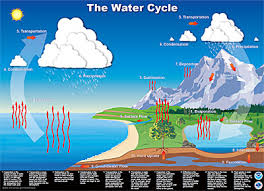
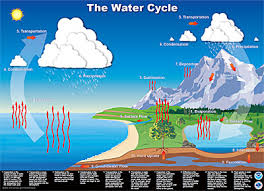


Gravity causes ___________________ to occur.
condensation
precipitation
evaporation
none of the above
This provides the power to keep the water cycle running.
The Sun
The Earth
The wind
living things
Which example is a form of precipitation?
Dew
Fog
Frost
Hail
Rain and snow are two different forms of precipitation that fall on Earth's surface. Which factor is responsible for there being different forms of precipitation?
Evaporation
Run-off
Temperature
Transpiration
Groundwater moves from a lower elevation to a higher elevation.
true
false
Aquifers are __________.
not a part of the water cycle
underground water
caused by evaporation
none of the above
What causes condensation?
is not part of the water cycle
water vapor does not change and becomes a liquid
water vapor heats up and becomes a liquid
water vapor cools and becomes a liquid

What is wind?
The movement of water due to pressure differences
The movement of air due to pressure differences.
The movement of air due to pollution differences
The movement of water deep in the ocean

Air moves from areas of _____ pressure to areas of ____ pressure.
high, low
low, high

Cold air is _______ dense than warm air.
more
less
the same as

Warm air is _____ dense than cold air.
more
less
the same as

Warm air _______ and cold air _______.
sinks, rises
rises, sinks

Winds move in a curved pattern called
Tradewinds
The doldrums
The Coriolis Effect
Easterlies

Winds that blow steadily from specific directions over long distances are called
Sea breezes
Land breezes
Jet streams
Global Winds
Three types of global winds are:
Tradewinds
Sea Breezes
Polar Easterlies
Prevailing Westerlies
Land breezes

Winds that blow over short distances are called
Local winds
Global winds
Doldrums
Coriolis Effect

A narrow belt of high speed winds that blow from west to east, between 7 km and 16 km above Earth’s surface is called
a jet stream
the doldrums
the Coriolis effect
global winds

Which absorbs heat the fastest?
Land
Water

Continental air masses are located above
land
water

Maritime air masses are located above
land
water

Polar air masses are
hot
cold
medium temperature
Tropical air masses are
hot
cold
medium tempertaure

Weather events (clouds, rain, storms) occur along the edges of air masses at boundaries called
Coriolis effect
fronts
sea breezes
jet streams

Surface ocean currents are caused by
water temperature
water density
salinty
Global winds

Deep ocean currents are driven by
global winds
salinity
water temperature
the Coriolis effect
An _________ is a large body of air that travels in one direction due to pressure.
Front
Air mass
Ocean current
Global winds don’t blow in straight north/south lines, due to....
Atmosphere
Clouds
Coriolis Force
None of the above
What is the main cause of the Coriolis Effect?
Temperature
Trade Winds
Earth’s Rotation
The Sun and Ocean
What does the Coriolis Effect impact?
Wind Speed
Wind Direction
Small Scale Objects
Bodies of Water
What does the Coriolis Effect help to directly develop in circular motion?
Tornadoes
Thunderstorms
Hurricanes
Floods
A polar air mass will have what kind of air in it?
Warm
Cold
Humid
Dry
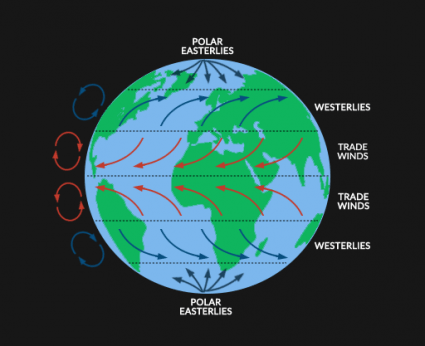
what is the coriolis effect?
change in location of warm and cold surface water every 2-7 years
tendency of objects moving large distances on Earth’s surface to bend to the right in the northern hemisphere & to the left in the southern hemisphere
winds in northern Indian ocean that blow from the southwest in the summer & from the northeast in winter
two layers of horizontal winds moving in opposite directions

Using one or more senses to gather information is called ...
hypothesis
observation
conclusion
problem

An educated prediction that can be tested is a/an
theory
hypothesis
problem
conclusion

Which of the following is an example of data?
measurements
conclusion
theories
materials

Observations that deal with a number or amount are called
manipulated observations
quantitative observations
qualitative observations
operational observations

The rock has bands of black, white and grey is an example of this type of observation.
manipulated observations
quantitative observation
qualitative observation
operational observation

The statement that correctly lists the steps of the scientific method in order is ______
ask a question- research-conclusion-form hypothesis
form hypothesis- ask a question- gather and analyze data- share
design experiment- research-ask a question
form hypothesis- design experiment- gather and analyze data- conclusion

The steps commonly used by scientists in gathering information to test hypotheses and solve problems are called _____.
descriptive research
pure science
applied science
scientific method

In a scientific experiment, the one variable that is changed by the scientist to test a hypothesis is called the _________________________ variable.
dependent
independent
controlled
problem

The _________________________ is the base metric unit of liquid volume.
liter
meter
gram
pound

For ease of understanding, scientists report measurements using the ______________ system.
dependent
science
English
SI or metric

A _________________________ is a visual display of information or data.
line
gram
graph
circle
A ________________ graph is used to show trends in data over time.
line
circle
bar
graph

____________ is the prefix meaning 1000.
milli-
kilo-
mega-
centi-

A process that uses observation and experimentation to gain knowledge about events in nature is _________________________.
gram
scientific method
experiment
science

Which prefix means hundredth?
milli-
deci-
centi-
hecto-

What type of data does the picture represent?
qualitative
quantitative
counting
scientific

What is the name of this piece of equipment?
beaker
graduated cylinder
test tube
flask

What is this piece of equiment used for?
measuring mass
measuring volume
holding liquids
mixing liquids
Mass is measured in
liters
grams
centimeters
pounds
It is safe to taste any substance to correctly identify it.
true
false

According to the circle graph, what is the favorite pizza topping?
cheese
supreme
sausage
pepperoni

According to the graph, what is the nicest fruit?
blueberry
apple
orange
banana

What was the highest temperature reached?
40F
30F
50F
60F
What variable goes on the x-axis?
independent
dependent
variable
control
You do not have to wear safety glasses when working with chemicals.
true
false
Which of these best describes an experiment?
mathematical analysis of data
observation of animals in their natural world
collection of data from an uncontrolled environment for comparative purposes
procedure with controlled conditions and test and outcome variables
Which piece of equipment are used to measure length?
balance
ruler
graduated cylinder
thermometer
Which property of vinegar can you observe through sense alone?
has a sour, acidic taste
has a pH greater than that of pure water
has a density greater than that of pure water
conducts an electrical current when dissolved in water
Identifying the Test (Independent) Variable and Outcome (Dependent) Variable in an experiment will help you interpret results. What is the difference between the Test (Independent) and the Outcome (Dependent) Variable in an experiment?
Test Variable changes due to the outcome variable, the Outcome Variable is what is measured in an experiment.
Test Variable changes due to the outcome variable, the Outcome Variable is what stays the same in an experiment.
The Test Variable is what we change in an experiment, and the Outcome Variable is what changes as a result of that change.
The Test Variable is what is measured in an experiment, and the Outcome Variable is what changes as a result of that change.
dependent
control
constant
independent
What are the steps of the Scientific Method?
Make observation & Ask question, Make Hypothesis, Analyze Results or data, Test Hypothesis, Draw Conclusion
Make observation & Ask question, Make Hypothesis, Test Hypothesis, Analyze Data, Draw Conclusion and Communicate Results
Make observation & Ask question, Communicate Results, Make Hypothesis, Analyze Results or data, Test Hypothesis, Draw Conclusion
Communicate Results, Make observation & Ask question, Make Hypothesis, Analyze Results or data, Test Hypothesis, Draw Conclusion
Anything that may affect the results of an experiment
This variable in an experiment is the one being deliberately changed by the scientist. It is the only variable that is different between groups.
conclusion
A diagram showing the relationship between variables
independent variable
constant
hypothesis
graph
An arrangement of data in rows and columns representing the variables
data table
constant
hypothesis
graph
The measurable effect of the experiment; the data collected
data table
constant
dependent variable
graph
A test of performance; the number of times repeated/tested
data table
trial
dependent variable
graph
A logical interpretation based on prior knowledge and experience
data table
trial
dependent variable
inference
In an experiment, the group that is not exposed to the treatment
control group
trial
dependent variable
inference

