wayground logo

Free Printable Worksheets

Font size

S
M
L
XL
Worksheets

2nd semester final review

Total questions: 144

Worksheet time: 2hrs 29mins
Name
Class
Date
1.
Deep Ocean currents are a result of
a)
Global Wind Patterns
b)
Earth's Rotation
c)
Density
d)
All of the above
2.
The Coriolis Effect is caused by
a)
Earth rotating around the sun
b)
Earth rotating on its axis
c)
The tides
d)
Gravity
3.
What happens to a current when it comes in contact with a continent or landmass?
a)
It continues over the continent
b)
It stops
c)
It changes direction
d)
It is absorbed by the land
4.
Due to the Coriolis Effect, water in the northern hemisphere moves
a)
clockwise
b)
counter clockwise
c)
both
d)
neither
5.
Due to the Coriolis Effect, water in the southern hemisphere moves
a)
clockwise
b)
counter-clockwise
c)
both
d)
neither
6.
Warm ocean currents generally come from
a)
The North Pole
b)
The South Pole
c)
The Equator
d)
Both A and B
7.
What process brings the deep cold ocean currents up to the surface?
a)
Conduction
b)
Global Wind Patterns
c)
Convection Currents
d)
Temperature and salinity
8.
Surface currents are a result of
a)
Global Wind Patterns
b)
Earth's Rotation
c)
Density
d)
All of the above
9.
As you go deeper in the ocean, the water is colder and less salty.
a)
True
b)
False
10.
Which best represents the order of seafloor features as you move from the shoreline to the deep ocean?
a)
 Continental slope – continental shelf- continental rise – mid-ocean ridge
b)
 Continental rise – continental shelf – mid-ocean ridge -  continental slope
c)
 Continental shelf – continental slope – continental rise – mid-ocean ridge
d)
   Mid-ocean ridge – continental rise – continental shelf- continental slope
11.
The Maraina __________ is the deepest known place on Earth
a)
Volcanoe
b)
Seamount
c)
Ridge
d)
Trench
12.
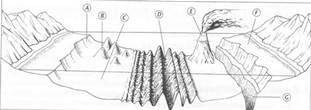
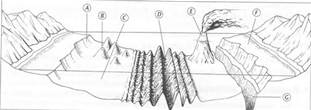
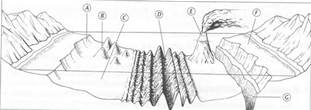
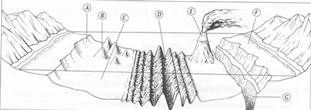
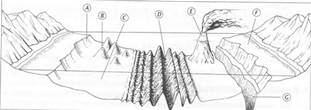
What is letter D?
a)
Cont. Shelf
b)
Mid-Ocean Ridge
c)
Volcanic Island
d)
Seamount
13.
What is letter E?
a)
Volcanic Island
b)
Seamount
c)
Mid-Ocean Ridge
d)
Abyssal Plain
14.
What is letter G?
a)
Mid-Ocean Ridge
b)
Rift
c)
Trench
d)
Cont. Shelf
15.
Rift is similiar to ...
a)
A hole
b)
A divide
c)
A valley
d)
A trench
16.
The continental slope is located at the end of the...
a)
shoreline
b)
continental shelf
c)
mid ocean ridge
d)
abyssal plain
17.
The place where new ocean floor forms is called the...
a)
mid ocean ridge
b)
abyssal plain
c)
trench
d)
continental shelf
18.
The shallowest(least deep) part of the ocean is the ____________________
a)
trench
b)
abyssal plain
c)
continental shelf
d)
continental slope
19.
the deepest part of the ocean
a)
trenches
b)
abyssal plain
c)
ocean basin
d)
rift
20.
Which process adds more crust to the ocean floor?
a)
earthquakes
b)
sea floor spreading 
c)
subduction
d)
convection
21.
What is the difference between a volcanic island & a seamount?
a)
A volcanic island rises above the water & a seamount does not
b)
A seamount rises above the water & a volcanic island does not
c)
Both the seamount & volcanic island are underwater
d)
Both the seamount & the volcanic island rise above the water
22.
What is letter A?
a)
Cont. Shelf
b)
Cont. Slope
c)
Seamount
d)
Abyssal Plain
23.
What is letter C?
a)
Mid-Ocean Ridge
b)
Cont. Shelf
c)
Cont. Slope
d)
Abyssal Plain
24.
What letter is B?
a)
Cont. Shelf
b)
Cont. Slope
c)
Mid-Ocean Ridge
d)
Seamount
25.
define a wave
a)
ocean movement
b)
currents
c)
tides
d)
a rhythmic movement that carries energy
26.
what causes tides
a)
moon
b)
wind
c)
earthquakes
d)
people
27.
what causes currents
a)
wind and Salinity 
b)
moon
c)
sun
d)
ocean animals
28.
what causes wave
a)
sun
b)
moon
c)
tides
d)
wind
29.
which factor does not influence wave height
a)
speed of the wind
b)
distance over which the wind blows
c)
length of time the wind blows
d)
the amount of wind blowing
30.
surface currents move water
a)
vertically
b)
horizontally
31.
surface currents are powered by
a)
water
b)
salt
c)
sea animals
d)
wind
32.
the rotation of the earth causes
a)
coriolis effect
b)
tides
c)
earthquakes
33.
when density increases temperature
a)
increases
b)
decreases
c)
stays the same
34.
as temperature increases density
a)
decrease
b)
increases
c)
stays the same
35.
as salinity increase desity
a)
increases
b)
decreases
c)
stays the same
36.
deep ocean currents are caused by 
a)
wind
b)
waves
c)
salinity
d)
animals
37.
A[n] ______________ tide occurs when the sun is at right angles to the line between Earth and the moon. 
a)
high
b)
neap
c)
low
d)
spring
38.
Differences in the moon's and sun's pull on different sides of the Earth cause _________.
a)
gravity
b)
lunar phases
c)
tides
d)
dabbing
39.
How many low tides and high tides happen in a day?
a)
1 low tide, 1 high tide
b)
4 low tides, 4 high tides
c)
3 low tides, 3 high tides
d)
2 low tides, 2 high tides
40.
The bulge of water on the side of the Earth closest to the moon produces ___________.
a)
high tide
b)
low tide
c)
neap tide
d)
spring tide
41.
A[n] ___________ tide occurs when the sun, Earth, and the moon are nearly in a line. 
a)
spring
b)
high
c)
low
d)
neap
42.
You visited the beach at 12 pm (noon) and it is high tide. If you return 6 hours later what tide will you see? 
a)
high 
b)
low 
c)
none
d)
spring 
43.
What part of the water cycle does this picture show?
a)
condensation
b)
precipitation
c)
evaporation
44.
Which of these is an example of precipitation?
a)
snow
b)
air
c)
clouds
d)
vapor
45.
Which is the opposite of condensation?
a)
runoff
b)
evaporation
c)
precipitation
d)
transpiration
46.
Which best explains why runoff is important?
a)
It returns water to other locations on Earth
b)
It increases the chance of flooding
c)
It makes evaporation occur faster
d)
It increases condensation
47.
Snow, sleet, hail, and rain are all examples of  ________________. 
a)
evaporation
b)
condensation
c)
accumulation
d)
precipitation
48.
Does evaporation happen before or after condensation?
a)
before
b)
after
c)
during
49.
What is it called when WATER is FORMED from an LIQUID to a WATER VAPOR Oor an [GAS]?
a)
EVAPORATION
b)
PRECIPITATION
c)
TRANSPIRATION
50.
What is the next stage after EVAPORATION in the water cycle?
a)
CONDENSTATION
b)
GROUNDWATER
51.
What does groundwater do?
a)
It sends water to our buildings, houses, and water transplant places
b)
to the sky
c)
to the sun
d)
To the Earth's surfaces
52.
What does groundwater do?
a)
It sends water to our buildings, houses, and water transplant places
b)
to the sky
c)
to the sun
d)
To the Earth's surfaces
53.
After the rain falls down onto Earth's surface, what most likely happens? What is it called?
a)
1. The remains of the water is soaked into the ground.
2.Groundwater
b)
1. Groundwater
2. The remains of the water is soaked into the ground.
c)
1. Groundwater
2. Transpiration happens to the plants.
d)
1. The liquid turns into an gas or an water vapor
2. Evaporation
54.

During the daytime, the land warms up faster than water causing the air above the land

a)

Sea breeze

b)

Land breeze

55.

What is the transfer of energy by circulation or movement of gas called?

a)

thermal conduction

b)

radiation

c)

convection current

d)

convection

56.

What type of heat transfer travels through empty space?

a)

convection

b)

radiation

c)

conduction

d)

thermal conduction

57.

What is the transfer of heat through direct contact?

a)

conduction

b)

convection

c)

radiation

58.

A gradual increase in average temperatures around the world...

a)

Greenhouse Effect

b)

Global Warming

c)

Radiation

d)

Convection

59.

Why are sea breezes felt during the day and land breezes at night?

a)

The land heats and cools faster than the water, causing a land breeze at night and a sea breeze during the day.

b)

The land heats and cools faster than the water, causing a land breeze during the day and a sea breeze at night.

c)

The water heats and cools faster than the land, causing a land breeze during the day and a sea breeze at night.

d)

The water heats and cools faster than the land, causing a land breeze at night and a sea breeze during the day.

60.
Why is it warmer in the summer?
a)
Closer to the sun
b)
More direct light from Earth's tilt
c)
Stronger light from the sun
d)
Earth spins slower
61.
Why is the Equator warmest?
a)
Because it is closest to the sun.
b)
Because it receives the most direct sunlight
c)
Because no clouds form here.
d)
Because it is far from the sun
62.
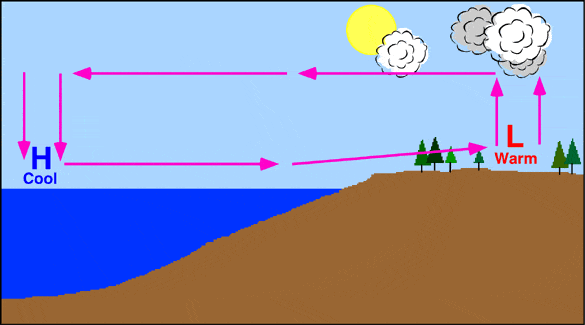
Is this a land or a sea breeze?
a)
land breeze
b)
sea breeze
63.
Which cools off faster at night?
a)
Sea
b)
Land
64.
This is the symbol for which type of front?
a)
cold front
b)
warm front
c)
occluded front
d)
stationary front
65.
This is the symbol for which type of front?
a)
cold front
b)
warm front
c)
stationary front
d)
occluded front
66.
Which system results in rainy or stormy weather?
a)
high pressure
b)
low pressure
c)
hurricane
d)
weather system
67.
what is an air mass?
a)
a large body of air that is made of the same temperature and moisuture
b)
when two air masses meet 
68.
Which type of weather is associated with a cold front?
a)
heavy rain, snow, thunderstorms, and snow for short periods of time 
b)
Steady, light rain or snow can occur for longer periods of time 
69.

forms when a warm air mass is caught between two colder air masses (brings cool temperatures and large amounts of rain and snow)

a)

occluded front

b)

stationary front

c)

warm front

d)

cold front

70.
What kind of breeze is this & what time of day/night would it form?
a)
Land breeze - daytime
b)
Land breeze - nighttime
c)
Sea breeze - daytime
d)
Sea breeze - nighttime
71.

What is one example of how humans impact global warming??

a)

Burning coal increase the level of carbon dioxide

b)

Plowing and increasing the level of rain water on farms

c)

Heat from factories increases the average global temperature

d)

Using copper increases the speed in electric currents

72.

What are the two most common gases in the atmosphere?

a)

Nitrogen and oxygen

b)

Oxygen and carbon dioxide

c)

Carbon Dioxide and methane

d)

Nitrogen and carbon dioxide

73.
What does the earth's atmosphere do?
a)
help to regulate the temperature on Earth
b)
Help UV rays to reach the Earth's surface
c)
Creates meteors in the sky
d)
Keep ocean waters cold
74.
What happens to the air pressure the higher up in space you go?
a)
the air pressure increases
b)
the air pressure decreases
c)
the air pressure stays the same
d)
there is no air pressure
75.
Why are some layers warmer than others?
a)
they get hotter the higher up you go
b)
some layers contain gases that can absorb the sun's energy
c)
some layers closer to the sun are hotter
d)
there is no wind in the upper atmosphere
76.
Where weather occurs.
a)
stratosphere
b)
thermosphere
c)
troposphere
d)
mesosphere
77.

Which order is correct from the earth to space?

a)

thermosphere

troposphere

exosphere

mesosphere

stratosphere

b)

thermosphere

troposphere

stratosphere

exosphere

mesosphere

c)

exosphere

thermosphere

mesosphere

stratosphere

troposphere

d)

troposphere

thermosphere

troposphere

stratosphere

exosphere

mesosphere

78.
An example of uneven heating of Earth's surface can be the heating and cooling of the same volumes of water and soil.  If exposed to the same light source for a period of time and then placed in shade  for another period of time, which will show the fastest rate of heating and cooling?
a)
water
b)
soil
c)
neither, they heat and cool at the same rate
d)
non of the above
79.

An atmospheric layer of a specific gas provides shielding from harmful ultraviolet light from the Sun, allowing life to thrive on Earth. What gas makes up this layer?

a)

H2O

b)

CO2

c)

N2

d)

O3

80.

Q) How do scientist divide up the different layers of the atmosphere?

a)

The change in temperature from one layer to the next.

b)

The change in humidity

c)

The change in air pressure

d)

The distance from Earth

81.
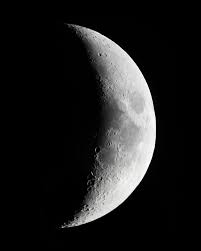
Name the moon phase
a)
full moon
b)
waxing crescent
c)
waning gibbous
d)
waxing gibbous
82.
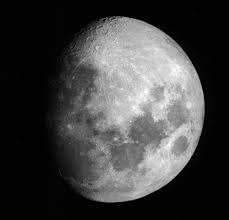
Name the moon phase
a)
waning crescent
b)
waxing crescent
c)
last quarter
d)
waxing gibbous
83.
Name the moon phase
a)
waning crescent
b)
first quarter
c)
waning gibbous
d)
waxing gibbous
84.
What is the difference between a gibbous moon and a crescent moon?
a)
The gibbous shows more than half of the bright side of the moon.
b)
The crescent shows more than half of the bright side of the moon.
c)
The gibbous shows less than half of the bright side of the moon. 
d)
There is no difference
85.
How many phases does the moon go through?
a)
4
b)
8
c)
10
d)
16
86.
The moon ____________ around the Earth.
a)
orbits
b)
rotates
c)
up
d)
down
87.
CHALLENGE
When the moon is lined up exactly between the sun and Earth, it is called a ______ ______. 
a)
Solar Eclipse
b)
Lunar Eclipse
88.
ROTATE vs REVOLVE
What causes the seasons? 
a)
The Earth spinning or rotating
b)
The Earth revolving around the Sun on its tilted axis.
89.
How much of the moon is always lit?
a)
All of it
b)
1/2
c)
1/4
d)
3/4
90.
Name the phase of the moon for letter a
a)
First Quarter
b)
Last Quarter
c)
Waxing Gibbous
d)
Waning Gibbous
91.
Name the phase of the moon for letter f
a)
Waning Gibbous
b)
Waxing Gibbous
c)
Waning Crescent
d)
Waxing Crescent
92.
Which side of the moon is visible if it is in a waxing phase?
a)
Right
b)
Left
93.
Which side of the moon is visible if it is in a waning phase?
a)
Right
b)
Left
c)
Huh
94.
During the phases of the Moon, the Moon appears to change shape.  This change in appearance is due to the Moon...
a)
physically changing size and shape.
b)
moving closer and then farther away from Earth.
c)
reflecting a different amount of light due to alignment with Earth and the Sun.
d)
having craters on its surface.
95.
About how long does it take the moon to make one complete cycle around the earth?
a)
65 days
b)
8 days
c)
365 days
d)
28 days
96.

What moon phase is at position 1?

a)

new moon

b)

full moon

c)

gibbous moon

d)

crescent moon

97.
darkest, innermost part of the shadow
a)
penumbra
b)
umbra
98.
lighter, outer part of the shadow
a)
penumbra
b)
umbra
99.
What does the rotation of the earth cause us to experience?
a)
seasons
b)
year
c)
day & night
d)
eclipse
100.
What is the longest day of the year?
a)
winter solstice
b)
summer solstice
c)
fall equinox
d)
spring equinox
101.
When are the equinoxes?
a)
June & December
b)
July & January
c)
April & October
d)
March & September
102.
Equinox means - 
a)
Equal light
b)
Longest day
c)
Shortest day
d)
Tilt
103.
Earth's axis is tilted at - 
a)
23.5 degrees
b)
33.5 degrees
c)
28 degrees
d)
90 degrees
104.
What happens when the area in which you live tilts away from the sun?
a)
It is summer.
b)
It is spring.
c)
It is winter.
d)
It is fall.
105.
What season is letter A in the northern hemisphere?
a)
Winter
b)
Summer
c)
Spring
d)
Fall
106.
In winter, the axis of the earth is pointed away or toward the sun?
a)
towards
b)
up
c)
down
d)
away
107.
What is the term for Earth being in the center?
a)
geocentric
b)
heliocentric
c)
sun centered
d)
Galileo
108.
The ancient Greek who proposed a geocentric model of the universe is
a)
Ptolomy
b)
Galileo
c)
Copernicus
d)
Kepler
109.
When Galileo peered into the telescope and saw that Venus went through phases, what did this suggest?
a)
The telescope must possibly be wrong.
b)
Venus had a moon orbiting it.
c)
Venus must be orbiting the Sun.
d)
Venus had moons just like Earth.
110.
Whose heliocentric model is seen as the first step in the development of the modern models of the solar system?
a)
Galileo
b)
Copernicus
c)
Ptolemy
d)
Kepler
111.
A model of the solar system in which Earth and the other planets revolve around the SUN.
a)
Heliocentric
b)
Geocentric
112.
A model of the universe in which Earth is at the center of the revolving planets and stars. This includes the sun revolving around the Earth. This model is no longer supported.
a)
Geocentric
b)
Heliocentric
113.
The Word "Helio" Refers To?
a)
Earth
b)
Mars
c)
Sun
d)
Juputer
114.
The Word "Geo" Means?
a)
Sun
b)
Earth
c)
Milky way
d)
Back
115.
As mass increases gravity __________.
a)
Decreases
b)
Increases
c)
Stays the same
116.
As distance increases, gravity __________.
a)
Decreases
b)
Increases
c)
Stays the same
117.

How can ellipses be described?

a)

Circles

b)

Wheels on wheels

c)

Ovals

d)

slow lines

118.
Which of the following is best shown in the picture?
a)
Earth's revolution
b)
A month on Earth
c)
A year on Earth
d)
Earth's rotation
119.
Day and night are caused by _______________.
a)
Earth's rotation
b)
Earth's revolution
c)
Moon's revolution
d)
Moon's rotation
120.
Earth revolves around ________, because it has the __________ in the solar system.
a)
the moon; most gravitational force
b)
the sun; least gravitational force
c)
Jupiter; most gravitational
d)
the sun; most gravitational force
121.
List the following items from smallest to largest.
a)
universe, solar system, galaxy
b)
galaxy, solar system, universe
c)
solar system, galaxy, universe
d)
solar system, universe, galaxy
122.

Which statement is true?

a)

The galaxies are moving toward us.

b)

The galaxies are moving away from us.

c)

The universe remains static or unchanged in motion.

d)

None of the above

123.

Which elements are most

abundant in the visible

universe?

a)

Hydrogen and Carbon

b)

Carbon and Helium

c)

Hydrogen and Oxygen

d)

Hydrogen and Helium

124.

Which description is considered most accurate regarding what actually happened during the Big Bang?

a)

Two galaxies collided causing an immense explosion as stars crashed into one another

b)

All of what would become the universe was concentrated in a single small point, or singularity, which rapidly expanded into what is now stars, planets, galaxies, matter, and energy.

c)

All matter emerged from a massive black hole at the center of the universe.

d)

Parts of the sun were ripped off by massive internal explosions and were thrown into space where they cooled to become other things, like plants, comets, and other galaxies.


125.
What is the difference between the inner planets and the outer planets?
a)
The outer planets are smaller than the inner planets 
b)
The inner planets are smaller than the outer planets
c)
The outer planets have more rocks than the inner planets
d)
the inner planets are heavier than  the outer planets
126.
Venus is called Earth's twin because they are about the same size
a)
True 
b)
False
127.
The inner planets are called terrestrial planets because they are composed of
a)
water
b)
gas
c)
frozen surfaces
d)
rocks
128.
One factor that makes life possible on Earth is
a)
an atmospher
b)
water
c)
greenhouse effect
d)
gravity
129.
Which planet is tipped on its side nearly 90 degrees?
a)
Jupiter
b)
Saturn
c)
Uranus
d)
Neptune
130.
Which planet has a giant red spot?
a)
Jupiter
b)
Saturn
c)
Uranus
d)
Neptune
131.
Which planet has very prominent rings?
a)
Jupiter
b)
Saturn
c)
Uranus
d)
Neptune
132.
Which planet is the hottest planet because of its clouds?
a)
Venus
b)
Earth
c)
Mars
d)
Pluto
133.
What celestial body is made of ice and cosmic dust?
a)
Meteor
b)
Meteoroid
c)
Asteroid
d)
Comet
134.
Where is our solar system located in the Milky Way
a)
At the center
b)
Near the center
c)
On a spiral arm
d)
Outside the galaxy
135.
Put the planets in order from the sun.
a)
Mercury, Venus, Mars Earth, Jupiter, Saturn, Uranus, Neptune, Pluto
b)
Mercury, Venus, Earth, Mars, Jupiter, Sarturn, Neptune, Uranus, Pluto
c)
Mercury, Venus, Earth, Mars, Jupiter, Sarturn,  Uranus, Neptune,Pluto
d)
Mercury, Venus, Earth, Mars, Sarturn, Jupiter, Neptune, Uranus, Pluto
136.
What is an astronomical unit?
a)
distance between the moon and earth
b)
distance between the earth and pluto
c)
distance between the earth and sun
d)
distance between NJ and Cali
137.
What keeps a planet moving on its path around the sun
a)
gravity & inertia
b)
heat & pressure
c)
inertia & pressure
d)
gravity & heat
138.
The closer a planet is to the sun...
a)
the faster it travels
b)
the slower it travels
139.
Which statement best describes a galaxy?
a)
a cluster of millions of stars held together by gravity
b)
a star, with planets, moons and other small space bodies revolving around it
c)
all known objects
d)
all of the above
140.
Which movement creates day/night?
a)
rotation
b)
revolution
141.
What is located between the inner and outer planets.
a)
Sun
b)
Asteroid belt
c)
Uranus
d)
Moons
142.
How does the distance between two objects affect the force of gravity?
a)
The closer the two objects are the more gravitational force they have.
b)
The farther apart the two objects are the more gravitational force they have.
c)
The closer the two objects are the less gravitational force they have.
143.
Which of the following is a common characteristic of outer planets?
a)
have rings
b)
shorter years
c)
terrestrial
d)
less than 5 satellites
144.
The idea that an object in motion will stay in motion unless acted upon is known as
a)
gravity
b)
inertia
c)
pressure
d)
heat