
 Worksheets
Q1 Science Benchmark Review SOL 6.1, 6.5, 6.6, & 6.8
Total questions: 144
Worksheet time: 2hrs 36mins
Which question would you ask yourself during the ASK step of the Engineering Design Process?
What are some possible solutions to your problem?
What is the problem you are trying to solve?
How can I improve my design?
Is my design working properly?
In which step of the Engineering Design Process would you share your final design with others?
ASK
IMAGINE
PRESENT
TEST
Which question would you ask yourself during the ASK step of the Engineering Design Process?
What are some possible solutions to your problem?
What is the problem you are trying to solve?
How can I improve my design?
Is my design working properly?
In which step of the Engineering Design Process would you check to see if your design is working properly?
PRESENT
TEST
CREATE
IMPROVE
In which step of the Engineering Design Process would you draw a sketch of your diagram, and makes a list of supplies you need?
CREATE
IMPROVE
TEST
PLAN
Which one of these pictures looks like a prototype for a phone?


What order do the steps of the Design Process go in?
Identify Problem, Plan Solutions, Create Model, Test Model, Reflect and Redesign
Imagine, Ask, Plan, Improve, Create, Communicate
Ask, Plan, Create, Imagine, Improve, Communicate
Ask, Improve, Communicate, Brainstorm, Create, Plan


Which of the following atoms has 14 electrons?

Which statement best describes the part of the atom that is shown by the letter B?
Na2CO3

Since water can dissolve many different materials, it is called a __________.
Universal liquid
Universal solvent
Universal Dissolvent
Universal Chemical

Water molecules can dissolve many substances because...
They shrink molecules
They are small and can squeeze between other substances
Their polar ends pull apart other substances
They can exist in all three states of matter

Water is a polar molecule because:
Water is frozen at the North and South Poles.
Oxygen has a negative charge and hydrogen has a positive charge.
Water exists in all three states of matter naturally on Earth.
All living things need water

When water changes from a liquid to a solid, it is called:
boiling
condensation
freezing
melting

Water droplets sticking to a spider web involves water sticking to other substances. This is an example of:
Surface Tension
Cohesion
Adhesion
Perspective

A water bug “walking” on water is an example of:
Solvent and solute
water cycle and precipitation
Adhesion and polarity
surface tension and cohesion

When drops of water are carefully dropped onto a penny, a round bubble forms. The water molecules are sticking to each other. This is an example of:
Perspective
Adhesion
Cohesion
Freezing

The process of changing from a liquid to a gas.
boiling
condensation
freezing
melting

Why does ice float in liquid water?
Ice is more dense than liquid water
Ice is less dense than liquid water.
Ice is colder than liquid water
Ice never floats in liquid water.

Surface tension can be best described as...
cohesion that occurs at the top of water.
adhesion that occurs at the top of water.

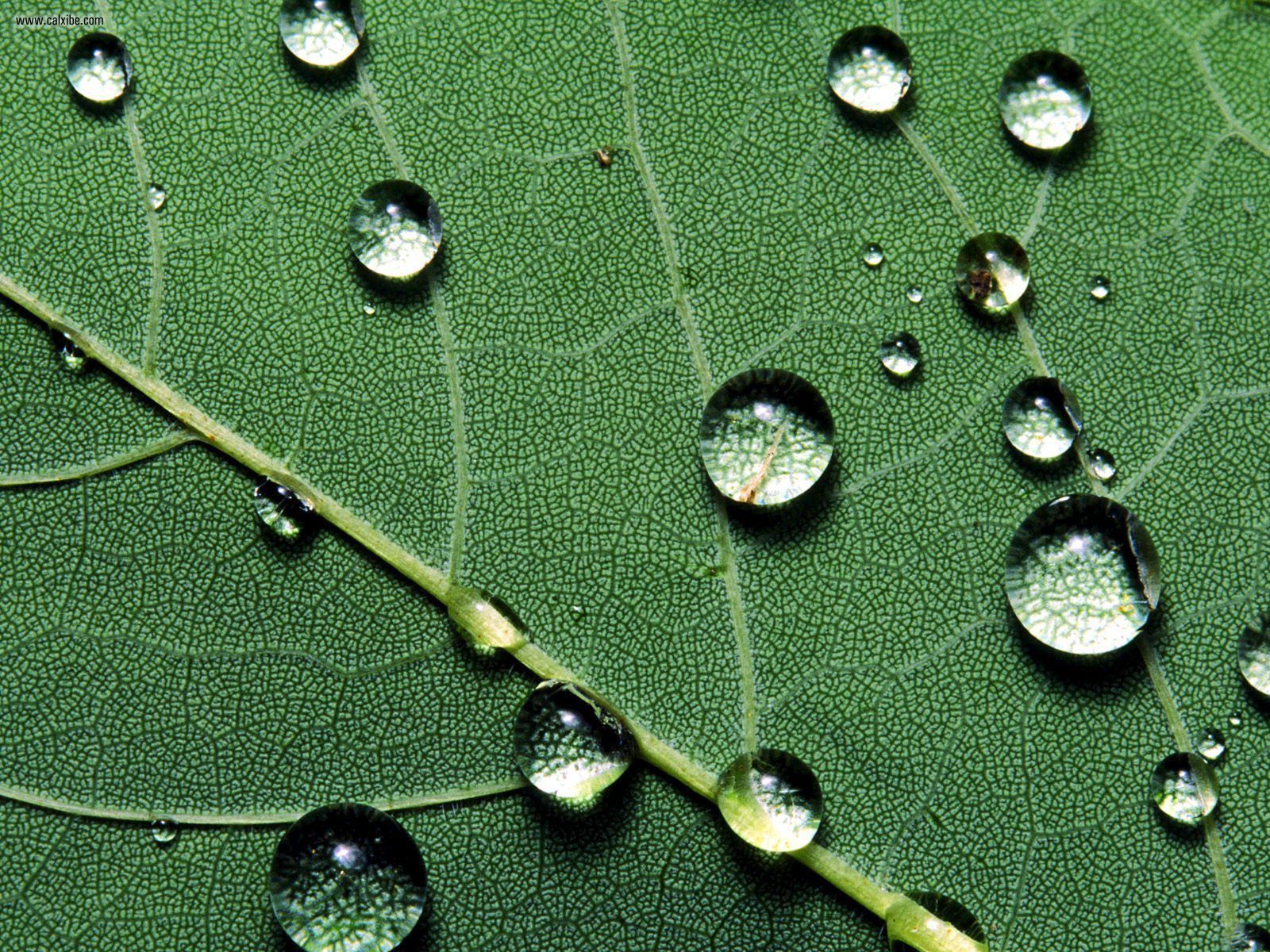
Refer to the picture; the water droplets are sticking to the leaf because of:
Adhesion
Cohesion
Describe COHESION.
Water molecules attracted to other substances.
Water molecules climbing upwards against the force of gravity.
Water molecules dissolving many substances because of its polarity.
Water molecules attracted to other water molecules.
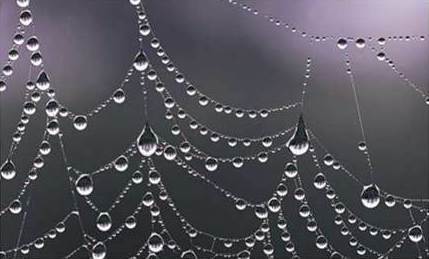
Refer to the picture; the water is sticking to the spider web because of:
Adhesion
Cohesion
Describe ADHESION.
Water molecules attracted to other substances.
Water molecules climbing upwards against the force of gravity.
Water molecules dissolving many substances because of its polarity.
Water molecules attracted to other water molecules.
Why can water striders walk across the surface of water without falling through?
They are light enough so they don't break the hydrogen bonds holding the water molecules together
The insects actually use their wings to hover slightly above the water’s surface
The insect’s feet are non-polar, so they are repelled by the polar water molecules and are pushed away from the water’s surface.
The insects are small enough to see the individual water molecules, so they are able to step carefully from one molecule to the next
Surface tension of the water is the cohesive force between water molecule on the surface of water.
True
False
Why does ice float?
As water freezes, it expands and its density decreases.
As water freezes, it takes up more hydrogen from the atmosphere
As water freezes, air becomes trapped between the water molecules.
As water freezes, it takes up more oxygen from the atmosphere
Water exists in this forms :
Gas
Plasma
Liquid
Solid

The boundary around a watershed is called the
watershed.
divide.
sub-watershed.
transpiration.
All water eventually empties into
an ocean
a river
the ground
a lake

Water that flows along Earth's surface to eventually return to the ocean is called ___.
Runoff
Storm drain
Surface water
Tributary
Watersheds can consist of smaller subwatersheds.
true
false
What is a body of water that combines freshwater from rivers and lakes with saltwater from the ocean?
Estuary
Floodplain
Wetland
Tributary
What is a land area that can be covered with water at various points throughout the year?
Estuary
Floodplain
Wetland
Tributary
What is a channel of water that flows into a larger one?
Estuary
Floodplain
Wetland
Tributary
What is the flat area of land that has sediment deposited when water overflows from rivers?
Estuary
Floodplain
Wetland
Tributary
What is the path of our local water?
Holston, Tennessee, Oregon, Mississippi, Gulf of Mexico
Holston, Tennessee, Ohio, Mississippi, Gulf of Mexico
Holston, Tennessee, Ohio, Michigan, Gulf of Mexico
Houston, Tennessee, Ohio, Mississippi, Gulf of Mexico
Which state is NOT included in the Chesapeake Bay Watershed?
Virginia
Maine
New York
Pennsylvania
Select the 3 bodies of water that Virginia watersheds drain into.
Chesapeake Bay
Gulf of Mexico
Lake Michigan
Albemarle Sound
Watersheds always go from north to south.
true
false
All of the abiotic and biotic organisms interacting together makes up a(n)-
Population
Community
Habitat
Ecosystem

What label should be placed where Title X is located?
Abiotic Factors
Biotic Factors
Living Factors
Neutral Factors
What label should be placed where Title Y is located?
Abiotic Factors
Biotic Factors
Living Factors
Neutral Factors
All the living organisms in an ecosystem make up the-
biotic factors
abiotic factors
living factors
neutral factors
Which of these is a biotic factor in an ecosystem?
Topography and Landforms
Sunlight
Geography
Algae
Select all of the abiotic factors in an ecosystem.
Water supply
Trees
Soil
Air quality
Rabbit population
The health of an ecosystem is directly related to the:
Air quality
Amount of animals in the area
Water quality
Amount of food in the area
Select all of the ways we can monitor the quality of water.
pH
salinity
dissolved oxygen
quantity of fish
temperature
What is a measure of how much salt is dissolved in the water?
pH
Dissolved oxygen
Turbidity
Salinity
What is the amount of suspended particles in water that increases cloudiness?
pH
Dissolved oxygen
Turbidity
Salinity

The shaded area shown contains the land that water flows across or through on its way to a stream, lake, wetland, or other body of water. What term is used to describe this area?
Watershed
Divide
Riverbed
Tributary

What watershed in Virginia is labeled number 1?
Gulf of Mexico or Mississippi River Watershed
North Carolina Sound Watershed
Chesapeake Bay Watershed
Atlantic Watershed
What watershed in Virginia is labeled number 2?
Gulf of Mexico or Mississippi River Watershed
North Carolina Sound Watershed
Chesapeake Bay Watershed
Atlantic Watershed
What watershed in Virginia is labeled number 3?
Gulf of Mexico or Mississippi River Watershed
North Carolina Sound Watershed
Chesapeake Bay Watershed
Atlantic Watershed
What are smaller streams that flow into larger rivers called?
Tributaries
Floodplains
Estuaries
Wetlands

A tributary of the Fredrick River is labeled number ___.
1
2
3
4

The areas labeled X and Z are known as the ____.
flood plain
riverbed
erosion
deposition

What are the flat areas around a river that can overflow with water at times?
Tributaries
Estuaries
Floodplains
Wetlands
Which of these can separate watersheds due to their high elevation?
Ridges
Floodplains
Tributaries
Estuaries

The river flows from North to South in this watershed. If each letter is a town, which town is likely a source of the pollution?
F
C
D
B

The above graphic depicts a transition zone between dry land and a river. One function of this transition zone is to provide food and shelter for wildlife and fish. What does the graphic represent?
Wetland
Estuary
Divide
Stream
Which of these is NOT considered a wetland?
Swamps
Marshes
Bogs
Lakes

How do wetlands help control water flow?
They add water to a river, increasing flooding.
They act like sponges, absorbing excess water and filtering pollutants.
They are dry most of the year, but absorb water during rainy seasons.
They are completely separate from streams and rivers and do not affect the amount of water.
Which of these is NOT a function wetlands can perform to improve the water quality?
They regulate runoff by storing flood waters.
They maintain water quality by filtering sediments.
They break down pollutants.
They recharge groundwater.
They can increase erosion by speeding up runoff.
Which of these provide food and shelter for wildlife and fish, while also providing nesting and resting areas for migratory birds?
Estuaries
Wetlands
Tributaries
Ridges
Estuaries are referred to as "nurseries of the sea" because they ___.
provide an excellent environment for organisms to raise their young
filter sediments by trapping pollutants
regulate runoff by storing flood waters
offer a productive environment for predators to capture prey
What is an estuary?
The widening channel of a river where it meets the sea, mixing fresh water and salt water.
A lowland area that is saturated with moisture that supports a natural habitat of wildlife.
An ecological community together with its environment, functioning as a unit.
The region draining into a river, river system, or other body of water.
Which of the following bodies of water is the largest and one of the most productive estuaries in the United States?
The Chesapeake Bay
The Mississippi River
The Narragansett Bay
The Hudson River
Which of these human activities will negatively affect the quality of watersheds?
Removing trees and vegetation that prevent erosion
Sewage leaks and roadway runoff into nearby streams
Livestock waste and fertilizer runoff from farmland into nearby streams
Cleaning up litter near the rivers
Planting trees and vegetation that prevent erosion
An area of land where the surface water and ground water drain into a particular body of water is known as a(n) ___.
aquifer
watershed
subsidence
divide
A scientist was asked to present his research at a national conference. What step of the scientific method is the scientist performing at the conference?
He is drawing conclusions.
He is communicating his results.
He is making an observation.
He is completing an experiment.
Moriah wants to begin a science experiment. What is the first step of the scientific method she needs to take in order to start the process?
Gather information
Collect Data
Ask a question
Create a hypothesis
Which of the following is NOT usually a part of the scientific method?
Conducting a phone survey
Conducting an experiment
Forming a hypothesis
Recording and analyzing data
Which of the following does NOT help to build our scientific knowledge and improve?
Asking new questions and re-checking old information
Discovering new information
Cashiers collecting money at a register
The invention of new technology


The instrument pictured can be used to mix and heat liquids...
graduated cylinder
florence flask
erlenmeyer flask
beaker


What is the independent variable in this experiment?
Types of Bacteria
Time of Incubation
Number of Bacteria
Culture Number

This example shows
Density of a rock
Volume of a rock
Mass of a rock
Length of a rock
A student recorded the temperatures in different countries for one day. Which of these will best display the data the student collected?
Line Graph
Bar Graph
Circle Graph
Pictograph
What is the independent variable in the following hypothesis?
HYPOTHESIS: "If I spend less time studying, then my grades in science will go down."
Improvement in grades
Playing music while studying
Studying in different locations
Time spent studying

What is the mass of the rock shown on the triple beam balance?
354.6g
355g
350g
355.5

