
 Worksheets
Meteorology Final Exam Review
Total questions: 141
Worksheet time: 2hrs 47mins
What is a Front?
A boundary between two air masses of different density, moisture, or temperature.
A line that connects points of equal temperature.
The study of weather.
A large body of air that has properties similar to the part of Earth’s surface over which it develops.
What is a Cold Front?
a model that shows the weather conditions at a specific location on Earth’s surface.
Occurs when colder air advances toward warmer air.
when air is cooled near its dewpoint near the ground.
What is a Warm Front?
masses of puffy, white clouds, often with flat bases. They sometimes tower to great heights and can be associated with fair weather or thunderstorms.
High thin, white, feathery clouds made of ice crystals.
occur when colder air advances toward warmer air.
occurs when lighter, warmer air advances over heavier, colder air.
What is a Occluded front?
a large body of air that has properties similar to the part of Earth’s surface over which it develops.
the amount of water vapor present in the air.
involves three air masses of different temperatures-cold air, cool air and warm air.
the temperature at which air is saturated and condensation forms.
What is a stationary front?
occurs when a boundary between air masses stops advancing.
a line drawn to connect points of equal atmosphere.
a line that connects points of equal temperature.
Meteorology is...
the amount of water vapor present in the air.
a boundary between two air masses of different density, moisture, or temperature.
the study of weather.
An air mass is a...
occurs when lighter, warmer air advances over heavier, colder air.
High thin, white, feathery clouds made of ice crystals.
the study of weather.
a large body of air that has properties similar to the part of Earth’s surface over which it develops.

What Front is this
Occluded
Warm
Cold
Stationary

What front is this?
Stationary
Occluded
Occudled
Circles and Triangles

What front is this?
Occluded
Stationay
Stationary
Warm and Cold
Which of the pictures is a stationary front


How does a tornado start
RAINBOWS
By ground
By Thunderstrom
By Wind
Which of the following is not a cause of acid rain?
Volcanic Eruptions
Burning of fossil fuels
electric cars
combustion engins

What type of front is being modeled in the diagram?
cold front
warm front
stationary front
occluded front

What type of weather is associated with this type of front?
widespread precipitation
light winds and precipitation
intense precipitation and thunderstorms
strong winds and heavy precipitation

What front is being forecast for this state?
cold front
warm front
stationary front
occluded front
The Coriolis effect is due to the __________ of Earth.
revolution
rotation
shape
density
Low-pressure systems are usually associated with ________ weather.
cold and dry
cloudy and rainy
sunny and dry
warm and humid
a boundary between two air masses of different density, moisture, or temperature
Station model
Front
Low pressure
Radio Model
occurs when colder air advances toward warmer air
Warm Front
Cool Front
Cold Front
Hot Front
occurs when lighter, warmer air advances over heavier, colder air
Warm Front
Hot Front
Cool Front
Cold Front
involves three air masses of different temperatures-cold air, cool air and warm air
Stationary Front
Occluded Front
Warm Front
Cool Front
occurs when a boundary between air masses stops advancing
Warm Front
Cold Front
Occluded Front
Stationary Front
A thermometer measures
distance
temperature
height
weight

What does the "H" on the weather map mean
hot pressure
happy pressure
high pressure
handy pressure

What does the "L" on a weather map mean
low pressure
lonely pressure
lumpy pressure
lucky pressure
Why is the sun important to the water cycle?
The sun is the source of energy that powers the water cycle.
The sun gives light so that people can see the water cycle happening.
The sun's gravity causes the tides which are important to the water cycle.
The sun isn't important to the water cycle.
The sun producing electromagnetic waves that heat the Earth is an example of
Conduction
Convection
Radiation
Combination
When magma in the mantle moves in currents this is an example of
conduction
convection
radiation
combination
As you go higher in the troposphere (the layer of the atmosphere that is closest to Earth) the temperature
Increases
Decreases
Stays the same
first decreases then increases
Which is caused by differences in air pressure?
Snow
Rain
Clouds
Wind
Which of the following is not a type of severe weather?
Blizzard
Tsunami
Severe Thunderstorm
Drought
Why does sand heat up faster than water during the daytime, and then cool off faster at night?
Water has a higher heat capacity than sand.
Water moves around more.
Water starts of colder than sand.
Water evaporates allowing it to cool.
What is a cold front?
A place where a warm air mass is pushing a cold air mass out of the way
A place where a cold air mass is pushing a warm air mass out of the way
A place where 2 air masses meet but no movement is taking place
A place where a cold air mass is being squeezed by 2 warm air masses
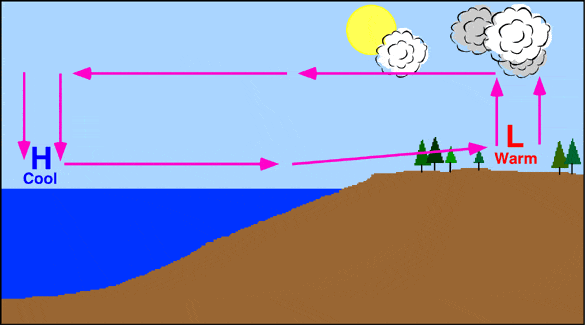
What causes land breezes and sea breezes to flow at the shore?
Uneven heating and cooling of the land and water.
Prevailing winds driven by the angle of the sun's rays
The pull of the moon's gravity and the tides
The Coriolis effect

Based on these graphs, in which place would you rather live if you need a very wet climate?
Boston
San Francisco
What causes differences in air pressure?
even heating of the Earth
Even cooling of the earth
uneven heating of the earth
global warming
A costal breeze blowing from sea to land caused by the temperature difference when the land surface is warmer than the sea surface and usually occurs during the day.
Sea Breeze
Land Breeze
Wind Breeze
The horizontal movement of air is
Gust
Wind
Air
Most of flying occurs in the
Stratosphere
Troposphere
Lonosphere
A storm wiht lightning and thunder, composed of cumulonimbus clouds and usually associated with gusty winds, heavy rain and sometimes, hail and tornadoes.
Hail storm
Thunderstorm
Sandstorm


Using the map, which statement is true for this particular day?
It is raining in Danville.
A cold front had just moved through Denver.
Air moves from low to high so it is probably windy in Miami
Is is snowing in Billings, MT.
Using the map, which statement is true for this particular day?
It is raining in Danville.
London is in the 80's
Air moves from low to high so it is probably windy in Miami
Is is snowing in Billings, MT.

Using the above map, which of the following would be true about London KY a month before camp started?
The wind direction would be northwest
A thunderstorm was taking place
The wind speed is 20 knots
A warm front was moving into the area.
Using the above map, which of the following would be true about London KY a month before camp started?
The temperature would be around 65
The wind direction would be northwest
A thunderstorm was taking place
The wind speed is 20 knots

Why do kids choose the bottom bunk at camp? (Think scientific reasons!)
Cold air sinks because it is more dense and it would be cooler.
The mattresses were more comfortable on the bottom bunk.
They couldn't climb to the top of the bunk.
Warm air sinks because it is more dense and they wanted to be warm.
When you roast marshmallows and touch the metal why does it burn your finger?
Heat moves from cold to warm.
Heat moves from warm to cold.
Marshmallows are good insulators.
Convention occurred through the metal.
When you roast marshmallows and touch the metal why does it burn your finger?
Heat moves from cold to warm.
Metals are good conductors.
Marshmallows are good insulators.
Convention occurred through the metal.
what is an air mass?
small body of air that has different properties of the area where it forms.
a body of water
large body of air that has similar properties of the area where it forms.
a body of air
what kind of weather comes from a maritime tropical air mass?
moist, cold
moist, warm
dry, warm
dry, cold
what is an occluded front?
a front where a warm air mass is caught between two cold air masses.
a front where a cold air mass doubles.
a front where a warm air mass is caught between two warm air masses.
a warm front.
A continential tropical air masses results in ______ weather
dry
cold
warm
moist
what happens when an air mass moves to a new region.
it brings characteristics with it.
it completely changes.
it takes on the conditions of the new region
it doesn't do anything.
Cold fronts always bring snow and ice
true
false
in the USA air masses move west to east
true
false
Which layer of the atmosphere contains water vapor, clouds and is where weather happens?
Troposphere
Thermosphere
Mesosphere
Stratosphere
What happens to temperature as altitude increases?
It gets colder as you go up in the atmosphere
It gets warmer as you go up in the atmosphere
It depends on which layer of the atmosphere you're talking about - some get colder and some get warmer
The Earth's atmosphere is.....
78% carbon dioxide and 21% methane
78% hydrogen and 21% water vapor
78% oxygen and 21% nitrogen
78% nitrogen and 21% oxygen
Which of the following is TRUE?
Sand absorbs heat slowly
Sand absorbs and releases heat faster than water
Water absorbs and releases heat faster than water
Water releases heat quickly
When the sand heats up the air above it by direct contact, we call it _________.
Conduction
Convection
Radiation
When warm air rises and cold air sinks, what type of heat transfer is occurring?
Conduction
Radiation
Convection
Which of the following are made by the unequal heating of the earth?
Global Winds
Local Winds
Global Winds and Local Winds
When do land breezes happen?
Night
Day
A sea breeze......
Happens at night and blows from the sea to the land
Happens during the day and blows from the sea to the land
Happens at night and blows from the land to the sea
Happens during the day and blows from the land to the sea
A land breeze......
Happens at night and blows from the sea to the land
Happens during the day and blows from the sea to the land
Happens at night and blows from the land to the sea
Happens during the day and blows from the land to the sea

Why is there an "L" at number 1?
There's low air pressure there because the air is rising up
There's low air pressure because the air is sinking
There's low temperature because sand heats up fast
There's low humidity because water doesn't evaporate during the day
What kind of air do we need to make a hurricane?
Cold and dry
Warm and dry
Warm and moist
Cold and moist
Where do hurricanes form on Earth?
Near the poles and on land
Near the poles and in the ocean
Near the equator and in the ocean
Near the equator and on land
During what two seasons do we get most tornadoes?
Spring and summer
Fall and spring
Summer and fall
Winter and summer

The picture is showing examples of what?
Global winds
Local winds
Sea breezes
Land Breezes

Which letter is which?
A is land breeze and B is sea breeze
A is sea breeze and B is land breeze
Both A and B are land breezes
Both A and B are global winds

Which of the following layers is represented by letter C?
Troposphere
Stratosphere
Mesosphere
Thermosphere

In order to avoid severe weather most planes fly in the:
Troposphere
Stratosphere
Mesosphere
Thermosphere

Which of the following statements is true concerning the graph above?
Layer A is the mesosphere because temperature is decreasing
Layer B is the stratosphere because temperature is increasing
Layer C is the mesosphere because temperature is increasing
Layer D is the stratosphere because temperature is increasing
Which layer of the atmosphere contains weather, clouds, pollution and life forms?
Mesosphere
Stratosphere
Thermosphere
Troposphere
Why is stratospheric ozone beneficial to life on Earth?
Stratospheric ozone is an important part of the water cycle.
Stratospheric ozone absorbs UV radiation that is dangerous to life.
Stratospheric ozone reverses the greenhouse effect in the atmosphere.
Stratospheric ozone produces much of the oxygen that life uses for respiration.
The characteristics of an air mass which formed over the Gulf of Mexico would probably be
cool and dry
warm and humid
warm and dry
cool and humid
Which action would best help to improve air quality?
increase deforestation efforts
decrease fossil fuel emissions
decrease the levels of oxygen in the atmosphere
increase the levels of carbon dioxide in the atmosphere
Which would be the best thing to help air quality?
walk to work everyday
ride a bus to work every day
drive a car to work every day
carpool with others to work every day
Which is the source of most man-made air pollution?
burning forests
plowing fields
burning fossil fuels
manufacturing food
Which produces strong winds and powerful waves, and can cause heavy flooding?
tornadoes
hurricanes
winter storms
thunderstorms
Which list shows atmospheric layers in the correct order upward from the Earth’s surface?
thermosphere, mesosphere, stratosphere, troposphere
troposphere, stratosphere, mesosphere, thermosphere
stratosphere, mesosphere, troposphere, thermosphere
thermosphere, troposphere, mesosphere, stratosphere

What does mT mean?
cold and dry
cold and wet
warm and wet
warm and dry
What does cT mean?
cold and dry
cold and wet
warm and wet
warm and dry
What does cP mean?
cold and dry
cold and wet
warm and wet
warm and dry
What does mP mean?
cold and dry
cold and wet
warm and wet
warm and dry

Which kind of pressure system brings cold and wet weather
High Pressure
Low Pressure

What gas makes the majority of our atmosphere?
nitrogen
oxygen
hydrogen
greenhouse gases

Which gas is beneficial to us not being fried by UV rays?
Nitrogen
Ozone
CO2
CFCs
sea breeze
cool air moves down a mountain slope towards a valley
warm air rises up a mountain slope from a valley
cool land air flows to the ocean at night, causing warm ocean air to rise
cool ocean air flows to land during the day, causing warm land air to rise
land breeze
cool air moves down a mountain slope toward a valley
warm air rises up a mountain slope from a valley
cool land air flows to the ocean at night, causing warm ocean air to rise
cool ocean air flows to land during the day, causing warm land air to rise

What weather is currently happening at letter C?
gentle rain
thunderstorms
fog
clear skies
What type of weather is associated with a cold front?
Thunderstorms
Clear skies
Warmer temperatures and tornadoes
Cool temperatures and thunderstorms, rain
What weather would you find at a stationary front?
Many days of wet weather
Dry, warm temperatures
A mix of dry and wet days
Mild weather



