
 Worksheets
Earth Science
Total questions: 145
Worksheet time: 2hrs 13mins
Mountain building is an example of what type of force?
constructive
destructive
The rigid layer of Earth made up of the crust and uppermost part of the mantle.
Asthenosphere
Lithosphere
Inner Core
Outer Core
Which layer of Earth makes up the majority of Earth's mass?
Lithosphere
Mantle
Inner Core
Outer Core
Which layer of Earth is a solid layer of iron and nickel due to intense pressure?
Asthenosphere
Mantle
Inner Core
Outer Core
Which of the following theories is Continental Drift connected to?
Plate Tectonics
Evolution
Gravity
Nebular Hypothesis
The movement of Earth's plates can cause everything except for:
Weathering
Mountains
Earthquakes
Volcanoes
This type of crust is described as denser and heavier
CONTINENTAL
OCEANIC
Thicker and older part of the Earth's crust
CONTINENTAL
OCEANIC
This is evidence that sea-floor spreading occurs. Choose 2 answers.
Younger rock was found close to the mid-ocean ridge.
Younger rock was found further away from the mid-ocean ridge.
Pillow lava is found on the bottom of the ocean floor.
Mid-ocean ridges are found at the bottom of the ocean floor.
Why did scientists not believe Alfred Wegener's hypothesis?
Wegener did not have enough evidence for continental drift.
Wegener did not collect enough fossils.
Wegener could not explain why there were the same fossils on different continents.
Wegener could not explain the force that could move the continents.
The idea that the continents were once joined together and since drifted apart is called
Pangaea
Continental Drift
Wegener's supercontinent
Sea-Floor spreading


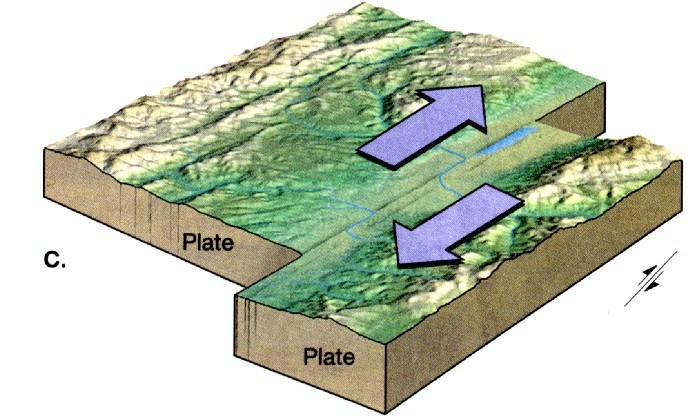
The three types of plate boundaries are
Convergent, divergent, change
Convergent, divergent, transform
Divergent, allegiant, insurgent
Push, pull, slide
Which of the following is not an indication of plate movement?
shapes of the continents
fossil distribution
size of the ocean
seismic activities on the crustal boundaries

Students were tasked with making a model of how natural forces can change the surface
features of Earth. They make a pile of sand in front of an electric fan and turn it on. This model best represents which of the following changes to the surface of Earth?
The formation of a delta at the mouth of a river.
The building of a mountain on the edge of a continent.
The movement of dunes caused by the blowing wind.
The creation of a canyon by flowing water.

Stalagmites are structures that form on the floor of some caves. Most scientists explain this by saying that stalagmites form when minerals dissolved in water are left behind where water drips. Which evidence would support this explanation?
Freezing water turns it into a solid.
Water found in caves has minerals in it.
Some stalagmites are taller than others.
Many caves are found deep underground.
A student argues that a destructive force can change the surface of Earth. Which of the following could be used to support this claim?
A new island forms in the middle of an ocean.
A plain becomes a deep canyon with steep walls.
A sand dune shifts from one location to another.
A mountain grows taller over a thousand years.

Students placed two desks next to each other, and then pulled them apart. This demonstration best models which change that happens to the surface of the Earth.
Large cracks forming on the ground.
Waves making a beach smaller.
Sand dunes moving by winds.
Weathering changing the shape of a mountain.

Over many years, the depth of a lake gets more shallow. What could cause this change?
The climate in the area gets warmer.
Sediments are deposited in the lake.
The Sun evaporates the water.
A hurricane brings heavy rains.
What is the breakdown of the Earth’s crust into sediment called?
Weathering
Raining
Erosion
Whooshing
What does physical weathering involve?
Water
Wind
Temperature
All of the Above
What is the process called when a glacier deposits rocks in oceans and lakes?
Deposition
Drainage
Pollution
Depotism
What do flood plains, sandbars, and river deltas in common?
They are formed by water erosion.
They have been formed by glacial erosion.
They have been formed by wind erosion.
They have been formed by sandblasting.
What type of erosion formed the Grand Canyon?
Wind
Water
Sandblasting
Glacial
How might a weathered mountain appear different from an unweathered mountain?
The weathered mountain might be taller.
The weathered mountain would appear rounder.
The weathered mountain would be more jagged
Weathered mountain would contain less trees.
How long does the weathering process take?
A few days.
No more than a month.
Exactly one year.
Years and Years.
Which of these is a constructive change?
Volcano erupting forming new land.
A river cutting out a canyon.
A glacier scraping down the side of a mountain
Ice forming causing a rock to cut in half.
What is it called when weathered rock is carried away?
Weathering
Raining
Erosion
Breaking
Which of these is an example of erosion?
Light shining on a mountain
Wind blowing away sediment.
Rain breaking down rock.
All of the above.
What type of change does Erosion cause?
Physical
Chemical
Electrical
Magnetic
What is a good way to prevent erosion?
Blocking the wind.
Planting trees.
Preventing rainfall.
Preventing the flow of rivers.
What is weathering?
Process of breaking rocks into smaller pieces.
A shift in weather patterns.
Process by which mountains are formed.
Process by which seasons change.
What types of rocks are formed by weathering?
Metamorphic Rocks
Igneous Rocks
Sedimentary Rocks
Volcanic Rocks
What are the two types of Destructive forces?
Weathering / Warming
Weathering / Erosion
Weathering / Water
Weathering / Climate
A universally used system for locating points and indicating locations on Earth's surface
Coordinate System
Geographic coordinate system
Latitudinal System
Polar System
Using the geographic coordinate system, the distance of places can be measured in what Units?
kilometers
kilograms
degrees
liters
The equator is located in what latitude?
60o
20o
0o
45o
The following are bodies of water that surrounds the Philippines except:
Philippine Sea
West Philippine Sea
Celebes Sea
Carribean Sea
This is an Archipelago, a sovereign state in Southeast Asia in the Western Pacific Ocean.
The Philippines is rich in the following resources:
Water and Energy Resources only
Mineral, Agricultural and Energy Resources
Water and Energy resources, forest and agricultural and minerals
Water and Energy resources, biogas, landforms and aquatic animals
The following are examples of aquatic resources except:
Corals
Shellfish
Pearls
Coal
The metals that are rich in the Philippines are:
Nickel, mercury and gold
Cobalt, silver and gold
Iron, Vibranium and Zinc
Copper, Coal and Methane gas
Statement 1: Oil supply from the Philippines is pumped out of our own oil wells.
Statement 2: The gas field in the Philippines in the Camago-Malampaya in Palawan is estimated 3.7trillion ft3 of natural gas reserve.
Only Statement 1 is correct
Only statement 2 is correct
Both statements 1 and 2 are correct
Both statements 1 and 2 are wrong.

What is the distance of A from the equator?
2o
15o
20o
30o

What is the direction of A with reference to the equator?
East
North
South
West

What is the distance of A from the prime meridian?
3o
15o
30o
45o

What is the direction of A with reference to the prime meridian
East
North
South
West

What is the exact location of A
10 northo, 15 westo
20 northo, 30 westo
30 northo, 30 westo
40 northo, 50 westo
These are harmful materials found in the atmosphere, in the bodies of water and on land?
Pollution
Pollutants
Dirt
Junk
The following are natural sources of air pollutants except:
Volcanoes
Forest fires
Sea waves
Vehicular emissions
When oxides of sulfur and nitrogen are dissolved in rainwater in the atmosphere, this type of precipitation occurs:
Acid Crystallization
Crystal Rain
Acid Sublimation
Acid Precipitation
A type of pollution caused when waste heat is discharged into the environment and altering its temperature
Water Pollution
Air Pollution
Eutrophication
Thermal Pollution
The process in which water becomes richer in dissolved nutrients resulting in oxygen deficiency.
Air pollution
Water pollution
Eutrophication
Thermal pollution
The following are ways to solve ecological problems except:
Proper maintenance of vehicle engines.
Smoke belching should be allowed.
Industrial firms must utilize pollution control devices.
Paper and bottles may be recycled.
Which of the following image is considered as a renewable energy?


What type of energy source that is a renewable energy because heat is continuously produced inside the earth.
Solar Energy
Wind Energy
Geothermal Energy
Nuclear Energy

It is a renewable organic material that comes from plants and animals and converted to energy through various process thru direct combustion, Thermochemical conversion , Chemical conversion and Biological conversion to produce liquid and gaseous fuels.
(a)

North Wind Power Development Corporation (NPDC) spearheaded the development and construction of the 70-meter wind farm in Bangui Bay in Ilocos Norte in 2005. What type of renewable energy source presented in this image??
(a)

Identify the type of energy source coming from moving water?
Geothermal Energy
Solar Energy
Liquid flowing Electrical Energy
Hydropower Electric Energy

2 Types of Natural Resources
Recyclable and Nonrecyclable Natural Resources
Limited and Unlimited Resources
Renewable and Nonrenewable Natural Resources
Toxic and Nontoxic Resources

Because there is a continuing movement of very hot magma or molten materials under the ground and this is why the Philippines is rich in Nickel, copper and gold mines. What do you call the place which home to approximately 75% of the world’s active volcanoes.
Atlantic Ring of Fire
Pacific Ring of Volcanoes
Pacific Ring of Fire
Mayon Volcano

It is the depletion of a species of fish from a body of water at a rate greater than that the species can replenish its population naturally, resulting in the species becoming increasingly underpopulated in that area.
Over Fishing
Fishkill
Coral Bleaching
Fish Culturing

Should the Bataan Nuclear Power Plant be Refurbished?


Should the Bataan Nuclear Power Plant be Refurbished? Why yes? and why not?
Organic matter is a main part of soil. What is the other main part of soil?
worms
dirt
water
inorganic matter
In a drought, farmers often have problems with their topsoil blowing away when it gets really dry. What could farmers do to keep the lightweight, dry soil from blowing away or eroding?
Plant the seeds farther apart.
Surround the fields with natural barriers, such as trees to block the wind.
Keep cows in the field.
Farmers often have trouble with their topsoil washing away during times of heavy rainfall. What could they do to keep the soil from washing away or eroding?
Keep pigs in the field.
Plant crops in valleys rather than on hills.
Try to create a place for the water to run off.
You are planning to buy a home along a river. You want to make sure that your home is safe from flooding and erosion. Which home should you buy?
A house on land that is level with the river with lots of pretty flowers.
A house on rocky, gently sloping land away from the river.
A house at the top of a steep cliff that is made of sandy soil.
What is a renewable resource?
A resource that can be replaced or recycled.
A resource that will not run out.
A resource that cannot be replaced at all, or cannot be replaced as fast as people use it.
What is a non-renewable resource?
A resource that can be replaced or recycled.
A resource that will not run out.
A resource that cannot be replaced at all, or cannot be replaced as fast as people use it.
What is an inexhaustible resource?
A resource that can be replaced or recycled.
A resource that will not run out.
A resource that cannot be replaced at all, or cannot be replaced as fast as people use it.
Sand dunes in the Middle East are created when the wind moves sand from deserts to new places. The sand being moved to a new location is an example of which of Earth's processes?
erosion and deposition
glacier movement
Earth crust movement
land mass motion
After a very heavy rain, a large amount of Earth breaks loose on a hillside. Which of Earth's processes caused this?
glacier movement
weathering
land mass motion
volcanic eruptions
Mount Everest grows 2 inches per year as the tectonic plates below it move toward each other. Which of Earth's processes causes this?
weathering
Earth crust movement
land mass motion
erosion and deposition
In the rock cycle, what causes igneous rock to form?
heat and pressure
weathering and erosion
tectonic plates
the cooling of magma
in the rock cycle, what causes sedimentary rock to form?
compaction and cementation
melting
heat and pressure
red, hot magma
In the rock cycle, what causes metamorphic rock to form?
red, hot magma
heat and pressure
erosion
wind
in the erosion lab, the larger, heavier sediments were generally deposited in the canyon and alluvial fan. Why did this happen?
the sediments were able to flow a long distance
the sediments couldn't be carried as far
in the erosion lab, the smaller and lighter sediments, such as clay and silt, were generally deposited downstream in the basin. Why did this happen?
the sediments were able to flow a long distance
the sediments couldn't be carried as far
In the erosion lab, what caused an increase in weathering, erosion, and deposition?
increased water supply
increased slope
both increased water supply and increased slope
neither - the weathering, erosion, and deposition stayed the same
Is it constructive or destructive when lava cools and creates new land?
constructive
destructive
The Hawaiian Islands were formed from volcanoes in the Pacific Ocean. Was this a fast process or a slow process?
fast
slow
A landslide occurs after a flash flood's flowing water caused large portions of the riverbank to be washed away. Was the land impacted by a constructive force or a destructive force?
constructive force
destructive force
What is the difference between renewable resources and inexhaustible resources?
Renewable resources, such as cows and eggs, could potentially run out, and inexhaustible resources, such as wind and water, will never go away completely.
Renewable resources can never be replenished and inexhaustible resources can.
Renewable resources are free and inexhaustible resources are very expensive.







The water cycle moves water from place to place on Earth. The illustration below shows some of the steps in the water cycle.
Which of the following best describes what is happening in Box L?
Deposition
Erosion
Precipitation
Condensation

Faith makes a model by using a cup, some water, and plastic wrap. After Faith places the model near a sunny window, she notices that moisture forms on the inside of the plastic wrap.
What is Faith observing as the moisture continues to collect on the plastic wrap?
Evaporation
Condensation
The boiling point of water
Precipitation

In science class, students are making a model of the water cycle with different objects and materials. As part of their model, students have a glass filled with water and ice. There are droplets of water forming on the outer surface of the glass.
Which part of the water cycle do the water droplets represent?
Evaporation
Condensation
Precipitation
Transpiration

During the water cycle, water goes through different phases. Which table shows the correct
order of three phases in the water cycle, starting with falling rain?


More water leaves the oceans through evaporation than is added to the oceans through precipitation. Which process keeps ocean water levels from dropping?
Evaporation
Transpiration
Condensation
Runoff

How would Earth most likely be affected if less water evaporated from the oceans during
the water cycle?
Ocean water levels would increase and there would be less precipitation.
Ocean water levels would decrease, and precipitation would stay the same.
Ocean water levels would stay the same and there would be more precipitation.
Ocean water levels would not be affected, and precipitation would stay the same.

During the day, a family was at the beach when they noticed clouds forming over the
ocean. Later, at night, they saw no clouds. Why would fewer clouds form over the ocean at night?
The Moon evaporates the water in the clouds.
Rain clouds dry up because of the Sun's heat.
Clouds move to the closest mountains in the area.
If there is no sunlight less water gets evaporated for cloud formation.

Which series of steps is in the correct order to describe how ocean water becomes rain,
snow, or some other form of precipitation?
1. The sun warms the ocean. 2. Water vapor rises into the air. 3. Water collects in clouds. 4. Rain, snow, or other precipitation falls.
1. Water collects in clouds. 2. The sun warms the ocean. 3. Rain, snow, or other precipitation falls. 4. Water vapor rises into the air.
1. The sun warms the ocean. 2. Water vapor rises into the air. 3. Rain, snow, or other precipitation falls. 4. Water collects in clouds.
1. Rain, snow, or other precipitation falls. 2. Water collects in clouds. 3. Water vapor rises into the air. 4. The sun warms the ocean.

A person goes outside and finds hail stones on the ground. Which type of weather is most likely to have hail?
Snowstorm
Thunderstorm
Ice Storm
Dust Storm
What kind of weather would be expected if cirrus clouds are in the sky?
Cirrus clouds mean fair weather is ahead.
Cirrus clouds come before strong winds.
Cirrus clouds appear just before storms form.
Cirrus clouds form when it is going to turn cold.

The temperature in Miami on a day in July is 92 F (33 ºC). There is very little wind on this day. What type of precipitation is most likely to form?
Hail
Rain
Sleet
Snow

Manuel sees snow outside. Which conditions most likely describe the weather outside?
cirrus clouds, high pressure, and 0 °Celsius
cirrus clouds, high pressure, and 15 °Celsius
stratus clouds, low pressure, and 15 °Celsius
stratus clouds, low pressure, and 0 °Celsius

Scientific studies show that people with arthritis feel more pain when the humidity is high. When is someone with arthritis more likely to feel pain?
when a snowstorm has ended
when the wind is blowing more than 20 knots per hour
when the sun is shining, and there are no clouds in the sky
when a storm with thunder and lightning is approaching

Brazil's rainforest is located in a region with a tropical climate. The tundra of the North Pole is located in a region with a polar climate. Why does air in an area with a tropical climate hold more water than air in a polar climate?
Tropical climates have more rivers.
Warm air holds more hot water vapor.
Polar climates get more sunlight.
Polar climates have ice instead of water.

It's summertime, and some friends are setting up for an outdoor picnic in the park. As they're working, they feel the wind getting stronger and the temperature dropping. They hear from a radio report that the air pressure is dropping, too. What should they do next?
Put up more umbrellas to protect against sun burns.
Put everything away to avoid the coming snowstorm.
Move the picnic into a shelter because rain is on the way.
Ask the park manager to turn on lights for the coming fog.

A meteorologist predicts that the day will be sunny and dry because the local air pressure is high. What instrument is used to measure air pressure?

Anemometer

Barometer

Compass

Thermometer

Which type of data would most help a meteorologist determine whether a nearby weather system is headed toward a certain area?
Humidity
Wind Speed
Temperature
Wind Direction

How much of Earth's water is fresh water?
3%
13%
23%
33%

On which kind of day would you expect the most evaporation from the surface of a pond?
Sunny and hot
Sunny and cold
Rainy and hot
Rainy and cold

Snow, sleet, hail, and rain are all examples of what?
Evaporation
Condensation
Transpiration
Precipitation

