
 Worksheets
7th Grade Final Review
Total questions: 140
Worksheet time: 5hrs 36mins
What is the starting source of energy for all food chains?
grass
sun
bug
mushrooms

What is this model called?
Food Chain
Food Web
Habitat
Herbivore
An animal that ONLY eats plants is called a
Herbivore
Carnivore
Omnivore
Plantivore
An animal that ONLY eats other animals is called a
Carnivore
Omnivore
Herbivore
Consumer

Why do people eat?
to gather family
to sleep
for energy
for exercise

Lions only eat buffalo, antelopes, zebras and crocodiles. They are called __________.
Omnivore
Herbivore
Carnivore
Delivore

Bears eat fish, insects, plants, seeds, nuts and young elk. They are called __________.
Franivore
Carnivore
Herbivore
Omnivore

An animal that only eats plants is a...
carnivore
omnivore
herbivore
decomposer

What's the name of this habitat?
Forest
Desert
Ocean
Tundra

What's the name of this habitat?
Forest
Desert
Ocean
Tundra

What's the name of this habitat?
Forest
Desert
Ocean
Tundra


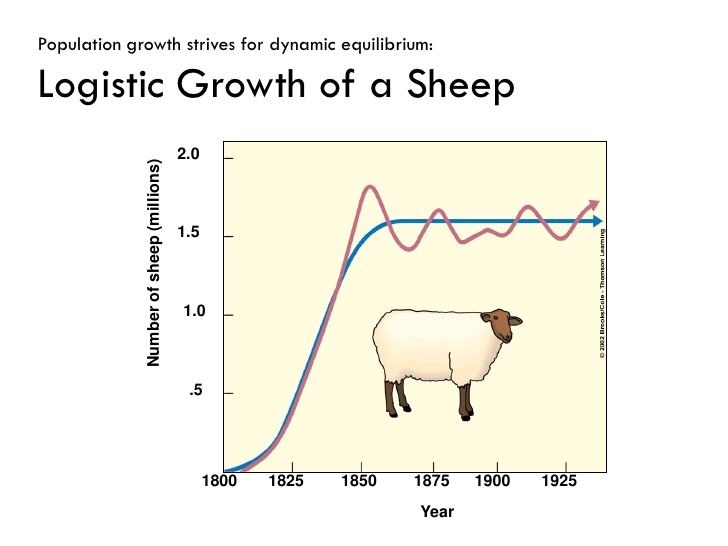


______________ means moving into a population.
Immigration
Emmigration
Plantation
Repopulation
A population of panthers lives in the southeastern United States. Over 50 years, the size of the panther population in the region increased. What best explains the increase in the size of the panther population?
The panther population is always increasing because no animal eats panthers.
Fewer panthers were born than died.
More panthers were born than died.
A lot of panthers were born and none of them died.

Scientists have been studying the size of three populations along the coast of Antarctica. In this ecosystem, penguins eat sardines (a type of small fish), and sardines eat zooplankton (very small animals that live in water). The data showed that all three populations were stable. Then the penguin population decreased suddenly.
What will likely happen to the size of the sardine population as a result?
stay the same. The size of its resource population did not change, so the amount of energy storage molecules available for the sardines did not change. There will be the same number of births and deaths in the sardine population.
decrease. A decrease in one population causes a decrease in the sizes of all other populations in the ecosystem.
increase. The smaller penguin population will leave more energy storage molecules available for the sardine population to reproduce more. This will lead to more births in the sardine population.
increase. The smaller penguin population will need fewer energy storage molecules, so they will eat fewer sardines. This will lead to fewer deaths than births in the sardine population.
What do birds such as hawks and eagles need energy for?
flying
digesting food
reproducing
All of the above

In a rainforest, anteaters eat ants, and ants eat aphids (a type of very small insect). The sizes of the populations have been stable for the last 10 years, but recently the size of the aphid population decreased. What will likely happen to the anteater population?
stay the same. Anteaters do not eat aphids, so the number of births and deaths in the anteater population will stay the same.
decrease. Fewer energy storage molecules will be available to the anteater population from the smaller ant population, so the anteater population will reproduce less. This will lead to fewer births than deaths in the anteater population.
decrease. A decrease in the size of any population leads to a decrease in the sizes of all other populations in an ecosystem.
increase. The smaller aphid population will leave more energy storage molecules available in the ecosystem for the anteater population, so there will be more births in the anteater population.
A large population of squirrels lives in a forest. In the last 50 years, the size of the squirrel population has stayed the same. What must be true about the squirrel population during the last 50 years?
The number of squirrels that were born was the same as the number of squirrels that died.
Humans started protecting the squirrel population so they stopped dying.
The squirrels did not have any baby squirrels during these years.
No squirrels were born and no squirrels died.

In this food web, which of the following animals are part of the resource population?
Deer
Coyote
Wolf

In this food web, which organism(s) are part of the consumer population.
CAN SELECT MORE THAN ONE!!
Deer
Coyote
Wolf
When a population is stable it means...
There are more births than deaths
There are more deaths than births
There are the same number of births and deaths
No organisms were born or died.
When a population is INCREASING it means...
There are more births than deaths
There are more deaths than births
There are the same number of births and deaths
No organisms were born or died.
When a population is DECREASING it means...
There are more births than deaths
There are more deaths than births
There are the same number of births and deaths
No organisms were born or died.
A consumer population is the population that..
eats others.
is eaten by others .
A resource population is the population that..
eats others.
is eaten by others .
How do producers get energy storage molecules?
By eating other animals (through food).
They make their own through photosynthesis.
They don't need energy storage molecules.
How do consumers get energy storage molecules?
By eating other animals (through food).
They make their own through photosynthesis.
They don't need energy storage molecules.

Scientists have been studying the size of three populations in a grassland. In this ecosystem, snakes eat rats, and rats eat grasshoppers. The data showed that all three populations were stable. Then the grasshopper population decreased suddenly. What will likely happen to the size of the rat population as a result?
stay the same. The size of their consumer population did not change, so the number of deaths in the rat population did not change. There will be the same number of births and deaths in the rat population.
increase. The smaller grasshopper population will need fewer energy storage molecules so there will be more energy storage molecules available for the rat population to reproduce. This will lead to more births in the rat population.
decrease. A decrease in any population leads to a decrease in the sizes of all other populations in the ecosystem.
decrease. The smaller grasshopper population provides fewer energy storage molecules for the rat population, so the rat population will reproduce less. This will lead to fewer births than deaths in the rat population.
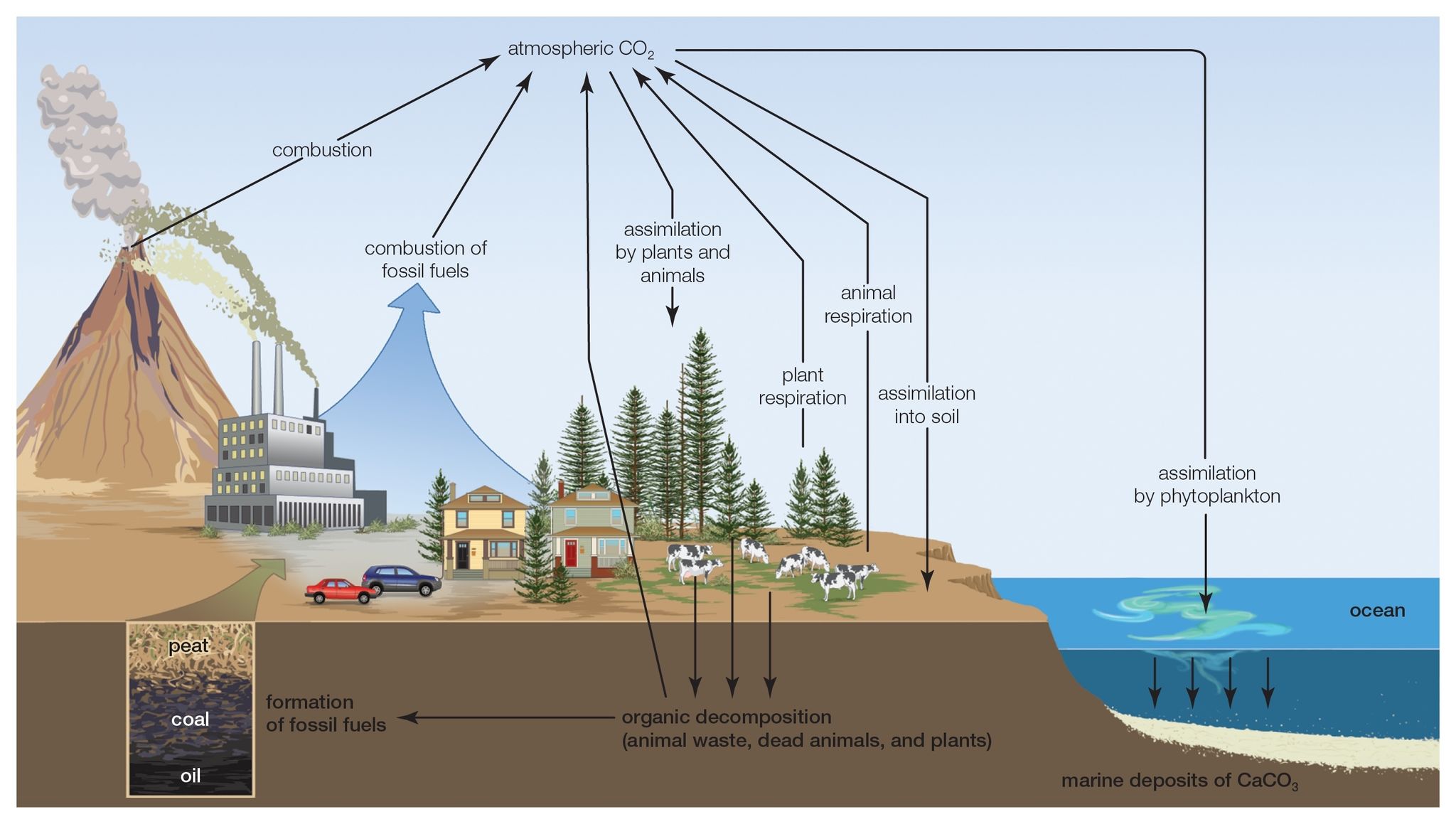
With the help of the Sun, through the process of photosynthesis, carbon dioxide is pulled from the air to make plant________
leaves
food
roots
nutrients
Through food chains, the carbon that is in plants moves to the animals that eat them. When an animal eats another animal, carbon is ___________________.
released
transferred
dissolved
gone
Which process contributes carbon dioxide to the atmosphere?
respiration
photosynthesis
tree farms
Which process removes carbon dioxide from the atmosphere?
deforestation
tree farms
burning fossil fuels
cellular respiration
Which of the following is correct?
There is as much carbon on earth as when it was formed
Carbon is being created whenever it is recycled
Carbon is lost every time it is recycled
Carbon changes to different forms and is never recovered
What is the greatest contributor to atmospheric carbon?
burning garbage
burning biomass
transportation
household usage

What are two (2) ways to reduce the carbon emissions from passenger cars?
Use less expensive gas
Carpooling
Public Transportation
Driving only passenger cars
Respiration is the process by which animals take in _____ and release _____ to make energy.
CO2 +light+H2O --> O2 + glucose
CO2 + glucose + H2O --> O2 + light
O2 + light + H2O --> CO2 + Glucosg
CO2 + O2 + H2O --> Light+ glucose
Cellular Respiration involves the chemical breakdown of _____ to form ATP Energy
Fats
Fructose
Glucose
Proteins
Water vapor leaves a plant in the biosphere and goes into the atmosphere through
transpiration
respiration
precipitation
evaporation
biosphere
all the water on Earth
regions that contain all the living things on Earth
the envelope of gases that surrounds Earth
living things on land
_____ moves underground to the ocean
sea water
groundwater
lake water
rain drops
What happens when water vapor loses thermal energy?
it expands into millions of droplets that form clouds
it condenses into millions of droplets that form clouds
it condenses into millions of droplets that form lakes and rivers
it expands on the surface of plants and goes into the air
atmosphere
all the water on Earth
regions that contain all the living things on Earth
the envelope of gases that surrounds Earth
living things on land
When is energy absorbed during the water cycle?
during evaporation
during transpiration
during condensation
during precipitation
hydrosphere
all the water on Earth
regions that contain all the living things on Earth
the envelope of gases that surrounds Earth
living things on land
____ happens when liquid turns into a gas on Earth's surface
evaporation
condensation
respiration
transpiration
How does energy from the Sun drive evaporation?
it slows down the water molecules and breaks their bonds
it makes the water molecules too big
it speeds up the water molecules and breaks their bonds
it speeds up the water molecules and creates new bonds
reservoirs
water storage areas during the water cycle
places reserved for water usage by humans and animals
made from water and ice that are too big to remain suspended in air
made up of water droplets or ice crystals that are so small they remain suspended in the air
Which statement does NOT apply to the water cycle?
it has no beginning
it has no end
it is continuous
it very rarely changes
clouds
water storage areas during the water cycle
places reserved for water usage by humans and animals
made from water and ice that are too big to remain suspended in the air
made up of water droplets or ice crystals that are so small they remain suspended in the air
Where does water from mountains or land NOT end up?
lakes
rivers
the ocean
space (unless sent there by a volcanic eruption!)
Which of the following drive the movement of water in the water cycle? (choose all that apply)
sunlight
transpiration
gravity
evaporation
Where is groundwater stored?
in lakes and rivers
in underground lakes
in cracks and pores beneath Earth's surface
in mid-ocean ridges
Evaporation adds water to the
biosphere
atmosphere
lithosphere
geosphere
What converts nitrogen gas into a usable form for plants and animals?
bacteria
rain
fungi
car exhaust
The process in which nitrogen circulates and is recycled is called
The nitrogen cycle
The carbon cycle
The water cycle
The phosphorus cycle
Organisms that need nitrogen to survive.
only plants
only animals
only bacteria
all living things
How is nitrogen "fixed" into a usable form for plants?
Through action of bacteria only
Through lightning only
Through action of bacteria and lightning
Through photosynthesis
How do animals get the nitrogen they need?
From the air they breathe
From the water they drink
From the food they eat
From the sun
Gas that makes up 78% of our atmosphere.
Oxygen
Nitrogen
Hydrogen
Carbon Dioxide
What is the process of combining nitrogen gas with other elements to make nitrogen into usable compounds?
nitrogen composition
nitrogen fixation
ammonia
denitrification
What is the formula for atmospheric nitrogen?
N
N2
NH3
NO3
What process occurs when dead plant and animal matter decomposes and nitrogen is released back into the atmosphere?
Assimilation
Fixation
Ammonification
Denitrification
Plants and animals cannot use nitrogen directly from the air.
True
False
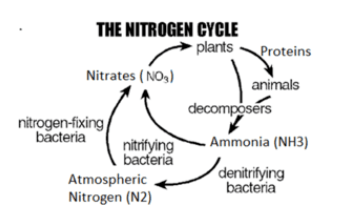
According to this diagram, plants use nitrogen to make _________________________
bacteria
animals
proteins
decomposers
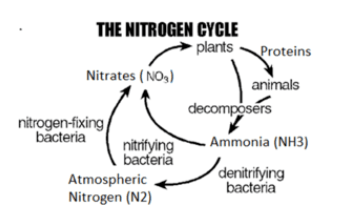
According to this diagram, plants absorb
nitrates
nitrogen fixing bacteria
animals
decomposers
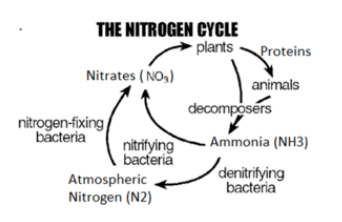
According to this diagram, animals get proteins from eating ________________________
decomposers
bacteria
plants
sunlight
The process that allows organisms to use nitrogen
assimilation
denitrification
fixation
ammonification
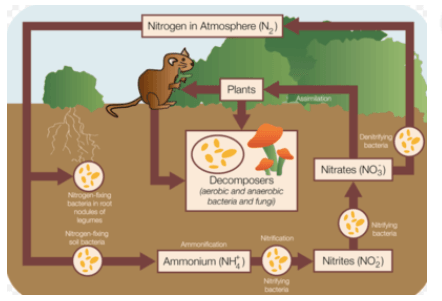
A correct path that nitrogen could take would be
air -> animals -> plants -> bacteria
animals -> air -> bacteria -> plants
bacteria -> air -> plants -> animals
air -> bacteria -> plants -> animals
Bacteria fix nitrogen from the atmosphere into a form plants can use.
True
False
Bacteria create a form of nitrogen that animals can use directly.
True
False
What do free living bacteria in the soil do?
Make clouds
Turn atmospheric nitrogen into nitrates
Make carbon dioxide for plants to go through photosynthesis
Help plants take in water
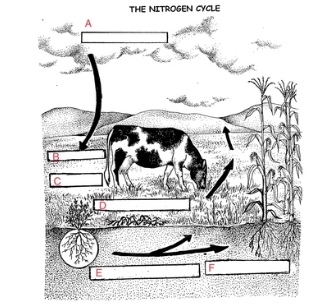
In the nitrogen cycle, what does label A in the diagram represent?
Gas
Clouds
Carbon dioxide in the atmosphere
Nitrogen in the atmosphere
All plants have nitrogen fixing bacteria in their roots.
True
False



