
 Worksheets
Quiz: Electric Charge and Current
Total questions: 75
Worksheet time: 2hrs 5mins
*
What is the electric charge of a neutron?
Neutral
Positive
Negative
Variable
How does an atom become a positive ion?
By having more protons than electrons
By having more electrons than protons
By having equal protons and electrons
By losing all neutrons
What happens when an atom has an equal number of protons and electrons?
It has no overall charge
It becomes a positive ion
It becomes a negative ion
It becomes unstable
Electric charge is a property of atoms and subatomic particles that helps determine the amount of __________.
charge
nuclear energy
electric energy
nuclear force

Match the subatomic particle with it's corresponding letter on the diagram.
Proton
C
Electron
A
Neutron
B
.
What is the overall charge of an atom with eight protons and seven electrons?
+1
-1
0
+2
How does an atom become negatively charged?
By gaining electrons
By losing electrons
By gaining protons
By losing protons
What happens to the charge of an atom if it has an equal number of protons and electrons?
The charge is neutral
The charge is positive
The charge is negative
The charge is +1
Why does the balloon have an overall positive charge?
It has more positively charged ions
It has more negatively charged ions
It has an equal number of positive and negative ions
It has lost electrons
What is the charge of an atom with eight protons and nine electrons?
-1
+1
0
-2

Match each balloon with it's overall charge.
A
Positive Charge
B
Negative Charge
C
Neutral or No Charge

Calculate the overall charge of this shoe.
+4
+2
-6
-4
Which of the following would create a positive charge in a neutral atom?
losing an electron
losing a proton
gaining a proton
gaining an electron
Match each subatomic particle, or part of an atom with its charge.
Proton
Positive
Neutron
No Charge or Neutral
Electron
Negative
An object has a (a) charge when it has more (b) than (c) .
.
What is the electric force between two charged objects?
A push or pull caused by electricity
A magnetic attraction
A gravitational pull
A chemical reaction
What happens when a positively charged object is placed next to a negatively charged object?
They attract each other
They repel each other
They remain neutral
They explode
Why do objects with opposite charges attract each other?
Because of their opposite charges
Because they have the same number of protons
Because they are both positively charged
Because they are both negatively charged
Which of the following pictures correctly represents the electric force between a positively charged object and a negatively charged object.


.
What happens when two objects with similar charges are placed next to each other?
They repel each other.
They attract each other.
They remain stationary.
They neutralize each other.
Which of the following best describes the behavior of two negatively charged objects when placed near each other?
They repel each other.
They attract each other.
They combine to form a neutral object.
They have no effect on each other.
How do electric forces act between two positively charged objects?
They push the objects away from each other.
They pull the objects towards each other.
They have no effect on the objects.
They cause the objects to spin.
What is the result of the electric force between two like-charged subatomic particles?
The particles move away from each other.
The particles move towards each other.
The particles remain in place.
The particles change charge.
Which of the following diagrams correctly represents the electric force between a positively charged object and another positively charged object?


.
What happens to objects with opposite electric charges?
They pull towards each other
They push away from each other
They remain stationary
They rotate around each other
How does the distance between two objects affect the electric force between them?
The closer the objects, the stronger the force
The farther the objects, the stronger the force
Distance does not affect the force
The force is strongest at a medium distance
What determines the strength of the electric force between two objects?
Amount of charge and distance
Color and shape of the objects
Temperature and humidity
Material of the objects
Which of these factors determine the strength of an electric force?
amount of charge
size
time elapsed
distance
Select the pair of objects with the greatest electric force.


Determine which pair of objects has the weakest electric force.


(a) is the force two charged subatomic particles exert on one another.
The charge and (a) between the objects determine the (b) of the electric (c) .

C, A , B
B , A , C
C, B, A
.
What do electric field lines represent in a diagram of electric fields?
The force within an electric field
The direction of a magnetic field
The path of a moving electron
The distance between charged objects
How do electric field line arrows indicate the movement of a positive charged subatomic particle?
They show the direction the particle would move
They show the speed of the particle
They show the particle's charge
They show the particle's mass
What happens when a positively charged object is placed on an electric field line?
It is repelled by the electric force
It is attracted by the electric force
It remains stationary
It loses its charge
What does a higher number of field lines in an area indicate about the electric field?
The electric field is stronger
The electric field is weaker
The electric field is neutral
The electric field is non-existent
Which object has the strongest electrical field?


What is the relationship between field lines and the strength of an electric force?
The greater the number of field lines, the weaker the electric force.
The greater the number of field lines, the stronger the electric force.
An (a) is the area around a charged object where other objects can be affected by electric forces.
.
What is static electricity?
A buildup of charged subatomic particles on an object
A flow of electric current through a conductor
A type of magnetic field
A form of energy produced by friction
How is static electricity created when a student rubs a balloon on her hair?
Electrons move from the student's hair to the balloon
Electrons move from the balloon to the student's hair
Protons move from the student's hair to the balloon
Protons move from the balloon to the student's hair
What happens to the student's hair and the balloon after rubbing?
The hair becomes positively charged and the balloon becomes negatively charged
The hair becomes negatively charged and the balloon becomes positively charged
Both the hair and the balloon become positively charged
Both the hair and the balloon become negatively charged

Electrons are created when a person rubs a balooon on his or her head?


..
What happens to electrons when two objects are rubbed together from friction?
Electrons are destroyed
Electrons move from one object to another
Electrons are created
Electrons stay in place
How does an object become positively charged?
By gaining electrons
By losing electrons
By staying neutral
By gaining protons
What is the process called when charges are rearranged within an object without direct contact?
Conduction
Friction
Induction
Destruction
What happens when a charged object directly touches another object through conduction?
Electrons are destroyed
Electrons transfer from the more negative to the more positive object
Electrons stay in place
Electrons transfer from the more positive to the more negative object
Which of the following are ways in which an object can become charged?
conduction
static
friction
induction
induction
The slippers become charged after rubbing on carpet through (a) .
.
What is electric discharge?
The loss of charges after static electricity has built up on an object
The gain of charges on an object
The movement of electrons from the ground to the clouds
The process of charging an object through friction
What happens to the charges on the ground and clouds after lightning strikes?
They become more equal
The ground becomes negatively charged
The clouds become positively charged
The charges remain the same
What causes a person to feel a shock after rubbing shoes on carpet and touching a doorknob?
Electrons in the doorknob move to the positively charged person
The doorknob becomes positively charged
The carpet loses its charge
The person's shoes become negatively charged
Which of the following is an example of electric discharge?
Lightning
Rainfall
Wind blowing
Sunlight
Which of the following are examples of electric discharge? Choose all that are true.
rubbing hair on balloon
lightning during a thunderstorm
shock after touching a doorknob
bits of paper sticking to a ruler
Why does touching a doorknob after rubbing shoes on the carpet produce a shock?
Due to the discharge of static electricity accumulated on your body.
Which of the following are ways objects can become charged. Choose all that are true!
Electrons can move from one object to another as two objects rub together through friction.
One object becomes charged when it directly touches a charged object through conduction.
Electrons of an object can rearrange themselves when placed near a charged object through induction.
.
What is the SI unit for measuring electric current?
Ampere
Volt
Watt
Ohm
Why can't lightning be used to power devices like a computer?
It does not provide a continuous flow of charges.
It has too high voltage.
It is too dangerous.
It is too unpredictable.
Which device requires more amperes to operate properly?
Video game console
Video game controller
LED light
Smartphone
What does an ampere measure?
The flow rate of electrical current
The voltage of a circuit
The resistance in a wire
The power consumption of a device
What is electric current?

Why can lightning NOT be used to power this dishwasher?
the dishwasher doesn’t need current to operate
lightning does not provide a continuous flow of current
lightning does not provide enough amperes of current
nonenone of the above

Which wire has the most electric current flowing through it?
A
B
C
D
.
What is an electric circuit?
A closed path allowing electric current to flow
A device that stores electric charges
A type of battery
A wire that connects two devices
Why does the light bulb not light up in a non-functioning circuit?
The path is not closed, so current cannot flow continuously
The battery is dead
The wire is broken
The light bulb is faulty
In which direction do electrons flow in a simple electric circuit with a battery?
From the negative end to the positive end of the battery terminal
From the positive end to the negative end of the battery terminal
In a circular motion around the battery
From the light bulb to the battery
What is the energy source in a simple electric circuit?
The battery
The light bulb
The wire
The switch

Which of the following are functioning circuits?
A
B
C
D
Which diagram best shows the flow of electric particles in a circuit.


Why is the circuit above not a functioning circuit?
The circuit must use a larger battery.
Electrons can not flow from the negative end to the positive end of the battery.
The circuit has a light bulb.
The circuit is not a closed continuous loop.
.
What is a direct current (DC)?
An electric current where charges flow in only one direction
An electric current where charges flow in both directions
An electric current used only in appliances
An electric current that switches direction over 100 times in one second
Which of the following devices is powered by direct current?
Refrigerator
Washing machine
Flashlight
Toaster
How does an alternating current (AC) flow?
In one direction only
In both directions, switching over 100 times in one second
In a circular motion
In a zigzag pattern
What type of current do household outlets use?
Direct current
Alternating current
Static current
Pulsating current
Which statement is true about alternating current?
It flows in one direction only
It is used in batteries and cars
It switches direction over 100 times in one second
It is used only in computers
Below you will find two examples of electrical currents, a direct current and an alternating current.
Select the example that demonstrates an alternating current.


An (a) is a closed path allowing electric current to flow.
(a) current flows only in one direction.
Batteries, cars, flashlights, and computers use (a) current.
(a) current flows in both directions.
.
What is a conductor?
A material that allows electric current to pass through easily
A material that prevents electric current from passing through easily
A type of insulator
A type of semiconductor
Why are most wires made from copper?
Because copper is an excellent conductor
Because copper is a good insulator
Because copper is cheaper than other metals
Because copper is a type of rubber
Which material is typically used as an insulator for wires?
Rubber
Copper
Silver
Nickel
What is the main purpose of an insulator in electrical wiring?
To prevent electrical shocks
To allow electric current to pass through easily
To conduct electricity better than copper
To increase the flow of electric charges
What is an insulator?
.
What is a semiconductor?
A material that allows more electric current to pass through than an insulator but less than a conductor
A material that allows no electric current to pass through
A material that allows more electric current to pass through than a conductor
A material that allows electric current to pass through without any resistance
Which materials are most commonly used as semiconductors?
Silicon and germanium
Copper and aluminum
Iron and nickel
Gold and silver
Why are semiconductors important in computers?
They allow engineers to control the direction and flow of electrical current
They completely block the flow of electrical current
They are the only materials that can conduct electricity
They are cheaper than other materials
Match each description to the type of material.

Conductor

Semiconductor

Insulator
Order the three types of materials from least conductive to most conductive.
1 being the least conductive and 3 being the most conductive.
insulator
semiconductor
conductor

An engineer is tasked with designing a power cord that needs to carry electric charges very long distances. Which type of material should she use?

Technicians who repair power lines usually wear gloves.
What kind of material would be best for these gloves and why?
Technicians who repair power lines usually wear gloves. Technicians should use gloves which do not allow electric current to (a) through easily. (b) , such as rubber, would (c) electric charges from passing (d) easily.
(a) are a type of material where electric charges can move very easily.
(a) are a type of material where electric charges cannot move easily.
(a) are a type of material where electric charges can flow but not as easily as electrical conductors.
.
What is the SI unit for voltage?
Volt (V)
Ampere (A)
Ohm (Ω)
Watt (W)
How is voltage similar to water pressure?
Both determine the rate of flow in their respective systems.
Both are measured in volts.
Both are related to temperature.
Both are forms of energy.
Which battery has a higher electric pressure according to the passage?
The green 9-volt battery
The gold 1.5-volt battery
Both have the same electric pressure
Neither has electric pressure
What happens to the current if the voltage increases?
The current increases.
The current decreases.
The current remains the same.
The current stops.

What is voltage?
Voltage is the amount of work needed to move each charged particle between two points
(a) is the amount of (b) needed to move each unit of charge between two points. The SI unit used to write the amount of voltage is the (c) (V).
Rearrange these batteries so they are in order from smallest to greatest voltage.


.
What is resistance?
The opposition to an electric current passing through an object
The flow of electric current through a conductor
The ability of a material to conduct electricity
The speed at which electrons move through a circuit
Which of the following materials would likely have the highest resistance?
Rubber
Copper
Silver
Gold
How does temperature affect the resistance of an object?
Resistance increases as temperature increases
Resistance decreases as temperature increases
Temperature has no effect on resistance
Resistance fluctuates randomly with temperature changes
Why do most computers have fans?
To prevent circuits from getting too hot and increasing resistance
To cool down the user
To increase the speed of the processor
To reduce the size of the computer
What happens to the resistance of a copper wire as its length increases?
Resistance increases
Resistance decreases
Resistance remains the same
Resistance fluctuates
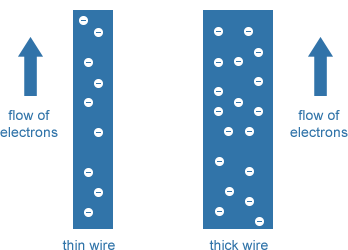
The thickness of a material can affect the resistance of an object. The resistance of an object decreases as the thickness of a material increases. Electrons can move through a thick wire more easily since there is a larger area for electrons to travel.
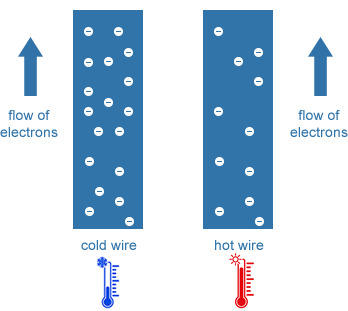
The resistance of an object increases as the temperature increases. For example, circuits in computers do not function properly at high temperatures. This is partly due to the increased resistance in the circuit. When the temperature is higher, the atoms are moving faster and there are more collisions, so it is harder for the electrons to move. In other words, the resistance increases.
What happens to the resistance of an object as the thickness of a material increases?
The resistance decreases
The resistance increases
The resistance remains the same
The resistance fluctuates
Why do circuits in computers not function properly at high temperatures?
Increased resistance in the circuit
Decreased resistance in the circuit
Stable resistance in the circuit
No resistance in the circuit
How does temperature affect the movement of electrons in a wire?
Higher temperature increases collisions, making it harder for electrons to move
Higher temperature decreases collisions, making it easier for electrons to move
Temperature has no effect on electron movement
Higher temperature stabilizes electron movement
Which combination of factors would produce the strongest electric current?
high resistance, low voltage
low resistance, high voltage
high resistance, high voltage
low resistance, low voltage
(a) prevents the flow of current. The (b) the resistance, the greater the flow of current. (c) is the amount of electric pressure. A greater voltage results in a (d) flow of electric current. Therefore, a low resistance combined with a high voltage would produce the (e) electric current.
Select the object that would provide the least resistance.


Select the object that would provide the least resistance.


Select the object that would provide the least resistance.


Imagine an electrician is designing a circuit. She is comparing different types of wires that can be used for the circuit. Order the following types of wire from least to greatest resistance.
Hint: Copper wire is more conductive than most metals.


Copper is one of the strongest conductors because it provides the least resistance to a current. Iron is a conductor, but still provides more resistance than copper. The longer the wire, the greater the resistance. The resistance of an object decreases as the thickness of wire increases. The resistance of an object decreases as the temperature of a wire decreases.

What is one of the strongest conductors mentioned in the passage?
Copper
Iron
Aluminum
Silver
How does the resistance of an object change with the thickness of the wire?
Decreases as thickness increases
Increases as thickness increases
Remains the same
Varies unpredictably
What happens to the resistance of a wire as its temperature decreases?
Resistance decreases
Resistance increases
Resistance remains constant
Resistance fluctuates
Which factor increases the resistance of a wire?
Longer wire length
Thicker wire
Lower temperature
Higher conductivity

In which of the following materials do charges flow more easily?
glass
wool
metal
rubber

If you increase the size of the resistor and keep the voltage the same, what will happen to the current?
Current will increase
Current will decrease
Current will stay the same
What happens to the electric current if the voltage is doubled and the resistance remains constant?
The current is reduced to zero
The current is doubled
The current stays the same
The current is halved
Which of the following is a good insulator of electricity?
Copper
Plastic
Aluminum
Silver
If the resistance in a circuit is decreased while keeping the voltage constant, what will happen to the current?
Current will remain unchanged
Current will increase
Current will decrease

You know that the object connected to the wires is a conductor because: (a)
It's a complete circuit.
It's a closed circuit.
The object is shiny.

Which of the following is NOT a good conductor of electricity?
Copper
Aluminum
Rubber
Gold

