
 Worksheets
Interim 2
Total questions: 142
Worksheet time: 2hrs 16mins

inner core


What tool do you use to test a mineral's hardness?
water
clay tiles
nail
penlight
What tool do you use to test a mineral's true color?
water
clay tiles
nail
penlight
What tool helps you determine if a mineral is opaque, transparent, or translucent?
water
clay tiles
nail
penlight
A precious stone that has been cut or polished.
fossil
cleavage
gem
luster
What tool helps us determine the true color or smell of a mineral?
water
clay tiles
nail
penlight
The way a mineral reflects light.
fossil
gem
cleavage
luster
Sedimentary rocks may have these remains of an organism inside of it.
cleavage
gem
luster
fossil
What makes a test of minerals a "fair test?"
You test each mineral differently
You test the mineral with a magnet
You test each mineral the same exact way
You test the mineral with a nail
What is the softest mineral?
feldspar
muscovite
talc
diamond
What is the hardest mineral?
graphite
fluorite
diamond
gypsum
A table is considered...
Opaque
Translucent
Transparent
A window is considered...
opaque
translucent
transparent
This type of rocks is made up of layers that are cemented together.
Igneous
Metamorphic
Sedimentary
This type of rock can be changed by heat, pressure, and water.
Igneous
Metamorphic
Sedimentary
What color is the mineral sample sulfur?
Green
White
Yellow
Brown
This type of rock is formed when melted rock cools.
Igneous
Metamorphic
Sedimentary
Using a penlight to observe if light passes through a mineral is what kind of test?
Light
Luster
Magnetism
Streak
If a mineral breaks into a defined shape, such as a cube, it has...
Cleavage
Fracture
Minerals can be found in medicines.
True
False
The hardness of a mineral is measured by a scale known as...
Luster scale
Hardness scale
Moh's scale
Transmissivity scale

What is the correct order (starting from the surface) of Earth’s layers?
crust, outer core, inner core, mantle
mantle, outer core, inner core, crust
crust, mantle, outer core, inner core
outer core, inner core, crust, mantle
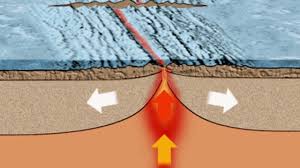
In sea-floor spreading, molten material rises from the mantle and erupts
along the edges of all the continents.
along mid-ocean ridges.
in deep-ocean trenches.
at the north and south poles.

The process by which the ocean floor sinks beneath a deep-ocean trench and back into the mantle is known as _______
convection.
continental drift.
subduction.
conduction.

Most geologists think that the movement of Earth’s plates is caused by _______
convection.
continental drift.
subduction.
conduction.
The geological theory of _______ states that pieces of Earth’s lithosphere are in constant, slow motion.
subduction
plate tectonics
deep-ocean trenches
sea-floor spreading
A place where two plates slip past each other, moving in opposite directions, is known as a _______
transform boundary
divergent boundary.
convergent boundary.
rift valley.
Scientists think that convection currents flow in Earth’s
continents.
mantle.
lithosphere.
inner core.

The place where two plates come together is known as a _______
transform boundary.
divergent boundary.
convergent boundary.
rift valley.

Below is a picture of sea-floor spreading. How are the ocean crusts moving?
Converging
Diverging
Sliding
No movement
The San Andreas Fault in California is known as an active earthquake area. What type of
boundary is it?
Converging
Diverging
Transform
Sea Floor Spreading
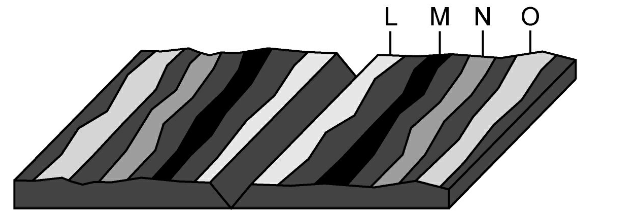


Soil is made of:
pieces of rock
air and water
matter that was once alive
all of the above

Which layer of soil has low organic material and has clay in the form of aluminum and iron compounds?
Topsoil
Bedrock
Subsoil

Which layer of soil contains lots of roots and minerals for growing plants?
Topsoil
Subsoil
Bedrock

Soil horizon is horizontal. Soil profile is vertical?
true
false

What is HUMUS made from?
The remains of decayed plants.
Both
The remains of decayed animals.
____________________ is energy that can be replaced as quickly as it is used.
nonrenewable
renewable
nuclear
kinetic
Fossil fuels are renewable because the Earth provides humans with an unlimited amount.
True
False
What are the 3 main fossil fuels?
Coal, Oil, and Gasoline
Uranium, Gasoline, Petroleum
Coal, Oil, Biomass
Coal, Oil, Natural Gas
Which of the following is a nonrenewable resource?
Biomass
Oil
Geothermal
Water


Precipitation means...
water vapor cooling to form clouds
water running downhill
water falling from the sky
water heating up and rising as gas
Runoff means...
water vapor cooling to form clouds
water running downhill
water falling from the sky
water heating up and rising as gas
Condensation means...
water vapor cooling to form clouds
water running downhill
water falling from the sky
water heating up and rising as gas

Evaporation means...
water vapor cooling to form clouds
water running downhill
water falling from the sky
water heating up and rising as gas
During evaporation water changes from ...
water vapor (gas) to liquid
liquid to water vapor (gas)
water vapor (gas) to solid ice
During condensation water changes from ....
solid ice to liquid water
liquid water to water vapor (gas)
water vapor (gas) to liquid water drops
Liquid water turns into gas and rises into the sky in....
precipitation
condensation
evaporation
Water falls from the sky in...
evaporation
condensation
precipitation
_____________________ is the step of the water cycle where the Sun heats up liquid water in a puddle and turns it into water vapor gas.
precipitation
evaporation
runoff
What are volcanic islands?
Gently sloping, shallow area
Mountains that reach the ocean surface
A geyser on the ocean floor
Underwater inactive volcanic mountains
What is a hydrothermal vent?
A geyser on the ocean floor
A smooth flat area on the ocean floor
Continuous underwater mountain range
A deep, steep-sided canyon at a subduction zone
What is a seamount?
Continuous underwater mountain range
A geyser on the ocean floor
At the edge of the shelf, the ocean floor drops down an incline
Underwater, inactive volcanic mountains
What is a trench?
Gently sloping, shallow area
A deep, steep-sided canyon at a subduction zone
A smooth and flat area on the ocean floor
At the edge of the shelf, the ocean floor drops down an incline
What is the Mid-Ocean Ridge?
Continuous underwater mountain range
A geyser on the ocean floor
Mountains that reach the ocean surface
Underwater, inactive volcanoes
What is an abyssal plain?
A smooth, flat area on the ocean
Mountains that reach the ocean surface
Gently sloping, shallow area
At the edge of the shelf, the ocean floor drops down an incline
What is a continental shelf?
Gently sloping, shallow area
Underwater, inactive volcanic mountains
A smooth, flat area on the ocean floor
A geyser on the ocean floor
What is a continental slope?
A gently sloping, shallow area
A continuous underwater mountain range
At the edge of the shelf, the ocean floor drops down an incline
Underwater, inactive volcanic mountains
At which type of plate boundary do volcanoes form?
Convergent - Continental and Oceanic Crust
Convergent- Continental and Continental Crust
Convergent - Oceanic and Oceanic Crust
What causes tsunamis?
Earthquakes
Typhoons
Hurricanes
Weather
Earthquakes happen when tectonic plates do what?
Move apart
Come together
Slide past each other

The arrow above the water is coming down and is blue because
the water is warm so it warms the air and warm air sinks.
the water is cold so it warms the air and cool air sinks.
the water is cold so it cools the air and cool air sinks.
the water is warm so it warms the air and cool air sinks.
The arrow above the land is going up and is red because
the land is warm so it warms the air and warm air rises.
the land is cold so it warms the air and cool air sinks.
the land is cold so it cools the air and cool air sinks.
the land is warm so it warms the air and cool air rises.

The H pressure area involves cold air moving _____________ and is near the _____________.
down ; land
up ; water
down ; water
up ; land
The L pressure area involves warm air moving _____________ and is near the _____________.
down ; land
up ; land
down ; water
up ; water
What causes the moon's phases
Where you are standing on Earth
the amount of sunlight reflected onto the moon from the sun
The tilt of Earth
how fast the moon is moving
The spinning of the earth on its axis that causes day and night is called
orbit.
axis.
rotation.
revolution.
The path of an object in space around another object is a(n)
orbit.
axis.
rotation.
revolution.
It takes about _____ for the earth to complete one rotation.
28 days
24 hours
365 hours
365 days

What planet is closest to the sun?
Mars
Earth
Venus
Mercury
What are the four inner planets?
Earth, Uranus, Mercury, Venus
Mercury Venus Earth Saturn
Mars, Earth , Mercury, Venus
Mars, Earth, Neptune, Mercury
Which planet is farthest from the sun?
Neptune
Jupiter
Mercury
Uranus
What are the outer planets?
Jupiter, Saturn, Earth, Neptune
Saturn, Neptune, Mars, Uranus
Uranus, Saturn, Neptune, Jupiter
Mercury, Venus, Earth, Mars
What is the fourth planet from the sun?
Mars
Earth
Saturn
Venus
What is at the center of our solar system?
asteroid belt
Earth
sun
moon
What is the sixth planet from the sun?
Uranus
Saturn
Earth
Venus
Which planets are made of solid surfaces and rocky cores?
terrestrial
gas giants
outer planets
Which planets are mostly made of gases?
terrestrial
gas giants
inner planets
Which planet is third from the sun?
Mars
Earth
Mercury
Venus
Which planet is a gas giant?
Mercury
Earth
Saturn
Venus
Which planet is a terrestrial planet?
Uranus
Neptune
Jupiter
Venus
Which planets are the gas giants?
Earth, Jupiter, Venus, Neptune
Saturn, Uranus, Jupiter, Neptune
Jupiter, Saturn, Uranus, Mars
Uranus, Jupiter, Earth, Neptune
Which planets are all inner planets?
gas giants
terrestrial planets
Which planets are all outer planets?
gas giants
terrestrial planets
How many planets are in our solar system?
6
7
8
9
Which two facts describe Earth?
inner planet
outer planet
terrestrial planet
gas giant



