
 Worksheets
EOY Review 6th
Total questions: 138
Worksheet time: 2hrs 3mins
Mitochondria
Makes energy (ATP)
Cell membrane
allows things in an out (selectively permeable)
Nucleus
Command center; houses DNA, boss
Vacuole
Storage bubble
Ribosomes on the ER
Make proteins
Why is the vacuole larger in plants?
They can't walk to water
Chloroplasts are...
in plants, green, and responsible for photosynthesis
The cell wall...
is outside the cell membrane and provides extra structure and support to plants

Nucleus

mitochondria

chloroplast
Mitochondria
Makes energy (ATP)
Cell Wall
outside the cell membrane; gives plants added structure
Nucleus
Command center; houses DNA, boss
Cytoplasm
The "gel" that holds it all together
Ribosomes on the ER
Make proteins
(a) have cell membranes, mitochondria, vacuoles, cytoplasm, endoplasmic reticulum, and a nucleus. (b) have ALL of those, a BIGGER (c) , AND (d) .
Which of these are part of cell theory?
all cells come from other preexisting (living) cells
cells are the basic (most simple) unit of life
all living things are made of cells
humans are multicellular
organisms grow by increasing the size of their cells
Prokaryotic
A cell that has NO nucleus
A cell that has a nucleus
An organism with one cell
An organism with many cells
Eukaryotic
A cell that has NO nucleus
A cell that has a nucleus
An organism with one cell
An organism with many cells
Unicellular
A cell that has NO nucleus
A cell that has a nucleus
An organism with one cell
An organism with many cells
Multicellular
A cell that has NO nucleus
A cell that has a nucleus
An organism with one cell
An organism with many cells
DNA is stored in the nucleus in ___________ cells.
Eukaryotic
Prokaryotic
Neither
Both prokaryotic and eukaryotic
TRUE OR FALSE: Unbalanced forces result in a change of motion.
True
False
What are the two factors that FRICTION depends upon?
Mass and Strength of the force pushing the two surfaces together
Mass and Distance
Type of surface and Strength of the force pushing the two surfaces together
Type of surface and Distance apart
What are the two factors that gravity depends on?
Mass and Type of surface
Distance and Width
Mass and Distance
Distance and Type of surface
What is the difference between Weight and Mass?
Weight stays the same; Mass depends upon gravity
Mass and Weight both stay the same
Mass and Weight both change due to gravity
Mass stays the same; Weight depends upon gravity
What is Friction ?
The distance an object travels per unit of time
Speed in a given direction
Force that opposes motion
Force that pulls objects towards each other
What is Gravity ?
The distance an object travels per unit of time
Speed in a given direction
Force that opposes motion
Force that pulls objects towards each other

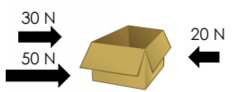
What is the net force acting on the object? (Just write the number)
(a)
Friction acts in the direction OPPOSITE to the direction of motion
True
False
What do applied forces, normal forces, and friction all have in common?
They are unbalanced.
They all push or pull from a distance.
They all push or pull through physical contact.
They are all types of gravity.
What happens if forces on an object are balanced?
There will be no change in motion.
The object will accelerate.
The object will stop moving.
The object will slow down.
The force between two charged objects is:
friction
gravitational force
magnetic force
electrical force
The force of attraction or repulsion between two magnetic poles:
friction
gravitational force
magnetic force
electric force
The Law of Universal Gravitation states:
Any two objects in the universe with mass will attract each other.
Energy cannot be created or destroyed, only transformed.
An object in motion will stay in motion unless acted upon by an outside force.
Gravity only exists in parts of the universe with large planets or stars.
The type of force that occurs when two objects are in direct contact.
Contact force
Distance force
The type of force that occurs when two objects are NOT in direct contact.
Contact force
Distance force
Which of the following best describes the difference between weather and climate?
Weather happens in your state, and climate happens in your country.
Weather includes the wind and rainfall, whereas climate only describes the temperature.
Weather can be predicted but climate cannot.
Weather describes conditions such as wind and rain at a particular time, whereas climate describes typical seasonal conditions.
Which one of the following factors does NOT influence climate?
ocean currents
the Sun's energy
global wind patterns
beach erosion
If you start at the equator and head north, on average the climates will get
drier
cooler
wetter
warmer
The average winter temperature is 30 degrees F.
weather
climate
The high temperature today will be near 75 degrees F.
weather
climate
What is the main cause of water evaporation from the ocean?
Heat energy from the Sun
Wind and wave action along the shore
Heat energy from the ocean floor
Currents in the ocean

Which best explains why the Gulf Stream tends to bring warmer air to the east coast of Florida?
The Gulf Stream brings water from the equator
The Gulf Stream is the result of the Earth’s Rotation
The Gulf Stream changes direction each year
. The Gulf Stream is a deep ocean current

The process in which water vapor is released into the atmosphere through plants.
evaporation
transpiration
condensation
precipitation

In order for evaporation to occur, liquid water must change state into a ___________.
gas
solid
plasma

What tool is used to measure the relative amount of water in the air (humidity)?
a barometer
an anemometer
a psychrometer
a thermometer
Heating by Radiation
Air molecules touch the warm ground, heating them up.
Warm air rises and takes heat with it; eventually it cools and sinks.
Sunlight travels through space without the aid of fluids or solids.
Air at the equator rises and sinks at the poles.
Heating by Conduction
Air molecules touch the warm ground, heating them up.
Warm air rises and takes heat with it; eventually it cools and sinks.
Sunlight travels through space without the aid of fluids or solids.
Air at the equator rises and sinks at the poles.
Heating by Convection
Air molecules touch the warm ground, heating them up.
Warm air rises and takes heat with it; eventually it cools and sinks.
Sunlight travels through space without the aid of fluids or solids.
Land and ocean absorb and re-emit heat from the sun.
Which direction does air flow?
from warm temperatures to cold temperatures
from areas of high pressure to areas of low pressure
from east to west
from high elevations to low elevations
Which is true about temperature, humidity, and pressure in an air mass?
Temperature and humidity vary, but pressure does not.
Temperature, humidity, and pressure are basically the same all through an air mass.
Temperature at the border of an air mass is always higher than in the middle.
Humidity makes the pressure in an air mass increase.
Temperature is affected by
Latitude
Altitude
Distance from large bodies of water
Ocean Currents
All of the above
Maritime Polar
Dry and cold. Form over land in Canada.
Maritime Tropical
Humid and hot. Form over ocean near the equator.
Continental Polar
Humid and cold. Form over icy water in the North Atlantic Ocean.
Continental Tropical
Dry and hot. Form over deserts and other dry land.
Based on latitude, what are the three temperature zones that the Earth can be divided into?
tropical, polar and equatorial
polar, temperate and dry
equatorial, tropical and wet
tropical, temperate and polar
What is Newtons 1st Law of Motion?
Every action has an equal but opposite Reaction
An object in motion/rest stays in motion/rest unless acted upon by an outside force.
A larger mass object requires more force to move
Every action has an equal but opposite reaction.
1st law
2nd law
3rd law
Newton's Second law basically says that
the more force applied to an object, the slower it will accelerate
the more force applied to an object, the faster it will accelerate
In the formula f=ma, the a stands for
net force
mass
applied force
acceleration
In the formula f=ma, the f stands for:
net force
mass
application
acceleration
In the formula f=ma, the m stands for:
net force
mass
application
acceleration
There is a skateboard rolling and then Billy steps on it and it stops. What Law of motion is this?
3rd
2nd
1st
Think about pushing a shopping cart and a car. If you apply the same amount of force to both, the shopping cart will travel fast, but the car will hardly move. To move the car yo would need a larger force. Which of Newton's laws is being represented?
1st
2nd
3rd
Sally jumps on her trampoline. She exerts a force on the trampoline and the trampoline exerts an equal but opposite force back on Sally. This represents
Law 1
Law 3
Law 2
Force is a ________ or ________ that is required to change the motion of an object.
up/down
push/pull
sliding/shifting
The unit used to measure force is called ________________
mass
acceleration
net force
newton
If you slide a piece of paper across a table top, what force slows down and eventually stops the paper?
gravity
air resistance
friction
Choose the letter of the correct answer.
1. What method of heat transfer requires direct contact between objects?
Convection
Radiation
Conduction
Sublimation
2. Which of the following materials will undergo convection?
Liquid and gas
Gas and solid
Solid and liquid
Gas only
How does the heat of the Sun reach the Earth?
Thermal expansion
Conduction
Convection
Radiation
5. You are holding a metal wire on one end, while the other end is placed over the flame. Very soon, the wire is too hot to handle. What method of heat transfer is taking place?
Convection
Conduction
Radiation
Sublimation
When you touch a piece of ice with your finger, energy flows _______.
from your finger to the ice
from the ice to the finger
both ways
energy does not flow

The woman is cooking a noodle soup. How does the heat travel through the pan?
Radiation
Dispersion
Convection
Conduction

The lady is cooking a noodle soup. How does the heat travel through the soup?
Radiation
Dispersion
Convection
Radiation
In convection in gases, what happens with the cold air?
Cold air rises
Cold air sinks
Cold air moves up and down
Cold air moves side ward
Wind is defined as moving air. It is caused by unequal heating of the Earth"s surface. What method of heat transfer is taking place in this phenomena?
Convection
Conduction
Radiation
Dispersion
What method of heat transfer does not require a medium?
Conduction
Convection
Radiation
Dispersion
What happens with air if temperature increases?
the air rises
the air sinks
the air move side ward
the air move vertically
Temperature is:
How hot or cold something is
The average kinetic energy of the particles in an object
The same as thermal energy
A measure of light energy
Heat transfers from higher temperature to lower temperature.
True
False
Materials that transfer heat very well are called
Thermal Insulators
Thermal Heaters
Thermal Communicators
Thermal Conductors
Materials that do not transfer heat very well are called
Thermal Insulators
Thermal Materials
Thermal Communicators
Thermal Conductors

The pace an object travels in a certain amount of time
speed
acceleration
Velocity
motion

A push or a pull are examples of
force
motion
weight
mass

This motion graph represents:
constant speed
acceleration
object at rest
slowing down

At which point is potential energy greatest?
W
X
Y
Z
A point that is not in motion, used to determine the speed of an object in motion is called:
(a)
The process of breaking rock and sediment into smaller pieces is known as...
Deposition
Weathering
Erosion
Constructive force
Running water from the Colorado River "cut down" into layers of rock to form the Grand Canyon
True
False
Plants and animals can cause weathering and erosion
True
False
The two types of weathering are...
Slow and rapid
Mechanical and chemical
Biological and physical
Temporal and gravitational
When water and gravity combine to cause mechanical weathering and erosion...
A volcano may erupt
A landslide or mudslide may result
Tectonic plates may shift
An island may form
Sand dunes form as a result of...
Recycling of crust at subduction zones
Erosion and deposition by wind
Freezing and thawing rock
Erosion and deposition by water
Sandy beaches are built up through the process of...
Deposition
Convection
Weathering
Destructive forces
When water freezes in cracks in rocks, it expands causing the rock to break. This is known as...
ice breaking
ice wedging
ice melting
ice cutting
The destructive force caused by the chemical reactions of water, oxygen, carbon, and other chemicals in the presence of moisture and heat is known as...
Mechanical weathering
Photosynthesis
Chemical weathering
Chemical reaction
Match the following...
Weathering
When rocks and land are broken down due to forces such as gravity, wind, water, and ice
Erosion
When rocks and sediment are moved elsewhere by water, ice, wind, or gravity
Deposition
When features are built up on Earth's surface by sediment, tectonic plates, or volcanoes
The deposition of sediment at the mouth of a river is a constructive force known as a...
Delta
Shore
Beach
Pond

This landform is formed by
water erosion
wind erosion
deposition
glaciers

What is this landform?
delta
canyon
valley
sand dune

This landform is formed by
water erosion
weathering
deposition of sediments
glaciers
Glaciers are masses of ice that move slowly on land. Which of these features was most likely formed by a glacier?
A wide valley
A deep ocean
A lava flow
A mountain range
A triangular landform where a river empties into another body of water.
Landform
Canyon
Delta
Valley
A deep gorge in the surface of Earth formed by the erosion of moving water and sediment.
Valley
Delta
Canyon
Landform
Hills formed by wind blowing, moving and depositing sand.
Valley
Dune
Delta
Canyon
The build up of land by the settlement of sediments and soil in a new location.
Weathering
Erosion
Deposition
River
The movement of sediment down a fast-moving river.
Weathering
Erosion
Deposition
River

Something that hangs on the cave's ceiling.
a stalactite
a stalagmite
a column

Something that rising from the ground.
a stalactite
a stalagmite
a column

Meteors begin to burn up in the...
stratosphere
thermosphere
troposphere
mesosphere
Where would there be more pressure?
on top of a roof of a tall building
sitting in this classroom
on top of a mountian
sitting in the top row of a stadium
Cara read an article on why repetition and replication are so important, but she did not understand the difference between them. Which of the following best explains the two terms?
Repetition is when a scientist repeats an experiment; replication is when a scientist conducts an experiment on genetic material.
Repetition is when a scientist does the same experiment a number of times; replication is when other scientists reproduce a scientist’s experiment.
Repetition is when a scientist publishes in more than one scientific periodical; replication is when another scientist reproduces another scientist’s results.
Repetition is when a scientist commits an error in an experiment the first time and must repeat it; replication is when a scientist repeats an experiment to make sure it is valid.

