
 Worksheets
Waves & Electromagnetic Radiation
Total questions: 134
Worksheet time: 6hrs 24mins

What do all waves transfer?
Matter
Heat
Electricity
Energy

Which of the following can waves transfer energy through?
solid
liquid
gas
empty space
all of the above
What are the two types of waves?
longitudinal and transverse
sound and light
wavy & slinky

What is the number of complete waves passing a fixed point in a given amount of time?
Amplitude
Intensity
Wavelength
Frequency

What is the frequency of this wave? You must count the number of complete waves.
1 Hz
5 Hz
10 Hz
What is frequency measured in?
Milliseconds
Miles
Hertz
Kilograms
a wavelength refers to...
how long it takes for the wave pattern to repeat.
how strong a wave is.
how long a wave is.
how much energy a wave has.

Which type of waves have the longest wavelength?
Visible light
Radio waves
X-rays
Gamma-Rays

Wavelengths are usually measured in ....
seconds
Hz
inches
meters

Shorter wave lengths can carry more energy. Which of these probably carries the MOST energy:
Infrared light
Visible light
X-rays
UV light

What does #1 represent?
Period
Frequency
Wavelength
Amplitude

What kind of wave is pictured?
compressional wave
transverse wave
sound wave
mechanical wave
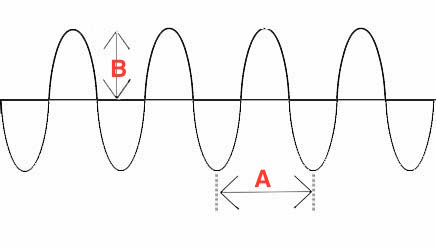
What property of this wave is represented by the letter "A"
amplitude
crest
trough
wavelength

What is the disturbance involving energy transfer from one place to another?
Medium
Amplitude
Wave
Vibration


The diagram shows a cartoon of a sound wave produced while a student is speaking.
What happens to the sound wave when the student speaks louder?
The amplitude increases
the wavelength will double
the speed will increase
the amplitude will decrease
________ travels through solids fastest because the molecules are closer together
sound
light
The distance from the wave crest to the equilibrium Level
Wave
Amplitude
Wave Crest
Wave Trough
Wave Height
The highest part of a wave.
Wave
Amplitude
Wave Crest
Wave Trough
Wave Height

The lowest part of a wave.
Wave
Amplitude
Wave Crest
Wave Trough
Wave Height

distance between two consecutive wave crests or between two consecutive wave troughs.
Wave
Amplitude
Wave Length
Wave Trough
Wave Height
The part of a wave that the particles are more pushed together.
Compression
Rarefaction
Particles
Wave
The part of a wave that the particles are pulled apart
Compression
Rarefaction
Particles
Wave

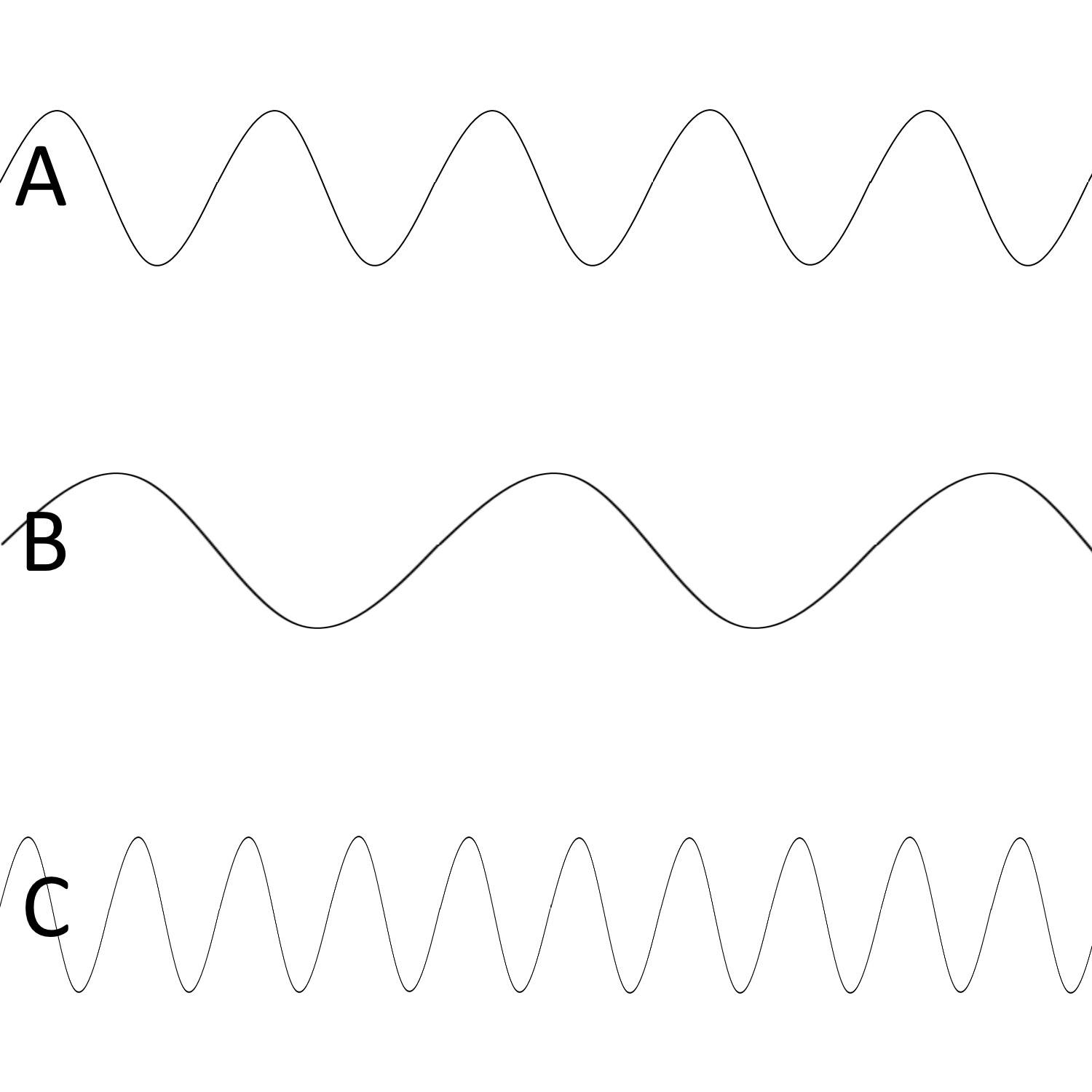
Which transverse wave has the highest frequency?
1
2
3
4
Which diagram shows the wavelength of a wave?


If the wavelength of a wave increased, what would happen to the frequency?
decrease
increase
stay the same
A wave that can travel through matter and empty space is a:
electromagnetic wave
longitudinal wavy
transverse wave
mechanical
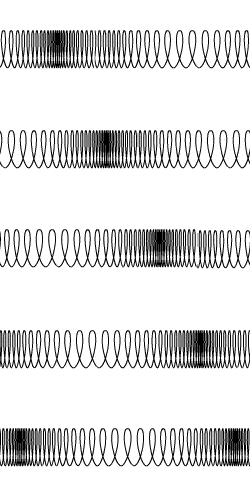
What type of wave is this?
Longitudinal
Transverse
Electromagnetic
x ray


You can't hear sounds in outer space because there is no
medium
light
energy
heat
Which are properties of a mechanical wave?
can be longitudinal or transverse
can move through outer space
must have matter to move
carries energy
What determines what color of light your eyes perceive?
The frequency of the wave
The amplitude of the wave
The intensity of the wave
The type of wave it is
Isaac Newton found that sunlight is a mix of different wavelengths Which evidence supports this?
light is white.
light is found all over the universe
light separates into colors in a prism
light can travel very rapidly through space
A wave is traveling in one medium. Then it begins traveling through another medium and changes direction. What happened?
The wave was absorbed
The wave was transmitted
The wave was refracted
The wave was reflected

Which wave has the most energy?
Wave 1
Wave 2
Wave 3
Wave 4

Which of these waves would be the dimmest?
Wave 1
Wave 2
Wave 3
Wave 4
What makes the sky blue?
Light refracting off the atmosphere
Light reflecting the color of the oceans
The atmosphere absorbed all the colors but blue
The atmosphere transmits the blue light

Identify B
Wavelength
Crest
Amplitude
Trough
If you increase the energy put into a wave how will the change the wave?
Change the crest
Change the trough
Change the type of wave
Change the frequency
What wave has particles that move perpendicularly to the direction of the wave?
Transverse waves
Longitudinal waves
Sound waves
Light waves

What is Letter A?
Crest
Wavelength
Amplitude
Frequency

What is letter B?
Crest
Wavelength
Trough
Frequency

Which letters are pointing to the Amplitude?
B
E
C
F
The wavelength is measured from crest to trough.
True
False
A wave is a repeating back and forth pattern of motion.
True
False
Waves carry matter, not energy.
True
False
A wave has a frequency(f) of 2 waves per second and a wavelength(w) of 5 cm. What is the velocity of the wave? HINT: V = f x w
10cm/s
7cm/s
3cm/s
Not possible
The sound is now a higher note/tone. What changed?
increase in amplitude
decrease in amplitude
increase in frequency
decrease in frequency
The volume of the sound just got softer. What happened to the wave?
increase amplitude
decrease amplitude
increase frequency
decrease frequency
When the frequency changes on a wave, what other property also changes?
amplitude
wavelength
crest
node
A faster frequency has _________ energy.
more
less
the same amount
none
Three different objects are shown in the pictures below. Which of the following refracts light?


Three different objects are shown in the pictures below. Which of the following absorbs all colors of light?
Three different objects are shown in the pictures below. Which of the following reflects all colors of light?
Light from the Sun transfers solar energy to the Earth system. Sunlight travels to Earth as _______ waves.
electromagnetic
seismic
sound
water
Which of the following situations would cause light to refract?
traveling through a vacuum
moving from air to water
moving through the air
passing from one glass block to another
Which of the images best describes the reflection of light?


What is the correct formula for wave speed?
Wave speed = frequency x wavelength
Wave speed = amplitude x wavelength
Wave speed = amplitude x period
Wave speed = frequency x period
As wavelength decreases, the crests of the wave:
become wider
become shorter
get closer together
get farther apart
If a wave has a long wavelength, it will have __________ energy.
High
Medium
Low
If a wave has a short wavelength, it will have __________ energy.
High
Medium
Low
If a wave has a high frequency, it will have __________ energy.
High
Medium
Low
If a wave has a high amplitude, it will have __________ energy.
High
Medium
Low

Which of the following statements can be concluded from the table?
X-Ray waves have a lower frequency than infrared waves.
Microwaves have a smaller wavelength than visible light.
The speed of all electromagnetic waves are equal.
The frequency and wavelengths are equal for each type of radiation.
A wave that vibrates the medium in the same direction it travels
transverse
longitudinal
latitudinal
wave
An area where coils are far apart
rarefaction
raresteak
rarefind
faction
An area where coils are close together
compression
compressor
conductor
composer
Measurement of highest point (or lowest point) in a wave when compared to resting position.
Amplitude
Frequency
Wavelength
Medium

How would part A on this picture be labeled?


At which point is the Rarefaction located?
A
C
D
E
F
At which point is the Crest located?
A
C
D
E
F
At which point is the Wavelength located?
A
C
D
E
F
At which point is the Trough located?
B
D
E
F
G
At which point is the Compression located?
B
D
E
F
G
At which point is the Amplitude located?
B
D
E
F
G

What are the parts of the wave equation?
(Check all that apply)
f = Frequency
v = Velociraptor
λ = Speed
λ = Wavelength
v = Velocity

What is the wave equation?
λ = 2 + 5
v = λ x f
λ = wave + speed
v = y + f
f = h x v
When a crest interferes with another crest to produce a larger amplitude crest what is this process called?
Constructive interference
Destructive interference
When a crest and crest or trough and trough of two different waves interact you _________ the amplitudes.
add
subtract
multiply
divide
What is the process called when a crest interferes with a trough to lessen or cancel the amplitude of a wave.
Constructive interference
Destructive interference
What type of waves are produced whenever two waves of identical frequency interfere with one another while traveling in opposite directions along the same medium, & appear to not move?
Standing
Constructive
Destructive
Transversal
True or false: constructive interference can make sounds much louder.
True
False


The bending of waves around an obstacle
refraction
diffraction
reflection
resonance
Process by which an object is made to vibrate by absorbing energy at it natural frequencies
interference
frequency
standing wave
resonance
medium
a point in a standing wave at which the interfering waves always cancel
node
compression
mechanical wave
rarefaction

In the diagram which letters represent the nodes
A B C
A C E
B D
B D E
A C D

How many antinodes does this standing wave have?
5
6
7
8

What is part B?
Crest
Trough
Rarefaction
Compression
Reflection

What is represented by letter A?
Crest
Trough
Rarefaction
Compression
Wavelength
What is part C?
Crest
Trough
Rarefaction
Compression
Wavelength
What do we call it when a wave changes directions because it is spreading out into a larger space after passing a barrier or through a small opening?
Refraction
Reflection
Rarefaction
Diffraction
Interfraction
What do we call it when a wave encounters a substance & some or all of its energy is transferred into the substance?
Refraction
Reflection
Rarefaction
Diffraction
Absorption
Which statement is true about visible light?
Humans cannot see any light from the electromagnetic spectrum.
Visible light makes up a small part of the electromagnetic spectrum.
Visible light has a frequency equal to that of gamma rays.
Humans can see visible light only as white light.
This occurs when light bounces off a surface
reflection
refraction
absorb
scatter

White light is made up of all of the colors of the rainbow
True
False
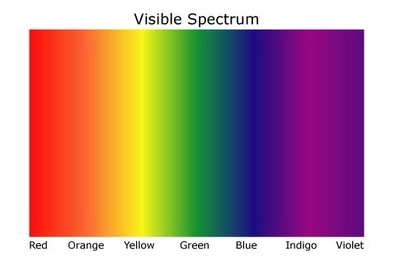
What color of light has the longest wavelength?
red
green
yellow
violet
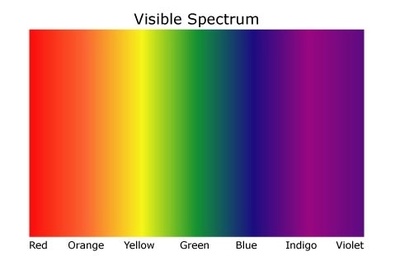
What color of light has the shortest wavelength?
red
indigo
yellow
violet

A student places a pencil in a glass of water and observes that the pencil appears to be broken. Which of these provides the best explanation for why the pencil appears broken?
The pencil absorbs all the light rays that hit it.
Water reflects light rays away from the pencil.
Light rays are bent by the water in the glass
The surface of the water reflects light rays.
What is the saying that can help you remember the order of the visible spectrum?
ROYGBIV
RYOBIVG
ROYBVIG
RIBYOVG
Which color REFLECTS all wavelengths of light?
Red
Black
White
Pink
Which color ABSORBS all wavelengths of light?
Red
Black
White
Pink
In the electromagnetic spectrum, which of the following is true of waves with long wavelengths?
They have high frequencies
They have low frequencies
They have moderate frequencies
They have inconsistent frequencies
The full range of energy in sunlight can be described as
ATP
Visible Light
Electromagnetic Radiation
Ultraviolet Light
What part of the electromagnetic spectrum can be seen by humans?
Visible Light
Microwaves
Ultraviolet Waves
Infrared Waves
A rainbow is sunlight disbursed into a spectrum of colors ranging from red to violet. When you are facing a rainbow, the sun is always behind you, the rain is in the direction of the rainbow, and the arc of the rainbow is directly opposite the sun. Which statement best describes the formation of a rainbow?
Tiny water droplets absorb the light waves that strike them disbursing the light into colored arcs.
Light travels faster after the rain due to increased moisture in the air.
Light in absorbed by the tiny water droplets in the atmosphere.
The water droplets in the air refract the light waves separating the light into colored arcs.
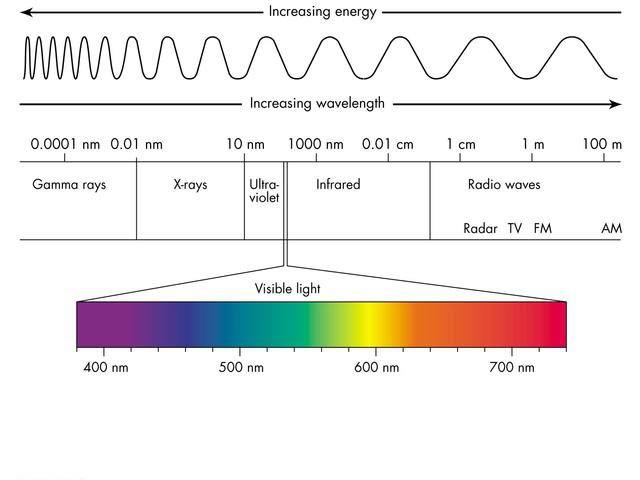
What is the correct order of the visible light spectrum starting with the longer wavelength?
Red, yellow, orange, blue, violet, indigo
Violet, indigo, blue, green, yellow, orange, red
Green, yellow, blue, indigo, red, orange
Red, orange, yellow, green, blue, indigo, violet
The musical note A above middle C has a frequency of 440 Hz. If the wavelength is measured to be 0.80m, what is the speed of the wave?
343 m/s
350 m/s
550 m/s
352 m/s
What is the wavelength of a wave with a speed of 25 m/s and a frequency of 50 Hz?
6250 m
.5 m
75 Hz
75 m
V=fλ
If the frequency is 5 Hz and the wavelength is 2 m, then what is the wave's velocity?
10 m/s
5/2 m/s
2/5 m/s
7 m/s
V=fλ
If the wave velocity is 20 m/s and the wavelength is 2 m, then what is the frequency?
10 Hz
40 Hz
0.1 Hz
Which cell is in charge of creating color in image captured by the eye?
Rod cell
Liver cell
Cone cell


