wayground logo

Free Printable Worksheets

Font size

S
M
L
XL
Worksheets

Biodiversity Test Review

Total questions: 130

Worksheet time: 2hrs 17mins

Name
Class
Date
1.
A toothed whale is a/an 
a)
odontocete
b)
baleen
c)
echolocation
d)
snail
2.
Any member of the group of marine mammals which includes whales, dolphins, and porpoises.
a)
pinniped
b)
echolocation
c)
adaptation
d)
cetancean
3.
A baleen whale is known as a/an
a)
odontocete
b)
mysticete
c)
pinniped
4.
What is baleen?
a)
Flexible bristles in the mouths of the whale used to filter prey out of the water.
b)
A way a dolphin navigates and locates prey.
c)
Something you blow up with air and use to decorate for a party.
5.
Which is used to breath with?
a)
blubber
b)
baleen
c)
flukes
d)
blowhole
6.
Which is used to keep warm?
a)
blubber
b)
baleen
c)
blowhole
d)
flukes
7.
Which is used to help the whale swim?
a)
blubber
b)
baleen
c)
blowhole
d)
flukes
8.
What organism does not belong to the order Cetacea? 
a)
whales
b)
sharks
c)
porpoises
d)
dolphins
9.

Mysticete whales have

a)

teeth

b)

no teeth

10.

Odontocete whales have

a)

teeth

b)

no teeth

11.

Which creature breathes through gills?

a)

Fish

b)

Cetacean

12.

Which creature has flippers

a)

Fish

b)

Cetaceans

13.

Which creature reproduces by laying eggs

a)

Fish

b)

Cetacean

14.

Which cetacean has baleen, or is a filter feeder?

a)

Odontocete

b)

Mysticete

15.

When classifying organisms, a chart that can be used that contains paired descriptors is known as:

a)

Dichotomous key

b)

Field Guide

16.

If a fin is located on top, or the back, of the creature, what is the correct name of location?

a)

Ventral

b)

Dorsal

17.

Which cetacean can have ventral pleats?

a)

Odontocete

b)

Mysticete

18.

Tail that is attached horizontally is known as:

a)

Fluke

b)

Tail fin

19.

If a creature that produces their own heat is known as:

a)

Ectothermic

b)

Endothermic

20.

What structures allow phytoplankton to stay in the sunlight zone?

a)

chloroplasts

b)

nucleus

c)

photosynthesis

d)

bristles or flat shape

21.

If the eyepiece of a microscope magnifies 10x and a student is looking through the low power objective (4x). Magnification is?

a)

14 times

b)

40 times

c)

6 times

d)

400 times

22.
Which of the following shows how energy is transferred from prey to predator?
a)
food web
b)
food chain
c)
taxonomy 
23.
Humans are classified as Homo sapiens.  The process of classifying living things into common groups is known as?
a)
oceanography
b)
taxonomy
c)
dewey decimal system
d)
food pyramids
24.
When looking at a data table, which column is written on the x-axis of a graph?
a)
left side
b)
right side
c)
neither
25.

Biodiversity means?

a)

bio = life ; diversity means same

b)

bio = life ; diversity means different

c)

bio = life ; diversity means death

26.
Odontocetes and Mysticetes are types of whales.  Which one is a tooth whale?
a)
Mysticetes
b)
Odontocetes
27.

A scientist is working with birds and is trying to compare different species. On one page, there are pictures of birds. On the other page there is information. What is he using?

a)

dichotomous key

b)

field guide

c)

Cetaceans

28.
What standard is used when we generalize how much energy is transferred up the food chain? 
a)
10%
b)
5%
c)
20%
d)
1%
29.

Fish breathe through their________?

a)

nose

b)

eyes

c)

gills

d)

fins

30.
When using a microscope, the first adjust knob you should use would be the ________?
a)
fine adjustment knob
b)
coarse adjustment knob
c)
stage
31.
In a microscope, the diaphragm is used to_______?
a)
adjust the amount of light
b)
focus the slide
c)
turn on the microscope
32.
Cetaceans can be divided into two groups based on whether they have...
a)
lungs or gills
b)
flippers or flukes
c)
teeth or baleen
d)
blowhole or nostrils
33.
_________: phytoplankton :: consumer : zooplankton 
a)
Producer
b)
Predator
c)
Parasite
d)
Host
34.
Which of the following shows the correct organization from smallest to largest?
a)
population, organism, ecosystem, community
b)
organism, population, community, ecosystem
c)
ecosystem, population, community, organism
d)
organism, community, population, ecosystem
35.
What do fish and cetaceans have in common?
a)
both are endothermic
b)
both have gills
c)
both have a dorsal fin
d)
both have flippers
36.
That part of an experiment that does not receive any treatment during the trials is called...
a)
a constant
b)
the control group
c)
the independent variable
d)
the dependent variable
37.
What would be the appropriate label for the Y-axis?
a)
Type of cetaceans
b)
Color of whales
c)
Length of whales
d)
Food that cetaceans eat
38.
What would be the appropriate label for the X-axis?
a)
Type of cetaceans
b)
Color of whales
c)
Length of whales
d)
Food that cetaceans eat
39.
Which term would be found in box A?
a)
Scales
b)
Tail fin
c)
Lungs
d)
Filter Feeder
40.
Which term would be found in box C?
a)
Scales
b)
Tail fin
c)
Lungs
d)
Filter Feeder
41.
Which term would be found in box E?
a)
Scales
b)
Tail fin
c)
Lungs
d)
Filter Feeder or carnivorous
42.
Which term would be found in box D?
a)
Scales
b)
Tail fin moves up and down: attached horizontally
c)
Lungs
d)
Filter Feeder or carnivorous
43.
Which level includes all biotic factors
a)
organism
b)
population
c)
community
d)
ecosystem
44.
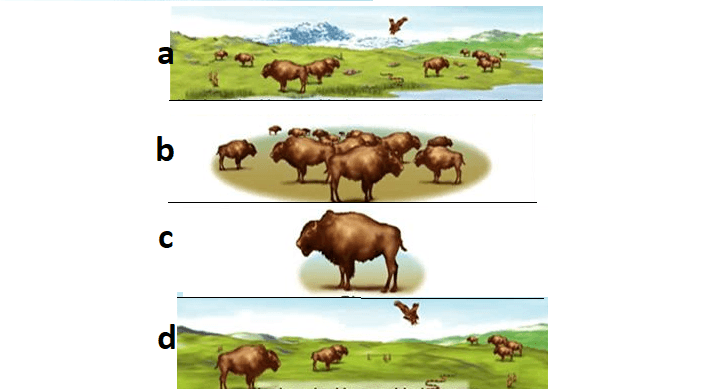
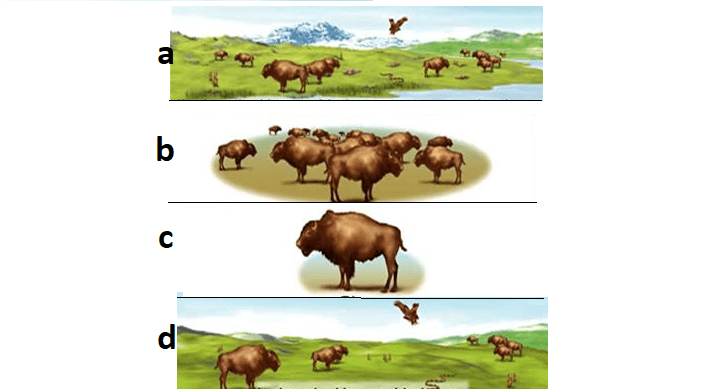
This picture depicts which level?
a)
Population
b)
Organism
c)
Ecosystem
d)
Community
45.
This picture depicts which level?
a)
Community
b)
Population
c)
Ecosystem
d)
Organism
46.
Sunlight
a)
Abiotic
b)
Biotic
47.
Which level includes all biotic and abiotic factors?
a)
Community
b)
Organism
c)
Population
d)
Ecosystem
48.
Bird
a)
Abiotic
b)
Biotic
49.
Which level includes only a single organism
a)
Population
b)
Community
c)
Organism
d)
Ecosystem
50.
This picture depicts which level?
a)
Ecosystem
b)
Organism
c)
Population
d)
Community
51.
Which level includes organisms of the same species in the same area?
a)
Organism
b)
Habitat
c)
Population
d)
4 Needs of Life
52.
Which accurately lists the levels from smallest to largest?
a)
ecosystem, community, organism, population
b)
organism, population, community, ecosystem
c)
population, ecosystem, organism, community
d)
organism, population, ecosystem, community
53.

Which list does NOT include biotic factors?

a)

elephants, zebras, acacia trees, bushes, bacteria

b)

rocks, water, temperature, sun, clouds

c)

algae, seaweed, fungi

d)

decayed zebra, bird eggs, poo from a kangaroo

54.

Which are NOT biotic factors?

a)

Minerals and nutrients

b)

Decayed tree and decayed bird

c)

Protista and Bacteria

d)

Lions and giraffes.

55.

Which of the following shows the correct order of the pictures from the LOWEST (smallest) to the HIGHEST (largest) level of organization?

a)

Q > S > T > R

b)

Q > R > T > S

c)

R > T > S > Q

d)

S > T > R > Q

56.

Which represents an organism?

a)

a

b)

b

c)

c

d)

d

57.

Which represents a community?

a)

a

b)

b

c)

c

d)

d

58.
Typically are multicellular
a)
Eukaryote
b)
Prokaryote
59.
Include kingdoms: Protist, Animal, Fungi, and Plant
a)
Prokaryote
b)
Eukaryote
60.
Include kingdoms: Bacteria and Archaea
a)
Prokaryote
b)
Eukaryote
61.
Made up of one cell
a)
Prokaryote
b)
Eukaryote
62.
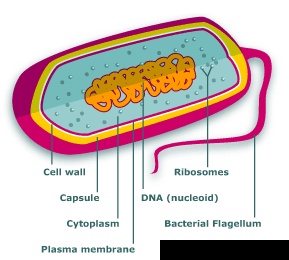
This is a picture of:
a)
Prokaryote
b)
Eukaryote
63.
One example of a prokaryote is a...
a)
fungus
b)
bacteria
c)
animal
d)
plant
64.
Which type of cell?
a)
Prokaryote
b)
Eukaryote
65.
Which type of cell?
a)
Prokaryote
b)
Eukaryote
66.
Which type of cell?
a)
Prokaryote
b)
Eukaryote
67.
Has nucleus
a)
Prokaryote
b)
Eukaryote
c)
both
68.
multicellular
a)
Prokaryote
b)
Eukaryote
c)
both
69.
What type of cell has a nucleus? 
a)
eukaryotic
b)
prokaryotic 
70.
What type of cell does not have a nucleus?
a)
eukaryotic 
b)
prokaryotic 
71.
Plants and animal cells are examples of ___ cells 
a)
prokaryotic cells 
b)
eukaryotic cells 
72.
Is a deer an abiotic or biotic factor? 
a)
abiotic
b)
biotic
73.

Temperature, light, air, water, and wind are all _____ parts of the environment

a)

alive

b)

biotic

c)

abiotic

d)

living

74.

What do parasites get from their hosts?

a)

Energy

b)

Nutrients

c)

Shelter

d)

All of the above

75.
Which terms best describe heterotrophs?
a)
Plants; producers
b)
Animals; producers
c)
Plants; consumers
d)
Animals; consumers
76.
Which terms best describe autotrophs?
a)
Plants; producers
b)
Animals; producers
c)
Plants; consumers
d)
Animals; consumers
77.
From where do autotrophs obtain their energy?
a)
The sun
b)
Other organisms
78.
What is another name to describe an autotroph?
a)
Consumer
b)
Producer
79.
What is another name to describe a heterotroph?
a)
Consumer
b)
Producer
80.
How can animals and fungi best be classified?
a)
Autotroph
b)
Heterotroph
81.
Which type of organisms perform photosynthesis?
a)
Autotrophs
b)
Heterotrophs
82.

BUNNY

a)

AUTOTROPH

b)

HETEROTROPH

c)

AUTOPHOTOTROPH

d)

NONE OF THE ABOVE

83.
Organisms that cannot make their own food and must obtain energy from external sources are called
a)
autotrophs
b)
heterotrophs
c)
thylakoids
d)
plants
84.
Using this dichotomous key, identity the name of the circled fish.
a)
band-tail puffer
b)
spotted goat fish
c)
peacock flounder
d)
trumpet fish
85.
The first part of a scientific name is an organism's _______________ and the second part is its ________________.
a)
species, genus
b)
phylum, order
c)
class, spices
d)
genus, species
86.
A dichotomous key for trees is provided. Hikers found a tree that has large brown cones and single sharp needles. What species of tree have the hikers found?
a)
Juniper
b)
Pine
c)
Spruce
d)
Fir
87.
A dichotomous key for insects is given. To what order does an insect with two pairs of scaly wings belong?
a)
Coleoptera
b)
Heteroptera
c)
Diptera
d)
Lepidoptera
88.
An illustration and a dichotomous key are given. What is the correct classification for this organism?
a)
Class Insecta
b)
Order Amblygygi
c)
Order Araneae
d)
Order Scorpiones
89.
The direction of the flow of energy in a food web is represented by ___.
a)
Light bulbs
b)
Dotted Lines
c)
Arrows
d)
Bubbles
90.
What does every food chain start with?
a)
producers
b)
sun
c)
consumer
d)
decomposers
91.
A frog eats a fly. The frog and fly are demonstrating ________.
a)
mutualism
b)
competition
c)
predator/prey
d)
parasitism
92.
What percentage of energy is passed on to each tropic level?
a)
10%
b)
50%
c)
90%
d)
100%
93.
What is this called?
a)
Food Web
b)
Food Chain
c)
Abiotic Factors
94.
What is this called?
a)
Food Web
b)
Food Chain
c)
Abiotic Factors
95.
An organism that lives by breaking apart dead organic matter into simpler parts is...
a)
scavenger
b)
consumer
c)
decomposer
d)
carnivore
96.
In a food web, arrows point at:
a)
who gets energy.
b)
who gets eaten.
97.
Bacteria, fungi, and earthworms are examples of: 
a)
scavengers
b)
predators
c)
prey
d)
decomposers
98.
Which of the following is a herbivore?
a)
cricket
b)
frog
c)
hawk
d)
shrew
99.
Which organism recieves the least amount of energy from the producer?
a)
Owl
b)
Grasshopper
c)
Lilypad
d)
Mouse
100.
An organism that can make its own food is called?
a)
Consumer
b)
Producer
c)
Decomposer
d)
Herbivore
101.
A consumer gets energy by doing what?
a)
Making it themselves.
b)
Breaking down biotic wastes and dead organisms and returning raw materials to the ecosystem.
c)
Soaking it up from the ground.
d)
Feeding on other organisms.
102.
Which of this energy roles is always located at the bottom of an energy pyramid?
a)
Producer
b)
Second-Level Carnivores
c)
Herbivores.
d)
First-Level Consumers.
103.
This type of consumer only feeds on the bodies of dead animals.
a)
Herbivore.
b)
Decomposer.
c)
Carnivore.
d)
Scavenger
104.
True or False. In this Food Web Pyramid the consumers on each level only get about 10 percent of energy that the plants have stored.
a)
True
b)
False
105.

In the energy pyramid here, how much of the energy in each level gets turned into heat and transferred back into the environment?

a)

80%

b)

90%

c)

10%

d)

20%

106.

How many pounds of rabbit would it take to support 10 pounds of eagle?

a)

10

b)

100

c)

1,000

d)

10,000

107.

You like to breathe? More than half of Earth's oxygen is created by ______________in the ocean.

a)

phytoplankton

b)

zooplankton

c)

chemosynthesis, hydrothermal vents

d)

agricultural plants

108.
Organisms, such as vultures, that feed on dead animals.
a)
Producer
b)
Scavenger
c)
Consumer
d)
Parasite
109.
Organisms that live in or on another organism and benefit at the host's expense.
a)
Parasite
b)
Producer
c)
Scavenger
d)
Decomposer
110.
What is the total magnification of a microscope with two lenses when one lens has a magnification of 10x, and the other lens has a magnification of 30x?
a)
15x
b)
30x
c)
40x
d)
300x
111.

If the eyepiece of your scope has a power of 10x, and the selected objective lens has a power of 20x, what is the total magnification?

a)

20x

b)

30x

c)

200x

d)

2000x

112.

The factor (variable) in an experiment that you measure.

a)

Independent Variable (IV)

b)

Dependent Variable (DV)

c)

Constants

d)

Control

113.

All the factors in an experiment that do NOT change.

a)

Independent Variable (IV)

b)

Dependent Variable (DV)

c)

Constants

d)

Control

114.

The one factor (variable) in an experiment that you intentionally change.

a)

Independent Variable (IV)

b)

Dependent Variable (DV)

c)

Constants

d)

Control

115.

A scientific prediction about a problem that can be tested.

a)

Observation

b)

Hypothesis

c)

Manipulate

d)

Inference

116.

The number of times an experiment is repeated.

a)

abundant

b)

model

c)

trials

d)

valid

117.

Accurate and correct data.

a)

abundant

b)

manipulate

c)

model

d)

valid

118.

Which of the following are an important reason to do repeated trials?

a)

reliable

b)

accurate

c)

valid results

d)

reliable, accurate, and valid results

119.

Is something that is kept the same, remaining unchanged in an experiment.

a)

Control

b)

Variable

c)

Data

d)

P, B, & J

120.
Multiple sets of measurements or observations in a scientific investigation.
a)
trials
b)
testable
c)
valid
d)
variable
121.

Independent Variable (IV) deals with

a)

The results

b)

What is changed on purpose

c)

The constants in the experiment

122.

The Dependent variable

a)

The results

b)

What changes

c)

The constant

123.
If I water the plant more often, then it will grow taller.  Name the independent variable.
a)
The height of the plant
b)
The size of the pot
c)
The amount of water
d)
The amount of light.
124.
If I water the plant more often, then it will grow taller.  Name the dependent variable.
a)
The amount of water.
b)
The amount of soil.
c)
The height of the plant.
d)
The amount of water.
125.
Students used various temperatures of water to see which one dissolved candy faster. 
What was the Independent Variable?
a)
Amount of Candy
b)
Amount of Water
c)
Temperature of Water
d)
Time for Candy to Dissolve
126.

How many Neutrons are in this element?

a)

12

b)

8

c)

7

d)

6

127.

How many neutrons are in this element?

a)

39

b)

19

c)

20

d)

40

128.

How many neutrons are in this element?

a)

6

b)

16

c)

15

d)

8

129.

How many neutrons does Sodium (Na) have?

a)

11

b)

23

c)

34

d)

12

130.

What is the number of protons that the element in this image contain?

a)

14

b)

7

c)

15

d)

18