wayground logo

Free Printable Worksheets

Font size

S
M
L
XL
Worksheets

Ch. 13 Chemical Bonds Adapted Learning

Total questions: 125

Worksheet time: 5hrs 17mins

Name
Class
Date
1.

The positive ions tend to _____________ electrons.

a)

lose

b)

gain

2.

The negative ions tend to _____________ electrons.

a)

lose

b)

gain

3.

When an atom loses an electron, it becomes a

a)

positive ion

b)

negative ion

c)

neutral ion

d)

neutral atom

4.

Why do all bonds form?

a)

so the number of protons equals the number of electrons

b)

so an atom can become unstable

c)

to fill the outermost energy level

5.
Ionic bonds are between...
a)
Metal and Non-metal
b)
Non-metal and Non-metal
c)
Metal and Metal
6.
How are ionic bonds formed?
a)
Transfer of electrons
b)
Sharing of electrons
7.
Why do elements bond?
a)
To be friends
b)
To create a new element
c)
To become stable
8.
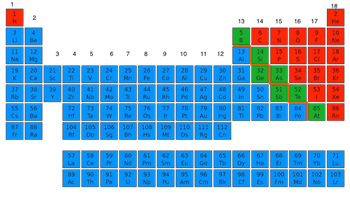
Where are the nonmetals located on the periodic table? 
a)
Blue
b)
Red
c)
Green
9.
Where are metals located on the periodic table?
a)
Blue
b)
Green
c)
Red
10.
Ionic bonds form between two ions that have...
a)
ionic compounds
b)
negative charges
c)
positive charges
d)
opposite charges
11.

What type of elements form cations?

a)

metals

b)

nonmetals

c)

metalloids?

12.

Anions

a)

Gain electrons, has an overall positive charge

b)

Lose electrons, has an overall positive charge

c)

Lose electrons, has an overall negative charge

d)

Gain electrons, has an overall negative charge

13.

Cations

a)

Gain electrons, has an overall positive charge

b)

Lose electrons, has an overall positive charge

c)

Lose electrons, has an overall negative charge

d)

Gain electrons, has an overall negative charge

14.

How does calcium become an calcium ion?

a)

it loses 2 electrons

b)

it gains 2 electrons

15.

How does magnesium become an magnesium ion?

a)

it loses 2 electrons

b)

it gains 2 electrons

16.

How does oxygen become an oxide ion?

a)

it loses 2 electrons

b)

it gains 2 electrons

17.
Is hydrogen considered a metal or a non-metal?
a)
A metal
b)
Nonmetal
c)
Metalloid
18.
Is this ionic bond drawn correctly?
a)
Yes
b)
No
19.
An electron has what kind of charge?
a)
no charge
b)
positive 
c)
negative
d)
it depends
20.

How many Aluminum atoms are in Al2O3?

a)

3

b)

5

c)

2

d)

1

21.
How do the following two elements bond together?
Cr3+  O2-         
a)
CrO
b)
Cr3O2
c)
Cr2O3
d)
CrO3
22.
How do the following two elements bond together?
K1+  S2- 
a)
KS
b)
K8S
c)
K6S3
d)
K2S
23.
How do the following two elements bond together?
Al3+  O2-         
a)
AlO
b)
Al2O3
c)
Al3O6
d)
Al3O2
24.
AgF
a)
silver fluoride
b)
silver fluorine
c)
monosilver monofluoride
d)
silver monofluorine
25.
The chemical formula for an ionic compound of potassium and oxygen is
a)
KO.
b)
K2O.
c)
K2O2.
d)
KO2.
26.
How many valence electrons does a bromine atom have?
a)
1
b)
2
c)
6
d)
7
27.
What is the correct formula for the compound, lithium oxide?
a)
LiO
b)
Li2O
c)
LiO2
d)
Li2O2
28.
How do covalent bonds form?
a)
Donating & receiving valence e- between atoms.
b)
Opposite slight charges attract each other between compounds.
c)
Scientists are still not sure how they form.
d)
Sharing valence e- between atoms.
29.
What two types of atoms make a covalent bond?
a)
2 Nonmetals
b)
1 Nonmetal and 1 Metal
c)
2 Metals
d)
2 Noble Gases
30.
Which of the following is NOT formed by a covalent bond?
a)
K2S
b)
H2O
c)
I2
d)
CO2
31.
Which of the following describes the strength of a covalent bond?
a)
Middle - Each atom shares an octet
b)
Middle - One atom gains an octet & the other loses.
c)
Weakest - it only forms because of another bond forming
d)
Strongest - each atom receives a "permanent" octet.
32.
What do we call a covalent bond where electrons are shared UNEVENLY or UNEQUALLY?
a)
Ionic
b)
Polar Covalent
c)
Nonpolar Covalent
d)
Van der Waals Force
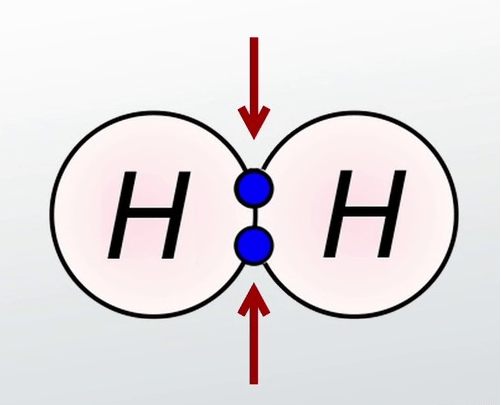
33.
What type of bond is shown in this image?
a)
Ionic
b)
Polar Covalent
c)
Nonpolar Covalent
d)
Van der Waals Force
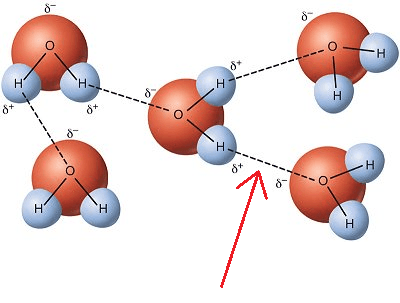
34.
What type of bond is shown in this picture?  It is the WEAKEST type & attracts one water compound to another!
a)
Ionic bond
b)
Polar Covalent
c)
Nonpolar Covalent
d)
Van der Waals force
35.
Which of the following is NOT considered a diatomic element?
a)
Carbon
b)
Nitrogen
c)
Chlorine
d)
Iodine
36.
Diatomic elements are defined as IDENTICAL elements that bond with each other (i.e. Oxygen with Oxygen).  What type of bond should they form?
a)
Ionic
b)
Polar Covalent
c)
Nonpolar Covalent
d)
Van der Waals force
37.
Diatomic elements are defined as IDENTICAL elements that bond with each other (i.e. Oxygen with Oxygen).  What do we call it when this forms?
a)
Compound
b)
Molecule
c)
Atom
d)
None of the above
38.
phosphorus trichloride
a)
KCl3
b)
PCl3
c)
K3Cl
d)
P3Cl
39.
silicon dioxide
a)
SO2
b)
NaO2
c)
SiO2
d)
SiO
40.

dinitrogen pentoxide

a)

N2O5

b)

NO5

c)

N5O2

d)

N2O6

41.
SiCl4
a)
silicon tetrachloride
b)
silicon quadchloride
c)
monosilicon tetrachloride
d)
silicon chloride
42.

P₄S₁₀

a)

tetrapotassium decasulfide

b)

phosphorus decasulfide

c)

tetraphosphorus decasulfide

d)

phosphorus (X) sulfide

43.

SO₃

a)

sulfate

b)

sulfur oxide

c)

sulfur trioxide

d)

monosulfur trioxide

44.

tetraphosphorus heptoxide

a)

K₄O₁₀

b)

P₄O7

c)

KO

d)

P₁₀O₄

45.

chlorine dioxide

a)

ClO2

b)

ClO

c)

ClO3

d)

HClO2

46.

hexaboron monosilicide

a)

B6Si

b)

BSi

c)

BSi6

d)

B6Si6

47.

What is the OFFICIAL name for H2O? Hint.. This is a trick question so choose carefully!

a)

Hydrogen Oxide

b)

Oxygen Dinitride

c)

Water

d)

Dihydrogen Monoxide

48.
How many nitrogen atoms in 
Mg(NO3)2
a)
1
b)
2
c)
3
d)
6
49.
How many magnesium atoms in 
Mg(NO3)2
a)
1
b)
2
c)
3
d)
6
50.
How many oxygen atoms in 
Mg(NO3)2
a)
1
b)
2
c)
3
d)
6
51.
How many NO3 polyatomic ions are in 
Mg(NO3)2
a)
1
b)
2
c)
3
d)
6
52.
How many NH4 polyatomic ions are in 
(NH4)3PO4
a)
1
b)
4
c)
3
d)
12
53.
How many nitrogen atoms are in 
(NH4)3PO4
a)
1
b)
4
c)
3
d)
12
54.
How many hydrogen atoms are in 
(NH4)3PO4
a)
1
b)
4
c)
3
d)
12
55.
How many oxygen atoms are in 
(NH4)3PO4
a)
1
b)
4
c)
3
d)
12
56.
How many water molecules are in 
CuSO4⋅5H2O
a)
1
b)
4
c)
5
d)
9
57.
How many oxygen atoms in total are in 
CuSO4⋅5H2O
a)
1
b)
2
c)
5
d)
9
58.
The _______ describes the atoms in a compound.
a)
chemical equation
b)
chemical formula
c)
chemical symbol
d)
coefficient
59.
How many elements are in C6H12O6?
a)
1
b)
2
c)
3
d)
4
60.
How many atoms of carbon (C) are in C6H12O6?
a)
3
b)
6
c)
12
d)
24
61.
Element or compound?
H2O
a)
element
b)
compound
62.
Which of the following is a compound?
a)
Co
b)
O2
c)
C
d)
CO2
63.
Which is the correct formula for:
 three hydrogen (H)
one sulfur (S)
four oxygen (O)
a)
H3SO4
b)
HSO4
c)
H4S3O
d)
H2O
64.
The blue numbers in the image below represent ________
a)
I don't know, and don't want to try
b)
coefficients
c)
subscripts
d)
none of the answers are correct
65.
How many atoms are there TOTAL in:
H2SO4
a)
6
b)
5
c)
7
d)
3
66.
How many Sodium (Na) are in 6NaCl?
a)
1
b)
12
c)
6
67.
The substances at the beginning of a chemical equation are called the ____
a)
product
b)
yield
c)
chemical symbol
d)
reactants
68.
In this image, the symbols to the right of the arrow (in black) are called the_______.
a)
Products
b)
Reactants
c)
Subscripts
d)
Coefficients
69.
Na + MgF2 -->  NaF + Mg
What are the reactants?
a)
Na + MgF2
b)
Na
c)
NaF + Mg
d)
NaF
70.
NH3 ---> N2 + H2
What are the products?
a)
N2 + H2
b)
N2
c)
H2
d)
NH3
71.
All of the following are chemical changes except
a)
iron rusting
b)
water evaporating
c)
wood burning
d)
food rotting
72.

How many hydrogen atoms are there?

a)

1

b)

4

c)

5

d)

6

73.

How many nitrogen atoms are there?

a)

4

b)

8

c)

10

d)

20

74.

How many phosphorus atoms are there?

a)

0

b)

1

c)

3

d)

4

75.

How many molecules of methane are there?

a)

0

b)

1

c)

2

d)

4

76.

How many atoms of carbon are there?

a)

0

b)

1

c)

2

d)

3

77.

CH4 is an example of a —

a)

chemical equation

b)

chemical formula

c)

chemical reaction

d)

chemical symbol

78.

A metallic bond is a bond between ________.

a)

nonmetals

b)

metals

c)

transition metals

d)

metalloids

79.

Which of the following is NOT a property of metals?

a)

Hard

b)

Can conduct electricity

c)

Very brittle (breaks easily)

d)

Malleable (can bend without breaking)

80.

What do electrons do in a metallic bond?

a)

They stay on the metal atom.

b)

They are transferred from atom to atom.

c)

They form a covalent bond with another atom.

d)

They float around freely.

81.

What is meant by the term "sea of electrons"?

a)

It's what we call all the free floating electrons in a metal.

b)

It's what we call electrons that are floating in a liquid.

c)

It's the total number of electrons in a metal atom.

d)

It's the total number of electrons in the ocean.

82.

Why are metals good conductors of electricity?

a)

The electric current can easily travel along the surface of the metal because it is smooth.

b)

A negative charge can easily push the sea of electrons in one direction, making a current.

c)

Metals attract electricity.

d)

Metals are malleable.

83.

Why are metals malleable? (They can bend without breaking.)

a)

Metals are very smooth.

b)

Metals have a sea of electrons.

c)

The sea of electrons form a strong metallic bond.

d)

Even though the metal ions repel each other, the electron sea holds all the atoms in place.

84.

What do we call electrons that move freely in a metallic bond?

a)

sea of electrons

b)

lone electrons

c)

unpaired electrons

d)

covalent electrons

85.

What property of metals is the image describing?

a)

malleable (bend without breaking)

b)

ductile (stretched into a wire)

c)

conductive (can conduct electricity)

d)

shiny

86.

What property of metals is being shown in figure 1(b) in the image?

a)

malleable (bend without breaking)

b)

ductile (stretched into a wire)

c)

conductive (can conduct electricity)

d)

shiny

87.

What is the one thing responsible for a metal being malleable, ductile, and conductive?

a)

metal atoms

b)

its covalent bonds

c)

its valence electrons

d)

its sea of free-floating electrons

88.

What is the left part of a chemical equation called?

2H2 + O2 ---> 2H2O

a)

Reactants

b)

Yields

c)

Products

d)

Chemical equation

89.

What is the right part of a chemical equation called?

2H2 + O2 ---> 2H2O

a)

Reactants

b)

Yields

c)

Products

d)

Chemical Equation

90.

What is the total number of atoms present in 5Na3PO4?

a)

5

b)

55

c)

40

d)

8

91.

How many Mn atoms are found in the following compound?

2MnO4

a)

1

b)

2

c)

4

d)

8

92.

What is the little number after an element in a chemical equation called?

Example: H2

a)

Coefficient

b)

Atom

c)

Subscript

d)

Equation

93.

Is the following equation balanced?

Al + O2 ---> 2Al2O3

a)

YES

b)

NO

94.

What is the number before a chemical formula called?

Example: 2H2 + O2 ---> 2H2O

a)

Coefficient

b)

Atom

c)

Subscript

d)

Equation

95.

How many elements are in C6H12O6?

a)

1

b)

2

c)

3

d)

4

96.

Which of the following equations are correctly balanced?

a)

12CO2 + H2O ---> C6H12O6 + O2

b)

CO2 + H2O ---> 3C6H12O6 + O2

c)

CO2 + 9H2O ---> C6H12O6 + O2

d)

6CO2 + 6H2O ---> C6H12O6 + 6O2

97.

Balance this equation:

H2 + Cl2 ---> HCl

a)

It is balanced.

b)

H2 + Cl2 ---> 2HCl

c)

3H2 + Cl2 ---> 6HCl

d)

H2 + 3Cl2 ---> 6HCl

98.

Balance this equation:

HgO ---> 2Hg + O2

a)

It is balanced.

b)

2HgO ---> 2Hg + O2

c)

2HgO ---> Hg + O2

d)

HgO ---> Hg + 2O2

99.

Complete the sentence.


During a chemical reaction, atoms ________.

a)

can appear

b)

can disappear

c)

get rearranged

d)

stop moving and vibrating

100.
What is a coefficient?
a)
The small number on the right of the chemical symbol.
b)
The large number in front of a chemical formula.
c)
The number in between the chemical symbols.
d)
The number behind a chemical formula.
101.

What is the Law of Conservation of Mass?

a)

It states that matter cannot be created or destroyed.

b)

It states that energy cannot be created or destroyed.

c)

It states that matter can be created or destroyed.

d)

It states that sound can be created or destroyed.

102.
How many HCl molecules do you need to balance this equation? 
Mg +  __HCl --->  MgCl2 + H2
a)
1
b)
2
c)
3
d)
4
103.
What are the smaller numbers that you CANNOT change in a chemical equation? 
a)
Coefficient
b)
Products
c)
Reactants
d)
Subscript
104.

Balance the following equation:

___ H2+ ___ O2→___ H2O

a)

1, 1, 3

b)

2, 2, 2

c)

1, 2, 1

d)

2,1, 2

105.

What type of reaction involves the breaking down of a substance into simpler substances?

a)

Single Replacement Reaction

b)

Double Replacement Reaction

c)

Synthesis Reaction

d)

Decomposition Reaction

106.

What type of reaction involves 2 substances combining to form 1 new compound?

a)

Decomposition Reaction

b)

Single Replacement Reaction

c)

Double Replacement Reaction

d)

Synthesis Reaction

107.

What type of reaction involves one element replacing another element in a compound?

a)

Single Replacement Reaction

b)

Double Replacement Reaction

c)

Synthesis Reaction

d)

Decomposition Reaction

108.

What type of reaction involves ions from 2 compounds exchanging places to form 2 completely new compounds?

a)

Single Replacement Reaction

b)

Double Replacement Reaction

c)

Synthesis Reaction

d)

Decomposition Reaction

109.

What are the reactants in the chemical equation pictured?

a)

CH4 and CO2

b)

CH4 and O2

c)

CO2 and H2O

d)

O2 and H2O

110.

What are the products of the chemical reaction pictured?

a)

CH4 and CO2

b)

CH4 and O2

c)

CO2 and H2O

d)

O2 and H2O

111.

What type of chemical reaction is this one?

Al(OH)3 --> Al2O3 + H2O

a)

Decomposition

b)

Combustion

c)

Synthesis

d)

Single Replacement

112.

What type of chemical reaction is this one?

CUO + CO2 --> CuCO3

a)

Decomposition

b)

Combustion

c)

Synthesis

d)

Single Replacement

113.

What type of chemical reaction is this one?

Ca + MgCl2 --> CaCl2 + Mg

a)

Decomposition

b)

Combustion

c)

Synthesis

d)

Single Replacement

114.

3KOH + H3PO4 --> K3PO4 + 3H2O

a)

Combination

b)

Decomposition

c)

Single replacement

d)

Double replacement

115.
CxHy +O--> H2O + CO2
a)
Decomposition
b)
Double replacement
c)
Combustion
d)
Single Replacement
116.
Pb(NO3)2 --> PbO + NO2 + O2
a)
Synthesis (combination)
b)
Decomposition
c)
Single replacement
d)
Combustion
117.

Combustion reactions will always involve

a)

Oxygen and a solid

b)

Liquid nitrogen and heat

c)

Oxygen and heat/energy

d)

CO and H2O

118.

Balancing this reaction:

____ CH4 + ____ O2 ---> ___ CO2 + ____ H2O

a)

2,1,3,1

b)

1,2,1,2

c)

1,2,2,1

d)

2,1,1,2

119.

Balance this reaction:

____ Na3PO4 + ____ KOH ---> ____ NaOH + ____ K3PO4

a)

1,3,3,1

b)

1,3,2,1

c)

2,3,3,1

d)

1,1,3,1

120.

Balance this reaction:

____ NaF + ____ Br2 ---> ___ NaBr + ____ F2

a)

3,1,2,1

b)

1,2,3,4

c)

2,1,2,1

d)

1,2,1,2

121.
The red numbers in the image below represent ________
a)
subscripts
b)
coefficients
c)
I don't know, and don't want to try
d)
None of the answers are correct
122.
The blue numbers in the image below represent ________
a)
I don't know, and don't want to try
b)
coefficients
c)
subscripts
d)
none of the answers are correct
123.
What kind of reaction is this:
4Fe  +  3O2 →   2Fe2O3 
a)
Synthesis
b)
Decomposition
c)
Single Replacement 
d)
Double Replacement
124.
What kind of reaction is this:
2H2O2 →2 H2+ O2
a)
Synthesis
b)
Decomposition
c)
Single Replacement 
d)
Combustion
125.
What kind of reaction is this:
Fe + CuSO4 -> Cu + FeSO4
a)
Double Replacement
b)
Decompostion
c)
Single Replacement
d)
Combustion