
 Worksheets
SOIL
Total questions: 135
Worksheet time: 2hrs 37mins
The plant and animal remains are called
Bacteria
inorganic matter
organic matter
decomposer
A process begins with rocks and ends with soil
soil pollution
soil formation
soil degradation
soil erosion
The first step in soil formation is:
Parent rock breaks down.
Soil and the soil community develops.
Organisms add organic matter.
weathering
From place to place, soil horizons are the same
True
False
The differences between different soil horizons depend on:
the original parent rock
climate
Both
The last step in soil formation is:
Parent rock breaks down.
Soil and the soil community develops.
Organisms add organic matter.
weathering
________ can cause bedrock to breakdown.
Bacteria and fungi help create soil by decomposing dead plants and animals into:
humus
subsoil
The top, or A horizon of soil is called (a) .
Name 2 things that soil is a mixture of ________ and ________.
Name 2 properties of soil.
When eroded soil is deposited in other places, it is called _________.
bedrock
transported
The thickness of soil can depend on the climate.
True
False
Soil becomes (thicker or thinner) over time.
(a)
Water passes slowly through soils with high permeability.
yes
no
Explain why soil is important.
How can we prevent soil erosion in areas with MOUNTAINS?
No-till farming
Crop Rotation
Contour Plowing
Terraces
How can we prevent soil erosion in an area with HILLS?
Contour Plowing
Terraces
Crop Rotation
Windbreaks
How can we prevent soil erosion in areas where the air is swirling around at fast speeds?
Crop Rotation
No-till Farming
Windbreaks
Terraces
Which strategy will prevent soil erosion?
Plant the same crops every year
Rotate your crops on a 3 year schedule
How can planting trees prevent erosion?
Trees slow down the water cycle.
The leaves soak up all the water.
The roots hold on to the soil.
Trees don't actually prevent erosion.
What soil erosion prevention strategy involves leaving last season's dead crops in the field to hold down the soil?
Windbreaks
Crop Rotation
No-till Farming
Terraces

What soil erosion prevention strategy is shown in the picture?
Contour Plowing
Crop Rotation
Windbreaks
No-till Farming

What soil erosion prevention strategy is shown in the picture?
Plant Trees
Windbreaks
Contour Plowing
Terraces

What soil erosion prevention strategy is shown in the picture?
Contour Plowing
Terraces
Crop Rotation
Windbreaks

What soil erosion prevention strategy is shown in the picture?
Contour Plowing
Plant Trees
Crop Rotation
No-till Farming

What kind of soil is this?
Silt
Sand
Dirt
Beach

Which of the following is NOT one of the layers of soil?
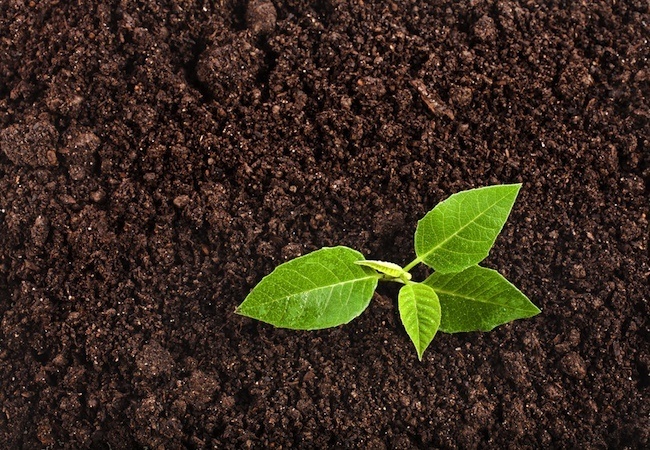


Which layer is the parent material?
Horizon O
Horizon A
Horizon B
Horizon C
Horizon R

Which layer is the subsoil?
Horizon O
Horizon A
Horizon B
Horizon C
Horizon R

What is NOT an acceptable observation of soil characteristics?
Gritty
Dry
Brown
Dirt
Soil is the same everywhere in the world. True or False?
True
False
The breaking down of rocks is called ______________.
Texture
Decomposing
Weathering
Rock and Minerals
A mixture of pieces of rock, decomposing plants and animals is called _____________.
Decomposing
Soil
Rock
Mound
soil is made of
decaying organic material
rock particles
minerals
water
air
this is decaying organic matter.
humus
sand
loam
bedrock
topsoil

Which property describe a characteristic of a sedimentary rock?
large crystals
glassy
small crystals
layers
How do metamorphic rocks form?
melting
crystallization
heat and pressure
erosion
Which type of rocks are classified according to the organization of the grains?
igneous
sedimentary
metamorphic
clastic
What factor would cause two places to have different soil? Example: a forest will have different soil compared to a desert.
amount of weathering or erosion
amount of plant and animal life
type of bedrock
all of the above
Solid inorganic materials that naturally occur in earth's crust and have a definite chemical composition are called
rocks
minerals
sedimentary rocks
humus

Soil is formed over a long time. Which sentence best tells how soil forms?
Soil forms when rocks break down and mix with dead plants and animals.
Soil forms when a lot of rain falls on the ground at once.
Soil forms when sand is mixed with water.
Soil forms when large rocks break down and turn into sand and water.


Which type of soil has the lowest rate of permeability?
sand
silt
clay
loam

Soil is made of ---
weathered rocks and minerals.
dead plants and animals.
air and water.
all of the above

Which layer of soil is on the bottom of a soil profile?
topsoil
subsoil
bedrock
humus

Which of the following is NOT one of the three layers of soil?
topsoil
undersoil
subsoil
bedrock

Humus is ---
the dead parts of plants and animals in soil.
A food we eat with pretzels.
The tiny particles inside of soil.
The roots that come off of a plant and live in soil.
When plants, animals, and other organisms die, they break down and become part of the soil. What is this part of the soil called?
sand
silt
clay
humus

What is the layer of soil just below the topsoil?
bedrock
subsoil
topsoil
humus


Horizontal layers of soil are called ---
Soil profiles
Soil horizons
The texture of soil depends mainly on ---
the types of plants that grow in the soil.
the size of the particles in the soil.
the color of the soil.
the number of worms in the soil.

What is the layer of soil that contains humus, leaf litter, and other organic matter called?
O - Organic
A - Topsoil
B - Subsoil
R - Bedrock
Why is topsoil darker than all other levels of soil?
It contains all the darker colored minerals.
It contains volcanic rock.
It contains more organic matter.
It contains bits of burned trees.
Where does most of the water go when it rains?
In the ocean
In the rivers
In the gutters
It absorbs into the soil.
What is the common name for Horizon A?
bedrock
topsoil
subsoil
Why is soil an important natural resource?
soil is used to make buildings
soil can grow crops
soil comes from bedrock
soil is full of microbes


Permeability is...
when soil gets carried away
when soil is broken down by wind, water, or ice
how fast water travels through the soil
how much water the soil holds


What is HUMUS made from?
Chick-Peas
The remains of decayed plants and animals
Inorganic materials
Rocks and Minerals


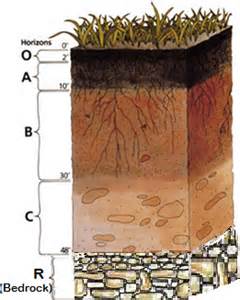
Which horizon is made up of partially weathered rocks?
Horizon A
Horizon B
Horizon C
Horizon D or R (Bedrock Layer)
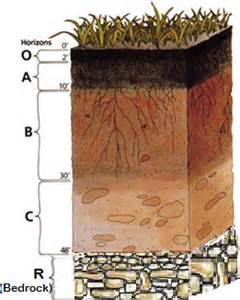


What soil horizon is shown?
Horizon O
Horizon A
Horizon E
Horizon B
Horizon C

What soil horizon is shown?
Horizon O
Horizon A
Horizon E
Horizon B
Horizon C

What soil horizon is shown?
Horizon O
Horizon A
Horizon E
Horizon B
Horizon C

What soil horizon is shown?
Horizon A
Horizon E
Horizon B
Horizon C
Horizon R

What soil horizon is shown?
Horizon A
Horizon E
Horizon B
Horizon C
Horizon R

What soil horizon is shown?
Horizon A
Horizon E
Horizon B
Horizon C
Horizon R

Match the description of the horizon to the horizon name.
Horizon O
Horizon A
Horizon B
Horizon E
Horizon C

Match the description of the horizon to the horizon name.
Horizon O
Horizon A
Horizon B
Horizon E
Horizon C

Match the description of the horizon to the horizon name.
Horizon R
Horizon A
Horizon B
Horizon E
Horizon C

Match the description of the horizon to the horizon name.
Horizon R
Horizon A
Horizon B
Horizon O
Horizon C

Match the description of the horizon to the horizon name.
Horizon R
Horizon A
Horizon B
Horizon O
Horizon C

Match the description of the horizon to the horizon name.
Horizon R
Horizon A
Horizon B
Horizon O
Horizon C
What soil layer contains the most humus?
Horizon A
Horizon E
Horizon R
Horizon O
Horizon B
What soil layer contains the LEAST amount of humus?
Horizon A
Horizon E
Horizon R
Horizon O
Horizon B
Match the horizon letter with its name.
Horizon R
Organic Matter
Topsoil
Eluviation
Subsoil
Bedrock
Match the horizon letter with its name.
Horizon E
Organic Matter
Topsoil
Eluviation
Subsoil
Bedrock
Match the horizon letter with its name.
Horizon A
Organic Matter
Topsoil
Parent Material
Subsoil
Bedrock
Match the horizon letter with its name.
Horizon O
Organic Matter
Topsoil
Parent Material
Subsoil
Bedrock
Match the horizon letter with its name.
Horizon B
Organic Matter
Topsoil
Parent Material
Subsoil
Bedrock
Match the horizon letter with its name.
Horizon C
Organic Matter
Topsoil
Parent Material
Subsoil
Bedrock
Which horizon would you expect to find the following:
Living and dead plants and animals
Horizon E- Eluviation Layer
Horizon O- Organic Material
Horizon A- Topsoil
Horizon B- Subsoil
Horizon R- Bedrock
Which horizon would you expect to find the following:
Leached clay and minerals from the horizon above
Horizon E- Eluviation Layer
Horizon O- Organic Material
Horizon A- Topsoil
Horizon B- Subsoil
Horizon R- Bedrock
Which horizon would you expect to find the following:
Sand and silt (clay and minerals get leached to layer below)
Horizon E- Eluviation Layer
Horizon O- Organic Material
Horizon A- Topsoil
Horizon B- Subsoil
Horizon R- Bedrock
Which horizon would you expect to find the following:
True soil layer: a mixture of humus, mineral grains, water, and air
Horizon E- Eluviation Layer
Horizon C- Parent Material
Horizon A- Topsoil
Horizon B- Subsoil
Horizon R- Bedrock
Which horizon would you expect to find the following:
Thick slab of unbreakable rock
Horizon E- Eluviation Layer
Horizon C- Parent Material
Horizon A- Topsoil
Horizon B- Subsoil
Horizon R- Bedrock
Which horizon would you expect to find the following:
Slightly weathered rock chunks; very little organic material found here.
Horizon E- Eluviation Layer
Horizon C- Parent Material
Horizon A- Topsoil
Horizon B- Subsoil
Horizon R- Bedrock

