
 Worksheets
Population and Resources Review
Total questions: 135
Worksheet time: 2hrs 41mins
A population of tigers lives in Bangladesh. Over 50 years, the size of the tiger population increased. What best explains the increase in the size of the tiger population?
A lot of tigers were born and none of them died.
Fewer tigers were born than died.
The tiger population is always increasing because no animal eats tigers.
More tigers were born than died.

Scientists have been studying the size of three populations in a grassland. In this ecosystem, lizards eat fireflies, and fireflies eat gnats (a type of insect). The data showed that all three populations were stable. Then the lizard population decreased suddenly. What will most likely happen to the size of the firefly population as a result?
The firefly population will . . .
increase because there are less lizards eating them.
decrease because there are more lizards eating them.
stay the same
increase because there will be more energy storage molecules available for the fireflies to eat.

In Australia, both opossums and foxes eat rats. The sizes of the populations have been stable for the last 12 years, but recently the size of the opossum population increased. What will likely happen to the fox population?
The size of the fox population will . . .
increase because there will be more rats to make energy.
decrease because the opossum population is taking more energy storage molecules from the rats.
stay the same because there are still energy storage molecules available.
decrease because the opossum population is using the fox population for energy storage molecules.
A population of bluefish lives in the Gulf of Mexico. Over the last 50 years, the size of the bluefish population has decreased. What best explains the decrease in the size of the bluefish population?
A lot of bluefish died and no new bluefish were born.
Fewer bluefish were born than died.
More bluefish were born than died.
The bluefish population is always decreasing because bluefish are always being eaten.

Scientists have been studying the size of three populations in a region. In this ecosystem, lions eat wild pigs, and wild pigs eat frogs. The data showed that all three populations were stable. Then the frog population decreased suddenly. What will likely happen to the size of the wild pig population as a result?
The size of the wild pig population will . . .
increase because the wild pigs and lions will find energy storage molecules elsewhere.
decrease because there are less energy storage molecules available.
stay the same because the lions are still stable.

In the Arctic Ocean, sharks eat whales, and whales eat crabs. In the last 10 years, the sizes of the populations have been stable, but recently the size of the crab population increased. What will likely happen to the shark population?
The size of the shark population will . . .
increase
decrease
stay the same
A large population of ducks lives in an area with a lake. In the last 40 years, the size of the duck population has stayed the same. What must be true about the duck population during the last 40 years?
The number of ducks that were born was the same as the number of ducks that died.
Humans started protecting the duck population so they stopped dying.
No ducks were born and no ducks died.
The ducks did not have any baby ducks during these years.

Scientists have been studying the size of three populations in a swampland. In this ecosystem, herons (a type of bird) eat frogs, and frogs eat dragonflies. The data showed that all three populations were stable. Then the dragonfly population increased suddenly. What will likely happen to the frog population as a result?
The size of the frog population will . . .
increase
decrease
stay the same

In North America, both bears and eagles eat trout. The sizes of the populations have been stable for the last 9 years, but recently the size of the eagle population decreased. What will likely happen to the bear population?
The size of the bear population will . . .
increase
decrease
stay the same
A population of mice lives in the northeastern United States. Over the last 50 years, the size of the mouse population decreased. What best explains the decrease in the size of the mouse population?
Fewer mice were born than died.
More mice were born than died.
A lot of mice died and no new mice were born.
The mouse population is always decreasing because mice are always being eaten.

Scientists have been studying the size of three populations in Peru. In this ecosystem, pumas (large wild cats) eat deer, and deer eat grass. The data showed that all three populations were stable. Then the puma population increased suddenly. What will most likely happen to the size of the deer population as a result?
The size of the deer population will . . .
increase
decrease
stay the same

In the Arctic region, polar bears eat seals, and seals eat cod (a type of fish). In the last 7 years, the sizes of all the populations stayed stable, but recently the size of the polar bear population decreased. What will likely happen to the cod population?
The size of the cod population will . . .
increase because when one population increases, the others do too.
decrease because less seals are being eating, making them increase, and eating more cod.
stay the same

An ecologist is a scientist who studies…
The types of rocks and soil in an area.
The interactions between living things and their environments.
The phase changes of different substances.
The life cycles of viruses and their hosts.
What organism is the main focus of our Amplify unit story?
Marine biologists
Moon Jellies
Orca Whales
Giant Kelp
In our Amplify story, what is the problem we are trying to solve?
Why are there so many different species living in Glacier Sea?
How has climate change affected Glacier Sea?
Why is the moon jelly the only type of jelly in Glacier Sea?
Why did the population of moon jellies in Glacier Sea mysteriously increase?
An ecosystem is made up of ______ .
living things and their offspring
nonliving things such as rocks and soil
living things and nonliving things
many types of animals
What is the best definition of an organism?
Many individuals of the same species living in the same area.
All of the living and nonliving things in a particular area.
An individual plant, animal, fungus, or single-celled life form.
A creature that is large enough to see without using a microscope.
Which picture accurately shows a "population"?


Which 2 pictures most accurately show an "ecosystem"?
What is a scientific word that refers to new organisms being made?
Reproduce
Renovate
Expire
Subsist
Within a population, organisms are always…
eating and sleeping.
being born and growing up.
being born and dying.
dying of old age and eating other things.
What causes a population size to increase?
The number of births is greater than the number of deaths.
The number of deaths is greater than the number of births.
The number of births and the number of deaths is equal.
What causes a population size to decrease?
The number of births is greater than the number of deaths.
The number of deaths is greater than the number of births.
The number of births and the number of deaths is equal.
If the population size stays stable, does this mean that no organisms have been born or died?
Yes, because if organisms were born or died that would change the number of organisms in the population.
No, because if some organisms are born and the same number of organisms die, then the total population size can stay constant.
Yes, because some organisms never die, so they don't need to reproduce.
No, because all organisms will give birth and then die.

Based on this graph, what must be true about the US honeybee population?
There are more births than deaths occurring.
There are more deaths than births occurring.
There is an equal number of deaths and births occurring.
People don't like honeybees.
When something remains mostly the same over time it is said to have....?
Uneventful
Potential Energy
Stability
Boring
A small part that is meant to show what the whole is like...?
A piece of something
A fraction
A sample
Competition
A large population of squirrels lives in a forest. In the last 50 years, the size of the squirrel population has stayed the same. What must be true about the squirrel population during the last 50 years?
No squirrels were born and no squirrels died.
Humans started protecting the squirrel population so they stopped dying.
The squirrels did not have any baby squirrels during these years.
The number of squirrels that were born was the same as the number of squirrels that died.

all the living and nonliving things interacting in a particular area
ecosystem
ecologist
exosystem
ecology

Check all the things that could be found in an ecosytem.
animals
plants
rocks
streams

living things, such as plants, animals, and bacteria are called
organisms
organ systems
organ music
organizations

when two or more populations use the same resource, such as the same food source
competition
completion
cooperation
consumerism

Check all the following that are organisms.
elk
soil
bacteria
pine trees

A consumer population is
a population that eats organisms from another population
a population that is eaten by organisms from another population
a population that uses up more energy than other populations
a population that gets it's energy all from plants

a scientist who studies interactions of organisms with each other and their environment
ecologist
geologist
cosmologist
biologist

What type of scientist might be most likely to work with an ecologist?
astronomer
geologist
cosmologist
biologist

How can we define energy?
as the ability to make things move or change
as the ability to go up or down
as the ability to rise or fall
as the ability to go in circles

What is a molecule that organisms can use to release the energy they need to survive
an energy storage molecule
a water storage molecle
an internal storage molecule
any storage molecule

Check all of the energy storage molecules:
glucose
fats
proteins
water

A model that shows what eats what in an ecosystem is a
food web
food chain
food fight
food court

What is a population?
a group of the same type of organism living in the same area
a group of similar organisms in an ecosystem
a group of people attending a movie
a group of different types of organisms in the same area

A population that is eaten by organisms from another population is a
resource population
resort population
resident population
respectful population

Which of the following is a type of organism that is a resource population?
grass
mice
lions
krill

a small part that is meant to show what the whole is like
a sample
a bit
a piece
a molecule
a group of the same type of organism living in the same area
population
populist
popcorn
pop music
Choose all the factors that affect an increase or decrease in a population.
availability of food sources
deaths
births
scientific name
A ________ depends on its ____ for getting its energy molecules (fats, carbohydrates and proteins)
predator/prey
organism/predators
person/friends
crustacean/shell
What is the primary role of kelp in the marine ecosystem?
Kelp has no role in the marine ecosystem
Kelp is a primary consumer in the marine ecosystem
Primary producer and providing food and habitat for marine organisms
Kelp serves as a predator in the marine ecosystem
How do green sea urchins contribute to the balance of marine populations?
By causing overpopulation of algae and suffocating other marine life
By controlling the growth of algae and maintaining the health of kelp forests
By eating kelp and destroying the marine ecosystem
By introducing harmful parasites to other marine species
What is the main food source for orca whales?
Mammals
Plankton
Seaweed
Fish
Explain the significance of leatherback turtles in the ocean ecosystem.
Leatherback turtles disrupt the balance of the ocean ecosystem
Leatherback turtles contribute to the overpopulation of jellyfish in the ocean ecosystem
Leatherback turtles help control jellyfish populations and maintain the balance of the ocean ecosystem.
Leatherback turtles have no significance in the ocean ecosystem
What is the importance of algae in the food chain?
Algae is harmful to other organisms in the food chain
Algae serves as a primary producer, providing food and energy for other organisms.
Algae has no importance in the food chain
Algae is only important for aesthetic purposes
Describe the role of zoo plankton in the marine food web.
Zooplankton play the role of primary consumers in the marine food web.
Zooplankton play the role of decomposers in the marine food web.
Zooplankton play the role of top predators in the marine food web.
Zooplankton have no role in the marine food web.
What is the economic importance of walleye pollock?
It is only used for scientific research
It is a major commercial fish species used for processed seafood products.
It is a rare species with no economic value
It is a freshwater fish with no commercial importance
How do moon jellies impact the marine environment?
Moon jellies have no impact on the marine environment
Moon jellies help other species thrive in the marine environment
Moon jellies reduce the population of predators in the marine environment
Moon jellies impact the marine environment by providing food for predators, and by competing with other species for food and space.
Explain the relationship between kelp and sea urchins in the ocean ecosystem.
Kelp provides food and habitat for sea urchins, while sea urchins help control the growth of kelp by consuming it.
Kelp and sea urchins compete for the same resources in the ocean ecosystem
Sea urchins provide food and habitat for kelp, while kelp helps control the growth of sea urchins
Kelp and sea urchins have no relationship in the ocean ecosystem
Discuss the impact of overfishing on the population of walleye pollock.
Overfishing can lead to a decline in the population of walleye pollock.
Overfishing has no impact on the population of walleye pollock
The population of walleye pollock increases with overfishing
Overfishing has a positive impact on the population of walleye pollock
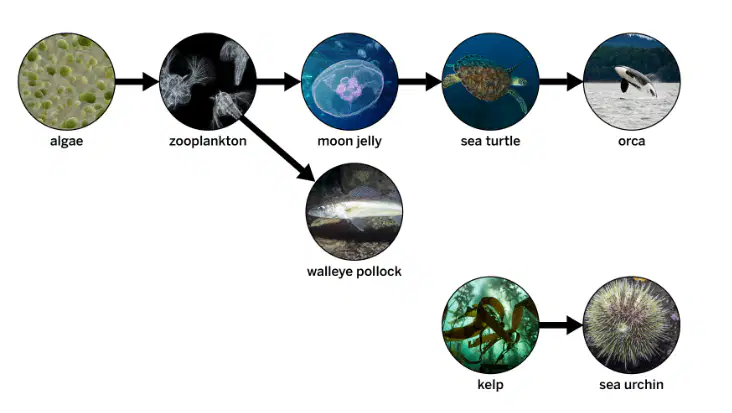
What will happen to the walleye pollock population if the moon jelly population decreases?
increase
decrease
stay the same
What will happen to the moon jelly population if the algae increases?
increase
decrease
stay the same
What will happen to the moon jelly population if the orca increases?
increase
decrease
stay the same
What will happen to the sea urchin if the kelp decreases?
increase
decrease
stay the same
What will happen to the sea turtle if the zooplankton increases?
increase
decrease
stay the same
What is an "organism"
The nonliving things in an ecosystem (ex. water)
Only the animals in an ecosystem
Only the plants in an ecosystem
ALL of the LIVING things in an ecosystem
Populations are where animals live.
True
False
What is an ecosystems?
Where only plants live
Where only animals live
Where everything, living and nonliving, interact with each other
A group of the same organism
When a population is stable it means....
there are more births than deaths.
there are less births than deaths.
there are the same number as births than deaths.
If a population is INCREASING this means...
there are more births than deaths.
there are less births than deaths.
there are the same amount of births and deaths.
If a population is DECREASING this means....
There are more births than deaths.
There are less births than deaths.
There are the same amount of births as deaths.
A consumer population is the population that....
is eaten by others.
eats others.
A resource population the population that....
gets eaten by others
eats others.
If the resource population decreases, then the consumer population will....
Increase
Stay the same
Decrease
If the consumer population decreases, the resource population will....
Increase
Stay the same
Decrease
A population of panthers lives in the southeastern United States. Over 50 years, the size of the panther population in the region increased. What best explains the increase in the size of the panther population?
The panther population is always increasing because no animal eats panthers.
Fewer panthers were born than died.
More panthers were born than died.
A lot of panthers were born and none of them died.

Scientists have been studying the size of three populations along the coast of Antarctica. In this ecosystem, penguins eat sardines (a type of small fish), and sardines eat zooplankton (very small animals that live in water). The data showed that all three populations were stable. Then the penguin population decreased suddenly.
What will likely happen to the size of the sardine population as a result?
stay the same. The size of its resource population did not change, so the amount of energy storage molecules available for the sardines did not change. There will be the same number of births and deaths in the sardine population.
decrease. A decrease in one population causes a decrease in the sizes of all other populations in the ecosystem.
increase. The smaller penguin population will leave more energy storage molecules available for the sardine population to reproduce more. This will lead to more births in the sardine population.
increase. The smaller penguin population will need fewer energy storage molecules, so they will eat fewer sardines. This will lead to fewer deaths than births in the sardine population.
What do birds such as hawks and eagles need energy for?
flying
digesting food
reproducing
All of the above

In a rainforest, anteaters eat ants, and ants eat aphids (a type of very small insect). The sizes of the populations have been stable for the last 10 years, but recently the size of the aphid population decreased. What will likely happen to the anteater population?
stay the same. Anteaters do not eat aphids, so the number of births and deaths in the anteater population will stay the same.
decrease. Fewer energy storage molecules will be available to the anteater population from the smaller ant population, so the anteater population will reproduce less. This will lead to fewer births than deaths in the anteater population.
decrease. A decrease in the size of any population leads to a decrease in the sizes of all other populations in an ecosystem.
increase. The smaller aphid population will leave more energy storage molecules available in the ecosystem for the anteater population, so there will be more births in the anteater population.
A large population of squirrels lives in a forest. In the last 50 years, the size of the squirrel population has stayed the same. What must be true about the squirrel population during the last 50 years?
The number of squirrels that were born was the same as the number of squirrels that died.
Humans started protecting the squirrel population so they stopped dying.
The squirrels did not have any baby squirrels during these years.
No squirrels were born and no squirrels died.

In this food web, which of the following animals are part of the resource population?
Deer
Coyote
Wolf

In this food web, which organism(s) are part of the consumer population.
CAN SELECT MORE THAN ONE!!
Deer
Coyote
Wolf
When a population is stable it means...
There are more births than deaths
There are more deaths than births
There are the same number of births and deaths
No organisms were born or died.
When a population is INCREASING it means...
There are more births than deaths
There are more deaths than births
There are the same number of births and deaths
No organisms were born or died.
When a population is DECREASING it means...
There are more births than deaths
There are more deaths than births
There are the same number of births and deaths
No organisms were born or died.
A consumer population is the population that..
eats others.
is eaten by others .
A resource population is the population that..
eats others.
is eaten by others .
How do producers get energy storage molecules?
By eating other animals (through food).
They make their own through photosynthesis.
They don't need energy storage molecules.
How do consumers get energy storage molecules?
By eating other animals (through food).
They make their own through photosynthesis.
They don't need energy storage molecules.

Scientists have been studying the size of three populations in a grassland. In this ecosystem, snakes eat rats, and rats eat grasshoppers. The data showed that all three populations were stable. Then the grasshopper population decreased suddenly. What will likely happen to the size of the rat population as a result?
stay the same. The size of their consumer population did not change, so the number of deaths in the rat population did not change. There will be the same number of births and deaths in the rat population.
increase. The smaller grasshopper population will need fewer energy storage molecules so there will be more energy storage molecules available for the rat population to reproduce. This will lead to more births in the rat population.
decrease. A decrease in any population leads to a decrease in the sizes of all other populations in the ecosystem.
decrease. The smaller grasshopper population provides fewer energy storage molecules for the rat population, so the rat population will reproduce less. This will lead to fewer births than deaths in the rat population.

Elephants eat grass. What is the consumer population?
Elephants
Grass
Both are the consumer population
Neither are the consumer population

Scientists have been studying the size of three populations in a grassland. In this ecosystem, lizards eat fireflies, and fireflies eat gnats (a type of insect). The data showed that all three populations were stable. Then the lizard population decreased suddenly. What will most likely happen to the size of the firefly population as a result?
increase. The smaller lizard population will need fewer energy storage molecules so they will eat fewer fireflies. This will lead to fewer deaths than births in the firefly population.
increase. The smaller lizard population will leave more energy storage molecules available for the firefly population to reproduce more. This will lead to more births in the firefly population.
stay the same. The size of its resource population did not change, so the amount of energy storage molecules available for the fireflies did not change. There will be the same number of births and deaths in the firefly population.
decrease. A decrease in any population causes a decrease in the sizes of all other populations in the ecosystem.

In Australia, both opossums and foxes eat rats. The sizes of the populations have been stable for the last 12 years, but recently the size of the opossum population increased. What will likely happen to the fox population?
increase. An increase in the size of any population leads to an increase in the sizes of all other populations in an ecosystem.
stay the same. Opossums and foxes do not eat each other, so the number of births and deaths in the fox population will stay the same.
decrease. The larger opossum population will leave fewer energy storage molecules for all other populations in the ecosystem, so the fox population will reproduce less. This will lead to fewer births than deaths in the fox population.
decrease. Fewer energy storage molecules will be available to the fox population from the smaller rat population, so the fox population will reproduce less. This will lead to fewer births than deaths in the fox population.

A population of bluefish lives in the Gulf of Mexico. Over the last 50 years, the size of the bluefish population has decreased. What best explains the decrease in the size of the bluefish population?
A lot of bluefish died and no new bluefish were born.
More bluefish were born than died.
Fewer bluefish were born than died.
The bluefish population is always decreasing because bluefish are always being eaten.

Scientists have been studying the size of three populations in a region. In this ecosystem, lions eat wild pigs, and wild pigs eat frogs. The data showed that all three populations were stable. Then the frog population decreased suddenly. What will likely happen to the size of the wild pig population as a result?
increase. The smaller frog population will need fewer energy storage molecules so there will be more energy storage molecules available to the wild pig population. This will lead to more births in the wild pig population.
decrease. The smaller frog population will provide fewer energy storage molecules for the wild pig population, so the wild pig population will reproduce less. This will lead to fewer births than deaths in the wild pig population.
decrease. A decrease in any population causes a decrease in the sizes of all other populations in an ecosystem.
stay the same. The size of their consumer population did not change, so the number of deaths in the wild pig population did not change. There will be the same number of births and deaths in the wild pig population.

In North America, both bears and eagles eat trout. The sizes of the populations have been stable for the last 9 years, but recently the size of the eagle population decreased. What will likely happen to the bear population?
stay the same. Eagles and bears do not eat each other, so the number of births and deaths in the bear population will stay the same.
increase. The smaller eagle population will leave more energy storage molecules for all other populations in the ecosystem, so all populations will reproduce more. This will lead to more births in the bear population.
increase. More energy storage molecules will be available to the bear population from the larger trout population, so the bear population will reproduce more. This will lead to more births than deaths in the bear population.
decrease. A decrease in the size of one population leads to a decrease in the sizes of all other populations in an ecosystem.
Competition occurs when two species share the same ______.
habitat
food source
both of the above
neither of the above

In a rainforest, both spiders and frogs eat flies. The sizes of the populations have been stable for the last 10 years, but recently the size of the frog population decreased. What will likely happen to the spider population?
increase. The smaller frog population will leave more energy storage molecules for all other populations in the ecosystem, so all populations will reproduce more. This will lead to more births in the spider population.
increase. More energy storage molecules will be available to the spider population from the larger fly population, so the spider population will reproduce more. This will lead to more births than deaths in the spider population.
stay the same. Frogs and spiders do not eat each other, so the number of births and deaths in the spider population will stay the same.
decrease. A decrease in the size of one population leads to a decrease in the sizes of all other populations in an ecosystem.
When a populations is known to be STABLE, it:
there are more deaths
there are more births
stays mostly the same, over time
horses live there
An indirect effect is:
the result of one cause leading to an effect that causes one or more other effects
the result of one cause stopping a desired effect
the result of more than one cause leading to the death rate of a population
when there is a direct relationship between one organism and the next
A resource population is:
a population that is avoided by organisms
a population that is eaten by organisms from another population
a population that is traded between organisms
a flea
A small part that is meant to show what the whole is like...?
A piece of something
A fraction
A sample
Competition
In an experiment where 2 groups of crickets were given different amounts of sugar in their food. Sugar is a type of energy storage molecule. Group A was given more sugar than Group B,which was given less sugar. Which group reproduced more?
Group A reproduced more
Group B reproduced more
Neither Group A or Group B reproduced
Both Group A and Group B reproduced the same
True or False? Consumer populations eat resource populations to get the energy they need to reproduce.
True
False
Neither True or False
Both True and False
A consumer population is the population that....
is eaten by others.
eats others.
If the resource population decreases, then the consumer population will....
Increase
Stay the same
Decrease
If the consumer population decreases, the resource population will....
Increase
Stay the same
Decrease

In the northwestern United States, both coyotes and wolves eat deer. The sizes of the populations have been stable for the last 6 years, but recently the size of the wolf population increased. What will likely happen to the coyote population?
The size of the coyote population will . . .
decrease. Fewer energy storage molecules will be available to the coyote population from the smaller deer population, so the coyote population will reproduce less. This will lead to fewer births than deaths in the coyote population.
decrease. The larger wolf population will leave fewer energy storage molecules for all other populations in the ecosystem, so the coyote population will reproduce less. This will lead to fewer births in the coyote population.
increase. An increase in the size of any population leads to an increase in the sizes of all other populations in an ecosystem.
stay the same. Coyotes and wolves do not eat each other, so the number of births and deaths in the coyote population will stay the same.

Scientists have been studying the size of three populations along the coast of Antarctica. In this ecosystem, penguins eat sardines (a type of small fish), and sardines eat zooplankton (very small animals that live in water). The data showed that all three populations were stable. Then the penguin population decreased suddenly. What will likely happen to the size of the sardinepopulation as a result?
The size of the sardine population will .
increase. The smaller penguin population will need fewer energy storage molecules, so they will eat fewer sardines. This will lead to fewer deaths than births in the sardine population.
increase. The smaller penguin population will leave more energy storage molecules available for the sardine population to reproduce more. This will lead to more births in the sardine population.
decrease. A decrease in one population causes a decrease in the sizes of all other populations in the ecosystem.
stay the same. The size of its resource population did not change, so the amount of energy storage molecules available for the sardines did not change. There will be the same number of births and deaths in the sardine population.
Define food web
a model that shows what eats what in an ecosystem
the result of one cause leading to an effect that causes one or more other effects
a group of atoms joined together in a particular way
living things, such as plants, animals, and bacteria
1. A population of tigers lives in Bangladesh. Over 50 years, the size of the tiger population increased. What best explains the increase in the size of the tiger population?
Fewer tigers were born than died
More tigers were born than died.

Scientists have been studying the size of three populations in a grassland. In this ecosystem, lizards eat fireflies, and fireflies eat gnats (a type of insect). The data showed that all three populations were stable. Then the lizard population decreased suddenly. What will most likely happen to the size of the firefly population as a result?
The firefly population will . . .
increase. The smaller lizard population will need fewer energy storage molecules so they will eat fewer fireflies. This will lead to fewer deaths than births in the firefly population.
decrease. A decrease in any population causes a decrease in the sizes of all other populations in the ecosystem.

In Australia, both opossums and foxes eat rats. The sizes of the populations have been stable for the last 12 years, but recently the size of the opossum population increased. What will likely happen to the fox population?
The size of the fox population will . . .
decrease. The larger opossum population will leave fewer energy storage molecules for all other populations in the ecosystem, so the fox population will reproduce less. This will lead to fewer births than deaths in the fox population.
decrease. Fewer energy storage molecules will be available to the fox population from the smaller rat population, so the fox population will reproduce less. This will lead to fewer births than deaths in the fox population.
A population of bluefish lives in the Gulf of Mexico. Over the last 50 years, the size of the bluefish population has decreased. What best explains the decrease in the size of the bluefish population?
More bluefish were born than died.
Fewer bluefish were born than died.
An ecologist is a scientist who studies…
The types of rocks and soil in an area.
The interactions between living things and their environments.
The phase changes of different substances.
The life cycles of viruses and their hosts.
A large population of squirrels lives in a forest. In the last 50 years, the size of the squirrel population has stayed the same. What must be true about the squirrel population during the last 50 years?
No squirrels were born and no squirrels died.
Humans started protecting the squirrel population so they stopped dying.
The squirrels did not have any baby squirrels during these years.
The number of squirrels that were born was the same as the number of squirrels that died.
An ecosystem is made up of ______ .
living things and their offspring
nonliving things such as rocks and soil
living things and nonliving things
many types of animals

Energy storage molecules are:
molecules required only for the birth rate
potatoes
a molecule organisms use to stabilize a population
a molecule that organisms can use to release the energy needed to survive

Foxes eat small animals called voles. In southern Sweden, scientists observed that when the vole population decreased, what will happen the fox population?
Population will decrease
Population will remain stable
Population will increase

The diagram above is called a food web. It shows the relationship between foxes and voles. What does the food web show?
foxes eat voles
voles eat foxes
voles compete with foxes
foxes compete with voles
If the consumer population decreases, the resource population will....
Increase
Stay the same
Decrease
If the resource population decreases, then the consumer population will....
Increase
Stay the same
Decrease
A resource population is the population that....
gets eaten by others
eats others.
A consumer population is the population that....
is eaten by others.
eats others.
When something remains mostly the same over time it is said to have....?
Uneventful
Potential Energy
Stability
Boring

Which of the following is a resource population of the weebug?
Greenleaf
Furbil
Which of the following is a consumer population of the weebug?
Greenleaf
Furbil
What would happen to the weebug population if the greenleaf population increased?
Weebugs would increase
Weebugs would decrease
What would happen to the weebug population if the Furbil population increased?
Weebugs would increase
Weebugs would decrease
What would happen to the weebug population if the Furbil population decreased?
Weebugs would increase
Weebugs would decrease

The crab population increased. What will happen to the shark population?
Nothing. Sharks do not eat crabs, so they do not have a direct relationship.
Decrease. A larger crab population leaves less energy storage molecules for sharks.
Increase. When one population increases, all other populations in the ecosystem increase.
Increase. The shark will have more energy storage molecules from the larger whale population, so the sharks will reproduce more.

What is the relationship between tuna and squid?
mutualism
commensalism
predator/prey
competition

Tuna population decreased. What will happen to the dolphin population?
Increase. There will be fewer tuna to eat the squid, so the dolphin will have more food.
Increase. There will be more births than deaths in the squid population, so the dolphin will be eaten less.
Decrease. There will be more births than deaths in the squid population, so the dolphin will have less food.
Stay the same. Tuna does not eat dolphin, so the herring will not be impacted.

Remora are a type of fish that attach to sharks. They travel with the sharks and feed on leftover scraps from the shark's meals. The shark gets nothing from the fish. What type of ecological relationship is this?
parasitism
predator/prey
commensalism
mutualism

Which of the following is an example of an indirect relationship?
crab and diving duck
gar and alligator
crab and gar
duck and gar

The dragonfly population increased. What will happen to the frog population and heron population?
frogs decrease, heron decrease
frogs decrease, heron increase
frogs increase, heron increase
frogs increase, heron decrease

Mistletoe extracts water and nutrients from the spruce tree to the spruce tree's detriment. What type of ecological relationship is this?
Predator/prey
Parasitism
Mutualism
Commensalism

Lynx eat snowshoe hare. The lynx population in Canada is decreasing due to the timber industry in the lynx's habitat. Does the smaller lynx population need more or less energy storage molecules?
Less, because a smaller population does not need as much food.
Less, because a smaller population will get more energy from the snowshoe hare.
More, because a smaller population needs more energy to reproduce more.
The same. A population always needs the same amount of energy no matter how large or small it is.

