
 Worksheets
YEAR 9 SCIENCE- BIOLOGY
Total questions: 131
Worksheet time: 1hrs 24mins

Humans have 22 chromosomes in all. They inherit 11 from one parent and 11 from the other.
true
false

This model can be used as evidence to support which claim?
Proteins are found inside of chromosomes and chromosomes make up proteins.
DNA makes up the majority of a cell and contributes to the functions of chromosomes.
Chromosomes are found in the nucleus of all cells and they contain long strands of DNA and proteins.
Genes are found within bands of DNA. Which sentence best describes the function of a gene.
Genes create more DNA for the organism to use later.
Genes create instructions that tell cells which proteins to make.
Genes create chromosomes for organisms to pass down to their offspring.
How many chromosomes are found in each cell of your body (excluding gametes)?
46
23
40
45
What are genes?
Pants
Specific traits
Sections of DNA arranged along the chromosomes
Chromosomes

What causes variation?
Your environment
Your genes and your environment
Your genes
Your names
What is variation?
Racial diversity
The variation of females and males
Variation of personalities
The differences between the individuals in a species
Where are genes found?
In the mitochondria
In our bone marrow
Chromosomes, in the nucleus of a cell
In our brains
What is natural selection?
There is no such thing as natural selection
Natural selection is when the variation of an animal helps it survive longer and reproduce. When it reproduces, it creates another animal that can survive very long. The animals who do not have these variations do not survive.
Natural selection is when humans breed animals to create more animals with desirable traits. For example, if someone wants a chicken that makes very large eggs, they could breed two chickens that do that.
Natural selection is when the animal species that do not survive for long die off completely extinct.
True or false: Individuals that have variations that best adapt them to their environments are most likely to survive and reproduce
(a)
What causes a species bacteria to become resistant to antibiotics?
Variation
Natural selection
Genetics
Adaptation
Why did the pepper moths in England turn brown from pale in 1900?
Because the darker ones were more attractive to moths, so they reproduced more
Because the white ones couldn't camouflage on people's clothes
Because of the pollution during the industrial revolution. The pollution cause the pale lichens on trees to die of and turned the bark brown. The pale moths could not hid from predators on the dark bark.
There is no reason for that to happen.
______ ______ was the first person to suggest a way in which one species could change into another species.
(a)
Who proposed the theory of natural selection?
Isaac Newton
Neil Armstrong
Albert Eintstein
Charles Darwin
What did the theory of natural selection state?
There is still no such thing as natural selection.
applies to all physical phenomena in the absence of gravity. General relativity explains the law of gravitation and its relation to other forces of nature
the individuals that are nest adapted to their environment are the ones that are most likely to pass on their features to the next generation
Gravity is arbitrary and that affects the natural selection of people for certain occupations in which their is realiance for the whole society to function.
(a) is the chemical from which chromosomes are made.
(a) is the part of a cell in which chromosomes are found.
(a) is the part of a chromosome that determines one particular characteristic of an organism.
(a) means that passing on of genes from parents to their offspring.
(a) means the differences between organisms belonging to the same species.
Are acquired physical traits passed down from parents to offspring?
yes
no

Gold contact lenses
Inherited Traits
Acquired Traits

Eye Color
Inherited trait
Acquired trait
Blood type
Inherited
Acquired
The passing on of genetic traits from parents to children or offspring.
Nurture
Heredity
Environment
To receive a characteristic or trait genetically form one's parent or grandparent.
Inherit
Nurture
Acquire
Brown eyes and black hair are what kind of traits?
Environment
Heredity
Nurture
What is the same thing as obtain?
Acquire
Characteristic
Environment
What do plants need to photosynthesise?
Oxygen
Food
Biomass
Carbon dioxide
The process of photosynthesis:
Carbon dioxide + water + energy --> Oxygen and Glucose
Energy and food --> oxygen
oxygen + water + energy --> Carbon dioxide and Glucose
Water and carbon dioxide make food
Where in the plant does photosynthesis take place?
Flower
Root
Leaf
Stem
What is biomass?
A mass of biological waste
Material made from living cells and tissues
Plants
Animals
Which layer inside the leaf does most of the photosynthesis?
Palisade layer
Spongy layer
Veins
Epidermis
What is the waxy layer on the leaf responsible for?
Keeping moisture in
Preventing the leaf from drying out
Protection
All of the above
An adaptation of roots to perform its function
They contain millions of root hairs
The root hairs are only 1 cell layer thick
They branch deep into the soil
All of the above
This variable is the variable you are measuring in an experiment and will dependent on what you are changing.
Controlled variable
Independent variable
Fixed variable
Dependant variable
If I am testing the effect of different water given on the rate of photosynthesis what would my independent variable be?
Light intensity
The different amounts of water given
The rate of photosynthesis
The type of plant
If I am testing the effect of different water given on the rate of photosynthesis what could an example of a controlled variable be?
The amount of water
The rate of photosynthesis
There won't be any
The type of plant
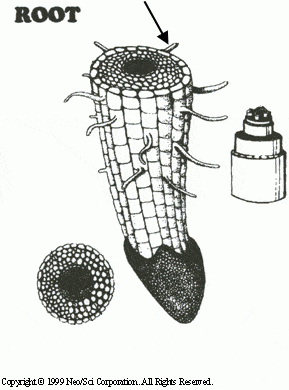
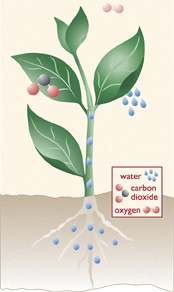
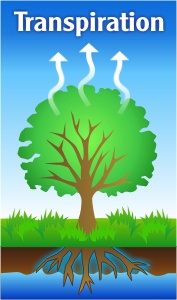
Where is xylem found in the plant?
leave -> roots -> stem
roots -> stem -> leaves
root hairs -> leaves -> veins
stem -> roots
Where does sugar transport begin?
Roots
Leaves
Root hairs
Vascular bundles

Which organelle is responsible making food (Glucose) using sunlight?
Ribosomes
Nucleus
Chloroplast
Mitochondria
Select all that are raw materials for Photosynthesis.
Water
Carbon Dioxide
Oxygen
Sunlight (Light Energy)
Glucose (Sugar/food)

Look at the diagram. Which gas would most likely be found in the greatest amount in the bubbles?

Select the correct term for the following definition:
"The water transport system in plants."
Villi
Bronchi
Bolus
Xylem
What does a plant need magnesium for
For healthy leaves and flowers
To make chlorophyll
For healthy growth
For healthy roots
How does a plant get water for photosynthesis
Soaks into the leaves from rain fall
Absorbed from the soil by roots and root hairs
Diffuses into the leaves through the stomata
Absorbed from the soil by roots
This mineral is important for healthy leaves and flowers
magnesium
nitrates
phosphates
potassium
This mineral is important for healthy growth
magnesium
nitrates
phosphates
potassium
This mineral is important for healthy roots
magnesium
nitrates
phosphates
potassium
Farmers add chemicals to the soil to replace missing minerals. These chemicals are called________.
Fertilisers
Soils
Vitamins
Chlorophyll
What type of deficiency if a plant has poor growth and older leaves are yellowed?
nitrate deficiency
magnesium deficiency
phosphorus deficiency
potassium deficiency
What type of deficiency if a plant leaves turns yellow?
nitrate deficiency
magnesium deficiency
phosphorus deficiency
potassium deficiency
What type of deficiency if a plant leaves turns yellow?
nitrate deficiency
magnesium deficiency
phosphorus deficiency
potassium deficiency
What type of deficiency if a plant has yellow leaves and dead patches.
nitrate deficiency
magnesium deficiency
phosphorus deficiency
potassium deficiency
Which choice correctly shows the gases that enter and exit plants during photosynthesis?
Enter: Oxygen
Exit: Carbon Dioxide
Enter: Carbon Dioxide
Exit: Oxygen
Enter: Water Vapor
Exit: Glucose
Enter: Light
Exit: Water Vapor
Plants take in ________from the air as one key ingredient for photosynthesis.
oxygen
soil
sugar
carbon dioxide
The main source of energy for all life comes from _____.
the Earth
the sun
the moon
the food we eat/make
Why are producers (plants) important for all life on Earth?
They make our world more beautiful
They make the planet look green
They provide shade for insects
They use carbon dioxide and give us oxygen
____________________ is a part of oceans, air, rocks, soil, and all living things.
Nitrogen
Carbon
Water
Silver
How do animals get carbon?
By eating plants and or other animals.
They absorb it from the atmosphere.
From the ground
They do not get carbon from anywhere.
Which describes the relationship between plants and animals in the carbon cycle?
Plants produce and release oxygen that animals need
Plants produce and release carbon dioxide that animals need
Animals produce and release oxygen that plants need
Animals produce oxygen that plants turn into carbon dioxide
which of the following is a reactant to photosynthesis?
Oxygen
Carbohydrates
Glucose
Water
Photosynthesis occurs in the
Chloroplasts
Cell walls
Cytoplasm
Mitochondria
The law of conservation of mass states that, in a closed system
mass cannot be created or destroyed
mass can be created but not destroyed
mass can be destroyed but not created
mass can be created and destroyed
What is transpiration?
Excess water being released from the aerial parts of plants in the form of water vapor
Excess sugar being released from the leave
The way a plant makes its food
When the plant uses sugar for energy
Select all of the environmental factors that would increase transpiration.
Increased humidity
Increased wind speed
Increased temperature
Decreased surface area
Which statement correctly identifies the substance and direction it is transported in the xylem?
Water, only upwards
Glucose, only upwards
Water, up and down the plant
Glucose, up and down the plant
Factors which affect transpiration are (external)
Sunlight
Wind speed
Humidity
Rain
What are the main functions of the excretory system?
deliver oxygen to the body
deliver nutrients to the body
remove water and waste from the body
remove disease from the body
Which organ filters blood?
Kidneys
Large Intestine
Lungs
Bladder

What is organ is #1?
Kidney
Stomach
Bladder
Heart
What organ is #3?
Kidney
Stomach
Bladder
Heart
True or False:
Kidneys filter waste from blood.
True
False

The job of your kidneys is to...
Create feces
Take carbon dioxide out of your blood
Put oxygen into your blood
Clean blood, sending waste to bladder

Which structure transports urine from the kidney to the bladder?
Ureter
Urethra
Bladder
Kidney
What is the name of the structure that leads from the bladder to the outside environment?
Ureter
Bladder
Urethra
Kidney
In each kidney there are millions of tiny filtering units responsible for cleaning the blood, what are they?
Alveoli
Villi
Nephrons
Cilia

All of these structures combined make up which system?
Integumentary System
Digestive System
Urinary System
Immune System
Identify the structure labelled "C" in the diagram.
Kidney
Ureter
Bladder
Urethra
Melting glaciers are causing ___________ to rise around the world.
Carbon Dioxide
Greenhouse Effect
greenhouse gases
sea levels

A meteor that does not burn up in Earth's atmosphere and reaches Earth's surface
Meteorite
Meteoroid
Meteor
Which of the following are impacts of climate change?
Sea level rise
More frequent extreme weather events
Spread of some infectious insect-borne diseases
Lengthen the growing season in certain regions
Greenhouse effect
Global warming can cause the glaciers in Greenland and Antarctica to melt resulting in
more extreme weather
a rise in sea level
an increase in the spread of infectious diseases
Sea level rise is the increase in the mean height of the sea’s surface between high tide and low tide, relative to land.
True
False
Check all the statements that explain why sea level rise is a threat:
Sea level rise will lead to the inundation of low-lying areas such as coastal cities, which constitutes two-thirds of the world’s capital cities. This will cause massive economic losses.
Sea level rise will lead to the inundation of low-lying small island nation states, which often do not have alternative areas with higher relief to house the remaining population.
Higher temperatures cause the melting of glaciers and causes water in seas and ocean to expand, thus increasing the sea level.
Sea level rise will lead to widespread destruction and damage to properties in the densely-populated cities.
Which of the following are examples of extreme weather events?
Heat waves
Floods
Famine
Droughts
Tropical cyclones/hurricanes
Occurrence of extreme weather events has increased in the last few decades
True
False
Which of the following has been linked to climate change?
Droughts
Intense Storms
Melting of Polar Ice Caps
All of these

