wayground logo

Free Printable Worksheets

Font size

S
M
L
XL
Worksheets

Test 6.2 Review 2024

Total questions: 133

Worksheet time: 3hrs 58mins

Name
Class
Date
1.
What does this symbol show? 
a)
High pressure
b)
Low pressure
c)
Low humitidy
d)
Longing for someone (strong feelings)
2.
What does this image show? 
a)
A flag banner
b)
Blue alligator teeth
c)
Warm Front
d)
Cold Front
3.
What does this image represent?
a)
Cold front
b)
Red bulbous things
c)
Warm front
d)
Sarah Ju
4.
a)

Cold air is approaching Location A

b)

Warm air is approaching Location A

c)

Cold air is approaching Location B

d)

Warm air is approaching Location B

5.
a)

Cold air is approaching Location A

b)

Warm air is approaching Location A

c)

Cold air is approaching Location B

d)

Warm air is approaching Location B

6.
a)

Cold air is approaching Location A

b)

Warm air is approaching Location A

c)

Cold air is approaching Location B

d)

Warm air is approaching Location B

7.
a)

It's warmer at location A

b)

It's warmer at location B

8.
a)

It's cooler at location A

b)

It's cooler at location B

9.
What direction is the cold front moving?
a)
Northwest
b)
Southeast
c)
Northeast
d)
Southwest
10.
What direction is the warm front moving?
a)
Northeast
b)
Northwest
c)
Southeast
d)
Southwest
11.
What does this image represent? 
a)
TJ
b)
Thunderstorms
c)
Rain
d)
Partly cloudy
12.
What does this symbol represent on a weather map?
a)
Sunny
b)
Partly Cloudy
c)
Cloudy
d)
Thunderstorm
13.
Scientists who study weather and try to predict it are called 
a)
astronomers
b)
volcanologists
c)
meteorologists
d)
weatherologists
14.

What is this weather symbol?

a)

Sunny

b)

Rainy

c)

Partly Cloudy

d)

Stormy

15.

What does this weather symbol mean?

a)

Rain

b)

Thunderstorm

c)

Partly Cloudy

d)

Sunny

16.

What is this weather symbol?

a)

Partly Cloudy

b)

Cloud

c)

Sunny

d)

Storm

17.
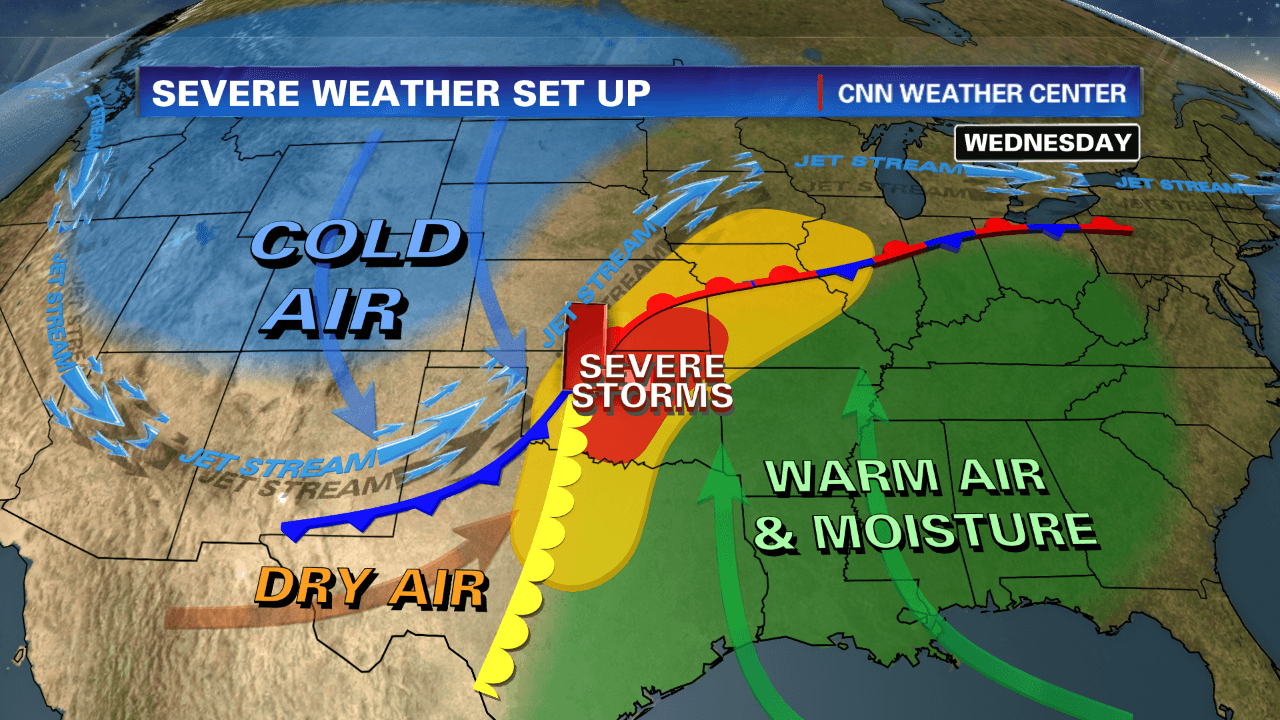
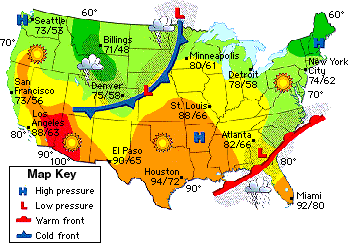
A cold front is approaching Minneapolis. What will happen to the air temperature?
a)
stay the same
b)
increase
c)
decrease
18.
When two air masses meet, there is a _____, or boundary.
a)
thunderstorm
b)
watch
c)
front
d)
cloud
19.
Which front leads to steady rain for several days?
a)
warm front
b)
cold front
c)
stationary front
d)
occluded front
20.
Which condition usually means cloudy, stormy weather?
a)
high pressure
b)
low pressure
21.
name this symbol
a)
warm front
b)
cold front
c)
stationary front
d)
occluded front
22.
The amount of water vapor present in the air is called ________________.
a)
weather
b)
humidity
c)
air mass
d)
dew point
23.
What information do you not  find on a weather map?
a)
cold front
b)
warm front
c)
high or low pressure
d)
seasons
24.
All the air surrounding the earth
a)
atmosphere
b)
hydrosphere
c)
mesosphere
d)
air
25.
Instrument for measuring temperature
a)
temperature vane
b)
hygrometer
c)
thermometer
d)
rain gauge
26.
 Which BEST describes a front?
a)
a large mass of moving air
b)
a boundary between 2 air masses
c)
a high pressure system
d)
a low pressure system  
27.
a)

decreasing temperatures

b)

increasing temperatures

c)

cloudy sky, maybe precipitation

d)

clear sky, sunny weather

28.
a)

decreasing temperatures

b)

increasing temperatures

c)

cloudy sky, maybe precipitation

d)

clear sky, sunny weather

29.
Located at the leading edge of a warm air mass. Brings gentle rain or light snow, followed by warmer, milder weather.  
a)
Warm Front
b)
Cold Front 
c)
Occluded Front 
d)
Stationary Front 
30.
What kind of pressure predicts good weather?
a)
high
b)
low
c)
cold
d)
stationary
31.
Where the warm and cold air meet and stall, clouds and fog form, and it may rain or snow.  It could bring many days of clouds and precipitation.  
a)
Warm Front
b)
Cold Front
c)
Occluded Front 
d)
Stationary Front 
32.
Our weather generally moves in this direction...
a)
West to East
b)
East to West
c)
North to South
d)
South to North
33.
High Pressure is associated with this type of weather...
a)
Cloudy/Overcast Weather
b)
Cold Weather
c)
Warm Weather
d)
Fair Weather
34.
What causes warm air to rise?
a)
the fact that it's less dense than cold air 
b)
The fact that it weighs more than cold air 
c)
The fact that it has higher pressure than cold
d)
the fact that its more dense than cold air 
35.
Large body  of air with similar temperature, pressure, and humidity.
a)
Cold front
b)
Warm front
c)
High pressure system
d)
Air mass
36.
Cold air moves in ______________direction.
a)
Downward
b)
Upward
c)
Left to right
d)
Circular
37.
Hot air moves in __________________direction.
a)
Upward
b)
Downward
c)
Circular
d)
Sideways
38.

Which of the following is NOT a type of data that is used to make a weather forecast?

a)

gravity

b)

wind speed

c)

air pressure

d)

temperature

39.

What type of weather should you expect to have at city D?

a)

Stormy weather.

b)

Lousy weather.

c)

A rainy day.

d)

Clear, sunny and calm winds.

40.

City A should be experiencing

a)

Cold Temperatures because a warm front just passed.

b)

Warm Temperatures because a warm front just passed.

c)

Warm temperatures because a cold front just passed.

d)

Cold temperatures because a cold front is coming in.

41.
Which statement correctly defines wind?
a)
Wind is the movement of air from areas of low pressure to areas of high pressure
b)
Wind is the movement of air to a colder area in the atmosphere.
c)
Wind is the movement of air from areas of high pressure to areas of low pressure.
d)
Wind is the movement of air pushed around and bouncing off Earth's surface.
42.

Air is warmer and less dense at the equator because the equator receives more____________________.

a)

wind

b)

solar radiation

c)

air pressure

d)

condensation

43.
Wind is caused mainly by air pressure differences that result from...
a)
a. uneven heating of the Earth's atmosphere.
b)
b. absorption of ultraviolet radiation by Earth's land masses.
c)
c. radiation of heat from Earth's land masses to water bodies.
d)
d. rotation of Earth on its axis.
44.
Where does the initial source of energy come from that creates winds?
a)
the moon
b)
the sun
c)
the Earth's surface
d)
the rotation of the Earth
45.
What causes global winds and convection in the atmosphere? 
a)
continental deflection
b)
the rotation of the Earth
c)
Moon's gravity
d)
unequal heating of the Earth by the sun
46.
Climate is
a)
the further you get from the equator
b)
the higher you go, the colder it gets
c)
the conditions of the atmosphere at a certain place and time.
d)
the average weather conditions of an area over a long period of time.
47.
Movements of ocean water in a continuous flow are called?
a)
ocean currents
b)
global winds
c)
air mass
d)
front
48.
What causes wind to blow?
a)
Differences in longitude
b)
Shock waves from clouds
c)
Differences in air temperature and pressure
d)
The rotation of earth
49.

What will most likely result when the jet stream moves south of North Carolina?

a)

North Carolina will experience tropical weather conditions.

b)

North Carolina will experience cold weather.

c)

North Carolina will experience hot, dry weather.

d)

North Carolina will experience mild weather.

50.

Hurricanes usually occur between the months of __________.

a)

January and March

b)

April and June

c)

November and January

d)

June and November

51.

The center of the hurricane is called the __________.

a)

bullseye

b)

point

c)

nose

d)

eye

52.

The sea water that starts a hurricane gets warm from ________________.

a)

volcanoes

b)

the moon

c)

lightning

d)

the sun

53.
Hurricanes develop in ________ regions.
a)
Arctic
b)
Tropical
c)
Arid
d)
None of the above
54.

What is the highest category hurricane?

a)

3

b)

5

c)

6

d)

7

55.

Why does a hurricane slow down when it hits land?

a)

The wind stops it

b)

It stops raining

c)

It loses its energy source

d)

The air is different

56.
The pressure inside a hurricane is _______.
a)
High
b)
Low
57.
Where do most hurricanes develop?
a)
Middle of the United States
b)
Near the Equator
c)
Near Canada and Alaska
d)
Antarctica
58.

Which picture shows material that is more dense?

a)

The picture of the left

b)

The picture on the right

59.

What is an example of convection currents

a)

Feeling the heat from a bonfire with your friends

b)

Touching a hot curling iron

c)

The movement of air in a circular motion in the atmosphere

60.
The main reason that we have currents in the ocean and air is
a)
the sun heats the air and ocean evenly everywhere
b)
the heat inside the earth heats the ocean and the ocean heats the air
c)
the sun cannot heat both the air and water, so one must heat the other
d)
the sun heats air and water more at the equator because it receives more direct sunlight
61.
Energy for convection on the Earth comes from...
a)
The sun
b)
The moon
c)
Solar winds
d)
The ocean
62.
In convection, WARM air
a)
Rises
b)
Sinks
63.
Heat transfers from an area of ____temperature to an area of ___ temperature.
a)
high to low
b)
low to high
c)
high to high
d)
It can travel high to low and low to high. 
64.
Warm air is __________ dense than cold air and rises creating convection currents.
a)
more
b)
less
65.
How do we characterize an air mass that forms over the ocean?
a)
Dry
b)
Wet
c)
Cold
d)
Warm
66.
How do we characterize an air mass that forms over land?
a)
Dry
b)
Wet
c)
Cold
d)
Warm
67.
How do we characterize an air mass that forms over near the equator?
a)
Dry
b)
Wet
c)
Cold
d)
Warm
68.
How do we characterize an air mass that forms near the poles?
a)
Dry
b)
Wet
c)
Warm
d)
Cold
69.
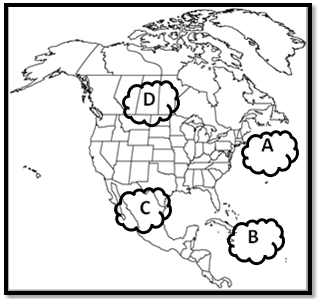
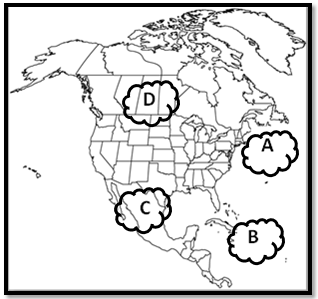
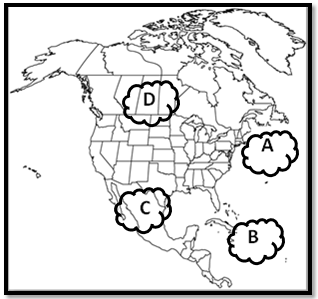
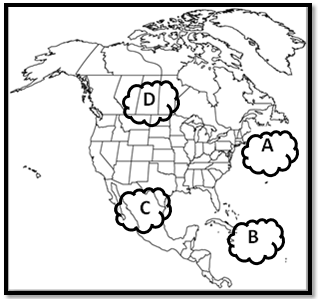
Which type of air would you find at air mass A?
a)
cold, dry
b)
warm, humid
c)
warm, dry
d)
cold, humid
70.
Which type of air would you find at air mass B?
a)
cold, dry
b)
warm, humid
c)
warm, dry
d)
cold, humid
71.
Which type of air would you find at air mass C?
a)
cold, dry
b)
warm, humid
c)
warm, dry
d)
cold, humid
72.
Which type of air would you find at air mass D?
a)
cold, dry
b)
warm, humid
c)
warm, dry
d)
cold, humid
73.

When we were working on our virtual hurricane simulation, you tried to create the strongest hurricane you could.

What meteorological season gave you the best chance for a strong hurricane?

a)

Summer

b)

Fall

c)

Winter

d)

Spring

74.
An air mass forms over the Gulf of Mexico and moves northeast across Georgia. What weather conditions are likely to prevail in Georgia?
a)
cool and dry
b)
cool and humid
c)
warm and dry
d)
warm and humid
75.
Most water vapor in the atmosphere comes from 
a)
evaporation from oceans.
b)
evaporation from soil.
c)
transpiration from plants.
d)
the burning of fossil fuels. 
76.
Which of the following is typical of a tropical climate?
a)
cold, dry air
b)
cool, moist air
c)
hot, dry air
d)
warm, moist air
77.
Warm air rising at the equator and cold air sinking at the poles is one reason for which event?
a)
hurricanes 
b)
Coriolis force
c)
earth's rotation
d)
convection currents
78.
The location where warm air mass is replacing a cooler air mass
a)
cold front
b)
warm front
c)
icy front
d)
storm front
79.
The location where cold air mass is replacing a warm air mass
a)
storm front
b)
hot front
c)
warm front
d)
cold front
80.
This front occurs when a warm air mass meets a cold air mass and stops.
a)
occluded front
b)
warm front
c)
stationary front
d)
cold front
81.
The average yearly weather pattern over many years.
a)
weather
b)
air pressure
c)
climate
d)
zone
82.
What will the weather be in a couple of days in Minneapolis?
a)
sunny and warmer
b)
sunny and colder
c)
rainy and warmer
d)
rainy and colder
83.
What front is occurring between Denver and St. Louis?
a)
occluded front
b)
warm front
c)
cold front
d)
stationary front
84.
Where would you expect to see nice weather?
a)
low pressure area
b)
high pressure area
85.

What is weather?

a)

average weather over a long period of time

b)

average precipitation at a certain time and place

c)

average temperature at a certain time and place

d)

what's happening in our atmosphere at a certain time and place

86.

Weather travels across the U.S. in what direction?

a)

north to south

b)

south to north

c)

west to east

d)

east to west

87.
______ affects weather and climate because it heats the Earth unevenly.
a)
latitude
b)
altitude
c)
atmosphere
d)
sunlight
88.
Large body of air with the same temperature, pressure, and moisture characteristics is called?
a)
warm front
b)
cold front
c)
air mass
d)
jet stream
89.
Earth is unevenly heated due to its?
a)
oceans and moon
b)
tilt and shape
c)
gravity and clouds
d)
climate and weather
90.
The boundary between two air masses that meet is called?
a)
front
b)
back
c)
side
d)
air mass
91.
A polar climate is?
a)
warm and cool
b)
consistently moderate
c)
consistently cool
d)
consistently warm
92.
What is the name of the job that tells the weather?
a)
meteorologist
b)
weather man
c)
weather person
93.

The kinds of data that reflect climate are different from the conditions described in weather data. Which of the following is a description of climate?

a)

Today it is hot and sunny in Phoenix, Arizona.

b)

Summers are usually mild in Lansing, Michigan.

c)

Last week it rained every day in San Antonio, Texas.

d)

Yesterday was cold and windy in Anchorage, Alaska.

94.

Weather data is different than climate data. Which of the following is an example of weather data?

a)

The average high temperature in May is 21°C in the Midwest of the United States

b)

Central Australia usually receives less than 110 mm of rainfall all year

c)

The relative humidity was 24% at noon on July 23 in Tempe, Arizona

d)

On average, there is 88mm of rain in the Gulf Coast region in July

95.

The table shows some weather data collected over a five-day period. What pattern over the five days can be observed in the collected data?

a)

There was more rain on the warmer days.

b)

Rain came along with lower temperatures.

c)

There were fewer clouds as the week went on.

d)

Temperature increased during the week.

96.
Identify the type of front that is shown in the image.
a)
Occluded Front
b)
Cold Front
c)
Stationary Front
d)
Warm Front
97.
Identify the type of front that is shown in the image.
a)
Occluded Front 
b)
Cold Front
c)
Stationary Front
d)
Warm Front
98.
Located at the leading edge of a temperature drop off. Bring heavy thunderstorms, rain, and hail. Cool, fair weather is likely to follow.  
a)
Warm Front
b)
Cold Front
c)
Occluded Front
d)
Stationary Front 
99.
Located at the leading edge of a warm air mass. Brings gentle rain or light snow, followed by warmer, milder weather.  
a)
Warm Front
b)
Cold Front 
c)
Occluded Front 
d)
Stationary Front 
100.
When there is a difference in air pressure, air moves from...
a)
Areas of low pressure to areas of high pressure
b)
It depends on the temperature of the air
c)
From areas of high pressure to areas of low pressure
d)
It could move either way
101.
A city is experiencing a high pressure system. What else are they most likely experiencing?
a)
Cloudy skies
b)
Storms
c)
Very hot temperatures
d)
Clear skies
102.
A cold front is heading towards Dallas. When the front is over the city, they should expect
a)
Warm air
b)
Gentle storms
c)
Thunder and lightening
d)
Long lasting storms
103.
This form of heat transfer happens when the warm ground touches the atmosphere. 
a)
radiation
b)
conduction
c)
convection
d)
conservation
104.
A convection current is caused by
a)
Differences in density
b)
Differences in wind speed
c)
Differences in air pollution
d)
Differences in atmosphere pressure
105.

In a convection current, ____________ air rises and ___________ air sinks.

a)

warm;cool

b)

cool;warm

c)

more dense;less dense

106.
Rain, snow, sleet, or hail that falls from clouds in the sky.
a)
weather
b)
precipitation
c)
humidity
d)
climate
107.
The amount of water vapor in the air.
a)
precipitation
b)
humidity
c)
weather
d)
climate
108.

A large, swirling, low pressure system that forms over the warm Atlantic ocean. It has winds of at least 120 km/h and loses force/power when it reaches land.

a)

precipitation

b)

blizzard

c)

tornado

d)

hurricane

109.
a)
From east to west
b)
From west to east
c)
From north to south
d)
From south to north
110.
Winds blow in curved lines because of...
a)
the greenhouse effect.
b)
the Coriolis effect.
c)
convection.
d)
the location of landforms.
111.
How does a hurricane form?
a)
It begins as a high-pressure area over cold ocean water.
b)
It begins as a low-pressure system area over warm ocean water.
c)
It beings as a high-pressure area over warm ocean water.
d)
It begins as a low-pressure area over cold ocean water.
112.
What does an "H" inside a circle represent on a weather map?
a)
Hurricane
b)
High Humidity
c)
Hot
d)
High Pressure
113.
Low Pressure is associated with this type of weather...
a)
Cloudy/Overcast Weather
b)
Cold Weather
c)
Warm Weather
d)
Fair Weather
114.
High Pressure is associated with this type of weather...
a)
Cloudy/Overcast Weather
b)
Cold Weather
c)
Warm Weather
d)
Fair Weather
115.
A cold front moving into an area can bring this type of weather...
a)
Warmer Temperatures, Clear Skies
b)
Colder Temperatures, Clear Skies
c)
Warmer Temperatures, Clouds
d)
Colder Temperatures, Clouds, and Precipitation
116.
A warm front moving into an area can bring this type of weather...
a)
Warmer Temperatures, Clear Skies
b)
Colder Temperatures, Clear Skies
c)
Warmer Temperatures, Clouds, and steady precipitation
d)
Colder Temperatures, Clouds, and Precipitation
117.
What causes warm air to rise?
a)
the fact that it's less dense than cold air 
b)
The fact that it weighs more than cold air 
c)
The fact that it has higher pressure than cold
d)
the fact that its more dense than cold air 
118.
A low pressure system is located over Georgia. What type of weather will they have?
a)
clear, sunny skies
b)
cloudy and rainy
119.
A high pressure system is located north of New York City. What type of weather will be experienced there?
a)
clear, sunny skies
b)
cloudy and rainy
120.
What direction is the cold front moving?
a)
Northwest
b)
Southeast
c)
Northeast
d)
Southwest
121.
A cold front is approaching Minneapolis. What will happen to the air temperature?
a)
stay the same
b)
increase
c)
decrease
122.
This symbol represents
a)
a cold front
b)
an occluded front 
c)
a stationary front
d)
a warm front
123.
Air masses are large bodies of air that can be many miles wide. 
a)
True
b)
False
124.

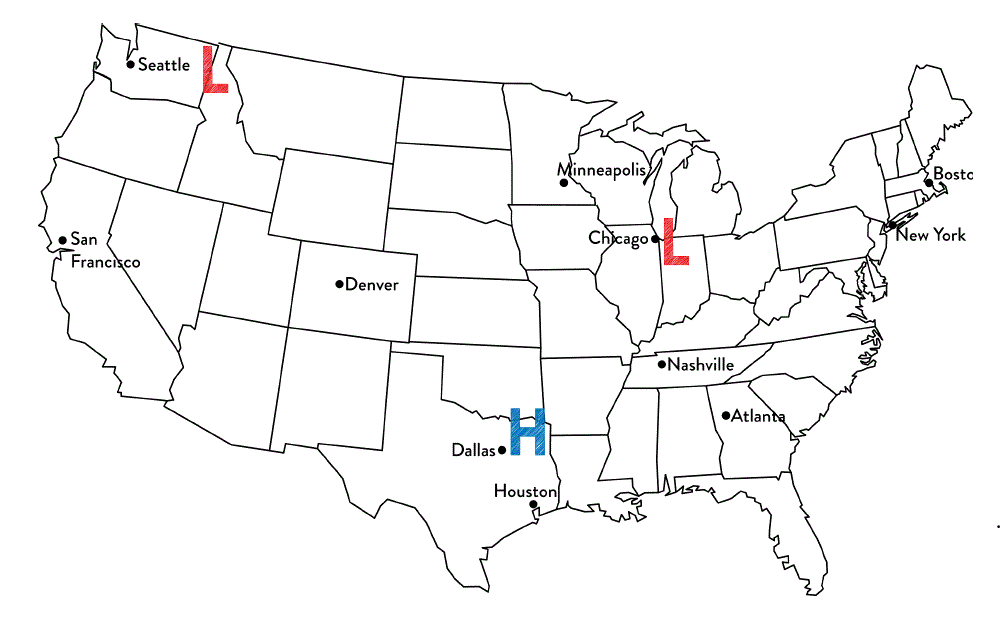
Which two cities are most likely to experience clear, dry weather?

a)

Seattle & San Francisco

b)

Chicago & Minneapolis

c)

Chicago & Nashville

d)

Dallas & Houston

125.

Tim said that Chicago is most likely to experience rainy weather. Jennifer thinks that Dallas is most likely to experience rainy weather.

Which student is correct?

a)

Tim because Chicago is the closest to a low pressure system and they produce precipitation.

b)

Jennifer because high pressure systems produce precipitation

c)

Both students are correct because all systems produce precipitation

d)

Neither of the students are correct because the cities are not close enough to the system.

126.

What type of weather is Minneapolis most likely experiencing?

a)

light/drizzly rain

b)

severe thunderstorms

c)

sunny skies

d)

cloudy skies, light precipitation

127.

Why does city "B" have clear skies?

a)

It is in North America

b)

There is not a front moving through city "B"

c)

Clouds do not form in the West

d)

It is located near a high pressure system

128.
Movements of ocean water in a continuous flow are called?
a)
ocean currents
b)
global winds
c)
air mass
d)
front
129.
Warm ocean currents generally come from
a)
The North Pole
b)
The South Pole
c)
The Equator
d)
Both A and B
130.
Deep Ocean currents are a result of
a)
Global Wind Patterns
b)
Earth's Rotation
c)
Density
d)
All of the above
131.

Which best describes the Gulf Stream?

a)

A cold ocean current that cools the weather off near Australia.

b)

A cold ocean current that helps decrease global warming.

c)

A warm ocean current that influences weather along the east coast of the U.S. and up toward Europe.

d)

A warm ocean current that influences weather in Cuba and moves toward Antarctica.

132.

What does the blue line represent in the Thermohaline circulation?

a)

Warm salty water

b)

Warm water

c)

Cold water

d)

Cold salty water

133.

If a material is less dense then water, it will

a)

sink

b)

float

c)

be neutrally buoyant

d)

freeze