
 Worksheets
Semester 1 Review (MATTER)
Total questions: 140
Worksheet time: 2hrs 20mins
The independent variable is the ONE thing you _____ to test your hypothesis.
change
keep the same
remove
ignore
The variable that you want to see a change in, and that is measured in the experiment, is the ________________ .
Controlled Variable
Responsive Variable
Dependent Variable
Independent Variable
Catherine is testing which kind of soil will help grass grow the tallest. The height of the grown grass is the __ variable.
constant (stays the same)
independent (it's what you change)
dependent (it's what you measure)

Abram is testing which paper airplane design flies furthest. What would the INDEPENDENT variable be in his experiment?
Hassan is experimenting with bean plants to see if they grow better with or without fertilizer. He uses six bean plants (same type/age/size) and one type of fertilizer. What type of variable is the fertilizer?
Dependent
Independent
Control
Compound
Mrs. Anderson set up an experiment to see how the mass of a ball affects the distance it rolls off a ramp. What will her dependent variable be?
Distance the ball rolls off the ramp
Height of the ramp
Mass of the ball
Where the experiment took place.
What is the maximum number of variables that you should tinker with during a single experiment?
None
One
Two
No limit
Shaniah finds a rock and writes down that it is solid black, smooth, and reflective. What type of data is this?
Qualitative data
Quantitative data
What is a hypothesis?
A hypothesis is the right answer
A hypothesis is the wrong answer
A hypothesis is an educated guess that you intend to test.
The long side of a right triangle.
The information that you get from your experiment (you organize it into charts and graphs).
hypotheses
data
variables
scientific theories
What does every scientific investigation begin with?
hypothesis
making observations and asking a question
procedures
conclusion
Elias can solve a Rubik's Cube in 17.4 seconds. What type of data is this?
Qualitative data
Quantitative data
Which of the following is NOT a scientifically testable question?
Why do people fall in love?
Does fertilizer help plants grow bigger?
Does heart rate increase with exercise?
Does the freezing point of water change when salt is added?
When making an observation, you use...
Your emotions
Your neighbor's opinion
Senses and tools
Only taste

The person is wearing a light-colored shirt
The person is going to an anniversary party for their grandparents

Anthony designed an experiment to answer the following question: How does the temperature of water affect the time it takes for a sugar cube to dissolve?
Multiple answers!!! Which things should Anthony keep the same in his experiment? Check all that apply.
the amount of water in each cup
the size of the sugar cubes
the temperature of the water
whether he stirs the water or not
Particles of matter...
Are motionless if they are a solid
Are always in motion
Do not actually move at all
Are only in motion if they are gases
Why would a balloon shrink when you put it in the freezer?
Its particles move faster and push apart
Its particles move faster and closer together
Its particles slow down and push apart
Its particles slow down and move closer together
Why is water a pure substance?
It can be broken down physically
It's a mixture, not a pure substance
Every water molecule is identical
Water molecules are made of many types of atoms
Which of these is a physical property?
a penny being able to tarnish
the shape of a piece of candy
the effect of acid rain on statues
fuel burning in car engines

What change of state is happening here?
Plasma to gas
Gas to solid
Liquid to solid
Liquid to gas
When ice melts, it is a
physical change, because it is a state change
chemical change, because new substances are formed

This balance is used to measure
gravity
weight
density
mass

In this chemical reaction, what is being formed in box C?
compound
element
mixture
atom

A rock is dropped into a graduated cylinder of water. What is its volume?
30 cm3
40 cm3
10 cm3
5 cm3
If you put a magnet near a pile of different substances and a few iron chips separate and move toward the magnet, what do you know about the pile?
It is a solution
It is all one magnetic element
It is a compound that contains iron
It is a heterogeneous mixture that contains iron
What is something that ALL states of matter have in common?
Particles are spaced far apart
Particles are constantly moving
Shape depends on container
Does not take shape of container
As you heat something up, what happens to its particles?
They melt
They move faster
They grow
They join together to make larger ones

What property is the SAME for the water in these beakers?
mass
weight
density
volume
Which of these is a physical change?
burning
rusting
dissolving
digesting
What is true about a substance's particles in the solid state vs. its particles in the gaseous state?
Solid particles are warmer
Gas particles are warmer
The same
You can't measure the temperature
Why does a puddle dry up on a hot day?
The water boils and becomes a gas
The water evaporates to water vapor
The water forms tiny blocks of ice
The water turns into oxygen
What type of substance is ALWAYS made up of ONE single type of atom?
mixture
element
compound
molecule
Which of these is a compound?
hydrogen
oxygen
chlorine
water
If a substance takes both the volume AND shape of its container, it is
gas
ice
liquid
solid
How should models of a substance's solid, liquid, and gas states be different?
Different sizes of atoms
Different numbers of atoms
Different arrangement and motion of atoms
They should all be identical
When a solid turns into a liquid,
the particles move faster
its mass increases
its identity changes
the particles expand to fill the container completely
Which change involves particles slowing down and moving closer together?
Boiling
Evaporation
Sublimation
Condensation
If ice melts inside an insulated container, what happens to its mass?
It gains mass
It loses mass
Mass remains the same
You can't measure the mass
Which is a PHYSICAL property of hydrogen?
It is found in acids and reacts with bases
It is highly combustible
It reacts with oxygen
In gas form, it is less dense than oxygen gas
Which is a chemical property of a piece of wood?
It can be burned
It cannot be crumpled into a ball
It does not attract a magnet
It does not conduct electricity
An object has these properties. Which is a CHEMICAL property?
It is white
It has a powdery texture
Its density is 3.98 g/cm3
It reacts with acid to form water
A safety pin, a knife, and a bucket are made of the same metal. Which is NOT a physical property that is identical for all of them?
mass
magnetism
melting point
electrical conductivity
Which of these is a physical change?
Chopping vegetables for a salad
Tacos are digested
A metal and a gas combine to form table salt
Sodium metal reacts violently with water
Which is a chemical change?
A bike rusting
Hot chili cooling down
Glass heated until it melts
Dropping and breaking an iPhone X
If you rip up your report card into a hundred pieces, what kind of change is it?
a change in total mass
a physical change
a chemical change
a change in energy
What substance demonstrates sublimation when exposed to room temperature conditions?
Balloon helium
Regular ice
Dry ice
Oobleck
Which material is a pure substance?
solution
alloy
compound
mixture
When two or more substances combine, but each keeps its own properties, the new combination is called a(an)
element
compound
mixture
pure substance
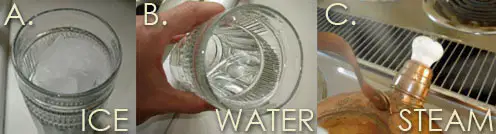
Which particle has the most energy?
ice
water
steam
there is no difference
Robert leaves a chocolate bar in his car while attending school all day. When he goes to his car in the afternoon, the bar has changed into a gooey liquid. Which statement BEST explains what happened to Robert's chocolate bar?
The energy from the sun caused the chocolate to melt.
The chocolate in the bar spread out due to entropy loss.
The energy holding the solid bar together was lost over time and it became liquid.
The liquid was the original state of the chocolate and over time it returned to this state.
To make salt water a heterogeneous mixture, you would have to
add sand.
add a small amount of sugar.
boil the water
remove the salt.
What would happen to a 10 kg block of ice if you slowly increased the kinetic energy of the molecules within the ice?
The ice would melt.
Sublimation would occur.
The ice would remain frozen.
Water vapor near the ice would also freeze.
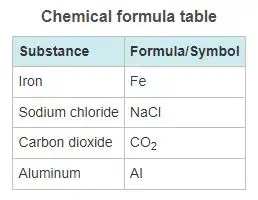
The table lists the chemical formulas or symbols of a few common substances. Which two substances are compounds?
aluminum and iron
iron and sodium chloride
carbon dioxide and aluminum
sodium chloride and carbon dioxide
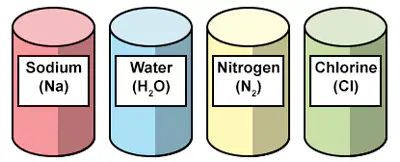
Ms. Roberts asked Tim to put the label "compound" on the correct jar in the picture. Which of the four substances is a compound?
chlorine
nitrogen
water
sodium
Jack and Jill have a pail of water. Which action will cause the molecules of water to move faster?
Putting ice cubes in the water.
Pouring the water into a heated pot.
Placing the water in the refrigerator.
Emptying the pail into a body of water at the same temperature.

Imagine you have mixed together some sand and salt. Based on the Venn diagram, this mixture would be placed where?
A
B
C
D
A teacher listed the following two processes.
• Process 1: water changing to ice in a freezer
• Process 2: steam coming out of a kettle filled with hot water
Which correctly identifies the change of state taking place in each example?
1 Liquid to gas
2 Liquid to gas
1 Liquid to gas
2 Liquid to solid
1 Liquid to gas
2 Gas to liquid
1 Liquid to solid
2 Liquid to gas
Sam wants to show his brother how water changes state from a liquid to a gas. What is the BEST way for Sam to show his brother this change?
Add ice to a bowl of water.
Heat a pot of water on the stove.
Put a bowl of water in the freezer.
Place a covered bowl of water on the table.
Water, H2O, is made up of different elements, hydrogen and oxygen. Is this a mixture or a pure substance?
Because water is composed of two separate elements, it is a mixture.
Because water can be heated and turned to steam, it is a mixture.
Because water is composed of elements found in the periodic table, it is a pure substance.
Because water molecules all have the same "recipe", it is a pure substance.
Mixtures occur when two or more materials are combined and each material keeps its own properties. All of the following are mixtures EXCEPT
salad
pizza
water
chocolate milk
A mixture is what you get when you combine two substances in such a way that no chemical reaction occurs between the components. A solution is a mixture that looks exactly the same everywhere. Which of these mixtures is NOT a solution?
a glass of apple juice
a chocolate chip cookie
a mixture of salt and water
a mixture of sugar and water
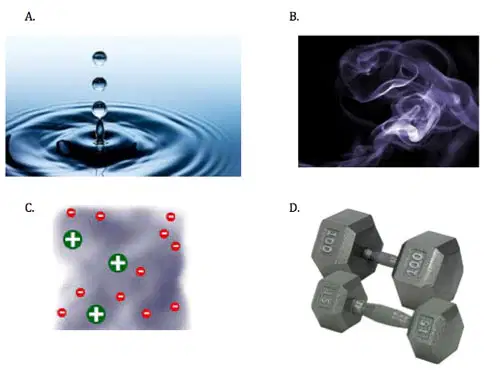
Which picture shows the state of matter with the following characteristics?
- Has a definite, fixed volume.
- Has a variable shape.
- Particles are constantly moving and sliding by one another.
A
B
C
D
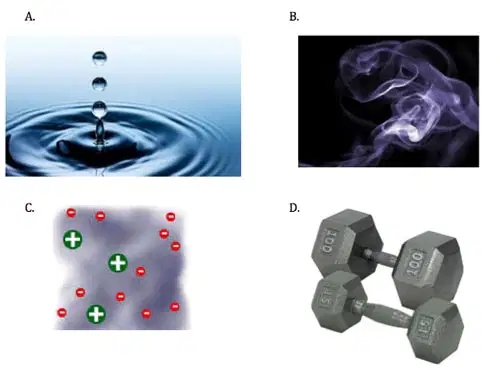
In which picture(s) will you find a state of matter that has particles who have more energy than liquid water?
B, C
A, B, C
B, C, D
A, B, C, D

Which image(s) would be considered pure substances?
V
I and II
II and IV
III and V
Which of the following models represents a pure substance?

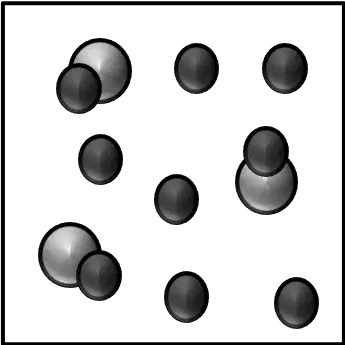
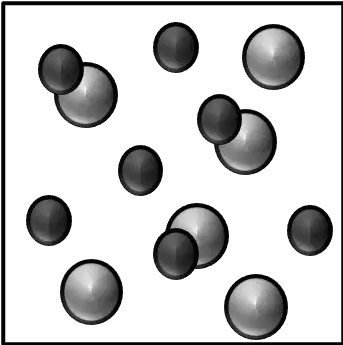
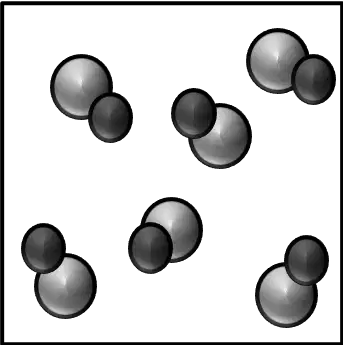

The diagram below shows three contains of gas. Which list correctly describes the gasses in containers R, S, and T?
R: element,
S: compound,
T: mixture
R: compound,
S: element,
T: mixture
R: mixture,
S: element,
T: compound
R: element,
S: mixture,
T: compound
A student made a snack after school by combining pretzels, peanuts, and raisins together in a bowl. What statement describes the student’s snack?
It is a heterogeneous mixture
It is a homogeneous mixture
It is a pure substance
It is a compound
Which of the following substances has the lowest average molecular kinetic energy?
Quartz at 25ºC
Steel at 50ºC
Nitrogen 75ºC
Water at -10ºC
Heat is applied to a beaker of water, raising the temperature a few degrees. What happens to the water molecules after heat is applied?
The molecules spread apart and move more slowly.
The molecules come together and move more slowly.
The molecules spread apart and move more quickly.
The molecules come together and move more quickly.
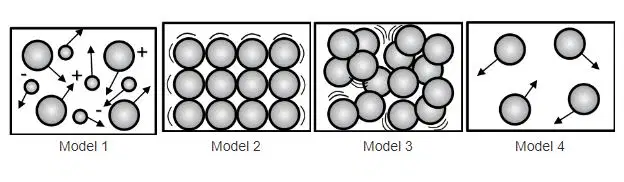
Look at the four illustrations below. Which model shows the structure and movement of particles in a liquid?
Model 1
Model 2
Model 3
Model 4

Which is the correct classification of these substances?
The first three are elements and the last two are compounds.
The first three are compounds and the last two are elements.
All five are elements.
All five are compounds.
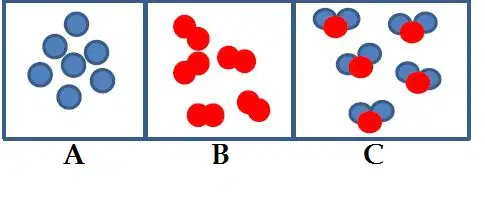
Identify the three substances correctly.
A - molecule
B - compound
C - element
A - compound
B - molecule
C - element
A - element
B - molecule
C - compound
As you move from solid to liquid to gas, you also move from:
lowest to highest kinetic energy
highest to lowest kinetic energy
all matter is made of
energy
atoms
electrons
pure substances
the central region of an atom where its neutrons and protons are is called its
nucleus
electron cloud
core
center
an atom with atomic number 46 would have how many protons?
46
92
23
cannot be determined
Particles in an atom that have no charge are
negatrons
electrons
neutrons
protons
True or False? Neutrons have a negative charge.
True
False
What is the atomic number for an element with three protons?
2
1
3
6
A particle that moves in a cloud around the nucleus is a(n)...
Proton
Neutron
Electron
Quark
In the modern periodic table, elements are arranged by increasing:
alphabetical order
atomic number
valence electrons
number of isotopes

What does the 1.00794 stand for?
number of electrons
atomic number
average atomic mass
density
The total number of protons and neutrons in the nucleus is the
atomic number
mass number
average atomic mass
charge
An atom's "identity" is its number of
protons
neutrons
electrons
energy shells
Elements that are useful as semiconductors in electronics are
metals
nonmetals
metalloids
noble gases
Which of these could NOT be a future element's chemical symbol?
TR
e
hF
None of those could be a chemical symbol
What is NOT a characteristic of most metals?
Shiny luster
Conducts heat well
Usually a gas at room temperature
Conducts electricity well
Who was responsible for the origins of the periodic table?
Gregor Mendel
Dmitri Mendeleev
Igor Stravinsky
Vladimir Putin
Valence electrons are found
In an atom's innermost energy level
In the nucleus
In an atom's outermost energy level
only in plasmas
An atom of Na (sodium) has 11 protons and 10 electrons.
Is it an ion or a neutral atom?
Ion
Neutral atom
No way to know
Which of these is a molecule?
Water (H2O)
Salt (NaCl)
Oxygen (O2)
All of them are molecules
Elements toward the middle and left side of the periodic table are
metalloids
noble gases
nonmetals
metals
The "zigzag" (stairstep) line on the period table consists of a handful of elements called
metals
nonmetals
metalloids
noble gases
These can be solids, liquids, or gases at room temp
Metals
Metalloids
Nonmetals
How many electrons will the first energy level hold?
None
2
8
Unlimited

How many valence electrons does fluorine have?
7
8
2
9

Is this fluorine atom likely to bond with another atom?
Yes, because it has an empty spot that it REALLY wants to fill
No, because its outer shell is completely full and it's "content."
On an atom diagram, some particles are labeled with a + (positive) and some are labeled with a - (negative). There are also some particles with no label at all. What are those?
Protons
Neutrons
Electrons
Two elements are "stacked" one on top of the other in a column of the periodic table. What do you know about them?
Their atoms are exactly the same size
Their names start with the same letter
They have similar chemical properties (behave similarly)
They have the same number of energy levels
Which particles contribute significantly to the mass of an atom?
Electrons
Protons
Protons & neutrons
Neutrons
What is the mass of a proton or a neutron?
1 newton
1 atomic mass unit (amu)
1 degree
1 nucleus weight unit (nwu)
An atom that has lost or gained electrons (has a charge) is called a(n)
isotope
neutral atom
conductor
ion
Atoms of the same element with different numbers of neutrons are called
ions
isotopes
radioactive atoms
compounds
Helium, neon, and argon are all on the rightmost column of the periodic table. They all have outer electron levels that are completely full. They are called
alkali metals
halogens
alkaline earth metals
noble gases
How can you tell the difference between an element and a compound when it's written out on paper?
Elements have a "recipe"; compounds have just one symbol
Elements have just one symbol; compounds have a "recipe"
If you want to find the element with the most electrons, you should look for the element with...
the fewest neutrons
the most degrees
the largest atomic number
the longest symbol
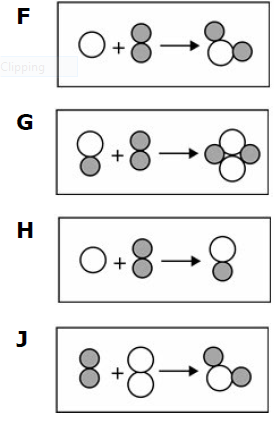
Which of these models demonstrates a balanced chemical equation?
The formula below represents glucose (a type of sugar). Which information does the chemical formula tell you?
C6H12O6
How the atoms are arranged in a molecule of glucose
The color of a glucose molecule
The size of a glucose molecule
The number of atoms of each element in a glucose molecule

The chemical formula for glucose, a simple sugar, is C6H12O6. The formula for ethanol is C2H6O. How are these compounds different?
The elements themselves are different
The ratio of the elements is different

How many total atoms are in a molecule of serotonin?
C10H12N2O
22
24
25
4
Which of the following BEST describes a chemical reaction?
A compound is crushed into a fine powder.
Atoms break apart into even smaller particles.
Atoms break their bonds to each other and reattach to other atoms
Molecules move faster until they fly apart from each other
In a ___________change, a new/different substance is formed.
Physical
Chemical
The Law of Conservation of Mass states
that matter exists in all states
that matter can only be changed into new substances by introducing a catalyst
that matter exists in the same state throughout any chemical change
that matter cannot be created or destroyed, and that the mass of the products must equal the mass of the reactants

a copper penny turning greenish over time is an example of a
Physical change
Chemical change
An gel ice pack getting cold after you put it in the freezer for an hour is an example of a
Chemical change
Physical change
Which of the following is a physical change?
Getting a haircut
rusting metal
souring milk
oxygen and hydrogen making water
___________________ are the elements or compounds that are formed in a chemical reaction.
Polymers
Bonds
Reactants
Products
In a chemical reaction, atoms are
Lost
Created
Rearranged
Slowed down
What are signs that a chemical change has happened?
Change of state, change of size, change of shape
Change in color or odor, formation of precipitate, gas bubbles
There are no observable signs of a chemical reaction
A molecule of CaCl2 has
1 atom of Cl, 2 atoms of Ca
1 atom of Ca, 2 atoms of Cl
2 atoms of H, 1 atom of O
2 atoms each of Ca and Cl
Which is correct?
Endothermic absorbs heat, exothermic gives off heat
Endothermic gives off heat, exothermic absorbs heat
Endothermic is explosive, exothermic is nonreactive
Endothermic changes color, exothermic does not
A coefficient applies to
The entire molecule that it's in front of
Only the atom it's beside
Concentration, surface area, temperature, and presence of a catalyst are things that affect...
Density
Freezing point
The rate of a chemical reaction
Weight
Isotopes have different numbers of
Protons
Neutrons
Electrons
The end product of nuclear fusion is
Not radioactive
Highly radioactive
Only energy
Which involves the nucleus of atoms?
Chemical reactions
Nuclear reactions
Physical changes
Changes of state
Nuclear power plants use ___ to make electricity.
Photosynthesis
Precipitation
Fusion
Fission
Which kind of reaction is a cake baking? Think: does it NEED heat or GIVE OFF heat?
Endothermic
Exothermic
Nuclear
What does increasing the heat (so that the particles move faster and collide more) do to a chemical reaction?
Slow it down
Speed it up
Stop it completely
Massive explosion
If the reactants are in very small pieces, will a chemical reaction go faster or slower?
Faster
Slower
Neither; surface area makes no difference
Why can't we use nuclear fusion for all of our electricity?
Waste is too radioactive
Hydrogen is too rare
We can't make starlike conditions of heat and pressure
We can, and already do
In the chemical formula
2Na7C2O5
how many atoms of carbon are there?
2
4
7
14
In which way can a nuclear reaction change the identity of an atom?
Add or remove protons
Add or remove neutrons
Add or remove electrons
It cannot do that
What process do unstable (radioactive) isotopes undergo?
Radioactive decay
Photosynthesis
Digestion
Waxing and waning
When a heavy, unstable atom splits into smaller ones, it is
Fusion
Fission
A chemical reaction
A physical change
When two small atoms' nuclei join to form one larger one, it is
Fusion
Fission
Radioactive decay
a balanced equation

