wayground logo

Free Printable Worksheets

Font size

S
M
L
XL
Worksheets

End of Year Review

Total questions: 135

Worksheet time: 1hrs 20mins

Name
Class
Date
1.
What does the 3rd phase in the image represent? 
a)
Anaphase 
b)
Metaphase 
c)
Telophase 
d)
Interphase 
2.
The end result of Meiosis....
a)
2 identical cells 
b)
4 identical cells 
c)
2 with 1/2 amount of chromosome 
d)
4 with 1/2 amount of chromosome 
3.
How many chromosomes are in sex cells?
a)
2
b)
4
c)
23
d)
46
4.
What is the purpose of Mitosis?
a)
Replace sex cells
b)
Clean all cells
c)
Repair damaged body cells
d)
Create egg and sperm
5.
What phase does the image represent? 
a)
Interphase 
b)
Prophase 2
c)
Cytokinesis 
d)
Anaphase 2 
6.
The 2 daughter cells at the end of Mitosis have how many chromosomes compared to the original?
a)
Half 
b)
Same 
c)
One-Third 
d)
None 
7.
What is the purpose of Meiosis?
a)
To replace damaged or dead body cells
b)
To recreate all the phases in Mitosis
c)
To clean out the cell to make room for the nucleus
d)
To divide chromosomes to create sex cells
8.
Egg and Sperm are what type of cells?
a)
Sex Cells
b)
Body Cells
c)
Plant Cells
d)
Cell Organelles
9.
What is a disadvantage of Asexual reproduction?
a)
No diversity
b)
Can easily adapt
c)
Quick population growth 
10.
Metaphase 2 happens in how many cells?
a)
1
b)
2
c)
3
d)
4
11.
What is the process of splitting cells?
a)
Cleavage 
b)
Budding 
c)
Crossover 
d)
Cytokinesis 
12.
What is the correct order of the phases of Mitosis.
a)
prophase, metaphase, anaphase, telophase, cytokinesis
b)
prophase, metaphase, anaphase, telophase
c)
interphase, metaphase, anaphase, telophase, cytokinesis
d)
interphase, metaphase, anaphase, cytokinesis
13.
What does this image represent?
a)
Meiosis 
b)
Mitosis 
14.
When only one parent is needed to reproduce
a)
Sexual Reproduction
b)
Asexual Reproduction
c)
Intersexual Reproduction
d)
Aggravated Reproduction
15.
What attaches to chromosomes and pushes and pulls them around the cell?
a)
Cell Membrane
b)
Centrioles
c)
Centromeres
d)
Spindle Fibers
16.
What forms in a plant cell to end Mitosis?
a)
Square Shape
b)
Cell Plate
c)
Sex Cells
d)
Cell Wall
17.
Which part of the cell cycle (mitosis) does chromosomes replicate?
a)
Prophase
b)
Anaphase
c)
Cytokinesis
d)
Interphase
18.
When the chromosomes are pulled apart to opposite ends of the poles?
a)
Prophase
b)
Anaphase
c)
Telophase
d)
Metaphase
19.
What can you use to decrease the amount of friction? 
a)
Salt 
b)
Water 
c)
Sugar 
d)
Peanut Butter 
20.
What direction is this object moving and what is the net force? 
a)
10N Right 
b)
0N 
c)
25N Right 
d)
1N Right 
21.
If the forces exerted on an object are equal the object will move? 
a)
True
b)
False
22.
Which direction will the soccer ball go and with how much force? 
a)
200N Left 
b)
1.66N Left 
c)
50N Left 
d)
12N Left 
23.
a)
Unbalanced 
b)
Balanced 
24.
What is the net force? 
a)
25N Up ON Left
b)
50N Left 25N Down 
c)
175N Up 50N Down 
d)
100N Right 75N Up
25.
Mrs. King and Mr. King decided to move a dresser across the room. They both stood on one side and each pushed left with 30N of force, although there was 10N of friction. What is the net force and direction? 
a)
40N Left 
b)
30N Left 
c)
20N Left 
d)
10N Left 
26.
Is this object moving? 
a)
Yes, Left 
b)
Yes, Right 
c)
Yes, Up
d)
Yes, Down 
27.
a)
100N
b)
50N
c)
35N
d)
110N
28.
a)
Balanced 
b)
Unbalanced 
29.

When the vectors (arrows) point in the same direction what function do you use?

a)

Dividing

b)

Multiplying

c)

Subtracting

d)

Adding

30.

When the vectors (arrows) point away what function do you use?

a)

Dividing

b)

Multiplying

c)

Subtracting

d)

Adding

31.
A force is a push or pull measured in what units? 
a)
Meters per second, squared
b)
Kilograms 
c)
Newtons 
32.

The thinnest layer of the Earth is the ___________.

a)

mantle

b)

crust

c)

core

33.
Tectonic plates are made up of continental crust and ________ crust.
a)
continental
b)
oceanic
c)
plates
d)
mantle
34.
What is the thickest layer of the Earth?
a)
the crust
b)
the mantle
c)
the outer core
d)
the inner core
35.
What describes the outer core?
a)
solid
b)
liquid
c)
viscous
d)
gas
36.
Why is the inner core solid?
a)
its unknown
b)
what it's made of
c)
the pressure
d)
it is colder than the outer core
37.
Which layer of the Earth is the only liquid layer?
a)
Outer Core
b)
Inner Core
c)
Mantle
d)
Lithosphere
38.
Which layer(s) of the Earth make up the asthenosphere?
a)
Part of the mantle
b)
Crust, mantle, Core
c)
Crust and upper mantle
d)
Only the crust
39.
What is the correct order (starting from the surface) of Earth's layers?
a)
crust, outer core, inner core, mantle
b)
mantle, outer core, inner core, crust
c)
crust, mantle, outer core, inner core
d)
outer core, inner core, crust, mantle
40.

What layer is a semisolid and acts like a plastic?

a)

Lithosphere

b)

Mantle

c)

Asthenosphere

d)

crust

41.
What happens to pressure as we move from the crust to the inner core?
a)
Pressure Decreases
b)
Pressure Increases
c)
Nothing
42.
Less dense materials rise to the top.
a)
True
b)
False
43.
Which layer of Earth has the GREATEST density?
a)
crust
b)
mantle
c)
outer core
d)
inner core
44.
Which layer of Earth is made up of tectonic plates?
a)
outer core
b)
inner core
c)
asthenosphere
d)
lithosphere
45.
The type of plate boundary where two plates come together is a .....
a)
Convergent Boundary
b)
Divergent Boundary
c)
Transform Boundary
d)
Plate Boundary
46.
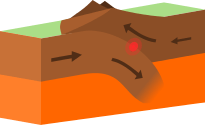
What type of plate boundary is this?
a)
Plate
b)
Divergent
c)
Convergent
d)
Transform
47.
What type of event will occur at this boundary?
a)
Earthquake
b)
Volcano Eruption
c)
Tornado
d)
Mountain Building
48.
A divergent boundary occurs when plates ....
a)
Pull apart
b)
Come together
c)
Slide past each other
d)
subducting
49.
Which of the following is the name of the ancient supercontinent formed 28 Million Years ago.
a)
Pangea
b)
Gondwanda
c)
Laurasia
d)
Neverland
50.
What are the two types of crust
a)
continental and oceanic
b)
ocean and upper
c)
lower and upper
d)
pizza and subway
51.

The theory that says Earth's continents once made up an ancient supercontinent, and have been drifting apart ever since, is called the theory of...

a)

Continental Drift

b)

Plate Tectonics

c)

Natural Selection

d)

Gravity

52.

Islands can form from magma which is pushed up at a __________ plate boundary

a)

Divergent

b)

Convergent

c)

Transform

53.

The Himalayan Mountains in Asia are an example of what type of plate boundary?

a)

divergent

b)

continent-to-continent convergent

c)

ocean-to-continent convergent

d)

transform

54.
Transform boundaries are most likely to produce what phenomenon?
a)
volcanoes
b)
deep sea trenches
c)
underwater mountain ranges
d)
earthquakes
55.

When an oceanic plate and a continental plate collide, which one will subduct (downward movement)?

a)

oceanic

b)

continental

c)

neither

56.
The area where two tectonic plates meet.
a)
mantle
b)
focus
c)
plate boundary
d)
convection
57.
According to Wegener's hypothesis of continental drift, 
a)
Earth's surface is made up of seven major landmasses
b)
the continents DO NOT move
c)
Earth is slowly cooling and shrinking
d)
the continents were once joined together in a single landmass
58.
What type of evidence was NOT used by Alfred Wegener to support his continental drift hypothesis?
a)
evidence from landforms
b)
evidence from fossils
c)
evidence from human remains
d)
evidence from climate
59.

Which of the following are ALL created by a glacier?

a)

Esker, Till, Moraine, Mountain, Rift Valley

b)

Erratics, Kettles, Moraine, Esker, Outwash

c)

Tills, Volcano, Glacier, Esker, Outwash

d)

Hot Spot, Volcano,Tsunami, Mid-Ocean Ridge

60.
According to the law of superposition, the oldest fossils are found 
a)
At the top of the rock layers
b)
Near the bottom of the rock layers
c)
In the middle of the rock layers
d)
Somewhat near the surface
61.
The age of a rock compared to the ages of other rocks is the rock's
a)
absolute age
b)
geologic age
c)
sedimentary age
d)
relative age
62.

Which of the following correctly lists the layers in order from oldest to youngest?

a)

A, B, C, D, E

b)

E, B, C, D, A

c)

E, D, C, B, A

d)

C, B, A, D, E

63.
Which of the following places the geologic time eras in order from oldest to most recent?
a)
Precambrian, Paleozoic, Mesozoic, Cenozoic
b)
Mesozoic, Cenozoic, Paleozoic, Precambrian
c)
Cenozoic, Mesozoic, Paleozoic, Precambrian
d)
Paleozoic, Cenozoic, Precambrian, Mesozoic
64.
Modern humans (Homo sapiens) and dinosaurs never existed together on Earth.
a)
True
b)
False
65.
Where is the point at which the first movement occurs during an earthquake?
a)
Epicenter
b)
Focus
c)
Fault
d)
Plate
66.
Where is the point on the Earth’s surface directly above the focus of an earthquake?
a)
Epicenter
b)
Fault
c)
Hypocenter
d)
Tremor
67.
Which type of wave is the first to arrive after an earthquake occurs?
a)
P Wave
b)
Rayleigh Wave
c)
S Wave
d)
Shear Wave
68.
Which body wave squeezes and stretches rock materials as they pass through the Earth?
a)
Body Waves
b)
P Waves
c)
S Waves
d)
Surface Waves
69.
P Waves can move through which of the following?
a)
Gas
b)
Liquid
c)
Solid
d)
All of these
70.
S Waves can move through which of the following?
a)
Gas
b)
Liquid
c)
Solid
d)
All of these
71.
Which scale measures the intensity of the ground movement?
a)
Mercalli Scale
b)
Richter Scale
c)
Seismogram Scale
d)
Bernoulli Scale
72.
What is a large ocean wave that results from an underwater earthquake, landslide, or volcanic eruption?
a)
Aftershock
b)
Liquefaction
c)
Seismic Gap
d)
Tsunami
73.
The hanging wall slides up and over the footwall is what kind of fault?
a)
strike-slip
b)
normal
c)
reverse
74.
When the hanging wall slips downward below the footwall, what kind of fault is it?
a)
strike-slip
b)
normal
c)
reverse
75.
Rock layers undergo stress when they are squeezed at convergent boundaries. This stress is called:
a)
compression
b)
combining
76.
A type of fault where rocks on either side move past each other sideways is called:
a)
normal fault
b)
reverse fault
c)
strike-slip fault
77.
The cat is standing on the...
a)
foot wall
b)
hanging wall
c)
left
d)
weirdest elevator ever
78.
Which kind of waves usually do the most damage in an earthquake?
a)
P waves
b)
S waves
c)
L waves
d)
Radio waves
79.
Determine the contour interval:
a)
5 m
b)
10 m
c)
15 m
d)
20 m
80.
What do close contour lines represent on a map?
a)
waterfall
b)
steep area
c)
gradual area
d)
river
81.
What does these image depict? 
a)
Vestigial Structures 
b)
Fossils 
c)
Adaptations
d)
Species 
82.
Change over time describes.....
a)
Speciation 
b)
Selective Breeding 
c)
Evolution 
d)
Adaptation 
83.
This is an example of....
a)
Dieting 
b)
Evolution 
c)
Selective Breeding 
d)
Adaptation 
84.
I traveled around the world on the HMS Beagle in 1831 in search of answers.
a)
Reginald Punnett
b)
Gregor Mendel
c)
Charles Darwin
d)
Alfred Hitchcock 
85.
What is this picture an example of? 
a)
Evolution 
b)
Speciation 
c)
Adaptation 
d)
Selective Breeding 
86.
What is a characteristic that helps an organism survive and reproduce in its environment? 
a)
Selective Breeding 
b)
Adaptation 
c)
Evolution 
d)
Fossils 
87.
What does this image represent? 
a)
Evolution 
b)
Natural Selection 
c)
Lunch 
d)
Selective Breeding 
88.
What provided information on the history of life? 
a)
Fossils 
b)
Speciation 
c)
Adaptation 
d)
Evaluation 
89.
These animals are examples of what?
a)
Plush Toys 
b)
Selective Breeding 
c)
Adaptation 
d)
Extinction 
90.
1. Separation 2. Adaptation 3. Division......
a)
Evolution 
b)
Adaptation 
c)
Extinction 
d)
Speciation 
91.
What does this image suggest? 
a)
Law of Superposition 
b)
Specations 
c)
Common Descent 
d)
Five Finger Discount 
92.
Which is not an adaptation of a polar bear? 
a)
White fur 
b)
Large Feet 
c)
Thin Layer of fat 
d)
Strong Swimmer 
93.
The process by which organisms with favorable traits survive and reproduce at a higher rate
a)
Natural Selection 
b)
Adaptation 
c)
Evolution 
d)
Speciation 
94.
What does this picture represent? 
a)
Extinction 
b)
Adaptation 
c)
Evolution 
d)
Fossils 
95.
What organism did Darwin study at the Galapagos Island? 
a)
Lions
b)
Tigers 
c)
Bears 
d)
Birds 
96.
Evolution was accepted in the 18th century when Darwin released his findings? 
a)
True 
b)
False 
97.
Fossils can only be the bones from dead animals
a)
True 
b)
False 
98.
This is an example of....
a)
Evolution 
b)
Adaptation 
c)
Desert 
d)
Natural Selection 
99.
The white feathers of a snowy owl allow it to blend in with its environment during the winter months (snow). This is an example of ________________
a)
Species
b)
Environmental Change
c)
Adaptation
d)
Variation
100.
Which of the following is Heterozygous?
a)
Two of the same recessive allele (aa)
b)
Two of the same dominant allele (AA)
c)
Two different alleles (Aa)
d)
Two different genes (AB)
101.
Which of the following is Homozygous Recessive?
a)
AA
b)
Aa
c)
aa
d)
aA
102.
Which of the following is Homozygous Dominant?
a)
RR
b)
rr
c)
Rr
d)
Rp
103.
Brown eyes (B) are dominant to blue eyes (b). What is the genotype of a person with blue eyes?
a)
Homozygous Dominant (BB)
b)
Homozygous Recessive (bb)
c)
Heterozygous (Bb)
d)
Single Recessive (b)
104.
Brown eyes (B) are dominant to blue eyes (b). What is the phenotype of a person who is Bb?
a)
Blue Eyes 
b)
Brown Eyes
c)
70% Brown 
d)
25% Blue 
105.
What is a gene?
a)
Section of DNA that codes for mutations
b)
ection of DNA that codes for the DNA sequence
c)
Section of DNA that codes for evolution 
d)
Section of DNA that codes for our traits
106.
What genotype belongs in the box with the question mark?
a)
AA
b)
Aa
c)
aA
d)
aa
107.
What genotype belongs in the top right box?
a)
TT
b)
tt
c)
Tt
108.
What is the probability that the offspring will be Homozygous Recessive?
a)
0%
b)
25%
c)
50%
d)
100%
109.
What two parents could produce at least one offspring that shows the recessive trait?
a)
Aa x Aa
b)
Aa x AA
c)
AA x aa 
d)
AA x AA
110.
Could two parents that show the dominant trait produce offspring with the recessive trait?
a)
Yes 
b)
No 
c)
Not enough information 
d)
I don't know 
111.
What is the probability that the offspring will have the dominant trait?
a)
1:4
b)
2:4
c)
3:4
d)
4:4
112.
Which word describes an organism's physical characteristics?
a)
Heterozygous 
b)
Homozygous 
c)
Phenotype 
d)
Genotype 
113.
What is the symbol for an Affected Male? 
a)
Half Circle 
b)
Half Square 
c)
Full Shaded Circle 
d)
Full Shaded Square 
114.
How many affected females are present? 
a)
1
b)
2
c)
3
d)
4
115.
How many offsprings did generation 2 have? 
a)
5
b)
8
c)
9
d)
10
116.
How are mates identified in a Pedigree? 
a)
Vertical Line 
b)
Horizontal Line 
117.
What would the genotype be for the blonde son in generation 2?
a)
BB
b)
Bb
c)
bb
d)
Not enough information 
118.
How many affected females are deceased? 
a)
0
b)
2
c)
4
d)
All 
119.
How many carrier males are present? 
a)
2
b)
4
c)
6
d)
8
120.
How many children in generation III are homozygous dominant? 
a)
1
b)
2
c)
3
d)
4
121.
Which generation connects these two pedigrees? 
a)
1
b)
2
c)
3
122.
A carrier is represented by what symbol? 
a)
Clear 
b)
Shaded 
c)
Half Shaded
d)
1:4 ratio 
123.
Offsprings are represented by....
a)
Horizontal Line 
b)
Vertical Line 
124.
If the affected female in generation 3 mates with an affected male. What will be their offspring's genotype? 
a)
100% Hybrid/Pure 
b)
100% Homozygous Dominant 
c)
100% Homozygous Recessive 
d)
100% Heterozygous 
125.
The Law of Inertia
a)
Newton's
1st
Law of Motion
b)
Newton's
2nd
Law of Motion
c)
Newton's
3rd
Law of Motion
126.
F=ma
a)
Newton's
1st
Law of Motion
b)
Newton's
2nd
Law of Motion
c)
Newton's
3rd
Law of Motion
127.
For every action, there is an equal and opposite reaction.
a)
Newton's
1st
Law of Motion
b)
Newton's
2nd
Law of Motion
c)
Newton's
3rd
Law of Motion
128.

An object with a mass of 3.0 kg has a force of 9.0N applied to it. What is the resulting acceleration of the object?

a)

0.33 m/s2

b)

3 m/s2

c)

27 m/s2

129.
When the force on a car is doubled, the acceleration is doubled.
a)
Newton's
1st
Law of Motion
b)
Newton's
2nd
Law of Motion
c)
Newton's
3rd
Law of Motion
130.
A magician pulls a table cloth from under a table of dishes.
a)
Newton's
1st
Law of Motion
b)
Newton's
2nd
Law of Motion
c)
Newton's
3rd
Law of Motion
131.
A skater pushes another skater forward, but the one pushing moves backwards.
a)
Newton's
1st
Law of Motion
b)
Newton's
2nd
Law of Motion
c)
Newton's
3rd
Law of Motion
132.
The harder you hit a baseball, the faster it accelerates.
a)
Newton's
1st
Law of Motion
b)
Newton's
2nd
Law of Motion
c)
Newton's
3rd
Law of Motion
133.
You step from a boat to a dock.  The boat moves backwards as you move forwards and you fall in the water.
a)
Newton's
1st
Law of Motion
b)
Newton's
2nd
Law of Motion
c)
Newton's
3rd
Law of Motion
134.
You are carrying a lunch tray when you bump into the edge of a table.  Although the tray did not tip, your milk falls off of the front of the tray.
a)
Newton's
1st
Law of Motion
b)
Newton's
2nd
Law of Motion
c)
Newton's
3rd
Law of Motion
135.
Mass is a measure of an object's inertia. Objects with greater mass have a greater inertia; objects with less mass have less inertia.
a)
true 
b)
false