
 Worksheets
Geologic Time Review
Total questions: 130
Worksheet time: 1hrs 14mins
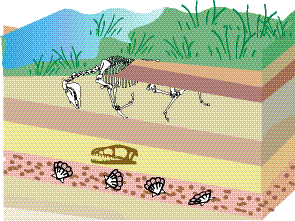
Dinosaurs were living during Mesozoic, Triassic and Jurassic eras and eventually became extinct during the Cretaceous period. In all of these eras dinosaur fossils were found. What does this evidence tell scientists about how natural processes have changed Earth over time?
Dinosaurs fossils in varying rock layers show that as the population changed they were fossilized in different rock layers by Earth’s natural processes.
Dinosaur fossils take a long time to form and demonstrate how long the natural processes take to change the
Earth
Dinosaur fossils are formed within layers of sedimentary rock that were laid down by natural Earth processes which
no longer occur today showing how Earth has changed.

How do these rock formations support the idea that Earth has changed due to natural processes?
It has changed because of Erosion
It has changed because of Plate Tectonics
It has changed because of gravitational pulls of the Earth
It has changed because of different rock layers.
The Law of Superposition states that
the older layers of rock are at the bottom
the older layer of rock are at the top
the younger layer of rock is at the bottom
the younger layer of rock is in the middle
What is relative dating?
used to determine a fossils approximate age by comparing it to similar rocks and fossils of known ages.
used to determine the precise age of a fossil by using radioactive dating to measure.
Order of layers from oldest to youngest
Used to determine the location of the rocks around the world.
Is fossil creation a natural process?
Yes
No
Sometimes
what is a fossil?
Why may fossil of the same organism be found on different continents?
Because the continents were once together
Similar fossils should not be found on different continents
Because fossils change over time
Because of the Evolution of the Earth

Which statement is correct
Layer 2 is younger than layer 4
Layer 1 is younger than layer 4
Layer 2 is older than layer 1
Layer 3 is younger than layer 1

Which of the following statements is incorrect?
Layer 4 is younger than 3
Layer 1 is older than 3
Layer 4 is older than 2
Layer 2 is older than 4
If Scientist we studying bones of animals that became igneous rock fossils. Why would they use radioactive dating to study the igneous rock?
It is the easiest method to determine age
The rate of decay in the rock provide an accurate way to calculate age.
This method tell them the exact age of the rock which is what they are looking for .
They would use relative dating instead.
Which of these choices is the best definition of absolute dating?
determining the age of a rock layer by studying the fossils present
finding the age of an object compared to other objects
measuring the age of an object in years using any method
determining the amount of a radioactive isotope in an object
What is the method of measuring age that gives the most precise results?
radioactive dating, when scientists measure the levels of an isotopic element inside of an object
rate of sedimentation, which dates layers of Earth based on their thickness
law of superposition, which dates layers of Earth based on their order
B. relative dating, when scientists fill an object with carbon and measure how much will fit
Which method determines the relative age of Earth's sedimentary layers based on their organization?
rate of sedimentation
law of suspension
radioactive dating
Fossil Comparison
Which of these choices is an example of the way a geologist would use
relative dating (The Law of Superposition)?
determining the minerals that make
up rocks
placing rock layers in order of
oldest to youngest
classifying rocks as igneous,
sedimentary, or metamorphic
using radioactive isotopes to
determine the exact age of rock samples
. Which of these statements describes what happens during radioactive decay?
A Stable isotope interacts with an unstable isotope
A stable isotope breaks down and becomes unstable
An unstable isotope breaks down into a more stable isotope.
An unstable isotope interacts with another unstable isotope.
How would a geologist determine the age of mountains formed by the upwelling of igneous rock?
use radioactive dating to date water in a lake in the mountains
use radioactive dating to date Earth's outer core below the mountains
use radioactive dating to date only the bedrock underneath the mountains
use radioactive dating to date the igneous rock and the topmost layer of soil
Limestone can be found at the top of the Himalayas, the highest mountain range in the world. Limestone is a rock that usually forms at the bottom of shallow, warm waters. What does this information show about Earth?
It shows that Earth has not changed much over the years as limestone has adapted to forming on mountain peaks.
It shows that Earth has evolved over time as areas of land that have once been covered in water, but no longer are.
It shows that Earth circulates its minerals so often that limestone always ends up on the peaks of mountains.
It shows that Earth has mostly convergent plate boundaries that push limestone from the ocean floor to the top of mountains.
At one time, several kinds of camels lived in Florida. The evidence comes from fossils found in Florida. Which of these objects would be a fossil that shows that camels once lived in Florida?
Sinkhole formed by a retreating glacier
sedimentary rock that formed a long time ago
crystal formation suspended from the ceiling of a cave
remains of an organism preserved by geologic processes
Radioactive dating measures the rate of decay of radioactive materials in rocks. A geologist determines the age of a rock by comparing the amount of radioactive material with the amounts of its decay products. How could a geologist best use information from one rock to learn about the time period over which a canyon formed?
The geologist could compare the age of one rock with the ages of rocks from another canyon.
The geologist could compare the age of one rock with the ages of many living plants.
The geologist could compare the age of one rock with the age of Earth.
The geologist could compare the age of one rock with the ages of many nearby rocks.

The timeline above shows changes that occurred in the Sahara Desert throughout history.
What does this timeline suggest about Earth?
It suggests that Earth has changed over time since human fossils became present in the Sahara after 9,000 years, indicating that the environment had been suitable enough to support human life at one time.
It suggests that Earth has not changed much over time since human fossils were present as early as 9,000 years ago, indicating that Earth's environment has almost always been suitable for the presence of life.
It suggests that Earth's deserts always receive monsoon rains every 1,000 years.
It suggests that Earth is only able to preserve fossils in environments that are desert like.

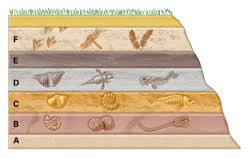
Analyze the image Above. According to the Law of Superposition, which sequence of letters describes the rock layers in the diagram from oldest to youngest?
D,C,B,A
A,B,C,D
A,B,D,C
C,D,B,A

The diagram above is cross-section of Earth’s sedimentary rock. Based on the Law of Superposition, which statement best compares the relative age of two rock layers?
Layer 7 is older than layer 5
Layer 2 is older than layer 7
Layer 5 is younger than layer 3
Layers 3 and 4 are the same age

Directions: The images show slices of sedimentary rock in Earth's surface in two different locations. Use the images to answer any questions that follow.
Which layer is most likely the oldest in location 1?
layer Q
layer R
layer S
layer T

Directions: The images below show slices of
sedimentary rock in Earth's surface in two different locations. Use the images to answer any question that follow.
What would be the best way to compare the ages of layers of the same slice?
by comparing the fossils in each layer, which will have the newest fossils on the bottom and the oldest fossils on the top
by using the law of superposition, which says the oldest rock will be on the bottom, and the newest rock on the top
by using radioactive dating, which measures the amount of carbon-14 in an object and compares to its decay rate
by comparing the rate of sedimentation, which says the layer that formed the quickest will be the oldest
The many methods of radioactive dating include the uranium-lead dating method and the potassium-argon dating method. Why do geologists use a variety of methods to date rocks on earth?
Many events in Earth's history caused rocks that formed on Earth's surface to form in Earth's inner core.
Different events in Earth's history caused different rocks to form on Earth's surface.
There are not enough differences among the events that caused rocks to form on Earth's surface.
Many events in Earth's history caused rocks that formed on Earth to form on the Moon.
Which of the following best describes an intrusive rock?
rocks formed from erosion
rocks formed from weathering
rocks that pushes up from underneath
rocks on the surface of the grand canyon
In which situation would a scientist prefer to use the Law of Superposition over radioactive dating?
A. to determine which mountain peak on Earth’s surface is the nearest
to determine which layer of sedimentary rocks at the bottom of a lake is oldest
to determine whether two dinosaurs whose fossils are found on different continents lived in the same time period
to determine the exact age of a human skeleton found in an ancient tomb
In 1997 a team of scientists discovered three fossilized skulls and other artifacts at a dig site in Ethiopia, Africa. Since it is difficult to determine the age of once-living organisms, the scientists used radioactive dating on the igneous rocks that surrounded the remains to determine their age. Why would scientists use radioactive dating in order to determine the age of the fossil they discovered?
Radioactive dating is an easier and less expensive method than applying the law of superposition for approximating the age of igneous rocks.
. Radioactive dating is specific and gives the exact date that a rock was formed while the law of superposition gives an approximate estimate of ages.
Radioactive dating gives an approximate estimate of the age of the igneous rocks, while the law of superposition will only reveal which is younger or older.
Radioactive dating determines whether the igneous rocks are older or younger than deeper layers of rocks, while the using the law of superposition depends on tectonic events.
A geologist was exploring a deep cave in the desert, and discovered a fossilized school of fish. Which option below most likely explains why the geologist would find fish fossils in a desert cave?
Local wildlife went into the cave and had brought the fish to eat and then left, the fish scraps left behind in the cave became fossilized.
A few hundred years ago the lake that was there was used to irrigate the local farm lands and the lake was drained leaving the fish in the lake to be fossilized in the rock.
During the recent rainy season fish were able to swim in the flood waters to the cave, once trapped, they died and were fossilized in the rock.
Millions of years ago the desert was a lake that had fish, over time the Earth changed, the lake became a desert, and the fish in the lake were fossilized.
Trilobites are a species of invertebrate fossils commonly found in places such as the Grand Canyon, a large landform made of many rock layers and coastal Florida. Trilobites lived in shallow marine environments and varied widely in size.
Trilobite fossils are in both rocky and marine areas proving that Earth has changed by natural processes.
Trilobite fossils are only in marine areas, showing how Earth has not been changed by natural processes.
Trilobite fossils are found in rock layers that were laid down by natural processes which no longer occurs today.
Trilobite fossils are found in marine areas under the Earth's surface compressed by natural processes over time.
Longest part of Earth's history and includes the Hadean, Archean, and Proterozoic eons.
Paleozoic
Mesozoic
Precambrian
Cenozoic
Era of "ancient life"
Mesozoic
Paleozoic
Cenozoic
Blue-green algae (unicellular) thought to be one of the earliest forms of life on earth.
Cyanobacteria
Trilobites
Jellyfish
Moss
A giant landmass that formed at the end of the Paleozoic Era when the continents came together.
North America
Eurasia
Pangea
Paleozoic
Traces of life are much easier to find during this time.
Precambrian Time
Paleozoic Era
This was the longest part of Earth's history.
Precambrian Time
Paleozoic Era
Shallow seas covered large parts of the continents during this time.
Precambrian Time
Paleozoic Era
At the end of this time, more than 90% of all marine species and 70% of all land species died off.
Precambrian Time
Paleozoic Era
Amphibians evolved during this time period.
Precambrian Time
Paleozoic Era
Cyanobacteria appeared during this time in Earth's history.
Precambrian Time
Paleozoic Era
Invertebrates appeared toward the end of this time.
Precambrian Time
Paleozoic Era
Vertebrates evolved during this time.
Precambrian Time
Paleozoic Era
Very little is know about the organisms that lived during this time period because the rocks have been changed and there are not many fossils.
Precambrian Time
Paleozoic Era
Several mountain building episodes occurred during this time.
Precambrian Time
Paleozoic Era
Continental plates came together and formed the supercontinent Pangea at the end of this time period.
Precambrian Time
Paleozoic Era
Ediacaran animals were living towards the end of this time period.
Precambrian Time
Paleozoic Era
This time period covers almost 4 billion years of Earth's history.
Precambrian Time
Paleozoic Era
Many fossils from this time are trace fossils.
Precambrian Time
Paleozoic Era
Plants and amphibians first moved to land during this time.
Precambrian Time
Paleozoic Era

The ______________ Era is the last and most recent of the geologic eras
Mesozoic
Paleozoic
Cenozoic
Precambrian

The term Cenozoic means _________ life.
Middle
Old
New
Existing

The new life of the Cenozoic Era could have just as easily been flowering _________, the insects, the newest fish (teleostei) or modern birds.
plants
fungi
mushrooms
animals

All of these groups, including the ____________, continued to evolve during this present Era.
rocks
mammals
reptiles
invertebrates
During the Cenozoic, mammals evolved from their somewhat insignificant stature during the Mesozoic to include giant species that have gone __________ in modern times.
extinct
populous
native
missing
True or False- None of the mammals ever reached the size of the dinosaurs.
True
False
True or False- During the Cenozoic Era some amphibians stood 7-feet tall.
True
False

During the Cenozoic Era-The _____________ mostly existed more or less as we know them.
climate
continents
animals
bacteria

At the beginning of the Cenozoic-_________ America, Africa, and India were not yet in the places they are today.
East
South
North
Central

The collisions of Africa and especially India led to mountain building resulting in the ________ and the Himalayan mountain ranges.
Pekinese
Andes
Alps
Caustic
The global climate was very __________ at the beginning of the Cenozoic, gradually cooling and becoming drier closer to the end of the era.
cold
warm
arid
calm

_____________ became more widespread, making habitat for grazing animals like buffalo, horses, camels and others.
Deserts
Grasslands
Mountains
Islands

What type of fossil is shown here?
Preserved remains
Carbon film
Mold
Cast
Which of these can preserve an organism's remains as a fossil?
water
gases
ice
oil
Fossils are usually found in layers of
sediment
cooled lava
dead plant matter
iron metal
When scientists want to know the exact age of a rock or fossil, they use...
a magnifying glass
the law of superposition
radioactive dating
a microscope
True or false: folding can cause rock layers to change order.
True
False
The law of __________ states that the oldest rocks are found in the bottom layers.
age
superposition
layering
fossils
If an element is radioactive, it means...
the element is dangerous
the element will decay over time
the element is Carbon
the element does not exist on Earth
If a radioactive element has a half life of 15,000 years, it will take ___________ for half of it to decay.
15,000 years
30,000 years
1,500 years
7,500 years
An element has a half life of 1 million years. In 2 million years, how much of the element will be left?
all of it
1/2 of it
1/4 of it
none of it
The longest span of time in Earth's history is...
the Paleozoic Era
the Mesozoic Era
the Cenozoic Era
Precambrian Time
Which statement is true about Earth's first atmosphere?
It still exists today
It contains Ozone
It was blown away by solar winds
It formed at the exact same time Earth formed
True or False: Throughout Earth's history, there has been only a single mass extinction.
True
False
What is the Mesozoic Era also sometimes called?
The Age of Plants
The Age of Mammals
The Age of Birds
The Age of Reptiles
The current era we are living in is the...
Paleozoic Era
Mesozoic Era
Cenozoic Era
Human Era
The current Period we are living in is the...
Cambrian Period
Devonian Period
Jurassic Period
Quaternary Period


Which layer is OLDER? Layer M or Intrusion P?
Layer M
Intrusion P

Which layer is OLDER? Layer E or Intrusion A?
Layer E
Intrusion A

Which layer is OLDER? Intrusion M or Layer D?
Intrusion M
Layer D
What is a supercontinent?
A continent that split in 5 pieces along time ago
a continent where everyone is super cool
Is an ancient landmass that separated into a present day continent
It’s a continent that is super duper cool
The Era with the largest extinction we know of is the..
Mesozoic era
Precambrian era
Paleozoic era
Cenozoic era
Trilobites were alive during the _____________.
Cenozoic
Mesozoic
Paleozoic
Cretaceous
The time when the first fishes appeared
A. Devonian
B. Cambrian
C. Permian
D. Jurassic
in which period did coal swamps form?
cambrian
Silurian
Devonian
carboniferous
what marked the end of the Precambrian period and the beginning of the Paleozoic era?
A mass extinction
A volcanic eruption
The Cambrian explosion
An Earthquake

When was the supercontinent Pangaea Formed ?
Late Paleozoic
Early Paleozoic
Middle Paleozoic
Early Cambrian
Life at the beginning of the Paleozoic Era was. . .
Primitive
Advanced
Organisms with_______ were very common during early Paleozoic
eyes
exoskeletons
wings
These organisms were believed to be the first to colonize land during the Devonian period.
fish
amphibians
birds
Apple trees
The climate during the Paleozoic Era was stable
True
False
North America was on the equator during Cambrian time.
True
False

Which of the following animals did NOT live during the Mesozoic era?
Birds
Dinosaurs
Fish
Monkeys
Reptiles

What are the two main groups of dinosaurs?
Mammischian "mammal-hipped"
Ornithischian "bird-hipped"
Saurischian "lizard-hipped"
Aquaschian "fish-hipped"

What type of dinosaur is shown?
Pachycephalosaur
Ceratopsian
Prosauropod
Theropod

Which Periods make up the Mesozoic Era?
Cambrian
Jurassic
Tertiary
Triassic
Cretaceous

What type of dinosaur is shown?
Pteradactyl
Tyrannosaurus
Spinosaurus
Sauropod

Why do scientists believe a meteor impact caused the KT mass extinction event?
A crater on the surface of the Earth
A layer of iridium which has dinosaur fossils below it
Damage seen on dinosaur fossils
Based on information from previous extinction events, it is the mostly likely cause
The Mesozoic Era is also known as the...
Age of Mammals
Age of Fishes
Age of Reptiles
Age of Invertebrates

The skeleton pictured above is...
Ornithischian "bird-hipped"
Saurischian "lizard-hipped"

Which of the following did NOT first appear during the Mesozoic era?
Flowering plants
Birds
Reptiles
Mammals

What is the name of the supercontinent that breaks apart during the Jurassic period?
Pangea
Rhodonia
Laurasia
Pannotia

What was the name of the giant ocean that existed at the beginning of the Mesozoic Era?
Indian Ocean
Atlantic Ocean
Panthalassa Ocean
Paleozoic Ocean

Why do supercontinents break apart?
They push against each other and break
Heat trapped under the surface of the continent causes the surface to raise and split apart.
Heat escapes easily from the continental surface.
Oceans flood parts of the continents leading to new seas.

Most early mammals are small because...
They are early in their evolutionary history.
The Earth was too hot for large mammals in the Mesozoic era.
To better avoid dinosaurs, their predators.

What do birds and theropods have in common?
Three-toed feet
Feathers
Wings
Hollow bones
Standing on two legs

Why do early flowering plants have large centers compared to most modern flowers?
There were not as many pollinators in the Mesozoic era.
They needed more pollen than modern flowers.
Petals are hard to grow.
Because there were more plants then compared to today.
The ______________ Era is the last and most recent of the geologic eras
Mesozoic
Paleozoic
Cenozoic
Precambrian
The term Cenozoic means _________ life.
Middle
Old
New
Existing
The new life of the Cenozoic Era could have just as easily been flowering _________, the insects, the newest fish (teleostei) or modern birds.
plants
fungi
mushrooms
animals
All of these groups, including the ____________, continued to evolve during this present Era.
rocks
mammals
reptiles
invertebrates
During the Cenozoic, mammals evolved from their somewhat insignificant stature during the Mesozoic to include giant species that have gone __________ in modern times.
extinct
populous
native
missing
True or False- None of the mammals ever reached the size of the dinosaurs.
True
False
True or False- During the Cenozoic Era some amphibians stood 7-feet tall.
True
False
During the Cenozoic Era-The _____________ mostly existed more or less as we know them.
climate
continents
animals
bacteria
At the beginning of the Cenozoic-_________ America, Africa, and India were not yet in the places they are today.
East
South
North
Central
The collisions of Africa and especially India led to mountain building resulting in the ________ and the Himalayan mountain ranges.
Pekinese
Andes
Alps
Caustic
The global climate was very __________ at the beginning of the Cenozoic, gradually cooling and becoming drier closer to the end of the era.
cold
warm
arid
calm
_____________ became more widespread, making habitat for grazing animals like buffalo, horses, camels and others.
Deserts
Grasslands
Mountains
Islands

