wayground logo

Free Printable Worksheets

Font size

S
M
L
XL
Worksheets

2018 MS CCRS 8th Grade Science Standards

Total questions: 137

Worksheet time: 2hrs 17mins

Name
Class
Date
1.
The stages of mitosis in order
a)
Metaphase, Anaphase, Prophase, Telophase
b)
Prophase, Anaphase, Metaphase, Telophase
c)
Prophase, Metaphase, Anaphase, Telophase
d)
Anaphase, Prophase, Telophase, Metaphase
2.
What is the next phase of mitosis?
a)
Prophase
b)
Metaphase
c)
Anaphase
d)
Telophase
3.
What is the next phase of mitosis?
a)
Prophase
b)
Metaphase
c)
Anaphase
d)
Telophase
4.
If the message never gets through for a cell to stop dividing and it just keeps dividing through mitosis over and over again, what can form?
a)
tumor
b)
freckle
c)
goosebump
d)
scab
5.
In which type of cells will mitosis occur?
a)
egg cells
b)
sperm cells
c)
jail cells
d)
Body cells except the sperm and egg cells
6.
When you start with 1 cell, at the end of mitosis, how many identical cells will you have?
a)
1
b)
2
c)
3
d)
4
7.
Cells of organism must replicate for ?
a)
growth
b)
repair of damaged cells
c)
replacement of dying cells.
d)
All of the above
8.
Before cells can divide, what must be copied?
a)
mitochondria
b)
cytoplasm
c)
DNA
d)
Cell Wall
9.
Which phase of the cell cycle is this cell in?
a)
Prophase
b)
Metaphase
c)
Anaphase
d)
Interphase
10.
a)
Anaphase
b)
Cytokinesis
c)
Telophase
d)
Metaphase
11.
a)
Anaphase
b)
Cytonkinesis
c)
Interphase
d)
Prophase
12.
a)
Cytokinesis
b)
Interphase
c)
Anaphase
d)
Metaphase
13.
a)
Cytokinesis
b)
Anaphase
c)
Telophase
d)
Prophase
14.
The cells produced via meiosis are called:
a)
sex cells (gametes)
b)
somatic cells
c)
body cells
d)
skin cells
15.
Which of the following cells is a gamete?
a)
egg
b)
bone
c)
heart
d)
muscle
16.
What is the name of the process in which DNA (genetic information) is exchanged during meiosis?
a)
crossing under
b)
crossing over
c)
melding
d)
blending
17.
Another name for a sex cell is a:
a)
gamete
b)
embryo
c)
bone cell
d)
muscle cell
18.
After meiosis is complete, the new cells:
a)
are all identical
b)
are all different
c)
are half identical and half different
d)
are all stretched out
19.
Why is sexual reproduction better than asexual reproduction?
a)
It gives an advantage to organisms to be different than the rest, if the environment changes.
b)
It is better for all organisms to be the same.
c)
It happens faster.
d)
It helps skin cells divide faster to heal wounds.
20.
You get one homologous chromosome from your ________ and one from your _______.  
a)
dad, mom
b)
brother, sister
c)
grandmother, grandfather
d)
the stork, the stork
21.
Interphase is when a cell is growing, replicating its DNA, and carrying out cell processes. Which of these is correct regarding its occurence?
a)
It occurs once before mitosis and once before meiosis.
b)
It occurs once before mitosis and twice before meiosis.
c)
It occurs once before mitosis and does not occur before meiosis.
d)
It does not occur before mitosis and occurs once before meiosis.
22.
Why would it be important to replicate DNA before a cell divides in mitosis or meiosis?
a)
In order for genetic information to be transferred into daughter cells.
b)
In order for the cell to be able to increase in size.
c)
In order for the DNA to be contained in the nucleus.
d)
In order for the cell to re-order the DNA sequencing in the new cells.
23.
In mitosis, the two resulting cells are
a)
different from the starting cell and identical to each other.
b)
different from the starting cell and different from each other.
c)
identical to the starting cell and different from each other.
d)
identical to the starting cell and identical to each other.
24.
Meiosis produces different types of cells than mitosis. If there was a "meiosis club," all of these cells could be included EXCEPT
(Which cell type is not produced in meiosis?)
a)
gametes
b)
body cells
c)
sperm cells
d)
egg cells
25.
In meiosis, crossing over occurs in prophase 1. What is the significance of this event?
a)
This process ensures that chromosomes are evenly divided into daughter cells.
b)
This process can lead to genetic variation in daughter cells.
c)
This process can create gaps in the chromosome DNA for RNA to bind.
d)
This process allows for spindles to connect to the chromosomes in order to pull chromosomes apart.
26.
Mitosis is useful for the creation of new cells which is important for all of the following EXCEPT
a)
organism growth.
b)
repair of damage.
c)
replacement of worn out cells.
d)
generation of gametes.
27.
Fruit fly body cells have 8 chromosomes. After mitosis, you would expect a resulting fruit fly daughter cell to have -
a)
16 chromosomes.
b)
46 chromosomes.
c)
8 chromosomes.
d)
4 chromosomes.
28.
Meiosis makes sperm and egg cells. In humans, sperm and egg cells each have _____ chromosomes. Therefore a fertilized human egg cell (sperm and egg cell combined) would create a cell with _____ chromosomes.
a)
23, 46
b)
46, 23
c)
2, 4
d)
50, 100
29.
Have you ever heard of a skin graft? Skin cells can be harvested from one area and be grown in order to help burn victims or other skin injuries. Which process would result in the development of more skin cells in this treatment? 
a)
Mitosis
b)
Meiosis
c)
Crossing Over
d)
Interphase
30.
In meiosis, the four resulting cells are 
a)
identical to the starting cell and different from each other.
b)
different from the starting cell and different from each other. 
c)
identical to the starting cell and identical to each other.
d)
different from the starting cell and identical to each other.
31.

a double division

a)

mitosis

b)

meiosis

32.

a single division

a)

mitosis

b)

meiosis

33.

results in 2 identical daughter cells

a)

mitosis

b)

meiosis

34.

Ends with Half the number of chromosomes in each cell- Haploid

a)

mitosis

b)

meiosis

35.

Ends with the same number of chromosomes- Diploid

a)

mitosis

b)

meiosis

36.

What word describes a trait that helps an organism survive in its environment?

a)

natural selection

b)

mutation

c)

camouflage

d)

adaptation

37.
What word describes the process of having the advantageous traits that helps an organism survive  and reproduce?
a)
natural selection
b)
adaptation
c)
mutation
d)
genetic engineering
38.
Why do frogs and other organism reproduce so many eggs or offspring?
a)
so that their babies can have friends to play with
b)
the more offspring the more likely the offspring will survive
c)
the more offspring the less likely offspring will survive 
d)
the more offspring the less competition
39.
Almost all adaptations started off as?
a)
selective breeding
b)
physiological
c)
structural
d)
mutation
40.
Any inherited trait that gives an organism an advantage in its environment is called ___.
a)
a mutation
b)
an adaptation
c)
evolution
d)
natural selection
41.
Which of the following means "genetic change over time"
a)
natural selection
b)
speciation
c)
evolution
d)
fitness
42.
Why are advantageous traits more likely to be passed onto offspring?
a)
Because they are more likely to survive and reproduce.
b)
Because they come from dominant alleles.
c)
Because they come from recessive alleles.
d)
Because the trait is an acquired phenotype.
43.
Survival of the Fittest and Evolution were proposed by what scientist?
a)
Charles Darwin
b)
Albert Einstein
c)
Steven Hawking
d)
Isaac Newton
44.
Behavioral changes of individuals of a species that allow for better survival. (Acquired traits)
a)
Variation
b)
Adaptation
c)
Behavior
d)
Environment
45.
The differences among a species, like different bird beaks, are called
a)
genes.
b)
variations.
c)
traits.
d)
theories.
46.
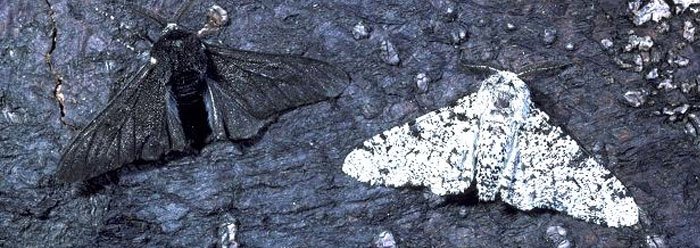
The trees these moths used to live on were white, but have been covered in soot from coal factories. Which moth will be more successful in this environment?
a)
Dark moth
b)
Light moth
c)
Both will be equally successful
d)
Neither will be successful
47.
Since the 1800s humans have stopped burning coal, and the trees have returned to their original color. Which moth will be more successful in this environment?
a)
Dark moth
b)
Light moth
c)
Both will be equally successful
d)
Neither will be successful
48.
Which of these statements best describes what Darwin observed on the Galapagos Islands?
a)
The finch population on each island was unique
b)
The finches on the islands ate seeds and nuts, but no insects
c)
The finches on the islands were the same as the finches in Ecuador
d)
The finches could produce offspring only with finches from other islands
49.
Selective breeding is where ___________ decides which traits should be passed on
a)
Nature
b)
 A human
c)
Mr. Holt
d)
The illuminati
50.
Mutations are important because they bring about
a)
death of the organism in which they develop
b)
genetic variation needed for a population to evolve
c)
benefits for the individual, not for the population
d)
Hardey-Weinberg equilibrium within a population
51.
An organism's genetic make-up:
a)
phenotype
b)
recessive
c)
genotype
d)
dominant
52.
An organism's appearance or other observable characteristics:
a)
phenotype
b)
recessive
c)
genotype
d)
dominant
53.
What does this picture represent?
a)
species diversity
b)
ecosystem diversity 
c)
genetic diversity
d)
biodiversity
54.
a change in one DNA triplet that may result in a new triplet that codes for a stop codon instead of an amino acid is known as
a)
missense
b)
nonsense
c)
frameshift
d)
silent
55.
which of the following mutations results in the loss or addition of a single nucleotide, changing the DNA triplets
a)
missense
b)
nonsense
c)
frameshift
d)
silent
56.
What do mutations change?
a)
DNA
b)
Chromosomes
c)
Genes
57.
What mutation has occurred here? 
T-G-A-C-C-A
T-G-A-G-C-A
a)
Substitution
b)
Deletion
c)
Insertion
d)
Frameshift 
58.
which of the following mutations results in the loss or addition of a single nucleotide, changing the DNA triplets
a)
missense
b)
nonsense
c)
frameshift
d)
silent
59.
DNA molecule segment is : TTACGCAAG
The mutated DNA segment is TTCGCAAG. This is an example of ___ mutation.
a)
Substitution
b)
Deletion
c)
Insertion
d)
Inversion
60.
Gene: ABCDEF
Mutation: ACEFCD
What mutation occurred?
a)
deletion
b)
substitution
c)
inversion
d)
insertion
61.
DNA is often considered the "______________" of life.
a)
Blueprint
b)
Mistake
c)
Swimming Pool
d)
Smelly Cheese
62.
What are the building blocks of proteins called?
a)
DNA
b)
RNA
c)
Ribosomes
d)
Amino Acids
63.
In DNA, Adenine bonds with ______________.
a)
Guanine
b)
Thymine
c)
Cytosine
d)
Adenine
64.
Guanine bonds with ______________.
a)
Adenine
b)
Guanine
c)
Cytosine
d)
Thymine
65.
What molecule is shown in the double helix diagram shown?
a)
DAN
b)
RAN
c)
DNA
d)
RNA
66.
If you are a boy, what percent of your genes did you get from your dad?
a)
25%
b)
50%
c)
75%
d)
100%
67.

An advantage of sexual reproduction is that?

a)

Many offspring are produced in a short time

b)

It is increases genetic diversity

c)

production of gametes requires energy

69.

Crossing-over is an efficient way to produce _________ ____________which increases genetic diversity

a)

genetic variation

b)

genetic recombination

c)

genetic elements

69.

Crossing-over is an efficient way to produce _________ ____________which increases genetic diversity

a)

genetic variation

b)

genetic recombination

c)

genetic elements

70.

The main role of gametes?

a)

to make connection between male and female

b)

active point in cytoplasm

c)

produce zygote

d)

make a sequence in genetic elements

71.

The main role of gametes?

a)

to make connection between male and female

b)

active point in cytoplasm

c)

produce zygote

d)

make a sequence in genetic elements

72.

The main role of gametes?

a)

to make connection between male and female

b)

active point in cytoplasm

c)

produce zygote

d)

make a sequence in genetic elements

73.

Which of the following is not a benefit of asexual reproduction?

a)

Offspring will be successful in an unchanged environment.

b)

Good at adapting to changing environments.

c)

Only requires one parent to produce offspring.

d)

Can reproduce rapidly.

74.

Asexual reproduction is associated with what type of cell division?

a)

Mitosis

b)

Meiosis

75.

An organism that has been reproduced by asexual means receives ______________ of its chromosomes from its one parent.

a)

3

b)

25%

c)

50%

d)

100%

76.

An organism that has been reproduced by asexual means receives ______________ of its chromosomes from its one parent.

a)

3

b)

25%

c)

50%

d)

100%

77.

An organism that has been reproduced by asexual means receives ______________ of its chromosomes from its one parent.

a)

3

b)

25%

c)

50%

d)

100%

78.

In asexual reproduction, all of the offspring are:

a)

Physically Identical

b)

Genetically Identical

c)

Physically and Genetically Identical

d)

Not Identical

79.

An organism that has been reproduced by sexual reproduction received ____________ of its chromosomes from the male parent.

a)

4

b)

25%

c)

50%

d)

100%

80.

An organism that has been reproduced by sexual reproduction received ____________ of its chromosomes from the male parent.

a)

4

b)

25%

c)

50%

d)

100%

81.

These are long strands of DNA in the nucleus that controls the traits of an organism.

a)

Gene

b)

Allele

c)

Chromosomes

82.

A fruit fly has 8 chromosomes like in the picture above. Which answer correctly shows the results of a fruit fly cell going through mitosis?

a)
b)
c)
d)
83.

If a cow has 60 chromosomes in a somatic cell how many chromosomes would be in a cow's sex cell?

a)

60

b)

120

c)

30

d)

90

84.

If a cow has 60 chromosomes in a somatic cell how many chromosomes would be in a cow's sex cell?

a)

60

b)

120

c)

30

d)

90

85.

The specific section of DNA that carries the code to control the specific characteristic or trait.

a)

Nucleus

b)

Chromosome

c)

Gene

d)

Allele

86.

The specific section of DNA that carries the code to control the specific characteristic or trait.

a)

Nucleus

b)

Chromosome

c)

Gene

d)

Allele

87.

The different variations of the same trait or characteristic.

a)

Gene

b)

Chromosome

c)

Allele

d)

DNA

88.

The different variations of the same trait or characteristic.

a)

Gene

b)

Chromosome

c)

Allele

d)

DNA

89.
What are some of the facts about asexual reproduction?
a)
Takes only one mate to reproduce and takes a longer time to reproduce
b)
Takes a shorter amount of time to reproduce and it takes two mates to reproduce
c)
Reproduces diverse offspring and takes a longer time to reproduce
d)
Takes only one mate to reproduce and takes a shorter time to reproduce
90.
What are some of the facts about sexual reproduction?
a)
Takes two mates to reproduce and takes a longer time to reproduce
b)
Takes one mate to reproduce and takes a shorter amount of time to reproduce
c)
Takes two mates to reproduce and takes a shorter amount of time to reproduce
d)
Takes one mate to reproduce and takes a shorter amount of time to reproduce
91.
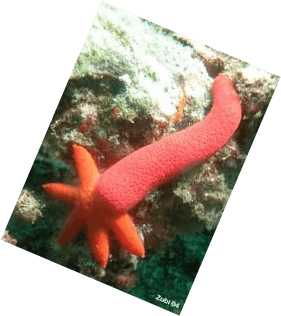
When a starfish grows a new body off a broken arm, what kind of reproduction is this?
a)
Sexual
b)
Differentiation
c)
Asexual 
d)
Specialization
92.
Sexual reproduction requires _____ parents and asexual reproduction requires ___ parents
a)
1,1
b)
2,2
c)
2,1
d)
1,2 
93.
Sexual reproduction requires _____ parents and asexual reproduction requires ___ parents
a)
1,1
b)
2,2
c)
2,1
d)
1,2 
94.
What type of asexual reproduction is taking place?
Fishermen work hard to catch and remove all the starfish that get into their favorite shell fishing beds and the “underwater farms” where they raise clams and oysters. In the past, they put the starfish into their boats, cut them up with knives, and then throw the pieces of starfish overboard. They thought this would kill the starfish. What they did not know was that each piece of starfish will grow into a whole new animal.
a)
Regeneration
b)
Vegetative propagation
c)
Budding
d)
Fission
95.
What type of asexual reproduction is taking place?
Fishermen work hard to catch and remove all the starfish that get into their favorite shell fishing beds and the “underwater farms” where they raise clams and oysters. In the past, they put the starfish into their boats, cut them up with knives, and then throw the pieces of starfish overboard. They thought this would kill the starfish. What they did not know was that each piece of starfish will grow into a whole new animal.
a)
Regeneration
b)
Vegetative propagation
c)
Budding
d)
Fission
96.

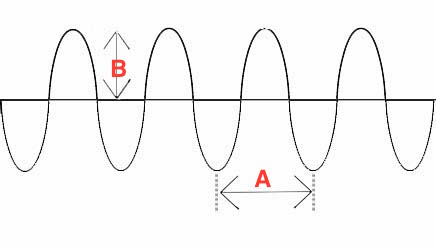
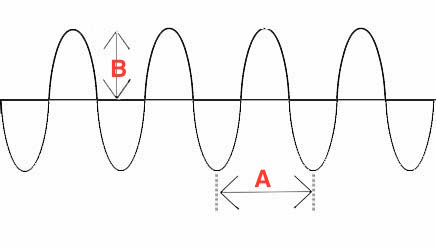
What property of this wave is represented by the letter "A"

a)

amplitude

b)

crest

c)

trough

d)

wavelength

97.
What property of the wave is represented by the letter "B"?
a)
amplitude
b)
crest
c)
trough
d)
wavelength
98.
The highest point on a wave is:
a)
the crest
b)
the trough
c)
the top
d)
the coast 
99.
The highest point on a wave is:
a)
the crest
b)
the trough
c)
the top
d)
the coast 
100.
The lowest point on a wave is the:
a)
Amplitude
b)
Crest
c)
Trough
d)
Wavelength
101.
The number of wavelengths that pass a point each per second is:
a)
frequency
b)
period
c)
longitudinal 
d)
transverse wave 
102.
The type of waves that require medium to pass:
a)
Mechanical Waves
b)
Electromagnetic Waves
103.
Which vocabulary term is used to identify the distance between points C & G?
a)
Amplitude
b)
Crest
c)
Frequency
d)
Wavelength
104.
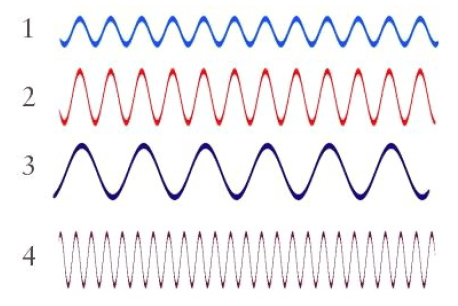
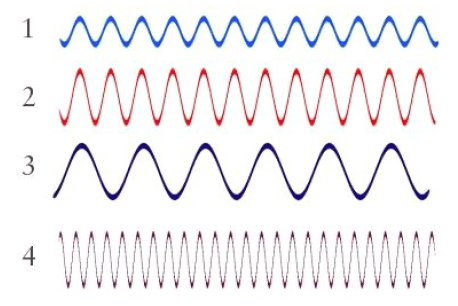
Which wave in the diagram has the greatest frequency?
a)
1
b)
2
c)
3
d)
4
105.
Which wave in the diagram has the greatest wavelength?
a)
1
b)
2
c)
3
d)
4
106.

The larger the amplitude, the less energy

a)

true

b)

false

107.

When light shines through a prism it creates ________________

a)

visible light

b)

infrared radiation

c)

ultraviolet rays

d)

electromagnetic wave

108.
Material that allows light to pass through allowing you to see "clearly" to the other side
a)
opaque
b)
translucent
c)
transparent
109.
Light is a form of 
a)
energy
b)
radiation
c)
reflection
111.

Compressions are...

a)

associated with transverse waves

b)

associated with longitudinal waves

c)

light waves

d)

visible light

111.

Compressions are...

a)

associated with transverse waves

b)

associated with longitudinal waves

c)

light waves

d)

visible light

112.

Mechanical waves can be transverse or longitudinal waves

a)

True

b)

False

113.

Rarefactions are...

a)

were waves are farthest apart

b)

were waves are closest together

c)

associated with transverse waves

d)

found near the crest of a wave

114.

When waves overlap

a)

Interference

b)

Resonance

c)

Reflection

d)

Diffraction

115.

The bending of waves around a barrier.

a)

refraction

b)

diffraction

c)

resonance

116.

Light is a type of energy

a)

true

b)

false

117.

Which statement accurately explains how Earth's internal heat drives the movement of tectonic plates?

a)

The convection currents in the Earth's crust cause the heat to circulate within the Earth's interior.

b)

The convection currents in the Earth's rocks cause the heat to circulate within the Earth's interior.

c)

The convection currents in the Earth's mantle cause the heat to circulate within the Earth's interior

d)

The convection currents in the Earth's core cause the heat to circulate within the Earth's interior.

118.
Any useful material that is found in nature:
a)
Natural Resource
b)
Human Resource
c)
Plants
119.
A resource that is not easily replaced...
a)
Renewable
b)
Nonrenewable
120.
Can be replaced within a human lifetime
a)
Nonrenewable resource
b)
Renewable resource
121.
Which group includes ALL renewable resources?
a)
Coal, trees, water, oil
b)
Water, wind, sun, plants
c)
Minerals, sun, natural gas, water
122.
Which of the following natural resources are nonrenewable?
a)
Water
b)
Animals
c)
Natural gas
d)
Wind
123.
What is a natural resource?
a)
Resources we get from our house
b)
Resources we get from people
c)
Resources we get from nature
124.
Which of the following natural resources are nonrenewable?
a)
Water
b)
Animals
c)
Natural gas
d)
Wind
125.
Which one is not a natural resource? 
a)
Water
b)
Plants
c)
Play dough 
d)
Air
126.
Fossil fuels are nonrenewable because...
a)
they are used to produce heat
b)
they take a long time to form
c)
they can be found underground
127.
What does conserving resources mean?
a)
Use as much of the resources as you can
b)
Only use the resources at school
c)
Protecting the resource so it does not run out
128.

Renewable or Non-renewable: Wind?

a)

Renewable

b)

Non-renewable

129.

Renewable or Non-renewable: Coal?

a)

Renewable

b)

Non-renewable

130.

Renewable or Non-renewable: Natural Gas?

a)

Renewable

b)

Non-renewable

131.

Renewable or Non-renewable: Oil?

a)

Renewable

b)

Non-renewable

132.

Renewable or Non-renewable: Trees?

a)

Renewable

b)

Non-renewable

133.

Renewable or Non-renewable: Soil?

a)

Renewable

b)

Non-renewable

134.

Renewable or Non-renewable: Plants?

a)

Renewable

b)

Non-renewable

135.
Is the resource renewable or non-renewable: sun
a)
renewable
b)
non-renewable
136.

Renewable or Non-renewable: Animals?

a)

Renewable

b)

Non-renewable

137.
Hydroelectric energy uses...
a)
water to make electricity.
b)
hydrogen to make electricity.
c)
lightning in water to make electricity.