wayground logo

Free Printable Worksheets

Font size

S
M
L
XL
Worksheets

6th Grade Review

Total questions: 138

Worksheet time: 2hrs 34mins

Name
Class
Date
1.

How many carbon atoms are there?

(a)  

2.

How many oxygen atoms are there?

(a)  

3.

Negatively charged particles found circling the nucleus

a)

electrons

b)

protons

c)

neutrons

d)

isotopes

4.

Positively charged particles in the nucleus of an atom

a)

protons

b)

electrons

c)

neutrons

5.

When atoms join together with other atoms to form larger particles

a)

molecules

b)

element

c)

isotopes

d)

protons

6.

_____________ are the building blocks of life and the universe.

a)

Atoms

b)

Elements

c)

Metals

7.

The center of an atom is called the

a)

neutron

b)

nucleus

c)

isotopes

8.

All matter is made up of atoms.

a)

True

b)

False

9.

Which one of these is a compound?

a)

Gold (Au)

b)

Silver(Ag)

c)

Lead (Pb)

d)

Water (H2O)

10.

Which one of these is a compound?

a)

Oxygen gas (O2)

b)

Hydrogen chloride (HCl)

c)

Lead (Pb)

d)

Chlorine (Cl)

11.

What is Newton's First Law of Motion?

a)

Every action has an equal and opposit reaction

b)

Objects in motion stay in motion/Objects at rest stay at rest until an outside force acts on it

c)

A force is required to accelerate an object with a known mass

12.

What is Newton's Second Law of Motion?

a)

Every action has an equal and opposite reaction

b)

Objects in motion stay in motion/objects at rest stay at rest until an outside force acts on it

c)

A force is required to accelerate an object with a known mass

13.

What is Newton's Third Law of Motion?

a)

Every action has an equal and opposite reaction

b)

Objects in motion stay in motion/objects at rest stay at rest until an outside force acts on it

c)

A force is required to accelerate an object with a known mass

14.

A frog pushes his legs down on a lily pad, but yet the direction he travels is upwards. Which law explains this?

a)

Newton's First Law

b)

Newton's Second Law

c)

Newton's Third Law

d)
15.

The Swimmer moves her hand down and to the left and her body moves forward and to the right

a)

Newton's first law

b)

Newton's Second Law

c)

Newton's Third Law

16.

A person in a car slides to the right when going through a very sharp left turn on the highway

a)

Newton's First Law

b)

Newton's Second Law

c)

Newton's Third Law

17.

What will be the effect on the boy in the picture if the driver stops quickly?

a)

Because of inertia he will remain in the same position.

b)

He will be pushed back into the car seat.

c)

He will move from one side of the car seat to the other.

d)

He will move forward pressing against the seatbelt.

18.

A force that opposes motion between objects that are touching is called...

a)

motion

b)

friction

c)

velocity

d)

acceleration

19.

When there is an INCREASE in MASS of an object you will have a DECREASE in ______________.

a)

friction

b)

acceleration

c)

force

d)

gravity

20.
What is the net force?
a)
5000 N right
b)
4000 N right
c)
40 N left
d)
4000 N left
21.
The tendency of an object to resist changes in its motion is...
a)
inertia
b)
force
c)
acceleration
d)
velocity
22.
An object is resting motionless on a surface. According to Newton's 1st Law, the object will only start to move if
a)
the net forces on the object equal zero
b)
an unbalanced force is applied to the object
c)
the upward force of the object is equal to its acceleration
d)
two forces that are equal and opposite are applied to the object
23.
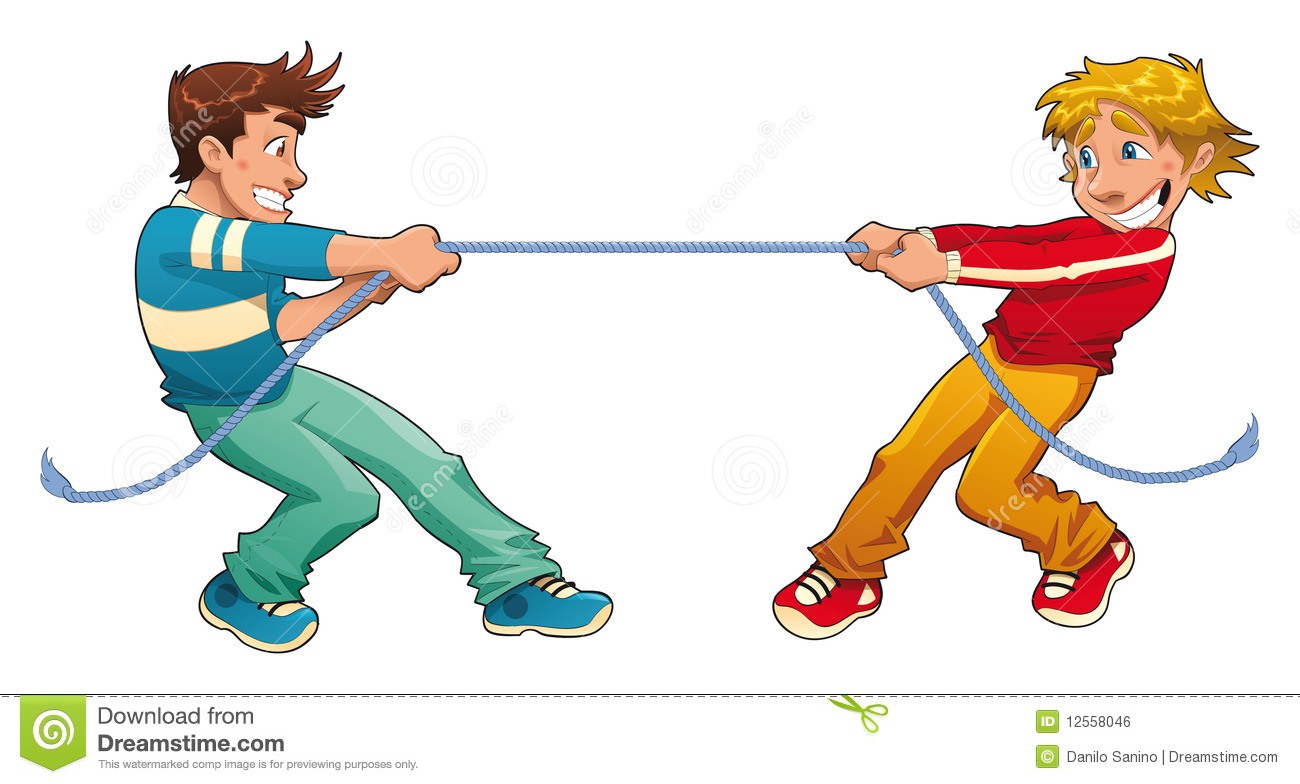
If these boys are pulling with the same amount of force.  What will happen?
a)
The boy in blue will win.
b)
They will not move at all.
c)
The boy in red will win.
d)
Both will fall down.
24.

Which law best explains why more force must be applied to the bowling ball to make it accelerate at the same rate as the tennis ball.

a)

Newton's 1st Law

b)

Newton's 2nd Law

c)

Newton's 3rd Law

25.

You push against a wall and the wall is pushing back on you.

a)

Newton's 1st Law

b)

Newton's 2nd Law

c)

Newton's 3rd Law

26.
Newton's third law states that any action will have a(n) _______ and ______ reaction
a)
Equal and similar
b)
Equal and opposite
c)
Equal and different
d)
Greater and opposite
27.
Why is it harder to push a van filled with bowling balls than it is to push a van with basketballs?
a)
The mass of the car is greater than the mass of the basketballs
b)
The mass of the bowling balls is greater than the mass of the basketballs
c)
The van with the basketballs is bigger than the van with the bowling balls
d)
It should be equally as hard to push the two vans
28.
You are holding a bowl of hot soup while standing in the kitchen. As you begin to move, the soup spills out of the bowl. Upon reflection you realize that
a)
the soup spilled because of air resistance
b)
if you had traveled faster this wouldn't have happened
c)
the soup wanted to stay where it was, but you moved the bowl
d)
the soup and the bowl act as one body with the same velocity
29.
A wheelbarrow is experiencing two forces. One is pushing 5N east and another 5N west. What is true about the motion of the wheelbarrow?
a)
it isn't moving
b)
it is accelerating
c)
it is slowing down
d)
its speed is constant
30.
A cup of coffee sits on the dashboard of an automobile. The car goes around a sharp curve. Even though you hold the cup still, coffee splashes out. This is explained due to 
a)
density
b)
friction
c)
gravity
d)
inertia 
31.
When a Civil War era cannon is fired, the force of the gas produced by exploding powder propels the cannonball forward at a high speed. According to Newton's 3rd law
a)
the cannon itself moves backward
b)
the cannon itself does not move due to inertia
c)
the cannon itself moves forward as well with the momenturm
d)
the cannon itself moves forward with the inertia of the cannonball
32.

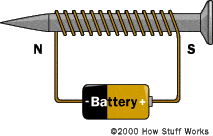
The best modifications to an electromagnet are..

a)

Add batteries, less winds

b)

Add batteries, more winds

c)

Add batteries, less winds, & thicker wire

d)

Add batteries, more winds, & thicker wire

33.

An electromagnet is...

a)

Metal that becomes a permanent magnet with electricity

b)

Metal that becomes a temporary magnet with electricity

34.

Can magnetism go through objects?

a)

yes

b)

no

35.

When two magnets interact...

a)

like poles attract

b)

opposite poles repel

c)

nothing happens

d)

opposite poles attract

36.

Net force of 0 N...

a)

...moves to the left

b)

...moves to the right

c)

...does not move

d)

...jumps in the air

37.

Forces in the same direction

a)

add together

b)

subtract from each other

38.

A magnet has two magnetic poles. Those poles are ...

a)

South Pole

West Pole

b)

East Pole

West Pole

c)

North Pole

West Pole

d)

North Pole

South Pole

39.

In a Closed Circuit ...

a)

The circuit is complete and electric energy flows through the circuit

b)

The circuit is not complete and electric energy flows through the circuit.

c)

The circuit is not compelte and no electric energy flows through the circuit.

d)

The circuit is compelte and no electric energy flows through the circuit.

40.

In a Open Circuit ...

a)

The circuit is compelte and no electric energy flows through the circuit.

b)

The circuit is complete and electric energy flows through the circuit.

c)

The circuit is not complete and no electric energy flows through the circuit.

d)

The circuit is not complete and electric energy flows through the circuit.

41.

Electromagnetism is the interaction between _____ and _____.

a)

Magnets and Light Bulbs

b)

Open circuits and Closed circuits

c)

Potential energy and Kinetic energy

d)

Electric charges and Magnets

42.

Which electromagnet is stronger?

a)

A

b)

B

43.

Which electromagnet is stronger?

a)

A

b)

B

44.
What kind of magnet can be turned on and off?
a)
refridgerator magnet
b)
electromagnet
c)
magnetite
d)
iron
45.

The gravitational force exerted by an object depends on its

a)

volume

b)

mass

c)

weight

46.

A student drops a bowling ball and an apple from a third-story window. Both objects hit the ground at the same time. From the experiment, the student should conclude that

a)

the apple weighs more than the bowling ball

b)

more air friction is acting on the apple than on the bowling ball

c)

gravity pulls on both objects, causing them to fall at the same time.

47.
This FORCE pulls things.  It PULLS things into orbit around the sun. 
a)
Newton
b)
gravity
c)
weight
d)
path
48.
Mass is a measurement of 
a)
how much matter is present in an object
b)
how much weight is present in an object
c)
the amount a spring is compressed on a scale
d)
none of the answers are correct
49.

Which statement is true?

a)

All objects with mass exert a gravitational force.

b)

Only celestial objects exert a gravitational force.

c)

Gravity can both push and pull objects.

d)

Only Earth exerts a gravitational force.

50.

The force between two masses

a)

gravitational force

b)

force

c)

mass

d)

attract

51.

The faster an object moves, the ________ kinetic energy it has.

a)

more

b)

less

c)

none of the above

d)

all of the above

52.

Kinetic energy is...

a)

energy carried in ultraviolet waves

b)

energy stored in food

c)

energy in motion

d)

energy from splitting an atom

53.

Kinetic energy is...

a)

energy carried in ultraviolet waves

b)

energy stored in food

c)

energy in motion

d)

energy from splitting an atom

54.

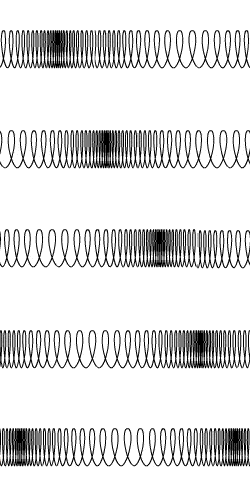
A wave that has the vibration parallel to the direction of the wave is called:

a)

Longitudinal

b)

Transverse

55.

A wave that has the vibration perpendicular to the direction of the wave is called:

a)

Longitudinal

b)

Transverse

56.

What does point C represent?

a)

Amplitude

b)

Trough

c)

Crest

d)

Wavelength

57.

What does point A represent?

a)

Amplitude

b)

Wavelength

c)

Crest

d)

Trough

58.

What are waves?

a)

Repeating pattern of motion that transfers energy

b)

The thing that you surf on

59.
What type of wave is this?
a)
Longitudinal
b)
Transverse
60.
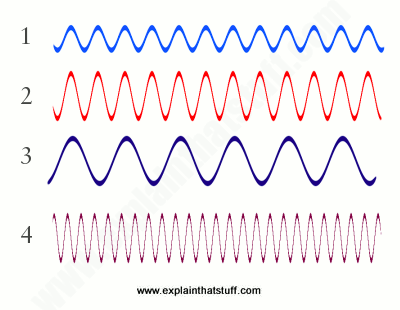
Which wave has the highest frequency?
a)
1
b)
2
c)
3
d)
4
61.
Frequency is
a)
Amount of time it takes for one wavelength
b)
How many wavelengths are completed in one second
c)
Distance between two crests or two troughs
d)
Amount of energy in a wave
62.
What do all waves transfer?
a)
Light
b)
Sound
c)
Heat
d)
Energy
63.
The path one object takes as it revolves around another object in space.
a)
rotate
b)
revolve
c)
orbit
d)
axis
64.
An imaginary line that a sphere rotates around.
a)
revolution
b)
rotation
c)
orbit
d)
axis
65.
Making a complete spin on an axis.
a)
rotation
b)
revolution
c)
axis
d)
orbit
66.
Making a complete turn or orbit around an axis or center.
a)
Revolution
b)
rotation
c)
orbit
d)
axis
67.

The center of our solar system that supplies heat and light to Earth; its enormous gravity keeps the solar system in orbit.

a)

Earth

b)

sun

c)

moon

d)

Jupiter

68.
How long does it take the Earth to revolve around the Sun one time?
a)
365 hours
b)
24 hours
c)
24 days
d)
365 days
69.
How long does it take the Earth to make one rotation?
a)
365 days
b)
24 day
c)
365 hours
d)
24 hours
70.

The moon revolves or rotates around the Earth?

a)

revolve

b)

rotate

c)

orbit

d)

floats

71.
What is this diagram showing?
a)
tides
b)
solar eclipse
c)
lunar eclipse
d)
rotation
72.
What is this diagram showing?
a)
tides
b)
lunar eclipse
c)
revolution
d)
solar eclipse
73.
In a lunar eclipse the moon is...
a)
directly between the sun and earth
b)
behind the earth
74.
In a solar eclipse the moon is...
a)
between the sun and earth
b)
directly behind the earth
75.
What two things cause our tides?
a)
the seasons and moon phases
b)
the earths gravity and rotation
c)
Moon's gravity and earth's rotation
d)
moon's gravity and earth's revolution
76.
What causes day and night?
a)
The sun rises and sets
b)
The Earth rotating on its axis
c)
The Earth revolves around the sun
d)
The tilt of the Earth
77.
Why do we have seasons?
a)
The earth's rotation on its axis
b)
The earth's revolution around the sun
c)
The moon's gravity pull on the earth
d)
The Earth's tilt as it revolves around the sun
78.
What season is it in the Northern Hemisphere?
a)
Winter
b)
Summer
c)
Spring
d)
Fall
79.
What season is it in the southern hemisphere?
a)
Winter
b)
Spring
c)
Summer
d)
Fall
80.
Why do we always see the same side of the moon from Earth?
a)
because the phases change
b)
because it rotates and revolves at the same rate
c)
because half of the moon always receives sunlight
d)
The moon changes positions
81.
About how many days does it take to moon to go through a complete cycle?
a)
7 days
b)
365 days
c)
29 days
d)
20 days
82.
What is illuminating the Moon?
a)
Nuclear Fusion
b)
Sunlight
c)
Mirrors
d)
Flood Lights
83.
Every living organism is made up of one or more cells
a)
True
b)
False
84.
A cell is...
a)
the basic unit of structure and function in living organism
b)
an organism
c)
a basic part of everything that we see
d)
found only in animals, not plants
85.
Which of the following are NOT found in animal cells
a)
chloroplasts and cytoplasm
b)
chloroplasts and cell wall
c)
cell wall and cell membrane
d)
mitochondria and nucleus
86.
The nucleus is like the ____________ of the cell.
a)
foot
b)
hand
c)
stomach
d)
brain
87.

Which of the following converts food into energy for the cell?

a)

vacuole

b)

mitochondria

c)

cytoplasm

d)

cell membrane

88.

The fluid that surrounds the organelles is... (hint... "Try to pull a fast one and..."

a)

chloroplast

b)

cytoplasm

c)

vacuole

d)

cell wall

89.
What do vacuoles do? 
a)
They actually do not have an important role
b)
They protect the cell
c)
They are the brain of the cell
d)
storage area for cells; water storage in plants 
90.

Which organelle takes in "sun showers" and helps plants with the process or photosynthesis?

a)

Vacuole

b)

Mitochondria

c)

Cytoplasm

d)

Chloroplast

91.
If you were some bad guy trying to sneak into an animal cell, who would be there to stop you?
a)
nucleus
b)
mitochondria
c)
cell membrane
d)
cell wall
92.
Which of the following, found ONLY in plant cells, provides structure?
a)
cell wall
b)
chloroplast
c)
mitochondria
d)
vacuole
93.

Animals cells and plant cells are exactly the same.

a)

True

b)

False

94.

Only ____________ cells have a cell wall instead of a cell membrane.

a)

plant

b)

animal

c)

white blood

d)

living

95.
This organelle creates the energy for the cell
a)
mitochondria
b)
cell membrane
c)
ribosome
d)
endoplasmic reticulum
96.
The ____________ regulates what enters and leaves the cell.
a)
mitochondria
b)
cell membrane
c)
golgi bodies
d)
cytoplasm
97.
What creates the protein for the cell?
a)
Cytoplasm
b)
Nucleus
c)
Golgi bodies
d)
Ribosomes
98.
Jelly-like material that makes up most of the cell
a)
cytoskeleton
b)
cytoplasm
c)
cyclops
d)
cytoliquid
99.
_________ ship and package materials
a)
Golgi bodies
b)
Mitochondria
c)
Rough endoplasmic reticulum
d)
Smooth endoplasmic reticulim
100.
This organelle is stores food, water and waste.
a)
Ribosome
b)
Cytoplasm
c)
Vacuole
d)
Mitochondria
101.
Animal cells have chloroplasts for photosynthesis
a)
True
b)
False
102.
What is the cell wall?
a)
Something in both animal and plant cells
b)
Only in animal cells
c)
Found in plant cells and it surrounds the cell membrane
103.
All living things are made up of...
a)
cells
b)
cell tissues
c)
organ
d)
organ systems
104.
Rocks are not living because
a)
they never move
b)
they aren't needed for humans
c)
they are not made of cells
d)
they don't break down
105.
An organism made of one cell is called
a)
unicellular organism
b)
multicellular organism
106.
Which best describes the main job of most cells in multicellular organisms?
a)
Cells work to keep themselves alive.
b)
Cells work to keep the organism alive.
c)
Cells work to release needed materials.
d)
Cells work to store unneeded materials.
107.
Which organisms are capable of surviving as a single cell?
a)
bacteria
b)
humans
c)
plants
d)
fish
108.
Which best explains why humans are multicellular organisms?
a)
Human cells are too small to function alone.
b)
Human cells join together to form one large cell.
c)
Humans need many cells to carry out life processes.
d)
Humans have many systems that perform the same function.
109.
Why do humans require many different types of cells to survive?
a)
Human cells are identical and work together to perform the same function.
b)
Human cells are specialized and work together to perform the same function.
c)
Human cells are identical and work independently to perform different functions.
d)
Human cells are specialized and work independently to perform different functions.
110.
Which symbols best describe mutualism?
a)
+,+
b)
+,-
c)
+,0
d)
-,0
111.
Which symbols best describe parasitism?
a)
+,+
b)
+,-
c)
+,0
d)
-,0
112.
Which symbols best describe commensalism?
a)
+,+
b)
+,-
c)
+,0
d)
0,0
113.
A tick and a dog have this type of relationship.
a)
mutualism
b)
commensalism
c)
neutralism
d)
parasitism
114.
Cattle egrets are birds that forage in fields among cattle. The egrets get easy access to food and the cattle don't care if they are there or not.
a)
mutualism
b)
commensalism
c)
competition
d)
parasitism
115.
A wrasse fish feeds on the parasites found on the black sea bass's body. Both species benefit. 
a)
Mutualism 
b)
Parasitism 
c)
Commensalism 
116.
Yucca flowers are pollinated by yucca moths. The moths lay their eggs  in the flowers where  the larvae hatch and eat some of the developing seeds. Both species benefit.  
a)
Mutualism 
b)
Parasitism 
c)
Commensalism 
117.
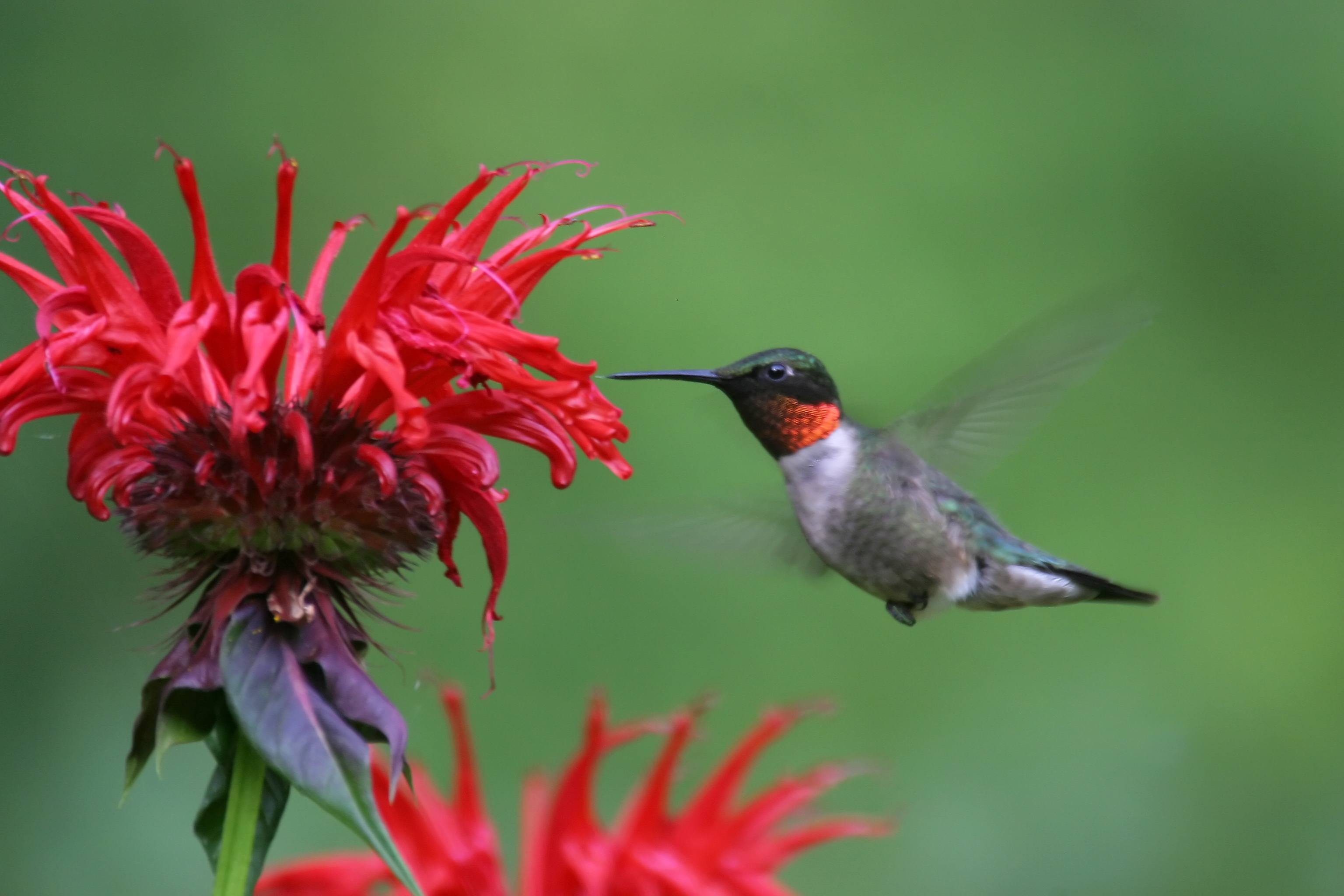
What type of symbiosis?  Hummingbirds feed on nectar from flowers.  The flowers are pollinated by hummingbirds as they move from flower to flower.
a)
commensalism
b)
mutualism
c)
parasitism
d)
predation
118.
A close, long-term relationship in which 2 different organisms live in close association with each other. 
a)
Carrying Capacity
b)
Coexistence
c)
Limiting Factor
d)
Symbiosis
119.
Mistletoe extracts water and nutrients from the spruce tree to the tree's detriment (harm). 
a)
Mutualsim 
b)
Parasitism 
c)
Commensalism 
120.

Make their own food for energy

a)

producers

b)

herbivores

c)

omnivores

d)

carnivores

121.

Get their energy from consuming plants (primary consumers)

a)

producers

b)

herbivores

c)

omnivores

d)

carnivores

122.

Get their energy from consuming plants and other organisms (primary or secondary consumers)

a)

producers

b)

herbivores

c)

omnivores

d)

carnivores

123.

Get their energy from consuming other organisms (secondary or tertiary consumers)

a)

producers

b)

herbivores

c)

omnivores

d)

carnivores

124.

Grasses directly pass energy to...

a)

grasshopper, frog, bird

b)

mouse, rabbit, grasshopper

c)

rabbit, fox, snake

d)

frog, owl, mouse

125.

What is the frog considered in this food web?

a)

producer

b)

primary consumer

c)

secondary consumer

d)

tertiary consumer

126.

Which would NOT be considered an apex predator?

a)

fox

b)

owl

c)

hawk

d)

snake

127.

The frog in this food web could be considered a second-level and third-level consumer

a)

true

b)

false

128.

Which organism DOES NOT pass energy directly to the eagle?

a)

rat

b)

thrush

c)

frog

d)

dragonfly

129.

How many producers are on this food web? Primary consumers (herbivores)?

a)

2, 3

b)

4, 3

c)

3, 3

d)

4, 2

130.

What is a producer?

a)

Organism that makes its own energy

b)

Organism that breaks down dead organisms

c)

Organism that eats other organisms for food & energy

131.
What is an omnivore?
a)
An organism that only eats plants for energy
b)
An organism that eats animals for energy
c)
An organism that eats both plants and animals for energy.
132.

What is a carnivore?

a)

An organism that only eats plants for energy

b)

An organism that eats animals for energy

c)

An organism that eats both plants and animals for energy.

133.

What is an herbivore?

a)

An organism that only eats plants for energy

b)

An organism that eats animals for energy

c)

An organism that eats both plants and animals for energy.

134.

What is a consumer?

a)

Organism that makes its own energy

b)

Organism that breaks down dead organisms

c)

Organism that eats other organisms for food & energy

135.

The ___% rule states that only ____% of energy is transferred to the next trophic level.

a)

10%

b)

25%

c)

50%

d)

100%

136.

What are "trophic levels"?

a)

Levels in a food web/food chain

b)

Levels of land in a mountain

c)

Animal diets

137.

Fungi: Producer, consumer or decomposer?

a)

Producer

b)

Consumer

c)

Decomposer

138.

Grass: Producer, consumer or decomposer?

a)

Producer

b)

Consumer

c)

Decomposer