wayground logo

Free Printable Worksheets

Font size

S
M
L
XL
Worksheets

Plate Tectonics

Total questions: 139

Worksheet time: 4hrs 30mins

Name
Class
Date
1.
A plate boundary where two plates move away from each other is called
a)
Divergent Boundary
b)
Convergent Boundary
c)
Transform Boundary
d)
Subduction
2.
Scientists hypothesize that a super continent existed 200 million years ago.  This continent is called
a)
America
b)
Super Earth
c)
Pangea
d)
Eurasia
3.
A Plate Boundary where two plates move toward each other is called
a)
Convergent Boundary
b)
Divergent Boundary
c)
Transform Boundary
d)
Subduction
4.
What is the difference between the lithosphere and asthenosphere that makes up the mantle?
a)
The lithosphere is ismade of dense solid meal whle the asthenosphere is made of liquid molten metal
b)
The lithosphere is a mixture of gasses while the asthenosphere is made of solid rock
c)
The lithosphere is molten rock that moves while the asthenosphere is ridid and thin
d)
The lithosphere is made of solid rock while the asthenosphere is more flexible hot rock that moves.
5.
Convergent Plate Movement can create
a)
Rifts
b)
Mountains
c)
Ocean Ridges
d)
Radiation
6.
_______________ Currents within the mantle cause the earth's plates to move and shift s molten material rises and falls due to density and gravity
a)
Convection
b)
Radiation
c)
Conduction
d)
Wind
7.
Divergent Plate movement can create
a)
Convection Currents
b)
Conduction
c)
Mountains
d)
Rifts and ocean ridges
8.
When pressure builds between two tectonic plates, it can suddenly release causing a (an) ______________________
a)
Earthquake
b)
Volcano
c)
Convection Current
d)
Gravitational Pull
9.

The movement of the tectonic plates is caused by

a)

the rotation of the Earth.

b)

convection currents in the Asthenosphere

c)

the gravity of the iron-nickel core.

d)

the Moho discontinuity.

10.

In some areas of the world, like California and Japan, earthquakes are a common occurrence. How can this best be explained?

a)

The strong ocean currents are undermining both areas causing earthquakes.

b)

Both areas are located near the edge of the Pacific Ocean, the unstable sand causes earthquakes.

c)

Both areas are subjected to strong ocean wind and waves that causes earthquakes.

d)

Both areas are on the boundary of active plates, the motion of the plates causes earthquakes.
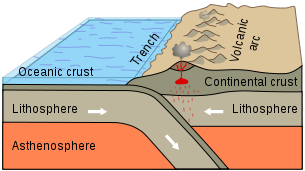
11.
Subduction zones occur on Earth where dense oceanic crust dives under more buoyant continental crust. These boundaries are characterized by a deep ocean trench next to a high continental mountain range, large numbers of earthquakes and volcanoes. All of this is further evidence for the
a)
big bang theory.
b)
theory of plate tectonics.
c)
origin of the species.
d)
theory of natural selection.
12.

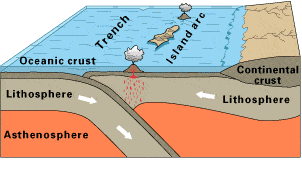
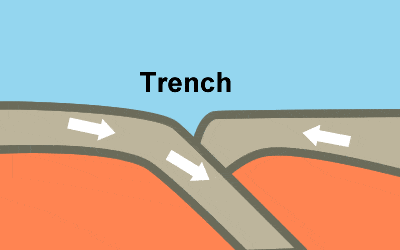
Observe this diagram of a plate boundary. One statement BEST describes what is happening. It is that

a)

the oceanic crust is melting.

b)

the denser ceanic crust is subducting under the less dense oceanic crust

c)

volcanic islands are forming.

d)

the tectonic plates are moving away from each other.
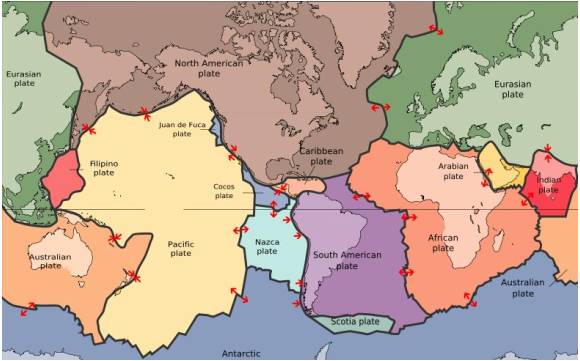
13.

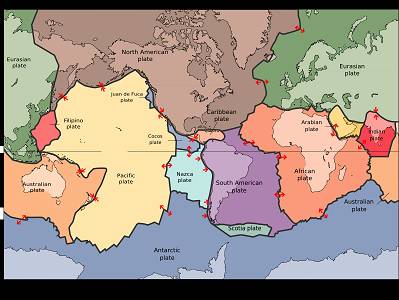
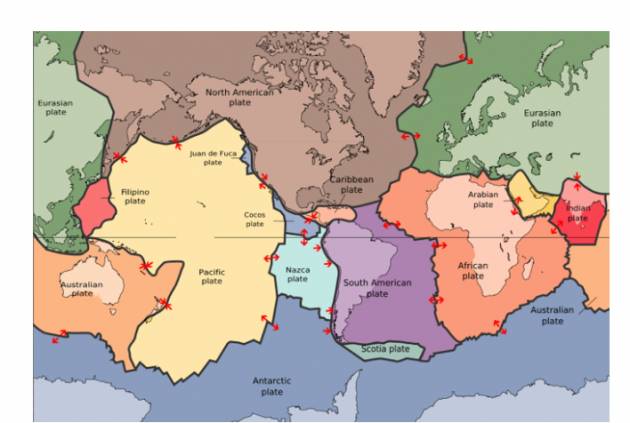
The map in the picture shows tectonic plate boundaries. This map would be useful in predicting the location of future

a)

droughts

b)

hurricanes

c)

earthquakes

d)

tornadoes

14.
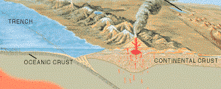
What geological forces might be responsible for this range of mountains?
a)
diverging tectonic plates
b)
erosion of the land by the ocean
c)
converging tectonic plates
d)
deposition of sediments by the ocean
15.

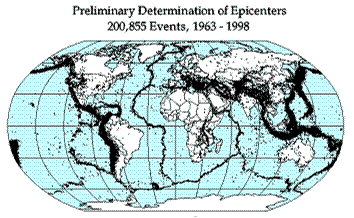
Earthquake epicenters (center of where the earthquakes started) were mapped for a 35 year period in the diagram above. The black dots indicate these epicenters. The black dots appear along what feature on Earth?

a)

hot spots

b)

plate boundaries

c)

rift zones

d)

sea floor spreading

16.
The Earth’s surface is not a solid surface but is divided into
a)
several oceanic plates.
b)
continental and crustal plates.
c)
seven continental plates.
d)
continental and oceanic plates.
17.
Geologists have long recognized that earthquakes are not randomly distributed on Earth but occur in concentrated areas that coincide with __________ and provide evidence for the theory of ___________ .
a)
mountain ranges; fault zones.
b)
continental borders; supercontinents.
c)
plate boundaries; plate tectonics
d)
areas of liquid magma; sea floor spreading.
18.

Where are earthquakes MOST LIKELY to occur?

a)

close to the equator

b)

close to the center of tectonic plates

c)

at divergent or convergent plate boundaries

d)

at transform plate boundaries

19.

The 2004 Indian Ocean tsunami was caused by a shift in two plates that pushed one section of the sea floor under another section of the sea floor by 5 meters. What type of boundary is this?

a)

divergent

b)

convergent

c)

transform

d)

metamorphic

20.
The Atlantic Ocean gets about 3-5 ______ wider each year.
a)
centimeters
b)
kilometers
c)
miles
d)
meters
21.

___________ currents in the Earth's asthenosphere cause plate to shift at their boundaries. This movement also causes earthquakes and volcanic activity.

a)

conduction

b)

convection

c)

radiation

d)

ocean

22.
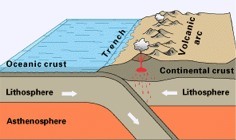
Observe the plate boundary shown here. What type of plate boundary is this? Many geologic events occur at these boundaries. Some are shown, but one is missing. What geologic event would you predict would occur at this plate boundary?
a)
convergent oceanic-oceanic plate boundary; volcano
b)
divergent oceanic-oceanic plate boundary; sea floor spreading
c)
convergent oceanic-continental plate boundary; earthquake
d)
convergent continental-continental plate boundary; mountain building
23.

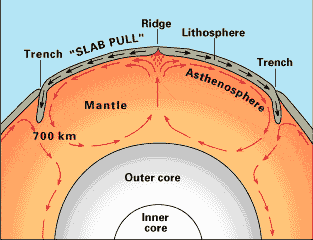
What is the source of energy that drives plate movement?

a)

the subducton of the sea floor

b)

the different densities of the oceanic and crustal plates

c)

convection currents in the asthenosphere

d)

the friction force between the plates that move past each other
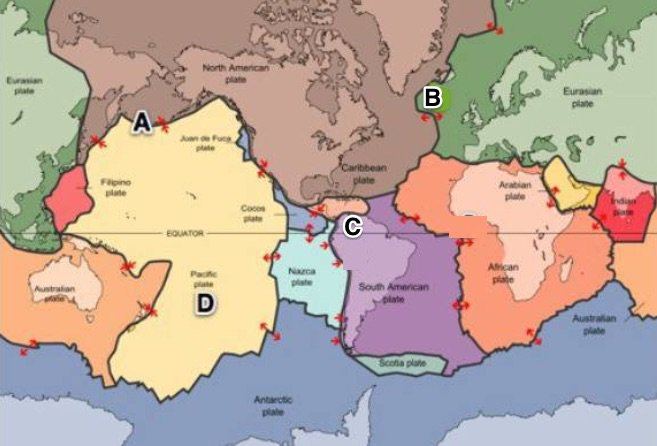
24.

Where would sea floor spreading most likely occur?

a)

At convergent boundaries (oceanic vs. oceanic)

b)

At convergent boundaries (oceanic vs. continental)

c)

At divergent plate boundaries (oceanic vs. oceanic)

d)

At transform plate boundaries

25.

The Marianas Trench, where the Pacific Plate descends under the leading edge of the Eurasian Plate, is the deepest sea floor in the world. These ocean trenches form when two oceanic plates collide

a)

and the older, less dense of the two plates rides over the edge of the older plate.

b)

when convection currents in the mantle force the older plate downward.

c)

and the younger, denser of the two plates, rides over the edge of the older plate.

d)

and the plates are approximately the same age and density.

26.
Identify the Major Plate labeled B
a)
African Plate
b)
Antarctic Plate
c)
Pacific Plate
d)
Eurasian Plate 
27.
Identify the Major Plate labeled I
a)
African Plate
b)
Antarctic Plate
c)
Pacific Plate
d)
Eurasian Plate 
28.
Identify the Major Plate labeled N
a)
African Plate
b)
Antarctic Plate
c)
Pacific Plate
d)
Eurasian Plate 
29.
Identify the Major Plate labeled J
a)
African Plate
b)
Antarctic Plate
c)
Pacific Plate
d)
Eurasian Plate 
30.
Identify the Major Plate labeled D
a)
Indo-Australian Plate
b)
North American Plate
c)
South Americana Plate
d)
Eurasian Plate 
31.
Identify the Major Plate labeled L
a)
Indo-Australian Plate
b)
North American Plate
c)
South Americana Plate
d)
Eurasian Plate 
32.
Identify the Major Plate labeled G
a)
Indo-Australian Plate
b)
North American Plate
c)
South Americana Plate
d)
Eurasian Plate 
33.
Which explains that the continents were once joined together and over time they broke up and then drifted apart?
a)
Plate Tectonic Theory
b)
Continental Drift 
34.
Which of these explains that Earth's outer layer is broken into large slowly moving pieces? 
a)
Plate Tectonic Theory
b)
Continental Drift 
35.
This boundary is described by two plates moving away from eachother along the edges and separating. The resulting gap allows magma to rise and create new crust, forming new lithosphere. 
a)
Convergent Boundary 
b)
Divergent Boundary  
c)
Transform Boundary
36.
This boundary is described as two plates moving past eachother ALONG THE EDGES horizontally.  These boundaries will get stuck or lock against eachother causing earthquakes when they slip and release. 
a)
Convergent Boundary
b)
Divergent Boundary
c)
Transform Boundary
37.
This boundary is described as moving toward one another  When the plates are both continental plates the will crumple up and form a mountains. When they are continental and oceanic plates, subduction occurs  and earthquakes and volcanoes form. 
a)
Convergent Boundary
b)
Divergent Boundary
c)
Transform Boundary
38.
Trenches, deep underwater canyons on the sea floor are created at this type of boundary 
a)
Divergent
b)
Convergent, Subduction Zone
c)
Transform 
39.
New crust is created at this type of  boundary.
a)
Divergent
b)
Convergent, Subduction Zone
c)
Transform 
40.
Mountains are created at this type of  boundary.
a)
Divergent 
b)
Convergent
c)
Transform 
41.
Mid Ocean Ridge Formation  is created at this type of  boundary.
a)
Divergent 
b)
Convergent
c)
Transform 
42.

What is the correct order (starting from the surface) of Earth’s layers?

a)

crust, outer core, inner core, mantle

b)

mantle, outer core, inner core, crust

c)

crust, mantle, outer core, inner core

d)

outer core, inner core, crust, mantle

43.

In sea-floor spreading, molten material rises from the mantle and erupts

a)

along the edges of all the continents.

b)

along mid-ocean ridges.

c)

in deep-ocean trenches.

d)

at the north and south poles.

44.

The process by which the ocean floor sinks beneath a deep-ocean trench and back into the mantle is known as _______

a)

convection.

b)

continental drift.

c)

subduction.

d)

conduction.

45.

Most geologists think that the movement of Earth’s plates is caused by _______

a)

convection.

b)

continental drift.

c)

subduction.

d)

conduction.

46.

The geological theory of _______ states that pieces of Earth’s lithosphere are in constant, slow motion.

a)

subduction

b)

plate tectonics

c)

deep-ocean trenches

d)

sea-floor spreading

47.

A place where two plates slip past each other, moving in opposite directions, is known as a _______

a)

transform boundary

b)

divergent boundary.

c)

convergent boundary.

d)

rift valley.

48.

Scientists think that convection currents flow in Earth’s

a)

continents.

b)

mantle.

c)

lithosphere.

d)

inner core.

49.

The place where two plates come together is known as a _______

a)

transform boundary.

b)

divergent boundary.

c)

convergent boundary.

d)

rift valley.

50.

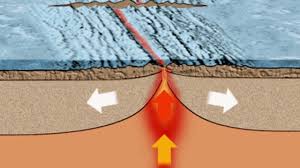
Below is a picture of sea-floor spreading. How are the ocean crusts moving?

a)

Converging

b)

Diverging

c)

Sliding

d)

No movement

51.

The San Andreas Fault in California is known as an active earthquake area. What type of

boundary is it?

a)

Converging

b)

Diverging

c)

Transform

d)

Sea Floor Spreading

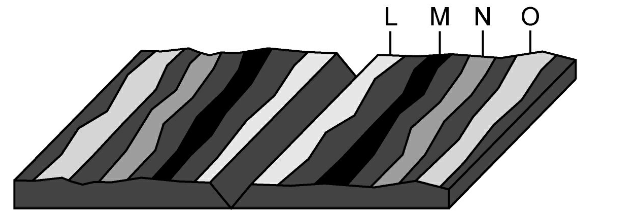
52.
Where would the oldest rock be found?
a)
L
b)
M
c)
N
d)
O
53.
How is it possible for new crust to be formed without increasing the surface area of the Earth?
a)
Crust is destroyed at the same time it is created
b)
New crust is underwater where it sinks
c)
New crust breaks more easily than old crust
54.
This layer of Earth is the thickest part
a)
crust
b)
outer core
c)
mantle
d)
inner core
55.
What are the two types of crust
a)
continental and oceanic
b)
ocean and upper
c)
lower and upper
d)
pizza and subway
56.
The Himalayas in Asia are an example of what type of plate boundary?
a)
divergent
b)
continent-to-continent convergent
c)
ocean-to-continent convergent
d)
transform
57.
What are Tectonic Plates?
a)
A continent 
b)
The Trees in Vietnam 
c)
ThE PlaTES That MoVE uNdERGRound :)
d)
The Plates that move the Continents
58.
What is Pangaea?
a)
the name of a German scientist
b)
the name of the super-continent that existed millions of years ago
c)
another name for continental drift
d)
the name of an ancient fossil
59.
Mountains form from ...
a)
plates sliding past one another
b)
collision of plates
c)
plates moving away from each other
60.

Earth's plates meet at ____________.

a)

plate tectonics

b)

plate boundaries

c)

continental drift

d)

oceans

61.

Breaks in the crust called __________ form where plates meet.

a)

mountains

b)

rift valleys

c)

faults

d)

trenches

62.

A __________ forms where plates diverge on land.

a)

rift valley

b)

mid-ocean ridge

c)

mountain

d)

trench

63.

Plates slide apart along _____________ boundaries.

a)

convergent

b)

divergent

c)

transform

d)

universal

64.

Which theory describes the motion of the force driving Earth's Plates?

a)

continental drift

b)

plate tectonics

c)

first law of motion

d)

third law of motion

65.

What is the motion of Earth's plates like?

a)

fast and in stages

b)

slow and in stages

c)

fast and constant

d)

slow and constant

66.

The San Andreas fault is an example of which type of boundary?

a)

transform

b)

divergent

c)

convergent

d)

universal

67.

a)

divergent boundary

b)

convergent boundary

c)

transform boundary

68.

a)

divergent boundary

b)

convergent boundary

c)

transform boundary

69.

a)

divergent boundary

b)

convergent boundary

c)

transform boundary

70.

This type of boundary does NOT involve magma.

a)

divergent

b)

convergent

c)

transform

71.

New crust is formed at this type of boundary

a)

divergent

b)

convergent

c)

transform

72.

This type of boundary creates folded mountains.

a)

transform

b)

divergent

c)

continental-continental convergent

d)

continental-oceanic convergent

73.

This feature can be found along a divergent boundary

a)

mid-ocean ridge

b)

folded mountains

c)

deep sea trench

74.

At which of these boundaries would you find a deep sea trench?

a)

transform

b)

divergent

c)

oceanic-oceanic convergent

75.

Volcanoes are formed when which type of crust subducts under another plate?

a)

continental

b)

oceanic

c)

magma

76.

Which feature is formed when two oceanic plates collide?

a)

mid-ocean ridge

b)

volcanic island arc

c)

folded mountains

77.

Magma that erupts out of volcanoes comes from.....

a)

melted transform crust

b)

melted oceanic crust

c)

melted continental crust

78.

When oceanic and continental crust collide what feature would form?

a)

volcanic island arc

b)

folded mountain

c)

volcanoes on the continent

79.

Subduction means.....

a)

one plate goes under another plate

b)

two plates slide past each other

c)

two plate collide and form folded mountains

80.

Sea-floor spreading explains how.....

a)

new crust is created at a divergent boundary

b)

volcanoes are formed on continents

c)

deep sea trenches are formed

81.

divergent plates move

a)

away fro each other

b)

towards each other

c)

slide past each other

82.

convergent plates move

a)

towards each other

b)

away from each other

c)

past each other

83.

At a transform boundary the plates.....

a)

collide

b)

diverge

c)

slide past each other

84.

This area is called the....

a)

Arc of Volcanoes

b)

Ring of Fire

c)

Horseshoe of Magma

85.
The image illustrates what type of boundary?
a)
Divergent
b)
Convergent
c)
Transform
d)
Emergent
86.
As you approach the center of the earth what happens to the temperature, pressure , and density.
a)
They all increase
b)
They all decrease
c)
They remain the same
d)
They disappear
87.
Which layer includes the crust and the upper mantle?
a)
Asthenosphere
b)
Lithosphere
c)
Mesosphere
88.
What is the correct order from the center of the earth to the surface of the earth?
a)
Crust, Mantle, Inner core , Outer core
b)
Crust, Mantle, Outer core , Inner core
c)
Inner core, Outer core, mantle, crust
d)
Outer core , Inner core, Mantle, Crust
89.
Volcanoes found away from plate boundaries, such as Hawaii, are known as 
a)
hot spots
b)
calderas
c)
trenches
d)
mid-ocean ridges
90.
The best example to demonstrate convection currents is a(n)
a)
alka seltzer tablet in water
b)
wind blowing 
c)
lava lamp
d)
electric oven
91.
What takes place because of sea-floor spreading?
a)
Crust is recycled.
b)
Crust is created.
c)
The ocean is evaporated.
d)
The sea floor remains unchanged.
92.
What is a common occurrence along plate boundaries?
a)
Earthquakes
b)
Polarities
c)
Stable land masses
d)
Transpiration
93.
Mountains form from....
a)
Tectonic plates sliding past one another
b)
Collision of tectonic plates
c)
Tectonic plates moving away from each other
d)
Tectonic plates disappearing
94.
Which of the following is the softer moving area of the mantle that contains convection current?
a)
Asthenosphere
b)
Lithosphere
c)
Outer core
d)
Oceanic crust
95.
This is the driving force behind the movement of tectonic plates.
a)
Mantle convection currents
b)
Oceanic convection currents
c)
Atmospheric convection currents
d)
Solar convection currents
96.
At a divergent boundary, tectonic plates move in what way? 
a)
Tectonic plates move towards each other
b)
Tectonic plates slide past each other
c)
Tectonic plates move up and down
d)
Tectonic plates move away from each other
97.
 A land feature that is produced at a convergent boundary is
a)
a valley
b)
an ocean
c)
a canyon
d)
a volcano
98.
What is a tectonic plate?
a)
A piece of the Earth's crust
b)
A piece of Earth's mantle
c)
A piece of Earth's core
d)
A piece of Earth's Moon
99.
Which type of plate boundary would cause mountains to form
a)
Transform
b)
Convergent
c)
Divergent
d)
Reform
100.
What is the name of the area where one crust slides underneath another
a)
Transform zone
b)
subduction zone
c)
Divergent zone
d)
School zone
101.
Name the boundary
a)
convergent
b)
transform
c)
divergent
d)
subduction
102.
Transform boundaries are most likely to produce what phenomenon?
a)
volcanoes
b)
deep sea trenches
c)
underwater mountain ranges
d)
earthquakes
103.
The outer layer of the Earth is called the __________.
a)
core
b)
crust
c)
mantle
d)
plates
104.
Which of the following is NOT a tectonic boundary?
a)
Convergent
b)
Divergent
c)
Observant
d)
Transform
105.
When two tectonic plates interact, what can be caused?
a)
Beach erosion and Tornadoes
b)
Tsunamis and storms
c)
Earthquakes and volcanoes
d)
Tornadoes and Hurricanes
106.
The earth is hotter in the center than near the crust.
a)
True
b)
False
107.
What boundary creates mountains?
a)
convergent
b)
divergent
c)
transform
d)
fast
108.

What geologic event would most likely be found at a transform boundary?

a)

Volcano

b)

Mountain

c)

Earthquake

d)

Mid-Ocean Ridge

109.

What landform would you most likely find at a divergent boundary between two pieces of oceanic crust?

a)

Rift Valley

b)

Mountain

c)

Mid-Ocean Ridge

d)

Volcano

110.

What landform would you most likely find at a divergent boundary between two pieces of continental crust?

a)

Mid-Ocean Ridge

b)

Rift Valley

c)

Mountain

d)

Volcano

111.

What landform would you most likely find at a convergent boundary between two pieces of continental crust?

a)

Mid-Ocean Ridge

b)

Oceanic Trench

c)

Mountain

d)

Volcano

112.

What landform would you most likely find at a convergent boundary between two pieces of oceanic crust?

a)

Rift Valley

b)

Mid-Ocean Ridge

c)

Mountain

d)

Ocean Trench

113.

The geological theory that states that pieces of Earth's lithosphere are in constant, slow motion is the theory of

a)

subduction

b)

plate tectonics

c)

evolution

d)

seafloor spreading

114.
When two tectonic plates interact, what can be caused?
a)
Beach erosion and Tornadoes
b)
Tsunamis and storms
c)
Earthquakes and volcanoes
d)
Tornadoes and Hurricanes
115.

The type of plate boundary where two plates come together is a .....

a)

Convergent Boundary

b)

Divergent Boundary

c)

Transform Boundary

d)

Plate Boundary

116.

A convergent boundary occurs when plates experience ________ force

a)

Compression

b)

Tension

c)

Sheer

d)

Subducting

117.

Islands can from from magma which is pushed up at a __________ plate boundary

a)

Divergent

b)

Convergent

c)

Transform

118.

Oceanic Trenches are formed by either _______ or _______ plate boundaries

a)

Convergent Oceanic / Continental

b)

Convergent Continental / Continental

c)

Convergent Oceanic / Oceanic

d)

Divergent

119.

Ocean Ridges are formed by _______ plate boundaries

a)

Convergent Oceanic / Continental

b)

Convergent Continental / Continental

c)

Convergent Oceanic / Oceanic

d)

Divergent

120.

Ocean Ridges are formed by _______ plate boundaries

a)

Convergent Oceanic / Continental

b)

Convergent Continental / Continental

c)

Convergent Oceanic / Oceanic

d)

Divergent

121.

Non-volcanic earthquakes are caused by _______ forces

a)

Compression

b)

Sheer

c)

Tension

d)

Divergent

122.

Oceanic crust is largely made of

a)

Dense basalt rock

b)

Light basalt rock

c)

Dense granite rock

d)

Light granite rock

123.

Continental crust is largely made of

a)

Dense basalt rock

b)

Light basalt rock

c)

Dense granite rock

d)

Light granite rock

124.

Why does oceanic crust subduct under continental crust?

a)

Oceanic crust is thin

b)

Oceanic crust is dense

c)

Continental crust is thin

d)

Continental crust is dense

125.
a boundary at which two plates move away from each other
a)
convergent plate boundary
b)
divergent plate boundary
c)
transform plate boundary
d)
subduction
126.
a boundary at which two plate move toward each other
a)
convergent plate boundary
b)
divergent plate boundary
c)
transform plate boundary
d)
subduction
127.

What Tectonic Plate is pictured?

a)

Eurasian

b)

Pacific

c)

Antarctic

d)

African

128.

Which Oceanic Tectonic Plate is yellow?

a)

North American

b)

African

c)

Pacific

d)

Australian

129.

Which Tectonic Plate is at #1

a)

Pacific

b)

Australian

c)

Africa

d)

North America

130.

What Lithosphere Plate is circled?

a)

North America

b)

African

c)

Australian

d)

Antarctic

131.

What Tectonic Plate is #8?

a)

African

b)

Eurasian

c)

Nazca

d)

Antarctic

132.

Which Lithosphere Plate is circled?

a)

North American

b)

Pacific

c)

Nazca

d)

South American

133.

What Tectonic Plate is # 11

a)

Australian

b)

American

c)

African

d)

Antarctic

134.

Which Lithosphere Plate is circled?

a)

Eurasian

b)

North American

c)

African

d)

Antarctic

135.

What is the Lithosphere Plate at #3?

a)

South American

b)

Nazca

c)

Eurasian

d)

Australian

136.

Which Lithosphere Plate is circled?

a)

South American

b)

North American

c)

Eurasian

d)

Australian

137.

What is Tectonic Plate #4?

a)

South American

b)

North American

c)

Australian

d)

Antarctic

138.

Which Lithosphere plate is #7?

a)

Australian

b)

Antarctic

c)

African

d)

American

139.

Which Lithosphere Plate is #13?

a)

Antarctic

b)

Eurasian

c)

Pacific

d)

Nazca