wayground logo

Free Printable Worksheets

Font size

S
M
L
XL
Worksheets

Unit 4 Exam Review

Total questions: 146

Worksheet time: 2hrs 4mins

Name
Class
Date
1.
Use the Hertzsprung-Russell Diagram to answer the following question.  Betelgeuse is a _____
a)
Hot and Bright Star
b)
Cool and Bright Star
c)
Hot and Dim Star
d)
Cool and Dim Star
2.
What are the three types of galaxies?
a)
Spiral, Elliptical, Ambiguous
b)
Whirlpool, Ellipse, Irregular
c)
Spiral, Elliptical, Irregular
d)
Swirly, Fuzzy, Uh...
3.
What is the name of the largest stars?
a)
Protostars
b)
Supergiants
c)
Red Giants
d)
Dwarf Stars
4.
Black holes are best described as:
a)
space fillers
b)
holes
c)
a place in space where gravity pulls so much even light can't get out
d)
gravity bombs
5.
Which star has the lowest temperature?
a)
A
b)
B
c)
C
d)
D
6.
Which star is considered a Main Sequence Star?
a)
A
b)
B
c)
C
d)
D
7.
In the diagram given, what happens as we move to the left?
a)
Stars Get Larger
b)
Stars get Colder
c)
Stars get hotter
8.
Stars are formed in a large cloud of gas and dust called a
a)
cumulonimbus cloud
b)
nebula
c)
neutron star
d)
black hole
9.
On the H-R diagram, the Sun is a _____.
a)
Main Sequence star
b)
Red Giant
c)
White Dwarf
d)
Blue Giant
10.
Which star is the coldest?
a)
Yellow Star
b)
Red Star
c)
Orange Star
d)
Blue Star
11.
Red stars are the _____________.
a)
hottest
b)
coolest
c)
biggest
d)
brightest
12.
Blue stars are the _____________.
a)
hottest
b)
coolest
c)
smallest
13.
What else does the H-R Diagram tell us besides the luminosity and temperature?
a)
Size, color and element make up
b)
Location and distance from Earth
c)
Constellation structures
14.

What is the HR diagram?

a)

A diagram that plots stars based on their distance from Earth.

b)

A diagram that plots stars based on the color & size.

c)

A diagram that plots stars based on the brightness & color.

d)

A diagram that plots stars based on the

15.

What is the definition of luminosity?

a)

The darkness of a star

b)

The color of the star

c)

The shape of the star

d)

The brightness of a star

16.

The variables that the Hertzsprung-Russell diagram uses?

a)

Temperature and color

b)

Color and temperature

c)

Luminosity and color

d)

Luminosity and temperature

17.
Early star formation, cloud of gas and dust
a)
main sequence
b)
supernova
c)
nebulla
d)
neutron star
18.
What type of galaxy is this?
a)
Spiral
b)
Elliptical
c)
Irregular 
d)
Irrational
19.
The Hertzprung Russell Diagram consists of two axis that are labelled...
a)
Luminosity and Size
b)
Luminosity and Temperature
c)
Luminosity and Age
20.
(8.8A) The Milky Way galaxy is described as a disk of stars orbiting a central point on the disk. Which of these best explains why people on Earth cannot see the entire shpae of the Milky Way?
a)
Earth is a part of this galaxy
b)
Many more stars exist outside the galaxy
c)
The stars in the center of the galaxy are extremely small.
d)
The center of the galaxy consists of a dense cluster of stars.
21.
Use the Hertzsprung-Russell Diagram to answer the following question.  Betelgeuse is a _____
a)
Hot and Bright Star
b)
Cool and Bright Star
c)
Hot and Dim Star
d)
Cool and Dim Star
22.
Which term would be considered the smallest object?
a)
Sun
b)
Supercluster
c)
Galaxy
d)
Universe
23.
A large cloud of dust and gas
a)
black hole
b)
nebula
c)
Galaxy
d)
Supercluster
24.
Star A is _________ and __________.
a)
dim and cool
b)
bright and hot
c)
bright and cool
d)
dim and hot
25.
What is the order of the components of the universe from greatest to least?
a)
galaxy, star, nebula, planet
b)
planet, star, nebula, galaxy
c)
galaxy, nebula, star, planet
d)
nebula, galaxy, star, planet
26.
What type of star is hot and dim?
a)
main sequence
b)
supergiants
c)
giants
d)
white dwarfs
27.
In the diagram given, what happens as we move to the left?
a)
Stars Get Larger
b)
Stars get Colder
c)
Stars get hotter
28.
Which category is our Sun located in?
a)
White Dwarfs
b)
Supergiants
c)
Main Sequence
d)
Giants
29.
Which star has the lowest temperature?
a)
A
b)
B
c)
C
d)
D
30.
Which spectral class does our star, the sun, belong to?
a)
M
b)
K
c)
G
d)
F
31.
The distance that light travels in one year...
a)
Light year
b)
Quantumyear
c)
Stellar-year
d)
1 million kilometers
32.
A large cloud of gas and dust in interstellar space; the predecessor to stars...
a)
Constellation
b)
Black hole
c)
Nebula
d)
Galaxy
33.
A collection of stars, dust, and gas bound together by gravity is...
a)
Universe
b)
Solar System
c)
Planet
d)
Galaxy
34.
What is a large celestial body that is composed of gas and that emits light?
a)
Nebula
b)
Star
c)
Galaxy
d)
Planet
35.
The sun and all of the planets and other bodies that travel around it make up our...
a)
Galaxy
b)
Solar System
c)
Cluster
d)
Constellation
36.
Lightyear is used by scientist to measure what?
a)
Distance
b)
Time
c)
Energy
37.
A wave with a large wavelength will have a ______ frequency and _____ energy
a)
high, low
b)
high, high
c)
low, high
d)
low, low
38.
Select the correct order of waves on the EMS 
a)
Radio, Micro, Infra, Visible, Ultra, X-ray, Gamma
b)
Gamma, X-ray, Ultra, Vis, Infra, Micro, Radio
c)
Vis, Micro, Infra, Ultra, X-ray, Gamma, Radio
d)
Micro, Radio, Vis, Infra, Ultra, X-ray, Gamma
39.
Which has the LONGEST wavelength and, therefore, the lowest frequency/energy
a)
Gamma Rays
b)
Radio Waves
c)
Visible Light
d)
Infrared rays
40.
Which section of the spectrum is the ONLY one we can see?
a)
X-rays
b)
Visible Light
c)
Gamma Rays
d)
Ultraviolet Rays
41.
Put the visible light colors in order from longest wavelength to shortest wavelength
a)
Violet, Indigo, Blue, Green, Orange, Yellow, Red
b)
Red, Yellow, Green, Orange, Violet, Blue, Indigo
c)
Red, Orange, Yellow, Green, Blue, Indigo, Violet
42.
High frequency waves have _________ wavelengths.
a)
varying
b)
long
c)
the same
d)
short
43.
Cell phones use_____________waves.
a)
Microwaves
b)
Gamma
c)
XRays
d)
Radio 
44.
The blue section of the wave is measuring _________________.
a)
wavelength
b)
crest
c)
trough
d)
amplitude 
45.

What color of visible light has the lowest energy?

a)

Violet

b)

Orange

c)

Red

d)

Yellow

46.
Which season is taking place in the Northern Hemisphere in Position 1?
a)
Winter
b)
Spring
c)
Summer
d)
Fall
47.
Which season is taking place in the Southern Hemisphere in Position 1?
a)
Winter
b)
Spring
c)
Summer
d)
Fall
48.
In summer, the axis of the earth is pointed away or toward the sun?
a)
towards
b)
up
c)
down
d)
away
49.
In winter, the axis of the earth is pointed away or toward the sun?
a)
towards
b)
up
c)
down
d)
away
50.
The hemisphere where you live 
a)
equator
b)
southern
c)
northern
d)
eastern
51.
Which of these locations on Earth experiences the least change in the number of daylight hours throughout the year? 
a)
Equator
b)
North Pole
c)
Tropic of Cancer
d)
Tropic of Capricorn
52.
Which season is taking place in the Southern Hemisphere in Position 3?
a)
Winter
b)
Spring
c)
Summer
d)
Fall
53.
The Earth's axis is tilted _____ degrees.
a)
23.5
b)
25.3
c)
30.2
d)
24
54.
What happens when the area in which you live tilts away from the sun?
a)
It is summer.
b)
It is spring.
c)
It is winter.
d)
It is fall.
55.
Why does the area around the equator stay the same temperature all year?
a)
The equator rotates slower than the poles 
b)
The equator remains the same distance from the sun.
c)
The equator always receives direct sunlight.
d)
The equator has 18 hour days.
56.
At position A, which hemisphere would have summer?
a)
Northern hemisphere
b)
Southern hemisphere
57.
At position C, which hemisphere would have winter?
a)
Northern hemisphere
b)
Southern hemisphere
58.
The Earth's _______ is an imaginary line that goes from the North Pole to the South Pole.
a)
vernal equinox
b)
axis
c)
solar eclipse
d)
solar flare
59.
What are the reasons for the seasons?
a)
Earth's tilt and rotation.
b)
Earth's rotation and revolution.
c)
Earth's tilt and revolution.
d)
Earth's tilt and resolution
60.
What is Earth's annual motion around the sun called?
a)
Rotation
b)
Revolution
61.
Which movement of Earth causes day and night?
a)
rotation
b)
revolution
62.
Where on Earth can you experience entire days of darkness?
a)
The equator
b)
The poles
c)
The Tropic of Cancer
d)
The Tropic of Capricorn
63.
How long does Earth take to make a complete rotation?
a)
365 days
b)
24 hours
64.
What direction does Earth rotate and revolve?
a)
clockwise
b)
counterclockwise
65.
Which one is NOT a reason we have seasons?
a)
the earth's gravitational pull 
b)
the earth's tilt
c)
how high the sun gets 
d)
the movement of the earth around the sun
66.
What causes more heat,  indirect sunlight or direct sunlight?
a)
indirect
b)
direct
67.
In the summer many people enjoy going to the beach. Argentina is located in the southern hemisphere. Which diagram shows position of the Earth when it is summer in Argentina.
a)
A
b)
B
c)
C
d)
D
68.
Which moon phase is when you can't see the moon at all?
a)
Waning crescent
b)
Full moon
c)
Waxing gibbous
d)
New moon
69.
About how long does it take the moon to make one complete cycle around the earth?
a)
65 days
b)
8 days
c)
365 days
d)
28 days
70.
Phases of the moon in which the moon appears to be getting larger are referred to as _.
a)
waxing
b)
waning
c)
new
d)
eclipse
71.
What Moon phase is this?
a)
Full Moon
b)
Waxing Gibbous
c)
New Moon
d)
Half Moon
72.
What Moon phase is this?
a)
Waxing Crescent
b)
Waning Gibbous
c)
Waning Crescent
d)
Waxing Gibbous
73.
What Moon phase is this?
a)
Last Quarter
b)
New Moon
c)
Third Quarter
d)
First Quarter
74.
What Moon phase is this?
a)
Waxing Gibbous
b)
Waning Crescent
c)
Waning Gibbous
d)
Full Moon
75.
What Moon phase is this?
a)
Old Moon
b)
Far Side of the Moon
c)
New Moon
d)
Waxing Gibbous
76.
What Moon phase is this?
a)
Waning Crescent
b)
Waxing Crescent
c)
Waxing Gibbous
d)
Waning Gibbous
77.
What Moon phase is this?
a)
Waxing Crescent
b)
Waning Gibbous
c)
Waxing Gibbous
d)
Waning Crescent
78.
What phase comes AFTER this one?
a)
Waning Crescent
b)
Waning Gibbous
c)
Waxing Crescent
d)
Third Quarter
79.
What phase comes BEFORE this one?
a)
Waxing Gibbous
b)
Waxing Crescent
c)
Waning Gibbous
d)
Waning Crescent
80.
What phase comes BEFORE this one?
a)
Full Moon
b)
Third Quarter
c)
New Moon
d)
First Quarter
81.
What phase comes BEFORE this one?
a)
Waxing Crescent
b)
Waxing Gibbous
c)
Waning Gibbous
d)
Waning Crescent
82.
What phase comes BEFORE this one?
a)
New Moon
b)
Third Quarter
c)
Waxing Crescent
d)
Full Moon
83.
What phase comes AFTER this one?
a)
Waxing Crescent
b)
Waning Gibbous
c)
Waxing Gibbous
d)
Third Quarter
84.
The complete cycle of the moon lasts about a _.
a)
day
b)
year
c)
week
d)
month
85.
When the Earth is between the moon and sun, it is most likely a:
a)
new moon
b)
full moon
c)
waxing crescent
d)
waxing gibbous
86.
Approximately how much time passes between the new moon and full moon?
a)
one month
b)
two weeks
c)
3 days
d)
24 hours
87.
Changes in the moon's appearance are
a)
phases
b)
eclipses
c)
stages
d)
cycle
88.
What causes the moon's phases
a)
Where you are standing on Earth
b)
the amt of sunlight reflected onto the moon from the sun
c)
The tilt of Earth
d)
how fast the moon is moving
89.
Why do we always see the same side of the moon from Earth?
a)
because the phases change
b)
because it rotates and revolves at the same rate
c)
because half of the moon always receives sunlight
d)
The moon changes positions
90.
Mrs. Smith says "the moon looks larger than the stars!" What explains this?
a)
The moons soaks up the star's light
b)
The moon is larger than Earth
c)
The moon is larger than stars
d)
the moon is closer to Earth than stars
91.
The Moon orbits Earth in a ________________ direction
a)
clockwise
b)
counterclockwise
c)
upwards
d)
downwards
92.

What causes tides?

a)

Differences in gravitational force between the Sun and moon.

b)

The solar energy generated by the Sun.

c)

The rotation of Earth.

93.

The ________ is mostly responsible for tides on Earth.

a)

the Sun

b)

the moon

c)

Earth's iron core

94.

Why does the moon have a greater effect on Earth's tides than the sun?

a)

It is closer.

b)

It is bigger.

c)

The Sun has a greater effect.

95.

These tides happen during full moons.

a)

Spring

b)

Neap

96.

These tides happen during first quarter moons.

a)

Spring

b)

Neap

97.

These tides happen during third quarter moons.

a)

Spring

b)

Neap

98.

These tides happen during new moons.

a)

Spring

b)

Neap

99.
During what phase of the moon can a lunar eclipse occur?
a)
3rd Quarter
b)
1st Quarter
c)
New Moon
d)
Full Moon
100.
For a solar eclipse to occur, what has to happen?
a)
The sun must be directly between Earth and the moon.
b)
The moon must be directly between Earth and the Sun.
c)
Earth must be directly between the Sun and the moon.
101.
When the Earth's shadow falls on the moon, the shadow causes what to happen?
a)
Lunar eclipse
b)
Solar eclipse
c)
Partial eclipse
102.
This type of eclipse occurs when the moon blocks the sunlight from reaching Earth?
a)
Solar eclipse
b)
Lunar eclipse
c)
Total eclipse
103.

Wha type of tide would this arrangement of earth-moon-sun create?

a)

full moon tide

b)

new moon tide

c)

neap tide

d)

spring tide

104.
Which body has the greater effect on Earth's tides?
a)
Sun
b)
Saturn
c)
Moon 
d)
Venus
105.
What is a difference between spring and neap tides?
a)
Spring tides occur when the earth and sun are IN LINE with the new or full moon. 
b)
Spring tides occur when moon in 3rd or 1st quarter phases
c)
Spring tides are LOWER than neap tides
d)
Spring tides occur in Spring and neap tides can occur in any season
106.

What is a high tide?

a)

Sea pulled TOWARD the moon where Earth is CLOSEST to the moon

b)

Sea pulled AWAY from the moon where Earth is FARTHEST to the moon

c)

Sea pulled AWAY from the moon where Earth is CLOSEST to the moon

107.
What type of tides would this arrangement of earth-moon-sun create?
a)
neap tide
b)
spring tide
c)
new moon tide
d)
full moon tide
108.
The Moon has a greater influence on Earth tides than the Sun because...
a)
it is smaller than the Sun
b)
it revolves around the Earth
c)
it is closer to the Earth
109.

Sam is work on a project. To record the height of the highest tides throughout the month Sam needs to know that the highest tides occur when?

a)

during the 1st quarter moon

b)

during the third quarter moon

c)

during full moon and new moon

d)

during the first and third quarter moon

110.
At the same time the sea is drawn to the moon, another tidal bulge takes place on other side of Earth.  True or False?
a)
True
b)
False
c)
Maybe
d)
I don't know!
111.
a)
Spring Tide
b)
Neap Tide
112.
a)
Spring Tide
b)
Neap Tide
113.
a)
Spring Tide
b)
Neap Tide
114.
a)
Spring Tide
b)
Neap Tide
115.
a)
neap tide
b)
spring tide
116.
Cold air _____ while warm air_____. 
a)
sinks, rises
b)
rises, sinks
c)
is colder, warmer
d)
is better, nicer. 
117.
Local winds 
a)
helps gravity. 
b)
produce solar energy. 
c)
rely on gravity. 
d)
result from from a local difference in temperature. 
118.
Land breeze 
a)
blows from sea to land. 
b)
blows from land to sea. 
c)
blows from land to land. 
d)
blows from sea to sea. 
119.
Sea breeze
a)
blows from sea to land. 
b)
blows from land to sea. 
c)
blows to sea to sea. 
d)
blows from land to land. 
120.
Front 
a)
where two air masses meet. 
b)
a large body of air that has similar temperature and humidity throughout. 
c)
an instrument for measuring air pressure. 
d)
an instrument measuring wind speed. 
121.

A boundary between air masses that don't move

a)

air pressure

b)

warm front

c)

cold front

d)

stationary front

122.

This forms when a cold air mass pushes under a warm air mass

a)

warm front

b)

cirrus clouds

c)

stationary front

d)

cold front

123.

A boundary between air masses where the warm air mass slides up and over the cold air mass

a)

warm front

b)

cold front

c)

stationary front

d)

wind tunnel

124.
A severe storm that involves strong winds and forms over warm water is:
a)
tornado
b)
thunderstorm
c)
hurricane
d)
blizzard
125.
Because the earth is spinning on its axis, the global winds appear to curve. This is known as the __________ ________.
a)
Coriolis Effect
b)
Greenhouse Effect
c)
Climate Effect
d)
Atmosphere Effect
126.
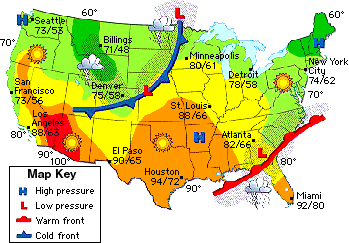
A cold front is approaching Minneapolis. What will happen to the air temperature?
a)
stay the same
b)
increase
c)
decrease
127.
A low pressure system is located over Georgia. What type of weather will they have?
a)
clear, sunny skies
b)
cloudy and rainy
128.
A high pressure system is located north of New York City. What type of weather will be experienced there?
a)
clear, sunny skies
b)
cloudy and rainy
129.
a)
Warm Front
b)
High Air Pressure
c)
Cold Front
d)
High Temperatures
130.
a)
Low Clouds
b)
Low Temperatures
c)
Light Wind
d)
Low Air Pressure
131.
a)
High Air Pressure
b)
High Temperatures
c)
Heavy Rain
d)
Hail
132.
a)
High Pressure
b)
Warm Front
c)
Cold Front
d)
Mountains
133.
Which city is experiencing thunderstorms?
a)
Denver
b)
New York 
c)
Miami 
d)
Boise
134.
Which city is currently experiencing a snow storm?
a)
Seattle
b)
Los Angeles
c)
Chicago
d)
New York
135.
Which city has the highest the highest temperature?
a)
Dallas
b)
Chicago
c)
Los Angeles
d)
Miami
136.
Which city has the lowest temperature on the map?
a)
Minneapolis
b)
Seattle
c)
New York
d)
Denver
137.
Which city is closest to a high pressure system?
a)
New York
b)
Miami
c)
Minneapolis
d)
Boise
138.
Which city is close to a warm front?
a)
Chicago
b)
New York
c)
Boise
d)
Denver
139.
Choose the best forecast for New York on Saturday. 
a)
sunny skies
b)
warmer temperatures
c)
snow
d)
sleet
140.
Choose the best forecast for Los Angeles on Saturday.
a)
cooler temperatures
b)
warmer temperatures 
c)
low pressure
d)
snow
141.
Choose the best forecast for Dallas on Saturday.
a)
thunderstorms
b)
snow
c)
warmer temperatures
d)
clear skies
142.

T/F: Air in contact with the tropical sea or land receives a lot of energy by radiation and conduction.

a)

Fals

b)

True

143.

As air in the atmosphere moves, Earth rotates, dragging the air along with it and changing its direction This is called

a)

the jet stream

b)

the Coriolis effect

c)

local winds

d)

prevailing winds

144.

T/F Jet streams are narrow bands of high-altitude wind that occur in predictable patterns, but vary over time.

a)

True

b)

False

145.
Warm air near the Earth’s surface rises and then cools and drops, this creates a _________________ in the atmosphere.
a)
run-off
b)
Greenhouse Effect
c)
convection current
d)
water cylce
146.
Where does the initial source of energy come from that creates winds?
a)
the moon
b)
the sun
c)
the Earth's surface
d)
the rotation of the Earth