
 Worksheets
Science Unit 1
Total questions: 148
Worksheet time: 1hrs 14mins
What does the Big Bang Theory propose about the early state of all matter and energy in the universe?
Spread thin across vast empty space
Compressed into an incredibly small dense point
Flowing in rings around early galaxies
Trapped inside giant early black holes
About how long ago did the Big Bang occur?
9.8 billion years ago
13.8 billion years ago
20.1 billion years ago
4.6 billion years ago
As the universe expanded and cooled after the Big Bang, what formed first that led to atoms and elements?
Massive stars and galaxies
Subatomic particles began to form
Molecules of water condensed
Large planets and moons appeared
Which statement best describes the current behavior of the universe?
The universe is contracting overall
The universe is expanding overall
The universe is static and unchanging
The universe rotates around one center
According to observations, what is the primary composition of matter found in stars and interstellar gases?
Mostly nitrogen with traces of neon
Equal parts hydrogen, helium, and silicon
Three quarters hydrogen, one quarter helium
Mostly carbon and oxygen

Which evidence supports that distant galaxies are moving away from us?
Blue shift in starlight indicates approach
Red shift in light due to expansion
Increased brightness from closer distance
Constant color showing no motion
What does cosmic microwave background radiation represent?
Leftover radiation from the Big Bang
Heat from nearby forming stars
Signals emitted by modern galaxies
Light scattered by interstellar dust
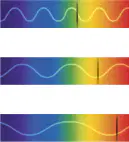
Which reasoning best connects redshift to an expanding universe?
Compressed waves decrease frequency
Stretched light waves increase wavelength
Constant wavelengths show fixed distances
Shorter wavelengths mean galaxies slow down
Which pair of elements would you expect to have distinct emission lines at different wavelengths in stellar spectra?
Hydrogen and helium lines are identical
Carbon and oxygen lines differ
Nitrogen and silicon lines match exactly
All elements share the same lines
Which conclusion aligns with the Big Bang Theory and observed composition of the universe?
Expansion stopped shortly after the first billion years
Early universe produced mostly heavy metals
Initial elements formed were mainly hydrogen and helium
Galaxies formed before any subatomic particles
Which layer is described as the visible surface of the Sun?
Chromosphere layer above photosphere
Photosphere the visible surface
Corona the outer atmosphere
Transition region separating layers
In which Sun layer are thermonuclear reactions generating energy?
Convective zone moving plasma
Core where energy is generated
Corona extending into space
Radiative zone diffusing energy
What process mainly carries the Sun’s energy through empty space to Earth?
Conduction through solid matter
Convection within fluids
Radiation as electromagnetic waves
Evaporation of atmospheric water
According to the spectrum diagram, which has higher energy: ultraviolet or infrared?
Both have equal energy levels
Infrared on longer wavelength side
Ultraviolet on higher frequency side
Microwaves between both bands
Which statement best describes the convective zone in the Sun?
Energy diffuses slowly through plasma
Thin layer separates cooler region
Rapid heating creates gas currents
Outer atmosphere extends into space
Which region separates the relatively cool chromosphere from the hotter corona?
Transition region thin irregular layer
Radiative zone near the core
Photosphere visible bright surface
Convective zone upper interior
Which band lies within the visible spectrum between blue and red?
X‑rays just beyond ultraviolet
Ultraviolet shorter than violet
Green located between blue and yellow
Microwaves longer than infrared
As wavelength increases along the spectrum arrow, what happens to frequency?
Frequency fluctuates unpredictably
Frequency stays approximately constant
Frequency increases accordingly
Frequency decreases accordingly
What happens to a heated fluid’s density in convection?
Density increases so fluid sinks
Density decreases so fluid sinks
Density increases so fluid rises
Density decreases so fluid rises
Which is the Sun’s outer atmosphere extending millions of kilometers?
Chromosphere lower solar atmosphere
Corona outer atmosphere extending far
Photosphere visible bright layer
Core central energy generation zone
Which statement best describes radiation in space contexts?
Energy transfer by direct contact of matter
Emission of energy as waves or moving particles
Movement of heat only through solid materials
Exchange of energy requiring a physical medium
What event can temporarily increase the Sun’s radiation output?
Seasonal axial tilt variations
Comet impacts into the Sun
Tidal forces from the Moon
Sudden solar flares eruptions
What cycle causes periodic changes in the Sun’s magnetic field and radiation output?
5-year aurora cycle
100-year eclipse cycle
27-day rotation cycle
11-year sunspot cycle
Why can changes in the Sun’s radiation output impact Earth’s climate and space weather?
Radiation variations alter atmospheric energy balance
Clouds block all incoming solar radiation
Earth’s core directly absorbs solar particles
The Moon amplifies solar energy to Earth
Which process powers stars like the Sun by forming helium from hydrogen?
Radioactive decay reactions
Chemical combustion of gases
Nuclear fusion combining light nuclei
Gravitational collapse alone
How does a star’s mass generally affect its life cycle?
Low-mass stars explode as frequent supernovae
All stars follow identical lifespans and endings
High-mass stars burn cooler and live longer
High-mass stars burn hotter and die sooner
Which sequence reflects the life path of a Sun-like star?
Protostar to red giant to white dwarf
Red supergiant to supernova to black hole
Planetary nebula to low-mass star to protostar
Neutron star to protostar to red dwarf

In massive stars, which end-of-life outcomes are shown in the diagram?
Gradual cooling into red dwarf
Supernova leading to neutron star or black hole
White dwarf without collapse
Planetary nebula formation only
What is nucleosynthesis in stars?
Breaking heavy elements into lighter ones only
Chemical bonding of atoms without fusion
Cooling of gases to form star dust
Creation of new elements via nuclear reactions
Why do stars shine according to the description of nucleosynthesis?
Light reflected from nearby planets
Electrical sparks in the atmosphere
Friction between orbiting asteroids
Energy released by fusion reactions
Which star color indicates the highest surface temperature?
Orange light stars appear hottest
Yellow light stars appear hottest
Red light stars appear hottest
Blue light stars appear hottest
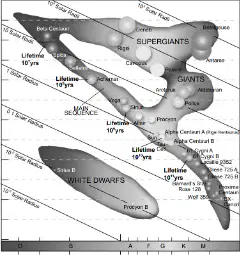
On an H–R diagram, what does the x-axis primarily represent for stars?
Surface temperature and color
Distance and parallax
Luminosity and brightness
Mass and composition
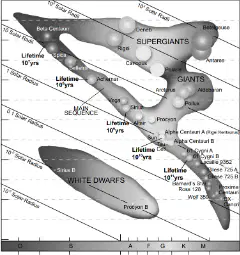
Which statement best describes main sequence stars on the H–R diagram?
They lie entirely off the plotted curve
They follow a temperature–luminosity trend
They cluster only at low luminosity
They show no relation to temperature
Why are many hot main sequence stars more luminous than cooler ones?
Hotter stars have less mass than cooler ones
Hotter stars emit more energy overall
Hotter stars are always closer to Earth
Hotter stars reflect more sunlight
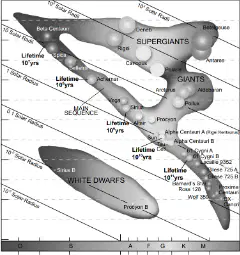
Which pair correctly contrasts red giants and white dwarfs?
Giants cool but bright; dwarfs hot but dim
Giants hot but dim; dwarfs cool but bright
Giants small and dense; dwarfs huge and diffuse
Giants blue and short-lived; dwarfs red and massive
What mainly makes red giants appear bright despite cooler temperatures?
They rotate faster than other stars
They burn heavier elements constantly
Their strong magnetic fields glow
Their huge radii increase total light
Which statement about white dwarfs is accurate?
They are hot but have tiny radii
They are cool with enormous radii
They are cold and highly luminous
They are blue giants on the main sequence
Why do blue stars tend to have shorter lifespans?
They use fuel quickly due to high mass
They cool rapidly and freeze solid
They lose mass by turning into planets
They receive less energy from nearby stars
A star moves from blue to red over time on the H–R diagram. What does this change primarily indicate?
Its chemical elements disappear
Its magnetic field strengthens
Its distance from Earth increases
Its surface temperature decreases
Which reasoning best explains why many stars fall along the main sequence curve?
Hydrogen fusion rate links temperature and luminosity
Random placement produces a visible band
Gravitational lensing draws stars onto a line
Interstellar dust pushes stars into clusters
Which observation supports that galaxies are moving away from Earth?
Shorter wavelengths in galaxy spectra
Longer wavelengths in galaxy spectra
Constant wavelengths in galaxy spectra
Random shifts in galaxy spectra
What does the Cosmic Microwave Background indicate about the early universe?
It was sparse and fragmented
It was cool and irregular
It was hot, dense, and uniform
It was always cold and empty
According to Hubble’s Law, what trend is observed among distant galaxies?
Closer galaxies move faster away
Farther galaxies move slower away
All galaxies move at same speed
Farther galaxies move faster away
Which tool is used to measure redshift in starlight?
Barometers for space pressure
Seismometers for starquakes
Spectrometers for spectra
Thermometers for stellar heat
Why does fusion inside stars release energy up to iron?
Iron splits and releases energy
Iron atoms emit heat spontaneously
Fusion to iron releases stored energy
Fusion to iron requires energy input
Why does fusion stop at iron in high-mass stars?
Iron fusion produces too much heat
Iron fusion absorbs energy instead
Iron fusion speeds core rotation
Iron fusion increases star brightness
What event spreads elements heavier than iron into space?
Planetary nebula expansion
White dwarf cooling
Supernova explosions
Red giant pulsations
How do spectral absorption lines help identify elements in stars?
They show unique dark wavelength gaps
They show uniform bright color bands
They show random flicker patterns
They show continuous smooth spectra
If a star’s spectral lines shift toward red, what does that indicate?
The star is moving closer
The star is moving away
The star is rotating faster
The star has cooled recently
What is the key difference between absorption and emission spectra?
Absorption shows bright lines; emission dark
Absorption shows dark lines; emission bright
Both show only continuous spectra
Both show identical line patterns
Which non-visible electromagnetic wave can reveal stars hidden behind dust?
Microwave waves behind dust clouds
Ultraviolet waves behind dust clouds
Infrared waves behind dust clouds
Radio waves behind dust clouds
What do X-rays often help astronomers detect in space?
Planetary atmospheres
Solar wind directions
Black holes or explosions
Comet ice composition
Why do some observations require space telescopes?
To avoid atmospheric blocking
To avoid telescope mirrors
To avoid star light colors
To avoid lunar phases
On the H–R diagram, what does a star’s blue color indicate about surface temperature?
Blue means cool temperature
Blue means changing temperature
Blue means hot temperature
Blue means medium temperature
Along the main sequence, how do hotter stars compare in luminosity?
Hotter stars are invisible
Hotter stars are more luminous
Hotter stars are less luminous
Hotter stars have same luminosity
Which description fits red giants compared to white dwarfs?
Hot but dim, huge radius
Hot but bright, tiny radius
Cool but bright, huge radius
Cool but dim, tiny radius
Why do blue stars have shorter lifespans?
They have low temperature
They have small mass
They burn fuel slowly
They burn fuel quickly
In fusion experiments, what does a value above breakeven on an energy graph mean?
No energy measured
Output equals the input
Input higher than output
Output higher than input
What process powers stars and is attempted in Earth laboratories?
Combustion of gases
Fission of heavy elements
Fusion of light elements
Radioactive decay
Which statement best describes atmospheric transparency across wavelengths?
Visible passes easily; infrared absorbed
Infrared passes easily; visible absorbed
UV passes easily; visible absorbed
All wavelengths pass equally
What does the trend in Figure 1 suggest about the structure of the universe?
Galaxies farther away are older than nearby galaxies
The universe is static and unchanging
Galaxies are orbiting around a central point
The universe is expanding outward in all directions
Which observation most directly supports the idea that galaxies are moving away from Earth?
The mass of each galaxy
Redshifted light from distant galaxies
High surface temperatures of galaxies
Blue-shifted starlight
The Cosmic Microwave Background Radiation provides evidence for the Big Bang because:
It forms patterns around galaxies
It shows that galaxies are accelerating
It changes with the seasons
It’s uniform in all directions and matches models of an early hot universe
Short Constructed Response: Explain how the redshift of galaxies is used as evidence for the expansion of the universe. Use the terms “wavelength” and “motion” in your response.
Redshift means color changes as stars rotate around a center
Redshift means wavelengths shorten as galaxies move toward us
Redshift means wavelengths lengthen as galaxies move away from us
Redshift means energy increases as galaxies slow down
According to Hubble’s Law described, how does the speed of a galaxy’s recession relate to its distance?
Speed decreases as distance increases
Speed increases as distance increases
Speed stays constant regardless of distance
Speed varies randomly with distance
What does the nearly uniform temperature of the Cosmic Microwave Background imply?
The universe stopped expanding billions of years ago
Stars emit microwaves that heat surrounding space
Radiation is left over from an early hot, dense universe
Space is colder near galaxies than between them
Which statement best describes the pattern astronomers observed for distant galaxies?
Galaxies spin faster the closer they are to Earth
Farther galaxies appear to move away faster than nearer ones
Nearer galaxies move away faster than distant ones
All galaxies move at identical speeds in any direction
In the graph "Galaxy Distance vs. Recessional Velocity," what does the slope of the line represent?
Temperature of interstellar space
Average mass of galaxies
Rate of expansion of the universe
Age of the oldest galaxies
Why is the Cosmic Microwave Background detected from all parts of the sky?
It is produced by black holes in our galaxy
It comes from Earth’s atmosphere
It is a uniform glow from the early universe
It is emitted by nearby stars only
Which term describes the observed increase in wavelength when a light source moves away from an observer?
Parallax
Refraction
Redshift
Blue shift
The nearly uniform glow of leftover radiation from the early universe is known as the __________________________.
interstellar dust glow
cosmic background radiation
solar wind emission
planetary nebula light
In a red-shifted galaxy spectrum, the light waves are stretched toward the __________________ end of the spectrum.
long-wavelength red
ultraviolet violet
short-wavelength blue
midrange green
Fusion reactions in stars produce energy by combining lighter elements into heavier ones, releasing _________________ in the process.
electrical current
chemical energy
gravitational waves
radiation and heat
Once a high-mass star forms iron in its core, the fusion process stops producing energy and instead __________________ energy, leading to a collapse and supernova.
absorbs rather than releases
stores excess
converts kinetic
doubles available
Which of the following elements is most likely to be formed during a supernova explosion?
Helium
Carbon
Gold
Hydrogen
What is the final stage in the life cycle of a medium-mass star like the Sun?
Supernova
Red supergiant
Black hole
White dwarf
Based on the plotted curve of relative abundance by atomic number, which trend is most apparent?
Elements decline with bumps
Elements stay constant
Elements rise steadily
Elements peak at iron
Why does fusion up to iron release energy but fusion of iron does not?
Iron has fewer protons
Gravity stops working
Binding energy per nucleon
Electrons become unstable
After a supernova of a high-mass star, which remnant can form?
Neutron star remnant
White dwarf remnant
Brown dwarf remnant
Cometary remnant
What observation indicates the universe is expanding?
Galactic red shifts
Solar flares
Planetary eclipses
Lunar phases
Which of the following best explains why we find uranium and lead on Earth?
They formed inside Earth’s core due to heat and pressure
They formed in the solar wind and were deposited on the planet
They were synthesized in supernovae and recycled into new planetary systems
They are condensed from hydrogen gas during the Sun’s formation
A star's light is split into a spectrum showing dark lines at specific wavelengths. What do these lines tell scientists?
The temperature of nearby galaxies
The star’s brightness over time
The elements present in the star’s outer layers
The age of the star
A star’s absorption lines appear shifted slightly toward the blue end of the spectrum. What can be concluded?
The star is moving away from Earth
The star is stationary
The star is losing mass rapidly
The star is approaching Earth
Two stars have the same surface temperature, but one is significantly more luminous. What could explain this difference?
The more luminous star is rotating faster
The more luminous star is younger
The more luminous star is larger in radius
The more luminous star is smaller
A star is classified as a white dwarf. Based on its position on the H–R Diagram, what are its likely characteristics?
Hot and dim
Cool and dim
Hot and bright
Cool and large
On an H–R Diagram, main sequence stars show a trend where temperature and __________ increase together.
lifetime
rotation
luminosity
distance
The giant and supergiant stars are found in the __________ region of the diagram due to their high luminosity and large size.
upper right
lower right
center band
lower left
Which of the following best explains how nuclear fusion powers the Sun?
Atoms of heavy elements are split apart, releasing heat
Hydrogen atoms combine to form helium, releasing energy
Protons are converted into neutrons without energy output
Radiation from the Sun's surface generates internal fusion
Why do astronomers use space-based telescopes to observe X-rays and gamma rays?
High-energy radiation only originates from the Moon
These wavelengths are easier to detect during the day
Earth's rotation makes these observations difficult
The atmosphere blocks most high-energy radiation
Which tool is most often used to identify the elements present in a distant star?
Electron microscope
Spectroscope
Seismometer
Radio antenna
In a fusion reaction, hydrogen nuclei combine to form ____________, releasing energy in the process.
helium nuclei
carbon atoms
oxygen molecules
neutron stars
The electromagnetic radiation produced by fusion travels through space as ______________.
gravity ripples
sound waves
ocean tides
electromagnetic waves
Which statement best explains why certain wavelengths must be observed from space rather than ground-based telescopes?
The atmosphere absorbs many high-energy wavelengths
Space telescopes have larger mirrors than ground ones
Cloud cover increases the brightness of stars
Mountains block long radio wavelengths
Which pair lists types of electromagnetic waves useful for studying non-visible parts of the universe?
Infrared and ultraviolet
AM radio and sonar
Microwaves and thunder
Visible light and sound
A student wants to determine the chemical composition of a star. Which method should they use?
Record seismic activity with a seismometer
Capture images with a radio antenna
Measure star brightness with a photometer
Analyze its spectrum with a spectroscope
Which observation would most likely require a space-based telescope?
Tracking cloud movement on Earth
Counting sunspots with binoculars
Detecting gamma rays from a supernova
Mapping city light pollution
Which sequence correctly describes energy production in stars like the Sun?
Conduction moves heat through solid metal
Combustion burns oxygen to release heat
Fusion combines hydrogen nuclei into helium
Fission splits heavy nuclei into smaller ones
Which reason best supports placing telescopes in orbit around Earth?
To reduce the need for electricity
To avoid nighttime temperatures
To eliminate atmospheric distortion and absorption
To shorten the distance to nearby stars
Which space-based technology is specifically designed to collect data about stars and galaxies by detecting light across many wavelengths?
Ground-based radio antenna arrays
Space telescopes with multiwavelength instruments
Deep-sea neutrino observatories
Weather satellites monitoring cloud patterns
What process powers the Sun and is responsible for the energy that ultimately reaches Earth?
Nuclear fission in the solar core
Nuclear fusion of hydrogen into helium
Chemical combustion of hydrogen gas
Radioactive decay of heavy elements
Which term best describes matter composed of charged particles found in stars and the solar wind?
Magma
Alloy
Plasma
Vapor
Which part of the electromagnetic spectrum is most useful for observing cooler objects like interstellar dust?
Microwaves used for cooking food
Visible light from human-eye wavelengths
Infrared radiation emitted by cool matter
Gamma rays with extremely high energy
A scientist uses spectroscopy to study a star. What information is most directly obtained from its spectrum?
Daily weather on the star’s surface
Precise age of the universe
Chemical elements present in the star
Exact mass of each planet
Which statement explains how nuclear fusion contributes to stellar evolution?
Fusion only occurs during star formation then ceases
Fusion splits heavy nuclei into lighter fragments
Fusion builds heavier nuclei from lighter ones over time
Fusion stops energy production as stars age
Why are space-based telescopes essential for observing ultraviolet light from distant galaxies?
Ultraviolet light cannot travel through vacuum
Earth’s atmosphere absorbs much ultraviolet light
Earth’s oceans absorb ultraviolet wavelengths completely
Earth’s core blocks ultraviolet radiation
Which pair represents two different types of evidence that can support a claim about galaxy formation?
Volcano ash samples and earthquake records
Ultraviolet spectra and infrared images
Surface ocean currents and wind speed data
Soil pH readings and plant growth charts
If a claim states that fusion research benefits life on Earth, which example best supports it?
Fusion makes metal alloys stronger for bridges
Fusion improves cloud seeding for rainfall
Fusion accelerates plant photosynthesis rates
Fusion enables cleaner, high-density energy sources
Which key term should be used to describe a technique that separates light into its component wavelengths to analyze composition?
Spectroscopy
Refraction
Photoelectricity
Diffusion
Which observation supports that the universe is expanding outward in all directions?
Planets orbit in perfect circles
Stars appear blue in most spectra
Galaxies show redshifted light consistently
Comets return on predictable schedules
What does redshifted light from distant galaxies indicate about their motion?
They are stationary in space
They are moving toward us
They are rotating faster
They are moving away from us
Which evidence demonstrates uniformity and remnants of early high-energy radiation in the universe?
Solar wind particle streams
Auroras near polar regions
Cosmic Microwave Background Radiation
Infrared emission from dust
A galaxy’s emitted light shifts toward the red end of the spectrum. What does this provide evidence for?
Increase in cosmic dust
Formation of planetary rings
Cooling of star surfaces
Expansion of the universe
In stellar fusion, combining hydrogen into helium primarily releases what?
Large amounts of energy
Heavy metal elements
Intense magnetic fields
Stable planetary systems
When a massive star’s core can no longer gain energy from iron fusion, what happens next?
The core expands and cools steadily
Fusion accelerates, stabilizing the core
Energy input is required, leading to core collapse
Radiation pressure overcomes gravity
Elements heavier than iron, such as gold, are mainly formed during which event?
Supernova explosions
Planetary nebulae ejection
Main-sequence burning
Black hole accretion
After the outer layers are shed, which compact stellar remnant can remain from a medium-mass star?
Brown dwarf
Neutron star
Red giant
White dwarf
Hubble’s Law describes a relationship between which two properties of galaxies?
Brightness and chemical composition
Mass and internal temperature
Age and rotational speed
Distance and recessional velocity
Why does light from receding galaxies stretch to longer wavelengths?
Gravitational lensing by clusters
Doppler effect due to motion away
Refraction through interstellar gas
Absorption by cosmic dust lanes
Which feature in a star’s spectrum helps identify elements present in its outer layers?
Continuous color bands across all wavelengths
Unique absorption lines at specific wavelengths
Random bright spots scattered across the spectrum
Uniform dark background with no variation
A shift toward the blue end of a star’s spectrum indicates what about the star’s motion?
It is moving toward the observer
It is moving away from the observer
It has increased surface temperature
It is rotating faster around its axis
What does the Doppler effect describe in astronomy?
How temperature determines a star’s color
How stars generate energy in their cores
How motion changes the observed wavelength of light
How gravity bends the path of starlight
Why are spectral lines useful for astronomers studying stars?
They reveal the star’s total mass directly
They provide unique fingerprints for element identification
They measure the star’s age with high precision
They show the star’s exact distance without error
Astronomers observe helium and iron absorption lines in a star’s spectrum. What conclusion can they draw?
The star is rotating unusually slowly
The star is cooling rapidly
Helium and iron exist in the star’s atmosphere
The star is a white dwarf
If spectral lines are redshifted, what does this indicate about the star’s motion relative to Earth?
It is rotating, wavelengths alternating
It is moving away from Earth, wavelengths stretched
It is stationary, wavelengths unchanged
It is moving toward Earth, wavelengths compressed
For main sequence stars, how does luminosity change as temperature increases from left to right on the H–R Diagram?
Luminosity decreases steadily top to bottom
Luminosity remains constant across all types
Luminosity fluctuates without a clear trend
Luminosity increases from bottom to top
Where are white dwarfs located on the H–R Diagram and what are their typical properties?
Upper right; cool and very bright
Lower left; hot and very dim
Upper left; hot and very bright
Center region; moderate and stable
If two stars have the same temperature, which star is more luminous?
The star with faster rotation
The star with smaller radius
The star with larger radius
The star with stronger magnetic field
Elements heavier than iron are most likely formed through which type of events?
Slow cooling of planetary atmospheres
Steady hydrogen fusion in stellar cores
Collisions between asteroids in space
Rare high-energy events like supernovae
Which process powers stars by combining hydrogen atoms into helium, releasing energy?
Gravitational compression only
Hydrogen fusion into helium
Nuclear fission in star cores
Chemical combustion of gases
Which part of Earth most strongly blocks X-rays and gamma rays from reaching ground-based telescopes?
The oceanic crust layer
Earth’s atmosphere layer
Mountain ranges barrier
The outer core layer
What instrument separates incoming light into spectra to identify elements in stars?
Spectroscope for light spectra
Seismograph for ground waves
Microscope for tiny objects
Barometer for air pressure
In stellar fusion, which element is primarily produced from hydrogen at typical core conditions?
Carbon from triple reactions
Helium from proton fusion
Iron from end-stage burning
Oxygen from partial fusion
Energy from stellar fusion reaches Earth mainly as which type of radiation?
Electromagnetic waves spectrum
Mechanical sound vibrations
Seismic crustal waves
Neutron particle fluxes
Which wavelength can reveal heat from dust clouds that block visible light, helping locate star-forming regions?
Radio waves from galaxies
Infrared waves from dust
Ultraviolet waves from stars
Microwaves from cosmic background
Observations of high-energy areas around black holes and exploding stars are best made using which wavelengths?
X-rays from energetic zones
Infrared light from dust
Radio waves from pulsars
Visible light from photospheres
Why do scientists place telescopes in space rather than only on the ground?
To avoid clouds only
To escape atmospheric blocking
To reduce instrument cost
To stay closer to stars
Which statement best explains a benefit of the James Webb or Chandra X-ray Observatory?
They forecast local weather
They map tectonic plate motion
They collect clearer space data sets
They measure ocean currents precisely
On an H–R Diagram, where are giants and supergiants typically located due to low temperatures and high luminosities?
Upper right region area
Center main sequence band
Lower left region area
Upper left region area
Which telescope is highlighted for using infrared wavelengths to study early galaxies?
Chandra X-ray Observatory for hot gas
James Webb Space Telescope using infrared
Spitzer Telescope for radio emissions
Hubble Space Telescope for visible light
Why is a space-based infrared telescope necessary for observing early galaxies?
Infrared cannot pass through lenses
Atmosphere absorbs much infrared light
Earth's rotation blurs all observations
Galaxies only emit radio signals
What stellar process powers stars and produces energy that reaches Earth?
Nuclear fusion of hydrogen
Gravitational collapse of dust
Chemical burning of helium
Magnetic reconnection in cores
During nuclear fusion in stars, hydrogen atoms fuse into which element?
Helium created by fusion
Oxygen produced by burning
Carbon formed in cores
Nitrogen from cosmic rays
Which statement best describes how spectroscopy helps scientists?
It analyzes light to reveal composition
It measures star masses directly
It maps gravity fields precisely
It photographs planets in color
What role does electromagnetic radiation play in the energy from stars?
It stores energy inside cores
It cools stars by conduction
It carries energy from fusion
It blocks energy in atmospheres
Which reason explains why the James Webb Space Telescope studies through dust clouds?
Infrared passes through dust better
Visible light reflects off dust
Radio waves scatter heavily
X-rays absorb in dust strongly
Which consequence of nuclear fusion helps sustain life on Earth?
It slows Earth's orbital speed
It increases atmospheric oxygen
It emits energy that warms Earth
It reduces Earth's magnetic field
Combining spectroscopy with fusion knowledge allows scientists to do what more effectively?
Control solar flares on the Sun
Measure Earth's interior heat flow
Explain star structure and processes
Predict asteroid impacts precisely
Which statement best summarizes the value of space-based technologies and discoveries?
They replace all ground telescopes
They provide deeper insight into origins
They eliminate atmospheric weather
They make stars brighter for viewing

