
 Worksheets
8th Grade Science Midterm Exam STUDY GUIDE (2025)
Total questions: 150
Worksheet time: 1hrs 15mins
Chemical Weathering chemically changes a rocks....
Composition
Density
Size and Shape
Color


Caves being formed by acid rain dissolving underground limestone are examples of what?
Chemical Weathering
Erosion
Deposition
Mechanical Weathering


Would plants growing throughout the ground cause mechanical or chemical weathering?
Mechanical Weathering
Chemical Weathering
Sandy beaches are built up through the process of...
Deposition
Convection
Weathering
Destructive forces
When water freezes in cracks in rocks, it expands causing the rock to break. This is known as...
ice breaking
ice wedging
ice melting
ice cutting
The deposition of sediment at the mouth of a river is a constructive force known as a...
Delta
Shore
Beach
Pond

What is it called when weathered rock is carried away?
weathering
erosion
deposition
breaking

Which of these examples is deposition?
wind blowing sand
sand that was dropped on the beach by waves
pebbles falling downhill due to gravity
a tree root breaking a rock
Water carrying sediment down a hill is an example of...
weathering
erosion
deposition

The process in which sediment settles out (drops to the bottom) of the water or wind that is carrying it
Weathering
Erosion
Sedimentation
Deposition

Which erodes faster? Soft rock or Hard rock?
hard rock
medium rock
soft rock
none of the above
Rocks could be broken down into gravel, sand, and find silt by which of the following?
Wind
Water
Ice
Plants

the grinding away of rock by other rock particles carried in water, ice, or wind
sediment
deposition
abrasion
constructive processes

the process in which sediment is laid down, dropped in new locations
weathering
erosion
deposition
destructive processes
Which one of the examples below is physical weathering?
lichens growing on rock
acid rain wearing away limestone
oxidation (rusting) of a flag pole
frost wedging splitting a rock apart
Which of these is an example of erosion?
light shining onto a mountain
wind blowing away sediment
rain breaking down rock
all options are correct
Rain WASHING AWAY soil from a hillside
Weathering
Erosion
Deposition
Sinkholes and caverns are created by what process?
chemical weathering
mechanical weathering
volcanism
sublimation
Where would a mudslide most likely occur?
on a hill with lots of trees
in a valley (down low) with lots of vegetiation
on a hill with very little trees and vegetation
in a desert with lots of hills
A pile of rocks at the base of a cliff resulted from erosion by...
ice
running water
wind
gravity
The Appalachian Mountains are much lower and rounder today than they were millions of years ago because of…
plate tectonics
volcanism
isostasy
weathering & erosion
A river moving a pebble downstream is an example of erosion.
True
False
Made up of the crust and upper part of the mantle
Lithosphere
Mesosphere
Crust
Outermost layer of Earth that is solid
Lithosphere
Mesosphere
Crust
Located between the core and the crust
Lithosphere
Core
Mantle
Weak layer of the mantle that flows slowly, “plastic like”
Crust
Mantle
Asthenosphere
Extends from below the mantle to the center of Earth
Crust
Mantle
Core
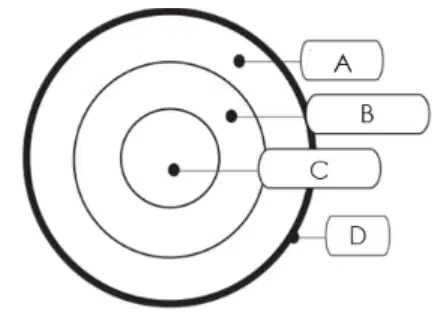
Use the diagram to identify what the name of layer [C] is.
Crust
Mantle
Core
Use the diagram to identify what the name of layer [D] is.
Crust
Mantle
Core
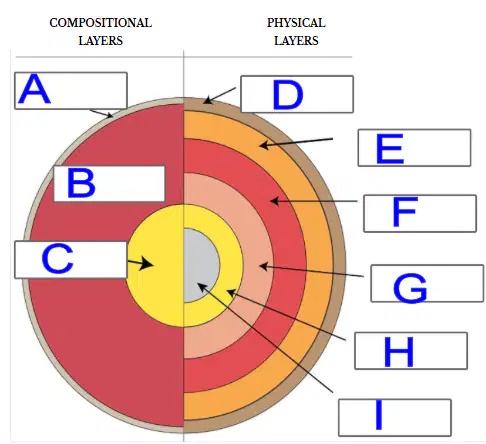
Use the diagram to identify what the name of layer [B] is.
Crust
Mantle
Core
Use the diagram to identify what the name of layer [I] is.
Inner Core
Outer Core
Lithosphere
P waves travel faster than S waves
True
False
Both P and S waves travel through solids.
True
False
Only P waves travel through the Mantle
True
False
Only P waves travel through the core.
True
False
Only P waves travel through liquids.
True
False
Which waves will reach a seismic station first?
P waves
S waves
Both reach at the same time
These waves can travel through the core...
P waves only
S waves only
P and S waves
Neither P nor S waves
These waves can travel through solid rock...
P waves only
S waves only
P and S waves
Neither P nor S waves

In the picture, which arrow is pointing to the layer that is a liquid?
1
2
3
4
Temperature ____ as waves travel deeper into the earth.
Hint: Think about what happens with temperature the further inward to Earth you go.
Density ____ as waves travel deeper into the earth.
Hint: Think about what happens with density the further inward to Earth you go.

Which type of wave is a longitudinal/compression wave?
p wave
s wave
surface wave
ryleigh wave
Which type of wave is a transverse wave?
p wave
s wave
surface wave
ryleigh wave
Which portion of the Earth can S waves NOT travel through?
Crust
Mantle
Core
What is seismology?
The study of seismic waves that exist in the exosphere.
The study of waves within the ocean.
The study of seismic waves (S & P waves) that are created by disturbances within Earth
The study of only volcanic eruptions in the ocean. These disturbances create waves that travel through Earth's atmosphere
S waves are waves that travel through ______________
solid rock only
liquid only
solid and liquid
P waves are waves that travel through ______________
solid rock only
liquid only
solid and liquid
S waves are __________ P waves
faster than
slower than
the same speed as
Certain seismic waves will not pass through liquids. The first place these waves do not pass through is the Earth's _____
outer core
inner core
crust
mantle
Tectonic plates move _________, a few _________ each year
quickly; yards (yd)
quickly; feet (ft)
slowly; miles (mi)
slowly; centimeters (cm)
Which TWO phenomenon's cause seismic waves?
hurricanes
earthquakes
volcanoes
tsunamis
Based on the law of superposition, where would the oldest rocks be found.
at the bottom
at the top
second from the bottom
second from the top
Which technique can be used to determine the numerical age of a rock? (apply a number)
Radiometric dating
Relative dating

Which letter matches with the OLDEST layer of rock?
W
X
Y
Z
What kind of dating is used to compare the age of a rock to those around it?
Radiometric
Relative
The age of a rock compared to the ages of other rocks.


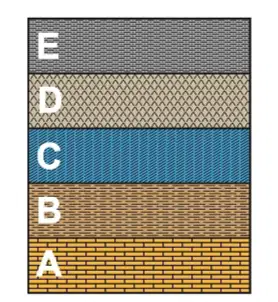
Which of the following correctly lists the layers of rock in order from YOUNGEST to OLDEST?

C = oldest
B = youngest
C = oldest
E = youngest
D = oldest
E = youngest
A = oldest
B = youngest


Imagine you are a geologist studying rock layers in a canyon.
You see a layer of sandstone on each side of the canyon, but the middle part has been eroded away by a river, creating two sides.
Based on the principle of lateral continuity, what can you conclude about the layers?
they layers are about the same age because they were once joined together
the layers must contain at least 20 different types of rock

Layer S
Layer E
Layer A

Which rock layer is oldest from Site 1?
G
B
A
E

Several layers of sedimentary rock are illustrated. They are in the same order as when they first formed. Which layer formed first?
Rock Layer W
Rock Layer X
Rock Layer Y
Rock Layer Z
The statement that the oldest layer will be at the bottom in an undisturbed sequence of rock layers is called the Principle of ....

Which principle states that sediments spread out flat, in all directions, until they either thin out or run into a barrier.
Principle of superposition
Principle of original horizontality
Principle of lateral continuity

The idea that sedimentary rocks are deposited in horizontal layers unless disturbed by forces within the Earth can best be explained by which principle?
Principle of horizontality
Principle of Superposition
Principle of original lateral continuity

What scientific law tells us that if one rock layer contains pieces or fragments of another rock layer, then the fragments will be older than the rock layer that surrounds it.
Cross-cutting Law
Principle of Original Horizontality
Principle of Inclusions
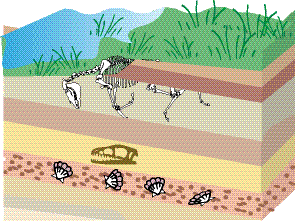

Applying what you know about the Law of Superposition:
As you travel deeper DOWN into the Grand Canyon, the rocks get _____.
younger
older
prettier
nicer

Which of the fossils is the oldest?
Dinosaur
Bird
Shell
Ammonite

Which layer is OLDER? Layer M or Intrusion P?
Layer M
Intrusion P

Which layer is OLDER? Layer E or Fault H?
Layer E
Fault H

How do we know that Intrusion A is YOUNGER THAN Layer C?
Law of Superposition
Law of Cross Cutting Relationships
Law of Exclusions
Law of Unconformities


Which Layer is the youngest?
Layer X
Layer Z
Layer W
Layer Y

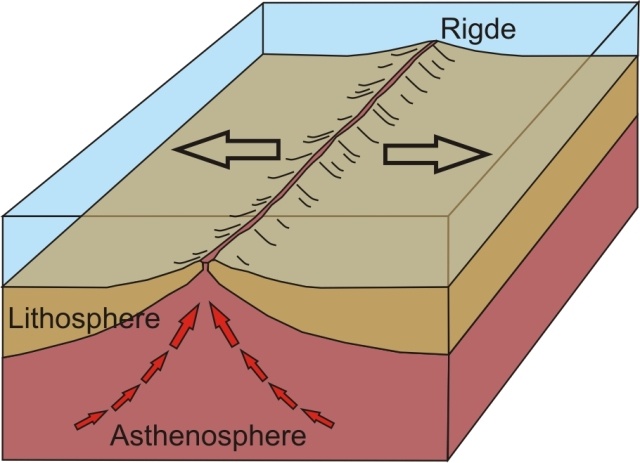
boundary between two tectonic plates that are moving away from each other
convergent boundary
divergent boundary
transform boundary
Ring of Fire

a tectonic plate boundary where two plates collide, come together, or crash into each other
divergent boundary
transform boundary
convergent boundary
continental drift (Pangea)
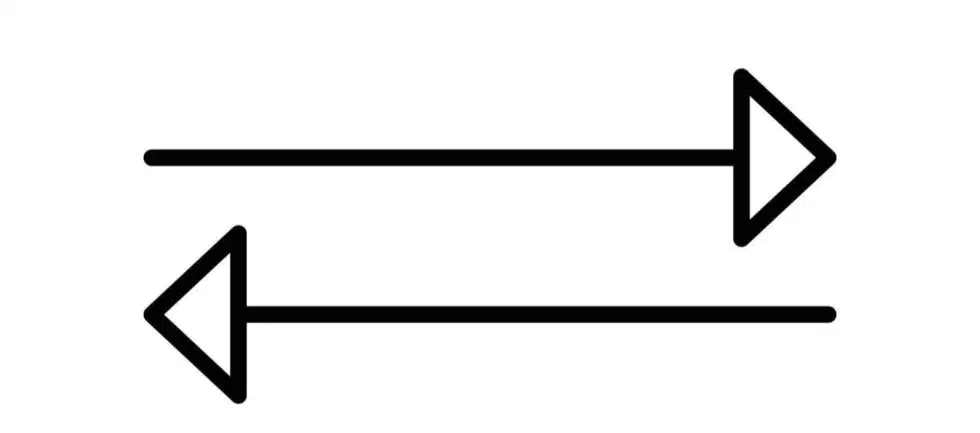
a plate boundary where two plates move past each other in opposite directions
transform boundary
seafloor spreading
convergent boundary
divergent boundary

In an ocean divergent boundary, the formation of new ocean crust as a result of magma pushing upward and outward from Earth's mantle to the surface is called....
seafloor spreading
Ring of Fire
continental drift (Pangea)
geological event

Alfred Wegner presented a hypothesis that the continents once formed a single landmass, broke up, and drifted to their present locations. This theory was called...
Ring of Fire
geological event
continental drift (Pangea)
plate tectonics
section of the lithosphere that is broken up into different sections and slowly moves over the asthenosphere.
subduction
fault
plate tectonics
boundary
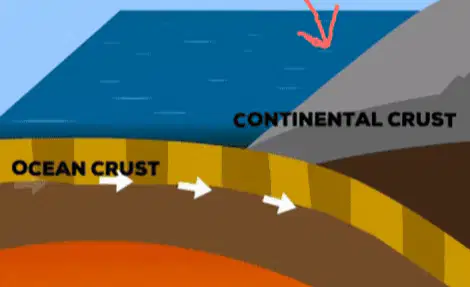
the process by which oceanic crust sinks beneath a deep-ocean trench and back into the mantle at a convergent plate boundary.
subduction
fault
plate tectonics
boundary
the place where two tectonic plates meet
fault
African plate
boundary
Eurasian plates
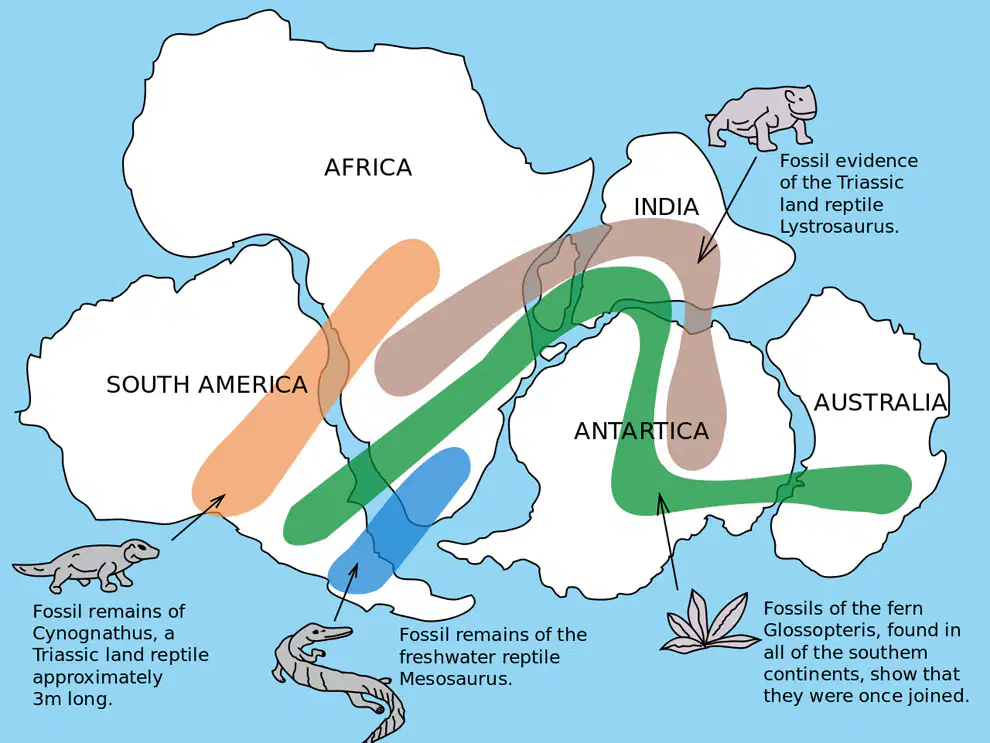
What did Alfred Wegener use to support his theory?
fossil records
Italian dressing
meteors
photosynthesis
Which boundary CANNOT create volcanoes?
subduction zones
transform boundaries
convergent boundaries
divergent boundaries
Type of Boundary where plates collide
Divergent
Convergent
Transform

This type of convergent boundary creates mountains
Continental-Continental
Continental-Oceanic
Oceanic-Oceanic

This type of Boundary results when plates separate
Divergent
Convergent
Transform

This types of boundary results when plates slide past each other
Transform
Divergent
Convergent


Which of the following is the name of the ancient supercontinent formed 280 Million Years ago.

Mid Ocean ridges are formed by ___________________________ plate boundaries
Convergent
Divergent
Transform


The area around the pacific plate where boundaries form is called...
death ring
fire zone
ring of fire
zone of fire
A subduction zone is formed...
Which layer of the Earth is the thinnest?
Crust
Mantle
Outer core
Inner core

A diagram of Earth's layers is provided. Which letter in the diagram identifies the layer scientists believe to be in a liquid state?
Location A
Location B
Location C
Location D
Oceans and other bodies of water are found on which layer of Earth?
Outer core
Crust
Mantle
Inner core
Which of the following best describes Earth's asthenosphere?
Liquid rock that can reach the surface
Solid rock that is broken into plates
Dense molten rock that moves the crust
Metal rock at the center of the Earth
Which layer of Earth is broken up into giant moving plates?
Asthnosphere
Lithosphere
Inner core
Outer core

Which Layer of the Earth is the most dense, and is also solid?
Inner Core
Outer Core
Mantle
Crust
Which Layer of the Earth has convection currents?
Inner Core
Outer Core
Mantle
Crust
Which Layer of the Earth is made of molten (melted) Nickel and Iron?
Inner Core
Outer Core
Mantle
Crust
Which layer of the Earth is the largest layer?
Inner Core
Outer Core
Mantle
Crust

What are the two types of Earth's Crust?
Oceanic and Continental
water and land
ocean and dessert
crust and mantle
The Lithosphere is made up of the ___________.
Crust and Upper Mantle
Inner and Outer Cores
Outer Core and Lower Mantle
Lower and Middle Mantle

Density ______________________ as you go deeper into the Earth.
increases
decreases
goes up or down depending on the layer
stays the same
Pressure ______________________ as you go deeper into the Earth.
increases
decreases
goes up or down depending on the layer
stays the same
Oceanic crust is more dense than continental crust?
true
false
This layer of the Earth has been described as having characteristics like plastic.
A. Lithosphere
B. Asthenosphere
C. Mesosphere
D. Inner Core
What is the only layer of the Earth that is completely liquid metal?
A. Crust
B. Mantle
C. Inner Core
D. Outer Core

Which layer is # 20.
A: Mesosphere
B: Lithosphere
C: Asthenosphere
As we travel deeper into the Earth which of the following is true:
A. Pressure goes up and temperature goes down
B. Pressure goes down and temperature goes up
C. Both pressure and temperature go up
D. Both pressure and temperature go down

Which layer is # 18?
A: Mesosphere
B: Lithosphere
C: Asthenosphere
Which of Earth’s layers has the lowest density?
Crust
Inner core
Mantle
Outer core

What is the general term for location E and F on the diagram?
Lithosphere
Mantle
Crust
Asthenosphere

What do we call location A on the diagram?
mantle
lithosphere
inner core
outer core

What do we call location H on the diagram?
mantle
asthenosphere
inner core
outer core

What type of crust is location E on the diagram?
Continental Crust
Oceanic Crust
Bread Crust

What do we call location B on the diagram?
Crust
Mantle
Outer Core
Inner Core

What do we call the layer at location D?
mantle
asthenosphere
inner core
outer core

This layer is 67% of Earth's mass, and is the layer between the crust and the core. Layer H
Mantle
Asthenosphere
Oceanic Crust
Mesosphere
What do we call location G on the diagram?
Crust
Mantle
Lithosphere
Asthenosphere

Which layer is composed mostly of iron?
Z
Y
V
X

