wayground logo

Free Printable Worksheets

Font size

S
M
L
XL
Worksheets

REVIEW: Weather (Science 8)

Total questions: 141

Worksheet time: 2hrs 1mins
Name
Class
Date
1.
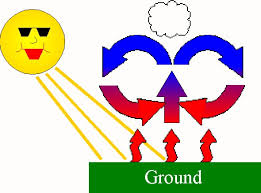
What heats the Earth's surface?
a)
the moon
b)
the sun
c)
the ocean
d)
the sky
2.
_____________ air is more dense and tends to sink
a)
cold
b)
warm
c)
moist
d)
dry
3.
Which kind of weather change will occur with an increase in air pressure?
a)
cooler and dryer
b)
colder and rainier
c)
hotter and stormier
d)
warmer and moister
4.
Pressure is the effect of
a)
the weight of all the air above pressing down
b)
water vapor in the atmosphere
c)
greenhouse gases
d)
solar radiation
5.
What is the most abundant gas found in the atmosphere?
a)
Carbon Dioxide
b)
Nitrogen
c)
Oxygen
d)
Water Vapor
6.
Humidity is the...
a)
Amount of Water Vapor in the Air
b)
Amount of Wind in the Air
c)
Amount of Precipitation in the Air
d)
Amount of Pressure in the Air
7.
What measures temperature?
a)
barometer
b)
anemometer
c)
thermometer
d)
psychrometer
8.
Warm air rises and the cool air sinks demonstrates this type of heat transfer. 
a)
conduction
b)
convection
c)
radiation
d)
Insolation 
9.
Clouds are made up of tiny drops of ______ or ice. The moisture in the cloud affects the weather.
a)
dust
b)
water
c)
cloud particles
d)
precipitation
10.
Which box has a higher density?  
a)
Box A
b)
Box B
c)
cannot be determined
d)
they are the same
11.
_______ pressure systems are characterized by rising air.
a)
High
b)
Low
12.
Air moves toward the center of a _________ pressure system.
a)
High
b)
Low
13.
Air moves away from the center of a _________ pressure system.
a)
High
b)
Low
14.
Thermal energy transfer by conduction is accomplished when heat moves from a warmer object to a cooler one by -
a)
moving across a solid barrier.
b)
being carried in a fluid, like air or water.
c)
coming in direct physical contact with it.
d)
traveling through empty space.
15.
When water is heated in the ocean by the sun and turns into water vapor
a)
condensation
b)
evaporation
c)
transpiration
d)
runoff
16.
The sun's energy 
a)
changes daily
b)
heats the ocean before evaporation
c)
directly causes evaportation
17.
More evaporation occurs 
a)
at night 
b)
during the day 
18.
A device that is used to measure atmospheric pressure is a ___________.
a)
barometer
b)
thermometer
c)
kilometer
d)
micrometer
19.
The sun heats up surface water, causing evaporation.  The water vapor then rises into the air creating....
a)
rain
b)
ice
c)
fog
d)
humidity
20.
Heat transfer between two substances that are in contact with each other is called
a)
conduction
b)
convention
c)
convection
d)
radiation
21.
Convection takes place because
a)
warm air is more dense than humid air
b)
warm and cold air have the same density
c)
cold air is less dense than warm air
d)
cold air is more dense than warm air
22.
Winds are caused by differences in
a)
precipitation
b)
humidity
c)
air pressure
d)
turbulence
23.
At the seashore late in the afternoon on a hot, sunny day, a person often feels a strong breeze coming in from the ocean.  Which of the following is the reason for the breeze?
a)
pounding waves generate air currents
b)
warm air over the ocean rushes in to replace the cool air that rises over land
c)
there are no clouds to block wind coming in
d)
heavy cool air over the ocean rushes in to replace warm air that rises over the land
24.
What causes winds?
a)
differences in precipitation
b)
differences in humidity
c)
differences in air pressure
25.
The amount of mass in a unit volume of a substance
a)
mass
b)
pressure
c)
volume
d)
density
26.
Before condensation can occur, the air must  be ____________________________.
a)
Humid
b)
Cold
c)
Hot
d)
Saturated
27.
Water exists in the air as a ___________?
a)
Solid 
b)
 Liquid 
c)
 Gas 
d)
Rain Drops
28.
The gaseous form of water is ______________. 
a)
 Gas
b)
Water Vapor
c)
Air 
d)
Rain Drops
29.
What must occur before clouds can form?
a)
Water vapor must get warmer.
b)
Water vapor must lose heat energy.
c)
Precipitation must begin to fall and run off.
d)
Transpiration must add water vapor to the atmosphere.
30.
Which most accurately explains the way clouds form?
a)
Warm water vapor hits warm air, changing the gas into a liquid, and forming a cloud.
b)
Warm water vapor hits cold air, changing the gas into a liquid, and forming a cloud.
c)
Warm water vapor hits warm air, changing the gas into a solid, and forming a cloud.
d)
Warm water vapor hits cold air, changing the gas into a solid, and forming a cloud.
31.
Which will most likely form during the condensation process?
a)
rain
b)
hail
c)
clouds
d)
runoff
32.
Which part of the water cycle is occurring when warm, moist air cools and begins forming clouds?
a)
condensation
b)
evaporation
c)
transpiration
d)
precipitation
33.
More molecules close together, means density is:
a)
high
b)
low
34.
Fewer molecules further apart, means density is:
a)
high
b)
low
35.
What does the air consist of?
a)
molecules
b)
helium
c)
density
d)
weather
36.
This forms when water vapor changes from gas directly to ice crystals on a surface when the temperature at which condensing would take place are at the freezing point or below.
a)
dew
b)
rain
c)
snow
d)
frost
37.
Any form of water that falls to Earth's surface from the clouds is called what?
a)
Evaporation
b)
Condensation
c)
Precipitation
d)
Sublimation
38.
What is Evaporation?
a)
1.Process of water movement through a plant from the drying up of its aerial parts
b)
2.Occurs on the surface of a liquid as it changes into the gaseous phase.
c)
3.Occurs when rain drops fall
d)
4.All of the above
39.
What is the process of evaporation?
a)
1.The particles move so quickly and escapes into the atomsphere as water vapor
b)
2.When a liquid becomes a gas through heat
c)
3.The process of air cooling water
d)
4.1&2
40.

In general what is the most dense form of matter?

a)

solid

b)

liquid

c)

gas

d)

plasmas

41.

Which box has a lower density?

a)

Box A

b)

Box B

c)

cannot be determined

d)

they are the same

42.

Why does a hot air balloon come back down to the ground?

a)

The air around it pushed it down.

b)

The air inside cooled and became more dense forcing the balloon to descend.

c)

The air inside the balloon heated up and the air was too hot to rise.

d)

The balloon may have had a hole in it.

43.

Hot air is ________dense than the air around it; that is how the balloon can rise.

a)

more

b)

less

44.

As an object is heated its density

a)

increases

b)

decreases

c)

remains the same

45.

Density is...

a)

the amount of mass in an object

b)

the amount of space an object takes up

c)

the amount of mass in a given volume or space

d)

the weight of an object

46.

_____________ is air that flows from areas of high pressure to areas of low pressure.

a)

Convection Cells

b)

Wind

c)

Atmospheric Pressure

47.

Why does warm air rise above cold air?

a)

Warm air is less dense

b)

Warm air is more dense

c)

Cold air is stronger than warm air

48.

How does air move?

a)

Warm air rises and cool air sinks

b)

Warm air sinks and cool air rises

49.

Which of the following types of clouds produces hailstorms?

a)

cumulus

b)

stratus

c)

cirrus

d)

cumulonimbus

50.

As the temperature rises, air pressure...

a)

increases

b)

decreases

51.

Heat from the Sun reaches Earth through which type of heat transfer?

a)

Conduction

b)

Radiation

c)

Convection

d)

All of the above

52.

Convection currents occur:

a)

Only in liquids

b)

When a dense substance is warmer than a less dense substance

c)

In both liquids and gases

d)

Weakly in solids

53.
The boundary  between two air masses is known as:
a)
front
b)
storm
c)
climate
d)
flood
54.
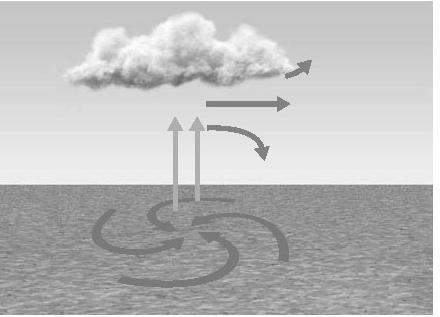
Which type of pressure system is pictured?
a)
high
b)
low
c)
medium
d)
none
55.
What type of weather would you expect with the pressure system pictured?
a)
clear
b)
cloudy
c)
severe storms
d)
hot
56.
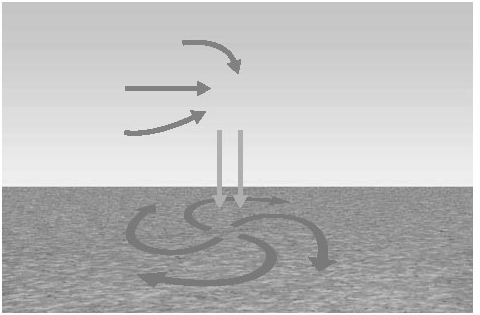
Which type of pressure system is pictured?
a)
high
b)
low
c)
medium
d)
none
57.
What type of weather would you expect from the pressure system pictured?
a)
clear
b)
cloudy
c)
hot
d)
stormy
58.
The temperature at which air is saturated and condensation forms is the:
a)
dew point
b)
rain point
c)
wind point
d)
relative humidity
59.
Cold air traveling south from Canada is:
a)
continental tropical
b)
continental polar
c)
maritime tropical
d)
maritime polar
60.
Warm air moving upwards from the Gulf of Mexico is:
a)
continental tropical
b)
continental polar
c)
maritime tropical
d)
maritime polar
61.
Warm air mass that does not carry water:
a)
continental tropical
b)
continental polar
c)
maritime tropical
d)
maritime polar
62.
Cold air mass that is carrying water is:
a)
continental tropical
b)
continental polar
c)
maritime tropical
d)
maritime polar
63.
In _________ pressure systems, air sinks:
a)
high
b)
low
c)
medium
d)
none
64.
In _______ pressure systems, air rises
a)
high
b)
low
c)
medium
d)
none
65.
This type of front results in the same weather for several days
a)
warm
b)
cold
c)
stationary
d)
occluded
66.
Which option pictured describes how rain is formed?
a)
A
b)
B
c)
C
d)
D
67.
Which weather tool measures the amount of kinetic energy in molecules?
a)
thermometer
b)
barometer
c)
psychrometer
d)
anememeter
68.
Where the warm and cold air meet and stall, clouds and fog form, and it may rain or snow.  It could bring many days of clouds and precipitation.  
a)
Warm Front
b)
Cold Front
c)
Occluded Front 
d)
Stationary Front 
69.
When a cold front overtakes a warm front, the temperature drops as the warm air mass is cut off from the ground and pushed upward.  It can bring strong winds and heavy precipitation. 
a)
Warm Front
b)
Cold Front
c)
Occluded Front
d)
Stationary Front 
70.
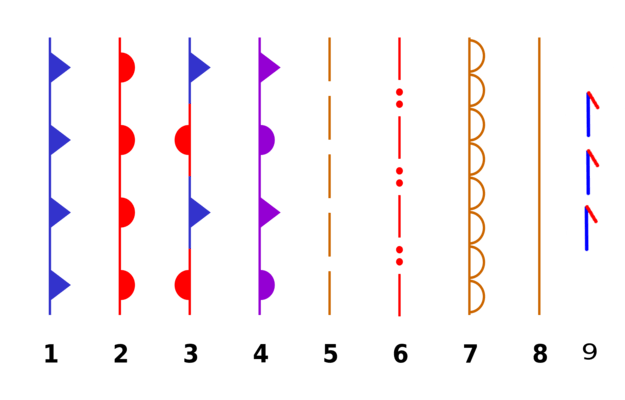
This is the symbol for a... 
a)
Cold Front
b)
Warm Front
c)
Stationary Front
d)
Occluded Front 
71.
This is the symbol for a... 
a)
Occluded Front
b)
Stationary Front
c)
Warm Front
d)
Cold Front 
72.
This is the symbol for a... 
a)
Stationary Front
b)
Occluded Front
c)
Cold Front
d)
Warm Front
73.
This is the symbol for a... 
a)
Stationary Front
b)
Occluded Front
c)
Cold Front
d)
Warm Front 
74.
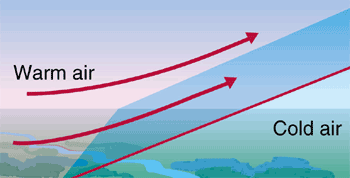
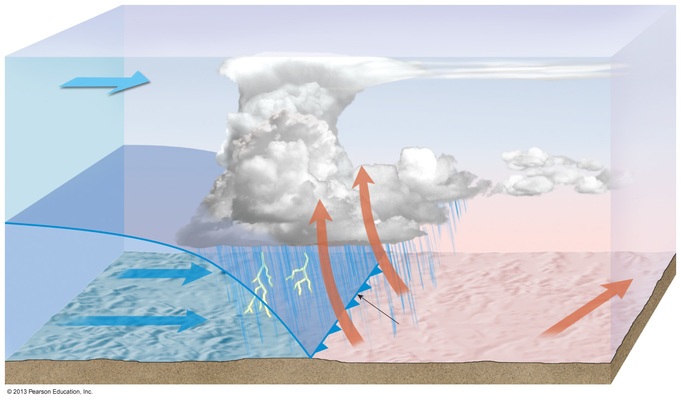
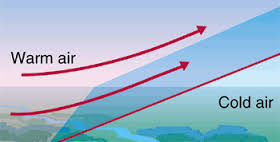
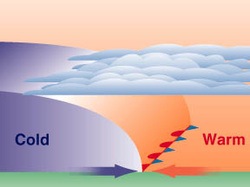
Identify the type of front that is shown in the image.
a)
Occluded Front
b)
Cold Front
c)
Stationary Front
d)
Warm Front
75.
Identify the type of front that is shown in the image.
a)
Occluded Front
b)
Cold Front
c)
Stationary Front
d)
Warm Front
76.
Identify the type of front that is shown in the image.
a)
Occluded Front 
b)
Cold Front
c)
Stationary Front
d)
Warm Front
77.
Identify the type of front that is shown in the image.
a)
Occluded Front
b)
Cold Front
c)
Stationary Front
d)
Warm Front
78.
_____________ has the same temperature and moisture content throughout. 
a)
convection current
b)
front
c)
air mass
79.
Which statement describe parts of the water cycle and how clouds form? 1. Water evaporates from the earth's surface as it changes from a liquid to a gas. 2. Water vapor rises with rising, warm air. 3. At higher altitudes, where temperatures are cool, vapor (along with dust particles) condenses into drops of water that form clouds. 4. Low-pressure conditions also help clouds form. 
a)
1 and 2
b)
1, 2, 4
c)
1 and 3
d)
all of the above
80.
 Which of the following are used to study and forecast most weather-related events?
a)
Doppler radar
b)
satellites and satellite images
c)
weather maps
d)
all of the above
81.
Rain, sleet, hail, and freezing rain are all...
a)
precipitation
b)
condensation
c)
evaporation
d)
perspiration
82.
____________ air sinks/falls because it is ____________dense.
a)
Cold, More
b)
Warm, Less
c)
Cold, Less
d)
Warm, More
83.
____________ air rises because it is ____________dense.
a)
Cool, Less
b)
Warm, Less
c)
Cold, More
d)
Warm, More
84.
The weight of air as it presses down on Earth's surface
a)
front
b)
air pressure
c)
air mass
d)
evaporation
85.
A(n) _____ is a large body of air that has properties similar to the part of Earth's surface over which it depends.
a)
tornado
b)
pressure system
c)
front
d)
air mass
86.
When two air masses meet, there is a _____, or boundary.
a)
thunderstorm
b)
watch
c)
front
d)
cloud
87.
What part of the illustration shows Evaporation? 
a)
1
b)
2
c)
3
d)
4
88.
Which condition usually means cloudy, stormy weather?
a)
high pressure
b)
low pressure
89.
Which number illustrates Condensation?
a)
1
b)
2
c)
3
d)
4
90.
What kind of weather is usually associated with a high pressure system?
a)
Sunny weather
b)
Precipitation (rain, snow, etc.)
91.
What does this symbol on a weather map indicate? 
a)
High pressure system
b)
Low pressure system
c)
Cold front
d)
Warm front
92.
Because the earth is spinning on its axis, the global winds appear to curve. This is known as the __________ ________.
a)
Coriolis Effect
b)
Greenhouse Effect
c)
Climate Effect
d)
Atmosphere Effect
93.
Water as a gas is called _________.
a)
water vapor
b)
tornado
c)
hibernate
94.
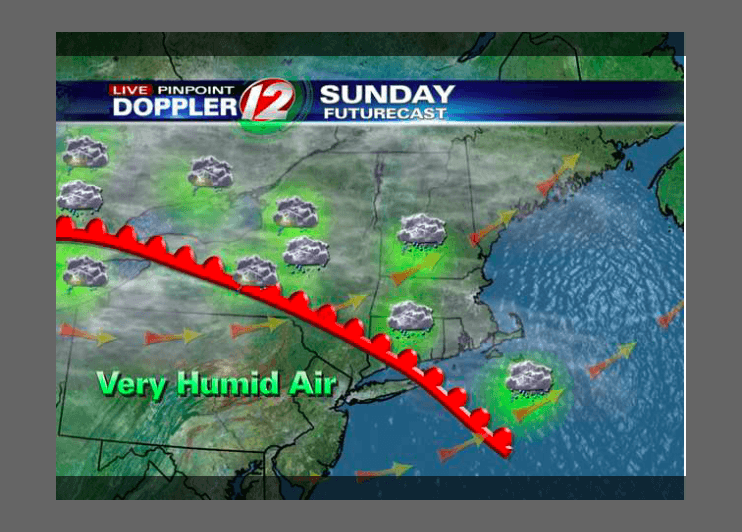
What type of storm front is this? 
a)
warm front
b)
cold front
c)
stationary front
d)
occluded front
95.
What does symbol # 3 mean?
a)
stationary front
b)
occluded front
c)
warm front
d)
cold front
96.
A front is
a)
where warm air is cooling at earth's surface
b)
a line where hot and cold air are separating
c)
a line where two different air masses meet
d)
where cold air is rising and forming rain clouds
97.
Which type of front is pictured?
a)
Cold front
b)
Warm front
c)
Occluded front
d)
Stationary front
98.
Which type of front is pictured?
a)
Cold front
b)
Warm front
c)
Occluded front
d)
Stationary front
99.

Why does New York typically have less energy/heat than places like Florida?

a)

New York receives more direct sunlight.

b)

New York's sunlight is more spread out than in places further south.

c)

New York has higher temperatures than places further south.

d)

New York has less rainfall than places further south.
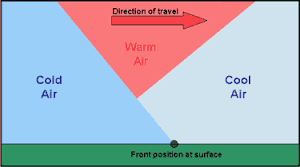
100.
Which type of front is pictured?
a)
Cold front
b)
Warm front
c)
Occluded front
d)
Stationary front
101.

Which one shows a warm front?

a)
b)
c)
d)
102.
Which front leads to steady rain for several days?
a)
warm front
b)
cold front
c)
stationary front
d)
occluded front
103.

Which of the following does NOT affect the weather?

a)

The temperature of the air

b)

The speed of the wind

c)

The types of clouds in the sky

d)

The phase of the moon

104.

Air with higher temperatures can hold _____ water and moves ______ in the atmosphere because of its density.

a)

less; down

b)

less; up

c)

more; down

d)

more; up

105.

Clouds are made up of tiny drops of ____________ or ice. The moisture in the cloud affects the weather.

a)

dust

b)

water

c)

oxygen

d)

cotton

106.

How do clouds form?

a)

Liquid water is heated and evaporates and becomes water vapor in the atmosphere.

b)

Water vapor in the atmosphere cools and condenses to become tiny liquid water droplets in the atmosphere.

c)

Tiny liquid water droplets float upwards and gather together in the atmosphere to form a cloud.

d)

Magic!

107.

__________ is the weight of air pushing on everything around it.

a)

wind speed

b)

sleet

c)

air pressure

d)

water cycle

108.
Which gas in our atmosphere is most abundant?
a)
Argon
b)
Oxygen
c)
Nitrogen
d)
Carbon Dioxide
109.
In which layer of the atmosphere does weather occur?
a)
Mesosphere
b)
Thermosphere
c)
Stratosphere
d)
Troposphere
110.
What causes the temperature to increase in the stratosphere?
a)
Nitrogen
b)
Ozone
c)
Water Vapor
d)
carbon dioxide
111.
Which layer protects the earth from meteors?
a)
Troposphere
b)
Stratosphere
c)
Mesosphere
d)
Thermosphere
112.
Describe how the ozone layer protects the earth.
a)
Absorbs solar radiation, Protects Earth from UV Rays,  and emits heat
b)
Ozone in the lower atmosphere is a pollutant
113.
Which layer of the atmosphere contains the ozone layer? 
a)
Mesosphere
b)
Stratosphere
c)
Ionosphere
d)
Exosphere
114.
Warm air rises and the cool air sinks demonstrates this type of heat transfer. 
a)
conduction
b)
convection
c)
radiation
d)
Insolation 
115.

What is the energy source for the water cycle?

a)

sun

b)

wind

c)

rain

d)

oceans

116.

Which type of air mass bring COLD and DRY weather?

a)

Maritime Polar (mP)

b)

Maritime Tropical (mT)

c)

Continental Polar (cP)

d)

Continental Tropical (cT)

117.

Which type of air mass bring COLD and WET weather?

a)

Maritime Polar (mP)

b)

Maritime Tropical (mT)

c)

Continental Polar (cP)

d)

Continental Tropical (cT)

118.

Which type of air mass brings WARM and WET weather?

a)

Maritime Polar (mP)

b)

Maritime Tropical (mT)

c)

Continental Polar (cP)

d)

Continental Tropical (cT)

119.

Which type of air mass brings WARM and DRY weather?

a)

Maritime Polar (mP)

b)

Maritime Tropical (mT)

c)

Continental Polar (cP)

d)

Continental Tropical (cT)

120.

Where do CONTINENTAL air masses form?

a)

Over water

b)

Over land

121.

Where do MARITIME air masses form?

a)

Over water

b)

Over land

122.

Name that symbol.

a)

Cold Front

b)

Warm Front

c)

Stationary Front

d)

Occluded Front

123.
The Coriolis effect is the curving of wind across Earth. What causes winds to curve?
a)
Earth's revolution
b)
Earth's magnetic field
c)
Earth's rotation
d)
Earth's gravitational pull
124.

In the Northern Hemisphere, winds traveling north appear to curve east because of the:

a)

trade winds

b)

convection currents

c)

Coriolis effect

d)

polar easterlies

125.

In which layer of Earth’s atmosphere does weather occur?

a)

mesosphere

b)

stratosphere

c)

thermosphere

d)

troposphere

126.

On Mount Everest the temperature decreases as the altitude increases. The summit (highest point) of this mountain is in which atmospheric layer?

a)

mesosphere

b)

stratosphere

c)

thermosphere

d)

troposphere

127.

The table indicates (shows) the percentages (amount) of some gases in the atmosphere of Mars. Which gas in the atmosphere of Mars is the primary (main) gas found in the atmosphere of Earth?

a)

carbon dioxide

b)

nitrogen

c)

argon

d)

methane

128.

In which layer of the atmosphere does MOST of Earth’s weather occur (take place)?

a)

the exosphere, which is the outermost layer

b)

the troposphere, which is the lowest layer

c)

the thermosphere, which has the highest temperature

d)

the stratosphere, which contains a sub-layer of ozone

129.
What two gases make up the majority of air?
a)
helium & argon
b)
helium & oxygen
c)
ozone & nitrogen
d)
nitrogen & oxygen
130.

Which atmospheric layer protects Earth from getting hit by most meteoroids?

a)

Troposphere

b)

Mesosphere

c)

Stratosphere

d)

Exosphere

131.
The process of convection transfers heat energy _____.
a)
from cold areas to warm areas
b)
from warm areas to cold areas
c)
from high altitudes to low altitudes
d)
from humid areas to dry areas
132.
List the layers of Earth's atmosphere in order of increasing altitude.
a)
exosphere, thermosphere, mesosphere, stratosphere, troposphere
b)
troposphere, stratosphere, mesosphere, thermosphere, exosphere
c)
troposphere, stratosphere, ozone layer, mesosphere, thermosphere, exosphere
d)
stratosphere, mesosphere, thermosphere, exosphere, troposphere
133.
energy that flows through a direct contact is called
a)
convection
b)
conduction
c)
radiation
d)
ocean waves
134.
Energy from the Sun travels to Earth as ______.
a)
conduction
b)
convection
c)
insulation
d)
radiation
135.
This is the outer layer of the thermosphere.
a)
ionosphere
b)
stratosphere
c)
exosphere
d)
atmosphere
136.
In which two layers does temperature decrease with altitude?
a)
mesosphere and troposphere
b)
troposphere and stratosphere
c)
stratosphere and thermosphere
d)
thermosphere and exosphere
137.
The coldest layer of the atmosphere is the ________.
a)
Mesosphere
b)
Thermosphere
c)
Stratosphere
d)
Troposphere
138.
Even though the air is very thin, the hottest layer is the __________.
a)
Exosphere
b)
Mesosphere
c)
Troposphere
d)
Thermosphere
139.
As altitude increases in the troposphere, temperature __________.
a)
increases
b)
decreases
c)
stays the same
d)
none of the above
140.
Where we live.
a)
stratosphere
b)
thermosphere
c)
troposphere
d)
mesosphere
141.
Which order is correct from the earth to space?
a)

thermosphere  troposphere  exosphere mesosphere stratosphere  

b)

thermosphere  troposphere  stratosphere  exosphere mesosphere  

c)

exosphere thermosphere mesosphere  stratosphere troposphere

d)
troposphere
thermosphere
 troposphere
 stratosphere
 exosphere
mesosphere