
 Worksheets
6 th Science Final
Total questions: 150
Worksheet time: 5hrs 0mins
After asking a question, a scientist can form a(n) _______ , which is an idea that may be proved or disproved by an experiment.
explanation
objective
observation
Science is the systematic study of .
earth
beliefs
life
Which best describes scientific facts?
observable and objective
true and subjective
unsupported and believed
estimated and unquestioned
What does a control group show in an experimental investigation?
the effects that the scientists are causing by manipulating variables
how nature would act without manipulation by the researchers
why each part of a system is related to every other part
all parts of a system that scientists are controlling and changing
Mutations are changes in the genes of living things. Mutations are common in all life forms and usually harmless. In fact, sometimes they help organisms survive. However, people often think that the word mutation means something dangerous.
Which best describes the question "Why do most people think mutations are dangerous?"
a scientific question, because it asks about mutations that happen in nature
a scientific question, because it asks about most people instead of just a few
not a scientific question, because it asks about what people think instead of how nature works
not a scientific question, because it asks about how mutations can be helpful to life in nature
6. Which types of questions can most likely be answered through a scientific investigation?
objective questions
Questions about personal opinions
subjective questions
questions about people's favorites
What did Leeuwenhoek use that enabled him to see bacteria?
the staining of dishes in a lab
the heating of foods and liquids
different magnification lenses
observations of diseased people
Imagine that a team of scientists test a certain hypothesis, and the experimental results show that it is false. How will this information most likely be helpful in the future?
The hypothesis and experiment will not be discussed again.
The hypothesis will be used to support a different theory.
The results will be on record and can inspire a new hypothesis.
The results will show which other hypotheses must be true.
Which is the best description of a scientific theory?
a statement about how two different variables are related
a collection of laws that are explained the same way
an explanation of many observations and tested hypotheses
an accepted fact that has always been observed to be true
Which tool is used to measure mass?
ruler
balance
graduated cylinder
liquid thermometer
What does the symbol "kg" represent in the metric system?
1,000 grams
100 liters
10 meters
1 degree Celsius
Which unit is used to measure temperature in the International System of Units?
degrees Fahrenheit
degrees Celsius
radians
therms
When all the values in a data set are written in order from least to greatest, the value that is in the middle, with an equal number of values below it and equal number of values above it, is called the
mean
mode
range
What is the mean of the data set [3, 2, 2, 12, 6, 5, 14, 4]?
2
4
6
7
In a data set, the number that appears the most is called the .
range
median
degrees
Which are characteristics of all living things? Circle three options.
A. grow and develop
B. make their own food
C. are made of many cells
D. respond to stimuli
E. can reproduce
What does food provide to organisms?
homeostasis
shelter
energy
air
Where do most living things get the energy they need for life?
either from air or food
either from sunlight or air
either from food or sunlight
either from air or water
What do all organisms need? Circle three options.
nervous system
a place to live
water
blood
food
Juliana was born at 7 pounds 3 ounces and now weighs 28 pounds. Which characteristic of life does this change display?
A. responding to stimuli
B. maintaining homeostasis
C. growing and developing
D. being made of cells
Which two elements make up water?
oxygen and phosphorus
oxygen and hydrogen
hydrogen and sulfur
hydrogen and phosphorus
Which element is the basis for all living things and can combine with other elements in many ways?
phosphorus
carbon
oxygen
sulfur
Which best describes a molecule?
a unit made of different kinds of elements
a unit made of only one kind of element
a unit made of two or more atoms
a unit made of a single atom
What is one reason scientists have developed a system to classify organisms?
Classification allows for organisms to interbreed and change.
A system was needed to better track genetic changes in an organism.
Classification allows for better identification of new organisms.
A system was needed to see microscopic organisms with more detail.
Which scientist created the most modern classification hierarchy that we use today?
Aristotle
Linnaeus
Woese
Whittaker
How many kingdoms are in the modern system of classification?
2
6
8
15
A(n) ________ is a group of organisms that can mate and produce offspring that can mate.
organism
species
homeostasis
carbon
Prokaryotes are found in
Eukarya only.
Bacteria only.
Archaea and Bacteria.
Archaea and Eukarya.
In which kingdom do all organisms have cells that lack a cell wall?
fungi
plants
animals
bacteria
What is the goal when using a dichotomous key?
to see changes in an organism
to analyze an organism's DNA
to determine lifespan of organisms
to identify an organism
Which is a physical characteristic of a cat?
feathers
fur
fins
wings
Which characteristics of an object are most likely the easiest to see and describe?
the elements that make it up
its chemical characteristics
its physical characteristics
the parts found inside it
Which best describes the importance of the microscope to the development of cell theory?
Microscopes color different parts of cells so they can be seen with the naked eye.
Cells are too small to see with the naked eye, and a microscope magnifies them.
The lenses in a microscope reduce the image of an organism to the size of a cell.
Microscopes trap “animalcules” from pond water so they can be studied.
Nuris is writing a paper on the scientist who first named cells after studying cork under a microscope. Who is her paper about?
Virchow
Schwann
Hooke
Leeuwenhoek
Why are cells called the building blocks of an organism?
They are visible to the naked eye.
They are made from nonliving materials.
They are the basic unit of life.
They are able to generate new cells.
A mitochondrion is most like a _______.
Brick wall
Water balloon
Conveyor belt
Power station
Which provides a protective covering to the cell and controls what enters and leaves?
nucleus
cell membrane
cytoplasm
ribosome
Which is most responsible for building proteins?
cytoplasm
ribosome
cell membrane
nucleus
Which organelle is found in photosynthetic organisms and captures energy from the sun?
mitochondrion
chloroplast
ribosome
nucleus
Which best compares plant and animal cells?
Animal cells have a nucleus while plant cells have DNA.
Animal cells have an irregular shape while plant cells have a rectangular shape.
Plant cells have proteins while animal cells have sugars.
Plant cells have a cell membrane while animal cells have a cell wall.
Which of these structures are found in both plant and animal cells?
cell wall, mitochondria, ribosomes
mitochondria, ribosomes, nucleus
ribosomes, chloroplasts, cytoplasm
cytoplasm, cell wall, mitochondria
_____ are a group of cells that work together to perform a specific function.
Tissues
Organ system
Organs
Organisms
Which is the energy source used to fuel photosynthesis?
sunlight
glucose
carbon dioxide
water
Which best describes the reactants and products of photosynthesis?
Reactants are formed inside the plant, and products are taken in from the environment by the plant.
Reactants are taken in from the environment by the plant, and products are formed inside the plant.
Reactants and products are formed inside the plant.
Reactants and products are taken in from the environment by the plant.
Sammy is taking notes to study for a test. He wrote out the steps that involve hydrogen during photosynthesis. The steps are shown, but they are not in the correct order.1 - Water is broken down into oxygen and hydrogen. 2 - Glucose is broken down to be used by plants. 3 - Hydrogen combines with carbon dioxide to form glucose. 4 - Hydrogen enters the plant as part of water.
Which lists the correct order of the steps?
A. 4, 2, 1, 3
B. 4, 1, 3, 2
C. 4, 3, 1, 2
D. 4, 2, 3, 1
Why is it important to eat a healthy meal before an afternoon of playing sports?
Food provides carbon dioxide, which is a product of cellular respiration.
Food provides oxygen, which is a product of cellular respiration.
Food provides glucose, which is a reactant in cellular respiration.
Food provides energy, which is a reactant in cellular respiration.
Which statement describes the role of a mitochondrion in providing an organism with energy?
It stores glucose that is taken from food so that respiration can happen later.
It combines blood and oxygen so that energy can be released from glucose.
It is the site where oxygen combines with small molecules, releasing large amounts of energy.
It is the site where food is broken down into small molecules, releasing small amounts of energy.
How will energy be used after leaving the mitochondrion during cellular respiration?
to repair parts of damaged tissue
to combine with carbon dioxide
to build new oxygen molecules
to start the second stage of respiration
A teacher wrote this chemical equation on the board and asked the class to make it correct.
water + carbon dioxide → glucose + oxygen + energy What should be changed to show the correct chemical reaction?
Carbon dioxide should be traded with glucose, and energy should be shown on both sides.
Water should be moved to the products side, and glucose and oxygen should both be moved to the reactants side.
Water and carbon dioxide should both be moved to the products side, and glucose and oxygen should be moved to the reactants side.
Glucose should be moved to the reactants side, and water and carbon dioxide should both be moved to the products side.
Which are the main stages of the cell cycle? Circle three options.
interphase
mitosis
metaphase
cytokinesis
anaphase
Which stage of the cell cycle involves the division of the cell’s nucleus?
mitosis
cytokinesis
interphase
replication
Which stage of the cell cycle involves the division of the cytoplasm?
mitosis
cytokinesis
interphase
anaphase
Which step of mitosis involves the nucleus splitting and nuclear membranes forming around each new nucleus?
metaphase
prophase
anaphase
telophase
What process allows for the development of haploid sex cells?
mitosis
meiosis
fertilization
pollination
What is the female sex cell that results from meiosis?
zygote
sperm
egg
bacteria
_________ is a process that involves one division of the nucleus and results in two identical cells.
Meiosis
Fertilization
Replication
Which are true of meiosis but not mitosis? Circle three options.
It generates genetically different cells.
It generates haploid cells.
It involves prophase, metaphase, anaphase, and telophase.
It involves two rounds of nuclear division.
It begins with a diploid cell.
What are the main differences between asexual reproduction and sexual reproduction?
A. Asexual reproduction requires two parents and produces non-identical offspring, while sexual reproduction requires only one parent and produces identical offspring.
B. Asexual reproduction requires two parents and produces identical offspring, while sexual reproduction requires only one parent and produces non-identical offspring.
C. Asexual reproduction requires only one parent and produces identical offspring, while sexual reproduction requires two parents and produces non-identical offspring.
D. Asexual reproduction requires only one parent and produces non-identical offspring, while sexual reproduction requires two parents and produces identical offspring.
59. Which of the following are forms of asexual reproduction? Circle three options.
binary fission
zygote formation
sporulation
fragmentation
What is required for sexual reproduction to occur?
an individual that produces sperm and an individual that produces eggs
an individual that produces sperm and an individual that produces spores
an individual that produces buds and an individual that produces spores
an individual that produces buds and an individual that produces eggs
What is the twisted ladder shape of the DNA called?
3-D model
nucleotides
double helix
single strand
Which best compares DNA and RNA with regard to the process of protein production?
DNA transforms from a nucleic acid into a protein, and RNA remains a nucleic acid.
RNA transforms from a nucleic acid into a protein, and DNA remains a nucleic acid.
DNA leaves the nucleus during the process and RNA remains in the nucleus.
RNA leaves the nucleus during the process and DNA remains in the nucleus.
Which best describes the storage of the genetic code?
A gene is a segment of DNA, a condensed DNA molecule makes up a chromosome, a chromosome is inside a nucleus, and a nucleus is contained within a cell.
A DNA molecule is a segment of a gene, a gene makes up a chromosome, a chromosome is inside a cell, and a cell is contained within a nucleus.
A gene is a segment of a chromosome, a condensed chromosome makes up a DNA molecule, a DNA molecule is inside a nucleus, and a nucleus is contained within a cell.
A. A DNA molecule is a segment of a chromosome, a chromosome makes up a gene, a gene is inside a cell, and a cell is contained within a nucleus.
Mutations that neither benefit nor harm the organism have __________ effect on the organism’s survival.
B. A positive
C. A negative
D. An aggressive
Which is most likely caused by a genetic mutation?
A kitten is born with blue eyes.
A kitten is born with sharp claws.
A kitten is born with six toes on one foot.
A kitten is born with a short tail that grows longer.
What effects do mutations have? Circle four answers.
could change protein shape
might be neutral
might be harmful
might be beneficial
never change protein shape
When will a genetic mutation most likely occur in an organism?
when a new trait has a neutral effect on the organism
when the organism is taking antibiotics
when a strand of RNA is copying a strand of DNA
when an organism is breaking down amino acids
Humans have a total of 46 chromosomes. Therefore, humans inherit chromosomes from each parent.
11
46
26
A plant is homozygous for flower color. Its flowers are pink. Which conclusion is best supported by the information?
Flower color is a recessive trait.
Flower color is a dominant trait.
Both parents had an allele for pink flower color.
Only one parent had an allele for pink flower color.
Which is an example of an inherited trait?
knowing how to add
building muscle tone
becoming a piano player
having a round face
Mendel studied "factors" that allowed for physical characteristics, which can have alternate versions, to be passed onto offspring. What are these factors called?
plants
traits
alleles
phenotypes
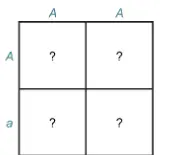
The Punnett square shows the cross for a particular trait between a homozygous dominant parent and a heterozygous parent. What is the probability the offspring will be heterozygous for this trait?
25%
50%
75%
100%
In a particular genetic cross, the probability of the offspring having a certain trait is ¾. Which percentage represents this probability?
25%
50%
75%
100%
The genotype of an offspring defines the physical characteristics or _________.
DNA
Cross
Probability
Phenotype
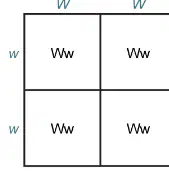
The Punnett square shows the possible genotype combinations of two parents who are homozygous for a trait. What is the probability of the parents having a child that is heterozygous for this trait?
0%
25%
75%
100%
How many alleles are there for the four main types of human blood?
one
two
three
four
Which statements describe codominance? Circle three answers.
A. Traits are usually dominant.
B. Traits are neither dominant nor recessive.
C. Offspring exhibit an intermediate form of alleles from the parents.
D. Both alleles, one from each parent, are expressed in offspring.
E. Codominance involves the interaction of two alleles.
Human blood type exhibits _______ inheritance pattern.
A recessive
An incomplete dominant
An intermediate
In the inheritance pattern incomplete dominance offspring demonstrate an intermediate form of alleles from the parents.
True
False
What is the main goal of gene therapy?
to cure human diseases
to produce inexpensive medicine
to lower the costs of livestock production
to increase the nutritional value in foods
Which best compares genetic engineering and cloning of animals?
Both result in offspring with a single, specific desirable trait.
Both result in offspring that are genetically identical to the original organism.
Both require that DNA be manipulated in some way.
Both require that only females are used in the process.
A scientist takes a cell from one cow and an egg from a second cow. The scientist removes the DNA from the egg and replaces it with the DNA from the first cow. The scientist’s goal is to produce a baby cow with DNA that is identical to the first cow. Which best describes this scenario?
genetic engineering
gene therapy
cloning
selective breeding
Gene therapy is a form of .
Selective breeding
Cloning
Artificial selection
Which best describes a difference between cloning plants and selectively breeding plants?
Cloning requires two parents and selective breeding requires one parent.
Cloning results in a genetically identical plant and selective breeding does not.
Cloning always requires that DNA be modified and selective breeding does not.
Cloning always results in larger plants and selective breeding always results in smaller plants.
Which is the best example of natural selection?
Some insects in a population survive temperature changes and pass on their traits to their offspring.
A deer population is rapidly killed off by a forest fire.
A few mice from a population randomly die from a disease, while surviving mice are not able to reproduce and slowly die off.
An injured bald eagle is captured and placed in a wildlife facility where it survives for 10 years.
What are the preserved remains of organisms that provide evidence to support Darwin’s theory of evolution?
fossils
species
extinctions
populations
Which scientist first named humans Homo sapiens?
Darwin
Lamarck
Malthus
Linnaeus
The process by which the organisms that are better adapted to the environment survive and reproduce is called _______.
extinction
evolution
variation
What occurs if the environment changes and a species is no longer able to survive?
The species becomes extinct.
The species evolves.
The species adapts.
The species is naturally selected.
Due to a genetic mutation, a deer is born with a missing toe. This makes it difficult for the deer to escape from predators. How will this mutation most likely affect the deer population?
The deer with the mutation will not survive, and the trait will disappear from the population.
The deer with the mutation will survive and reproduce, but it will not pass this trait on to its offspring.
The deer with the mutation will not survive, but the trait will appear again in the next generation.
The deer with the mutation will survive and reproduce, and the trait will commonly appear in future generations.
is the total disappearance of all members of a species.
Evolution
Natural selection
Cloning
How much time is needed to form most fossils?
a few months
a few years
hundreds of years
millions of years
A scientist is using relative dating to determine the age of a fossil that she discovered. What would allow her to draw the best conclusions about fossils that are younger than the one she discovered?
measuring the amount of carbon and nitrogen in the surrounding rock
measuring the amount of potassium and argon in the surrounding rock
finding fossils in the same area that are in layers deeper under the surface
finding fossils in the same area that are in layers closer to the surface
Which condition is necessary for a mold fossil to form?
The fossil must be preserved in amber.
Minerals must replace the remains.
The mold must be filled with sediment.
Hard parts of the organism must dissolve.
According to embryology, why do fish and birds have a common ancestor?
They both have embryos with gill slits and tails.
They both have embryos with traits that eventually disappear.
They both have embryos that develop into adults.
They both have embryos that form from a fertilized egg.

Zoe began to draw a cladogram. If she only needs to add the organisms, she can fit a maximum of _____ different species on her cladogram.
3
4
6
5
Which best describes how shared characteristics can be used to identify evolutionary relationships?
If organisms have a common ancestor, most of their characteristics will be shared.
If two organisms have a shared characteristic, it means one evolved from the other.
If organisms have many shared characteristics, they are likely to be closely related.
If organisms have a shared characteristic, it means they are closely related.
Tigers and crocodiles are more closely related than tigers and sharks.
Which statement about shared characteristics best supports this statement?
Crocodiles and sharks both live in water.
Crocodiles and tigers are both made of cells.
Crocodiles and tigers both have four legs.
Sharks and tigers are both meat eaters.
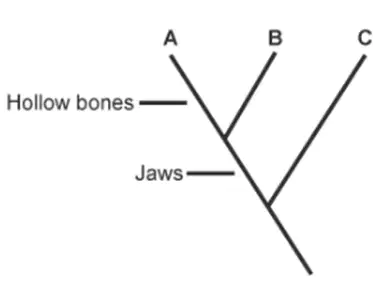
Ariel drew the cladogram shown.
Which best describes species C?
It has jaws, but no hollow bones.
It has hollow bones, but no jaws.
It has neither hollow bones nor jaws.
It has hollow bones and jaws.
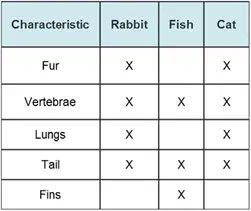
The chart shows shared characteristics of three organisms. Which is supported by the information in the chart?
The common ancestor of rabbits, fish, and cats had fins.
Rabbits and fish share two characteristics.
Only cats and fish had tails.
Cats are more closely related to fish than to rabbits.
How is the life cycle of seedless vascular plants different from the life cycle of nonvascular plants?
The adult form of each seedless vascular plant has xylem and phloem.
The gametophyte stage is lacking in the life cycle of seedless vascular plants.
The sperm of seedless vascular plants do not need to swim in water.
The zygote of each seedless vascular plant forms before the egg is fertilized.
How does pollen typically travel to a female cone?
birds
water
wind
insects
Junipers, hemlocks, and cedars belong to which group of gymnosperms?
conifers
gnetophytes
ginkgoes
cycads
Moss gets buried and compressed over time, forming ________, which can be burned and used to produce electricity.
peat
soil
rock
wood
Which statement explains a way that gymnosperms benefit animals?
They have exposed seeds, which can be found and eaten quickly.
They have wide leaves, which can support large nests.
They have fruits, which contain seeds and taste sweet.
They have short trunks, which provide shelter for smaller animals.
Unlike animal-like protists, many fungus-like protists are __________.
decomposers
parasites
heterotrophic
unicellular
A group of land plants performs photosynthesis, has specialized tissues and a cuticle, but does not have seeds.
Which hazard of living on land would this group of plants likely struggle with the most?
water loss through leaves
young plant death due to lack of water
transporting water
using the Sun’s energy to make food
Bees, which are known for aiding in pollination, help with which process?
enabling pollen to grow fruit to encase the sperm and egg
enabling pollen to grow a tube to transfer sperm to the egg
transferring pollen from the anther to the pistil
transferring pollen from the ovule to the ovary
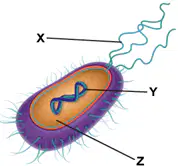
The diagram shows a bacterium. Which labels best complete the diagram?
X: DNA Y: Cell membrane Z: Ribosomes
X: Flagella Y: DNA Z: Cytoplasm
X: Flagella Y: Ribosomes Z: Capsule
X: DNA Y: Cytoplasm Z: Cell wall
In which environment would someone most likely find a living protist?
on the outer layer of human skin
inside a layer of rock
underneath sand
in a drop of lake water
A gecko is a type of reptile. How does a gecko most likely respond to cold air temperatures?
by shivering, which is in response to an internal stimulus
by shivering, which is in response to an external stimulus
by moving into the sun, which is in response to an internal stimulus
by moving into the sun, which is in response to an external stimulus
Which are characteristics of arthropods? Check all that apply.
radial symmetry
nervous system
segmented body
open circulatory system
asexual reproduction
A scientist is observing an invertebrate animal that she collected in shallow salt water. The animal has a hollow central cavity and a gut. Which animal is the scientist most likely observing?
a cnidarian, because it has a gut
a cnidarian, because it was collected in shallow salt water
a sponge, because it has tissue layers
a sponge, because it is an invertebrate
Which statement best compares segmented worms and roundworms?
Some segmented worms have setae, but roundworms do not.
Some roundworms have setae, but segmented worms do not.
Segmented worms have sense organs, but roundworms do not.
Roundworms have sense organs, but segmented worms do not.
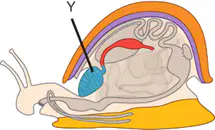
A snail is shown in the diagram.
What is one function of the structure labeled Y?
digest prey
pump blood into the heart
remove carbon dioxide from blood
capture prey
Which characteristics are shared by birds and mammals?
They have a three-chambered heart and are endothermic.
They typically give birth to live young and fertilize internally.
They reproduce sexually and typically give birth to live young.
They are endothermic and reproduce sexually.
Which are characteristics of cephalopods? Check all that apply.
swim by jet propulsion
open circulatory system
complex nervous system
two shells connected by a hinge
feet modified as tentacles
Andre is observing an arthropod that has three body sections, one pair of wings, three pairs of legs, and a one-way digestive system. Which conclusion is best supported by the information?
The arthropod is a fly because it has one pair of wings and three pairs of legs
The arthropod is a fly because it has three body sections and a one-way digestive system.
The arthropod is a pill bug because it has one pair of wings and three pairs of legs.
The arthropod is a pill bug because it has three body sections and a one-way digestive system.
Which characteristic is shared by all mollusks and echinoderms?
live only in salt water
lack a backbone
use tube feet to move
have an open circulatory system
A fish is resting in a shady part of the water, protected by surrounding rocks. The fish suddenly moves out into an open area that is sunny and closer to the surface of the water. What is most likely the reason the fish moved?
to increase its body temperature
to slow down blood circulation
to obtain oxygen
to take in extra carbon dioxide
Where are the sensory receptors for sound?
tongue
nose
ears
eyes
Which helps in the production of eggs?
testosterone
estrogen
semen
fallopian tube
What is the name of the state you are in ,when you are maintaining a stable internal environment despite changing external conditions ?
Homeostasis
Temperature
Imbalance
Resting
Sound can be heard when air passes over a respiratory structure that is located between the pharynx and the trachea. Which structure is responsible for the voice?
the nose
the larynx
the lung
the alveoli
Which is the pathway for information through a neuron?
dendrite → axon → cell body → axon terminals
axon terminals → axon → cell body → dendrite
dendrite → cell body → axon → axon terminals
cell body → dendrite → axon → axon terminals
Which structures produce a fluid to protect the body in the first line of defense? Select four options.
hair
stomach
mouth
eyes
skin
Veins take blood back to the heart. Which gas would be most abundant in a vein that takes blood from muscle cells in the arm back to the heart?
carbon dioxide
oxygen
nitrogen
hydrogen
Which shows a correct association between a structure and one of its functions?
Pores receive sensory information.
Vitamin D protects against bacteria.
Oil regulates temperature.
Sweat glands remove waste.
Which blood component makes up 41% of the blood’s volume?
plasma
red blood cells
platelets
white blood cells
Which is the temporary storage tank for urine?
bladder
stomach
kidney
urethra
In a grassland ecosystem, praying mantises catch and eat grasshoppers. However, there has been a significant decrease in the praying mantis population in recent years. How will this most likely affect the grasshopper population over time?
The population will decrease because grasshoppers are the competition.
The population will increase because grasshoppers are the prey.
The population will increase because grasshoppers are the competition.
The population will decrease because grasshoppers are the prey.
In contrast to most animals, which resource do plants typically compete for?
sunlight
water
space
food
Which biome receives 200 to 400 cm of rain per year?
deciduous forest
temperate rain forest
taigi
grassland
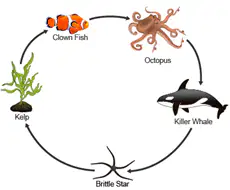
An ocean food chain is shown. Which organism is a tertiary consumer?
clownfish
brittle star
killer whale
octopus
Which biomes would be the coldest?
deciduous forests and savannas
deciduous forests and taigas
tundras and savannas
tundras and taigas
Which organism is a producer?
oak tree
mushroom
mountain lion
butterfly
Which represents the size of a population?
the birth rate
the death rate
number of species in an area
number of individuals in a species
Some consumers, like lions, do not eat plants or any other producers. They only eat other animals. How do lions obtain the carbon they need?
by eating animals that have carbon-based molecules stored in their bodies
by breathing it in from the atmosphere in the form of carbon dioxide
by absorbing carbon-based molecules through their skin from the soil
by drinking water that contains carbon dioxide
During the nitrogen cycle, through which structure are nitrogen compounds first absorbed into the plant?
roots
leaves
flower
stem
During one year, seven coyotes in a population die. Eight immigrate into the population, but none emigrate. If the overall population growth is 13 coyotes, what was the birth rate of coyotes during the year?
Use this formula: population growth = (birth rate + immigration) – (death rate + emigration)
7
11
12
15
What is a tsunami?
a warm season brought on by Earth tilting toward the Sun
an extended period of time with little to no snow or rainfall
a large wave usually caused by an undersea earthquake
a cool season brought on by Earth tilting away from the Sun
A large power plant burns coal to generate electricity for nearby homes and businesses. This contributes most directly to which short-term human-induced environmental change?
habitat destruction
eutrophication
global warming
wildlife hazard
Which statement best compares pioneer species with climax communities?
Both are involved with stages of succession, but climax communities are the beginning and pioneer species are the end result.
Both are involved with stages of succession, but pioneer species are the beginning and climax communities are the end result.
The appearance of each indicates that the number of species in the area is decreasing.
The appearance of each indicates that the number of species in the area is increasing.
Mosasaurs were large marine reptiles that resembled a cross between a crocodile and a giant iguana. The mosasaurs are believed to have completely died out after a huge asteroid impact caused Earth to drastically change. Which effect of an environmental change does this best illustrate?
migration
loss of habitat
adaptation
extinction
Underground mammals, such as the ancestors of moles, are thought to have first evolved as the dinosaurs died out. Which effect of an environmental change does this best illustrate?
migration
loss of habitat
change in behavior
speciation
Which human-induced change results in increased competition caused by an initial increase in the number of organisms in a habitat?
non-sustainable harvesting
ozone layer depletion
nonnative species introduction
mass extinction
Which best protects animal species that are endangered due to overhunting?
laws
increased biodiversity
poaching
captive breeding
Scientists have a theory about the relationship between climate and biodiversity. Which best describes this theory?
Warmer climates promote higher biodiversity, allowing plants to grow year-round. This supports more organisms that rely on plants.
Colder climates promote higher biodiversity, reducing the competition among organisms for food. This supports stronger organisms that live longer.
Warmer climates promote higher biodiversity because they tend to receive more rainfall. This provides a source of water for more organisms.
Colder climates promote higher biodiversity because they are usually larger in size. This provides space for more organisms.
A scientist is studying the biodiversity of an ecosystem that has a cool climate. The scientist counts the number and types of organisms in a 5 foot by 5 foot area. She finds that the ecosystem has very low biodiversity. Another scientist studies the same ecosystem. He counts the number and types of organisms in a 1,000 foot by 1,000 foot area and finds that the ecosystem has high biodiversity. What likely caused these different results?
The scientist who found high biodiversity observed fewer niches.
The scientist who found high biodiversity observed more plants than animals.
The scientist who found low biodiversity studied the ecosystem on cold days.
The scientist who found low biodiversity studied too small of an area.
Why are nonnative species a threat to biodiversity?
They often use up resources that other organisms need.
They are not able to successfully breed in the wild.
They release pollution into many environments.
They easily contract and spread diseases to other organisms.

