wayground logo

Free Printable Worksheets

Font size

S
M
L
XL
Worksheets

Forms of energy and Energy Transformation Quiz 24

Total questions: 153

Worksheet time: 2hrs 0mins

Name
Class
Date
1.

What energy transformation occurs when a crock pot is plugged into an outlet and then the control knob is turned "on"?

a)

thermal to electrical

b)

mechanical to thermal

c)

electrical to thermal

d)

electrical to sound

2.
A student connected some wire to a battery and a small bulb to make a simple circuit. Energy from the battery is changed into electricity. What type of energy is stored in the battery?
a)
chemical
b)
nuclear
c)
heat
d)
light
3.
What energy transformations take place when a battery-operated radio is in use?
a)
Electrical to chemical to light
b)
Sound to chemical to mechanical
c)
Chemical to electrical to sound
d)
Light to electrical to thermal
4.
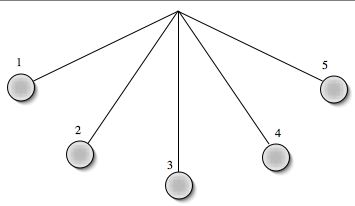
When a pendulum swings, at which point is potential energy at its greatest?
a)
1
b)
2
c)
3
d)
4
5.

At which position does the child on the swing have the most gravitational potential energy?

a)

W

b)

X

c)

Y

d)

Z

6.

Which object has elastic potential energy?

a)

a hanging leaf

b)

a burning coal

c)

a rolling ball

d)

a stretched bow

7.
At point B, the energy is ______.
a)
Potential
b)
Kinetic
c)
Thermal
d)
Chemical
8.
Food, batteries, and fuel such as gasoline are similar because they are sources of _________ energy.
a)
chemical energy
b)
kinetic energy
c)
mechanical energy
d)
heat energy
9.
What type of energy includes both kinetic and potential energy?
a)
mechanical energy
b)
chemical energy
c)
heat energy
d)
sound energy
10.
What is it called when forms of energy can be changed into other forms? 
a)
Light Energy
b)
Kinetic Energy
c)
Potential Energy
d)
Energy Transformation
11.
Plants convert the sun's energy into food (also known as photosynthesis).  The correct energy flow diagram for this process is radiant -> ___________.
a)
kinetic
b)
chemical
c)
thermal
d)
radiant
12.
What machine changes chemical energy into heat, light and sound energy
a)
blender
b)
firecracker
c)
lightbulb
d)
apple
13.
On a roller coaster, where is maximum potential energy?
a)
At the bottom of a big hill
b)
When going around a corner
c)
When going upside down
d)
At the top of a big hill
14.
On a roller coaster, where is maximum kinetic energy?
a)
At the bottom of a big hill
b)
When going around a corner
c)
When going upside down
d)
At the top of a big hill
15.
At which point is kinetic energy greatest? 
a)
W
b)
X
c)
Y
d)
Z
16.
Energy caused by the movement in the particles of matter. It is a form of kinetic energy.
a)
Nuclear energy
b)
Sound energy
c)
Light energy
d)
Thermal energy
17.
The ultimate source of energy is:
a)
The sky
b)
The sun
c)
Plants
d)
Movement
18.

Which form of energy is produced when a guitar string vibrates?

a)

Chemical Energy

b)

Electrical energy

c)

Sound Energy

d)

Light energy

19.
Which device transforms electrical energy into mechanical energy?
a)
Flashlight
b)
Pencil Sharpener
c)
Lamp
d)
TV
20.

Which of the following shows an example of Potential Energy?

a)

A football flying through the air

b)

Two kids high-fiving

c)

A rock sitting on top of a high ledge

d)

A flashlight shining brightly

21.
GRAVITATIONAL POTENTIAL ENERGY DEPENDS ON
a)
MASS AND VELOCITY
b)
MASS AND WEIGHT
c)

MASS AND HEIGHT

d)
HEIGHT AND DISTANCE
22.

What are the two factors influence kinetic energy?

a)

Mass and Speed

b)

Mass and Weight

c)

Weight and Speed

d)

Volume and Speed

23.

If a cotton ball and a brick are both held 30 feet above the ground, which object has more gravitational potential energy?

a)

the cotton ball, because it has more mass

b)

the cotton ball, because it has less mass

c)

the brick, because it has more mass

d)

the brick, because it has less mass

24.

An 18-wheeler and a motorcycle are both traveling 60mph. Which one has more kinetic energy?

a)

They both have the same amount

b)

the 18-wheeler because it has more mass even though the speed is the same

c)

the motorcycle because it has less mass

25.

The energy stored in a bow right before you release the arrow is called ______________________________

a)

gravitational potential energy

b)

elastic potential energy

c)

chemical energy

d)

kinetic energy

26.

A specific source of pollution is known as

a)
point source
b)
secondary source
c)
primary source
d)
nonpoint source
27.

Which is NOT an example of point source pollution?

a)
Air pollution
b)
Industrial waste discharge
c)
Nonpoint source pollution
d)
Sewage discharge
28.

Widespread pollution problems are known as...

a)

Point source

b)

Non-point source

c)

Erosion

d)

Oil spill

29.

The Gulf of Mexico oil spill is an example of

a)

bacterial pollution

b)

sediment pollution

c)

chemical pollution

d)

nutrient pollution

30.

1.      Animal wastes that runoff into water is an example of which types of pollution?

a)

Sediment & Nutrient

b)

Bacterial & Chemical

c)

Chemical & Sediment

d)

Bacterial & Biological

31.

The process of excessive nutrients runoff into waterways can cause...

a)

Thermal pollution

b)

Biological pollution

c)

Eutrophication

d)
deforestation
32.

______________________ is the introduction of chemical, physical, or biological agents into water that degrade water quality and adversely affect the organisms that depend

a)
noise pollution
b)
water pollution
c)
air pollution
d)
soil pollution
33.

This type of pollution comes from any heating of natural water that results from human activity

a)
soil pollution
b)
air pollution
c)
water pollution
d)
thermal pollution
34.

the growth of urban areas caused by people moving into cities

a)
Industrialization
b)
Suburbanization
c)
Ruralization
d)
Urbanization
35.

When human activity and natural process damage land to the point it can no longer support the local ecosystem.

a)
pollution
b)
urbanization
c)
deforestation
d)

Land Degradation

36.

1.      When wind, water, ice, or gravity transports soil and sediment from one area to another it is called

a)
transportation
b)
deposition
c)
weathering
d)
erosion
37.

1.      Land that is kept untouched but is used for hiking and other leisure activities

a)

Transport

b)

agricultural

c)

residential

d)
recreational area
38.

Land used for business and/or use of natural resources is called

a)
agricultural land
b)
residential land
c)
commercial land
d)
industrial land
39.

Land use for building homes and small communities

a)
commercial
b)
agricultural
c)
residential
d)
industrial
40.

Urban Sprawl is

a)
The controlled expansion of urban areas into surrounding rural lands.
b)
The unrestricted growth of urban areas into surrounding rural lands.
c)
The decline of urban areas and the growth of rural lands.
d)
The concentration of urban areas in a single location.
41.

What is the name of the process by which water vapor enters the atmosphere during the water cycle?

a)
evaporation
b)
precipitation
c)
condensation
d)
sublimation
42.

Humans rely on water for life, industry, and agriculture. Which statement describes a way that human activities affect the water supply?

a)
Human activities can affect the water supply through pollution, overuse, and contamination.
b)
Human activities can improve the quality of the water supply.
c)
Human activities have no impact on the water supply.
d)
Human activities only affect the water supply in extreme cases.
43.

How could pesticides get into lakes and streams?

a)
Through natural processes such as evaporation and condensation
b)
By being carried by wind and deposited in lakes and streams
c)
Runoff from agricultural fields, gardens, lawns, improper disposal, and accidental spills
d)
By being intentionally released into lakes and streams
44.

What is the result of sulfur dioxide and nitrogen oxides from coal burning power plants being emitted into the atmosphere combining with water droplets?

a)
Ozone depletion
b)
Acid rain
c)
Global warming
d)
Air pollution
45.

As population increases, the demand for fresh water also increases. Which of the following is most likely to occur because of increased population?

a)
Decreased supply of fresh water
b)
Increased supply of fresh water
c)
Increased demand for fresh water
d)
Decreased demand for fresh water
46.

Blaine rides a ski lift to the top of a mountain slope and then skis to the bottom all day long. Which

explains how his energy changes as he skis down the slope?

a)
His potential energy and kinetic energy both decrease.
b)
His potential energy and kinetic energy both increase.
c)
His potential energy decreases and his kinetic energy increases.
d)
His potential energy increases and his kinetic energy decreases.
47.

Gordon throws a baseball into the air. It rises, stops when it reaches its greatest height, and then falls back to the ground. At what point does kinetic energy convert to potential energy?

a)
At the beginning of the baseball's trajectory.
b)
At the highest point of the baseball's trajectory.
c)
At the midpoint of the baseball's trajectory.
d)
At the lowest point of the baseball's trajectory.
48.

Which of the following has the most kinetic energy?

a)

a 50-kg boulder suspended from a cliff

b)

a 7,500-kg car parked on a steep hill

c)

a 50-g fish swimming in a fish tank 

d)

a 25-kg fish tank sitting on a table

49.
The movement of thermal energy from a warmer object to a cooler object is called:
a)
heat
b)
temperature
c)
motion
d)
momentum
50.
The movement of thermal energy from a warmer object to a cooler object is called:
a)
heat
b)
temperature
c)
motion
d)
momentum
51.
A measure of the average kinetic energy of the individual particles in an object is called:
a)
thermal energy
b)
conduction
c)
convection
d)
temperature
52.
You're holding hands with your best friend.  Your friend's hands are REALLY warm and yours are really cold.  After a few minutes, this has changed.  How might you explain what happened?
a)
The cold energy from your hand transferred to your friend's hand through conduction.
b)
The heat energy from your friend's hand transferred to your hand through conduction. 
c)
The cold energy from your hand transferred to your friend's hand through convection.
d)
The heat energy from your friend's hand transferred to your hand through convection.
53.

If two objects have different temperatures, heat will flow from the warmer object to the cooler one UNTIL ____________

a)

one reaches a temperature of zero

b)

they both have an equal temperature

c)

one runs out of energy

54.
The heat from a lamp allows a lizard to remain warm. This is an example of which type of heat transfer?
a)
radiation
b)
conduction
c)
convection
d)
insulation
55.
What is the definition of CONDUCTION?
a)
When heat is transferred from objects like rays of light or electromagnetically.
b)
a  hot liquid or air that  expands, becomes less dense, and rises or becomes more dense, and sinks.
c)
When heat transfers from objects that are touching.
d)
When heat transfers through the heater or AC in your house.
56.
What is the BEST example of a conductor? 
a)
A wooden block
b)
A ceramic mug
c)
A glass cup
d)
A metal bowl
57.
Thermal energy always moves from ___________ to __________.
a)
Hot to Hot
b)
Cold to hot
c)
Warmer to cooler
d)
Cooler to warmer
58.
Why does warm air rise and cool air sink?
a)
Warm air is less dense than cooler air.
b)
Warm air is more dense than cooler air.
c)
Warm air weighs less than cooler air.
d)
Warm air weighs more than cooler air. 
59.

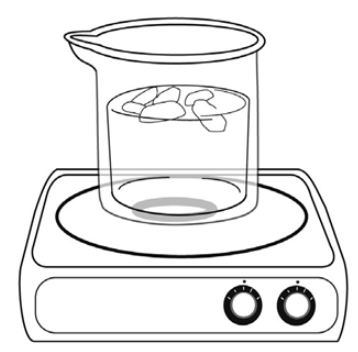
Emerson places a beaker of water on a hotplate and turns the hotplate on. The temperature in the room is 25 ºC. After the water heats to 75 ºC, she adds pieces of ice to the beaker.


Which of the following describes a transfer of heat energy that occurs during this experiment?

a)

from the air to the water

b)

from the ice to the beaker

c)

from the water to the ice

d)

from the water to the hotplate

60.

How does the thermal energy of the liquid in the larger beaker compare to the thermal energy of the liquid in the smaller beaker?

a)

The liquid in the larger beaker has less thermal energy than the liquid in the smaller beaker.

b)

The liquid in the larger beaker has more thermal energy than the liquid in the smaller beaker.

c)

The liquid in the larger beaker has the same amount of thermal energy as the liquid in the smaller beaker.

d)

The exact volume of the liquid in each beaker must be known to compare the thermal energy of the liquids.

61.

The pan is made of iron. The handle is NOT too hot to touch. What might the pan's handle be made of?

a)

copper

b)

aluminum

c)

wood

d)

iron

62.
There are four cups of hot cocoa. The cup sizes are shown. The temperature of the cocoa in each cup is 25 degrees celsius. Which cup has the MOST thermal energy?
a)
Large cup (Trenta)
b)
Small cup (Tall)
c)
Venti
d)
All three are the same temperature so they have same thermal energy
63.
Which best describes the process of convection?
a)
Convection is the primary way  heat travels  through rays.
b)
Convection is the primary way heat travels  through metals.
c)
Convection is the primary way heat travels  through appliances.
d)
Convection is the primary way heat travels  through liquids and gasses.
64.
Which is an example of heat being transferred by conduction?
a)
a furnace heating the air in a school
b)
an ice cube melting in a person’s hand
c)
a pot of water on a stove boiling
d)
the sun heating water in a swimming pool
65.
Warm air rises and the cool air sinks demonstrates this type of heat transfer. 
a)
conduction
b)
convection
c)
radiation
d)
Insolation 
66.
What happens to particles as they heat up?
a)
They slow down
b)
Nothing
c)
They don't move
d)
They speed up
67.
Mittens help keep your hands warm in winter because:
a)
They are conductors of heat.
b)
They are fuzzy.
c)
They are conductors of electrical energy.
d)
They are insulators.
68.
What energy transformations take place when a battery-operated radio is in use?
a)
Electrical to chemical to light
b)
Sound to chemical to mechanical
c)
Chemical to electrical to sound
d)
Light to electrical to thermal
69.
When a pendulum swings, at which point is potential energy at its greatest?
a)
1
b)
2
c)
3
d)
4
70.

At which position does the child on the swing have the most gravitational potential energy?

a)

W

b)

X

c)

Y

d)

Z

71.
At point B, the energy is ______.
a)
Potential
b)
Kinetic
c)
Thermal
d)
Chemical
72.
At which point is kinetic energy greatest? 
a)
W
b)
X
c)
Y
d)
Z
73.

What is the total energy of all of the particles in an object?

a)

Thermal Energy

b)

Heat

c)

Temperature

74.

What type of thermal energy transfer is number 2 pointing to?

a)

Convection

b)

Conduction

c)

Radiation

d)

Insulation

75.

Most natural gas is used to ______________.

a)

power cars

b)

to run power plants

c)

heat homes

d)

create electricity

76.

Nuclear energy comes from breaking apart which element.

a)

radium

b)

uranium

c)

polonium

d)

ruhlium

77.

Which one of these is not a fossil fuel?

a)

coal

b)

oil

c)

natural gas

d)

nuclear energy

78.

What is the main reason we use oil/petroleum?

a)

farming

b)

coooi

c)

transportation

d)

construction

79.
Fossil fuels are classified as nonrenewable because they.......
a)
require expensive equipment
b)
take millions of years to replace
c)
can be found all over 
d)
provide all the energy we use
80.
What are the 3 main fossil fuels?
a)
Coal, Oil, and Gasoline
b)
Coal, Oil, and Natural Gas
c)
Electricity, Gasoline, Petroleum
d)
Coal, Oil, Non-renewable Resources
81.
6. Gasoline comes from which fossil fuel?
a)
Coal
b)
Petroleum
c)
Natural Gas
82.
Which fossil fuel is used to make plastics, fabrics, and medicines?
a)
Coal
b)

Oil/petroleum

c)
Natural gas
83.

Which fossil fuel is mainly used for electricity?

a)
Coal
b)
Oil
c)
Natural gas
84.
What percentage of our energy use comes from fossil fuels?
a)
25%
b)
45%
c)
61%
d)
86%
85.
The splitting of a nucleus of an atom is called____
a)
Fission
b)
Fusion
c)
Radioactive waste
d)
Craziness
86.

What is energy we get from burning living things?

a)

Hydroelectricity

b)

Wind Energy

c)

Biomass Fuel

d)

Hydrogen Power

87.

A renewable resource is

a)

Something that will eventually run out

b)

Something that is always available and replaced quickly

c)

Is created when a cow burps

d)

Something that creates a lot of greenhouse gasses

88.

Which renewable resource is created using a dam or control gates?

a)

Solar Power

b)

Wind Power

c)

Hydroelectric Power

d)

Biomass Fuel

89.

Turbines or windmills are used to produce electricity from __.

a)

wind

b)

hydropower

c)

geothermal

d)

solar

90.

In a coal-fired energy plant, what is the energy transformation?

a)

nuclear --> mechanical --> electrical

b)

chemical --> mechanical --> electrical

c)

mechanical --> electrical

d)

electrical --> mechanical --> electrical

91.

Which renewable energy source gets its energy from the Earth?

a)

hydropower

b)

wind

c)

geothermal

d)

solar

92.

____________________ is the process by which water on the ground surface enters the soil.

a)

Infiltration

b)

Percolation

c)

Deposition

d)

Condensation

93.
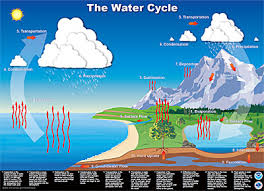
Water continually cycles between the atmosphere (troposphere), land, and ocean via the water cycle.  These processes are propelled by sunlight and gravity.
a)
precipitation
b)
condensation
c)
water cycle (hydrologic cycle)
d)
surface run off
94.
Forms of water falling from the sky as rain, sleet, hail, and snow. 
a)
condensation
b)
transpiration
c)
precipitation  
d)
surface run off
95.
When water enters the atmosphere as water vapor through the release of water vapor from plants' leaves.                
a)
evaporation
b)
transpiration                                      
c)
condensation
d)
ground water
96.
Which stages does liquid water from the ocean turn into water vapor?
a)
condesantion
b)
evaporation
c)
precipitation
d)
run off
97.
What is B?
a)
Evaporation
b)
Condensation
c)
Precipitation
d)
Runoff
98.
Which reservoir in the water cycle contains the most water?
a)
Ice Caps
b)
Lakes
c)
Groundwater
d)
Oceans
99.
The hydrologic cycle is a continuous process driven by energy from the ...
a)
Moon.
b)
Sun.
c)
gravity.
d)
Earth's interior.
100.
The supply of freshwater under the Earth's surface.
a)
watershed
b)
mouth
c)
headwaters
d)
groundwater
101.
What part of the water cycle does this picture show?
a)
condensation
b)
precipitation
c)
evaporation
102.
What is the water cycle?
a)
the 3 forms of water
b)
the movement of water on, above, or below the surface of the Earth
c)
when water melts
d)
when clouds form
103.
Water vapor is the _______ form of water.
a)
solid
b)
liquid
c)
gaseous
104.
Which stage does the #3 show in the diagram?
a)
condensation
b)
evaporation
c)
precipitation
d)
run off
105.

Water that flows across the land and enters rivers and streams. It eventually flows into lakes and the ocean.

a)

Snowmelt runoff

b)

Surface Runoff

c)

Deposition

d)

Precipitation

106.

When a solid turns into a gas without ever being a liquid

a)

Evaporation

b)

Precipitation

c)

Sublimation

d)

Condensation

107.

If each ball is rolled with the same amount of force on the same surface, which ball will roll the farthest?

a)

Golf Ball 46 grams

b)

Tennis Ball 58 Grams

c)

Soccer Ball 420 Grams

d)

Basketball 600 Grams

108.

Samuel rolled each ball with the same amount of force. Which ball most likely rolled the farthest?

a)

500 grams

b)

900 grams

c)

700 grams

d)

300 grmas

109.
Two nuclei with low masses are combined to form one nucleus of larger mass is called what?
a)
Nuclear fission
b)
Nuclear fussion
c)
Nuclear half-life
d)
Half-life
110.
At what position does the rock have the greatest kinetic energy?
a)
A
b)
B
c)
D
d)
E
111.

What type of energy is greatest when the cannonball is at point C?

a)

kinetic energy

b)

potential energy

c)

elastic energy

d)

compressed energy

112.

What type of energy is greatest when the cannonball is at point A?

a)

kinetic energy

b)

potential energy

c)

elastic energy

d)

compressed energy

113.

Some characteristic types of wind result where global pressure belts meet. Which of the following is a zone of weak, variable winds located at 30°N and 30°S latitude?

a)

jet streams

b)

local winds

c)

the doldrums

d)

the horse latitudes

114.

The Coriolis Effect greatly affects the paths of air circulation on Earth. What causes the Coriolis Effect?

a)

the sun

b)

the moon

c)

Earth’s rotation

d)

Earth’s revolution

115.

As cold air sinks, it causes more pressure on Earth.

a)

High Pressure

b)

Low Pressure

c)

Wind

d)

Jet Stream

116.

Warm air rises causing less pressure on Earth

a)

High Pressure

b)

Low Pressure

c)

Wind

d)

Jet Stream

117.

Name that Breeze

a)

Sea Breeze

b)

Land Breeze

c)

Valley Breeze

d)

MOuntain Breeze

118.

Air moves from a ____ pressure area to a ____ pressure area. 

a)

High / Low

b)

High / High

c)

Low / High

d)

Low / Low

119.

Name that breeze

a)

Sea Breeze

b)

Land Breeze

c)

Valley Breeze

d)

Mountain Breeze

120.

Name that breeze

a)

Sea Breeze

b)

Land Breeze

c)

Valley Breeze

d)

Mountain Breeze

121.

A narrow belt of high-speed winds that blow from west to east. 

a)

High Pressure

b)

Low Pressure

c)

Wind

d)

Jet Stream

122.

Name that breeze

a)

Sea Breeze

b)

Land Breeze

c)

Valley Breeze

d)

Mountain Breeze

123.

What causes differences in air pressure?

a)

even heating of the Earth

b)

Even cooling of the earth

c)

uneven heating of the earth

d)

global warming

124.
Which global winds have the greatest impact on the weather in the US?
a)
trade winds
b)
prevailing westerlies
c)
doldrums
d)
polar easterlies
125.
In which direction do prevailing westerlies flow?
a)
from east to west
b)
from west to east
c)
from north to south
d)
from south to north
126.
What type of winds blow constantly, predictably, and over long distances?
a)
land breezes
b)
mountain breezes
c)
global winds
d)
land breezes
127.
The tropical winds running from 0 to 30 degrees latitude are called:
a)
subtropical westerlies
b)
polar westerlies
c)
trade winds
d)
polar winds
128.
Cool, sinking air at 30 degrees North create a pressure belt known as the:
a)
Trade Winds
b)
Doldrums
c)
Horse Latitudes
d)
Westerlies
129.

What is the jet stream?

a)

Precipitation in North Carolina

b)

Weather over a long period of time

c)

Strong winds above the Earth's surface

d)

Football flying over the Earth

130.

Which best describes a characteristic of the jet stream?

a)

It forms a boundary between a cold air mass and a warm air mass.

b)

It creates the high winds around the eye of a hurricane.

c)

It forces the hot air along the equator to rise to areas in North

America.

d)

It causes high pressure air masses to rotate clockwise.

131.

What will most likely result when the jet stream moves south of North

Carolina?

a)

North Carolina will experience tropical weather conditions.

b)

North Carolina will experience hot, dry weather.

c)

North Carolina will experience mild weather.

d)

North Carolina will experience cold weather.

132.
Why does warm air rise?
a)
Warm air is more dense than cooler air.
b)
Warm air has more pressure than cooler air.
c)
Warm air is less dense than cooler air.
d)
Warm air has a higher dew point than cooler air.
133.

Polar Easterlies

a)

bands of high and low pressure found about every 30 degrees of latitude

b)

the curving of a path of a moving object from an otherwise straight path due to Earth's rotation

c)

winds that blow from east to west between 60 and 90 degrees latitude

d)

narrow belts of strong winds that blow in the upper troposphere

134.

westerlies

a)

winds that blow from west to east between 30 and 60 degrees latitude in both hemishpheres

b)

winds that blow from 30 degrees latitude almost to the equator in both hemispheres

c)

area around the equator where there is very little wind ("dull", "sluggish")

d)

area around 30 degrees latitude in both hemispheres where there is very little wind

135.

trade winds

a)

winds that blow from west to east between 30 and 60 degrees latitude in both hemispheres

b)

winds that blow from 30 degrees latitude almost to the equator in both hemispheres

c)

area around the equator where there is very little wind ("dull", "sluggish")

d)

area around 30 degrees where there is very little wind

136.

doldrums

a)

winds that blow from west to east between 30 and 60 degrees latitude in both hemispheres

b)

winds that blow from 30 degrees latitude almost to the equator in both hemishperes

c)

area around the equator where there is very little wind ("dull", "sluggish")

d)

area around 30 degrees latitude where there is very little wind

137.

horse latitudes

a)

winds that blow from west to east between 30 and 60 degrees latitude in both hemispheres

b)

winds that blow from 30 degrees latitude almost to the equator in both hemispheres

c)

area around the equator where there is very little wind ("dull", "sluggish")

d)

area around 30 degrees latitude in both hemispheres where there is very little wind

138.

Which of the following movements of ocean water has the greatest direct effect on the growth of producers?

a)

upwelling

b)

deep current

c)

surface current

d)

convection current

139.

Which three factors most directly affect surface currents in the oceans?

a)

upwelling, convection, and the sun’s energy

b)

deep currents, convection currents, and surface winds

c)

dissolved solids, dissolved gases, and the sun’s energy

d)

surface winds, the Coriolis Effect, and continental deflection

140.

Stream like movements of water

a)

Ocean Currents

b)

Continental Deflections

c)

Coriolis Effect

d)

Upwelling

141.

Currents change direction by hitting the continents or other large landmass.

a)

Ocean Currents

b)

Continental Deflections

c)

Coriolis Effect

d)

Upwelling

142.

Movements of ocean water located far below the surface.

a)

Ocean Currents

b)

Convection Currents

c)

Deep Currents

d)

Surface Currents

143.

The Gulf Stream carries _____________ water from the east coast of The United States to the West coast of Europe.

a)

Cold

b)

Warm

c)

Freezing

d)

Fresh

144.

Warm water from surface currents replaces colder denser water that sinks to the ocean floor.

a)

Ocean Currents

b)

Convection Currents

c)

Deep Currents

d)

Surface Currents

145.

Surface Currents are driven mainly by

a)

Coriolis Effect

b)

Wind

c)

Upwelling

d)

Moon

146.

What does the blue line represent in the Thermohaline circulation?

a)

Warm salty water

b)

Warm water

c)

Cold water

d)

Cold salty water

147.
Two types of ocean currents are
a)
local and global
b)
sea and land
c)
surface and deep
d)
warm and cold
148.

________ and _______ affect the ocean's density and cause the Global Conveyor Belt to travel

a)

gravity and the Coriolis Effect

b)

temperature and salinity

c)

wind and climate

d)

temperature and the Coriolis Effect

149.
Which current affects the west coast?
a)
California Current
b)
Gulf Stream Current
c)
Caribbean Sea Current
150.
Analyze the map.
Why is it colder in San Diego than it is in Charleston even though they are the same distance from the Equator?
a)
San Diego is affected by the Gulf Stream
b)
Charleston is affected by the California current
c)
San Diego is affected by the California Current
151.
Analyze the map.
Why is it warmer in Charleston than it is in San Diego even though they are the same distance from the Equator?
a)
San Diego is affected by the Gulf Stream
b)
Charleston is affected by the California current
c)
Charleston is affected by the Gulf Stream
152.
Which of the following describes what is happening in a low pressure system?
a)
cold air sinking
b)
cold air rising
c)
warm air rising
153.
Which of the following describes what is happening in a high pressure system?
a)
cold air sinking
b)
cold air rising
c)
warm air rising