wayground logo

Free Printable Worksheets

Font size

S
M
L
XL
Worksheets

MIDTERM REVIEW 23-24

Total questions: 155

Worksheet time: 4hrs 30mins

Name
Class
Date
1.
What kind of energy is in a moving skateboard?
a)
Potential
b)
Kinetic
2.
What kind of energy is in a rock at the edge of a cliff?
a)
Potential
b)
Kinetic
3.
What kind of energy is in a stretched rubber band?
a)
Potential
b)
Kinetic
4.
The faster an object moves, the ________ kinetic energy it has. 
a)
more
b)
less
c)
none of the above
d)
all of the above 
5.
__________ is stored energy. 
a)
Potential
b)
Kinetic
c)
None of the above 
d)
All of the above 
6.
Gravitational potential energy depends on the ________ and ________ of the object. 
a)
Height and mass
b)
Friction and movement
c)
Mass and Movement
d)
Height and Friction 
7.
Energy _______ be created or destroyed. 
a)
Shouldn't
b)
Will
c)

Cannot 

d)
Can 
8.
Acceleration is a change in ________. 
a)
direction 
b)
speed 
c)
velocity 
d)
distance 
9.
Velocity is both ____ and _____. 
a)
speed , direction 
b)
direction, mass
c)
volume, density 
d)
direction, magnitude 
10.
 Who will win the tug of war contest and with how much force?  
a)
Students on the right with 300 N
b)
Students on the left 300 N
c)
It will end in a tie with 0 N
d)
Students on the right with 600 N
11.
Energy due to motion is ____________ energy. 
a)
Potential 
b)
Energy
c)
Kinetic
d)
Friction
12.
Explain what happens to the potential energy of a rock as it falls off the side of a cliff.
a)
The kinetic energy decreases as the potential energy increases.
b)
The kinetic energy decreases as the potential energy decreases.
c)
The potential energy decreases as the kinetic energy increases.
d)
The potential energy decreases as the kinetic energy decreases. 
13.
When riding a roller coaster, you go up and down many hills. As you get to the top of a roller coaster, what energy change is taking place.
a)
Potential energy is changed into kinetic energy.
b)
Kinetic energy is changed into potential energy.
c)
Chemical energy is changed into heat energy.
d)
Heat energy is changed into chemical energy. 
14.
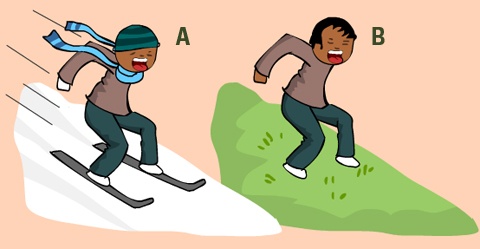
Why is it harder for the boy in Image B to get down the hill?
a)
Motion
b)
Friction
c)
Work
d)
Displacement
15.
Edward kicks a soccer ball across the backfield. What force works to slow the ball down?
a)
pushes and pulls
b)
friction
c)
magnetism
d)
gravitation
16.

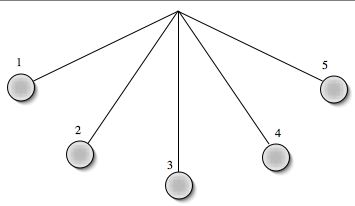
When a pendulum swings, at which point is potential energy at its GREATEST?

a)

1 due to greatest height

b)

2 due to speed increasing

c)

3 due to greatest speed

d)

4 due to height increasing

17.

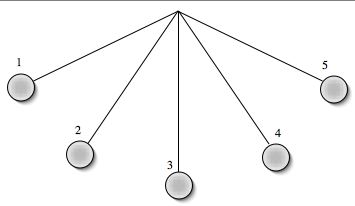
When a pendulum swings, at which point is kinetic energy GREATEST?

a)

1 due to greatest height

b)

2 due to increasing speed

c)

3 due to greatest speed

d)

4 due to increasing height

18.

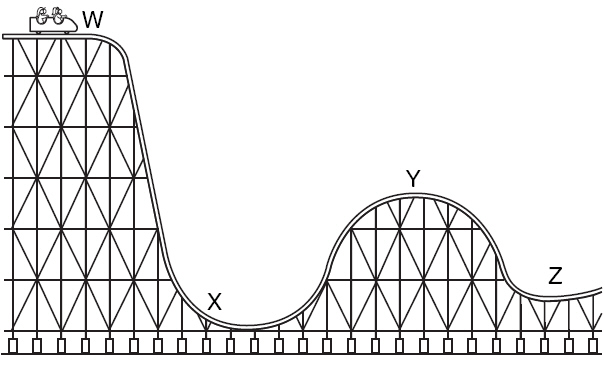
At which point is kinetic energy GREATEST?

a)

W due to greatest height

b)

X due to greatest speed

c)

Y due to increasing height

d)

Z due to increasing speed

19.

At which point is potential energy GREATEST?

a)

W due to greatest height

b)

X due to greatest speed

c)

Y due to increasing height

d)

Z due to increasing speed

20.

The Law of Conservation of states that energy cannot be created or destroyed, only converted from one form to another.

a)

true

b)

false

21.

While walking you make a right turn. Did you accelerate?

a)

yes

b)

no

22.

You are walking and start to slow down. Did you accelerate?

a)

yes

b)

no

23.

Which value represents a velocity?

a)

10 m

b)

10 m/s

c)

10 m/s north

d)

10 m/s squared

24.

What happens to energy during a collision?

a)

It is Conserved

b)

It is Wasted

c)

It Runs Out

d)

It is Gained

25.

A force is...

a)

a push

b)

a pull

c)

a push or pull

d)

a push or pull that can change the motion of an object
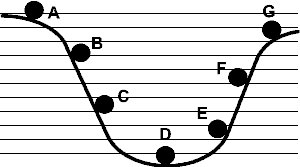
26.
Which point has the most potential energy?
a)
G
b)
f
c)
b
d)
a
27.

When riding a roller coaster, you go up and down many hills. As you go up one of the hills , what energy change is taking place.

a)

Potential energy is changed into kinetic energy.

b)

Kinetic energy is changed into potential energy.

c)

Chemical energy is changed into heat energy.

d)

Heat energy is changed into chemical energy.

28.
The basic unit of matter is
a)
a mixture
b)
a substance
c)
an atom
d)
a compound
29.
A substance that contains only one type of atom is a(n)
a)
compound
b)
element
c)
heterogeneous mixture
d)
homogeneous mixture
30.
Which of these is a pure substance?
a)
bread
b)
table salt
c)
garden soil
d)
sea water
31.
Which of these is an example of a molecule?
a)
a small nugget of pure gold
b)
the smallest grain of salt in a salt shaker
c)
 a small drop of sugar water
d)
two oxygen atoms joined to a carbon atom
32.
Which of these is a mixture?
a)
Uncooked chocolate chips and cookie dough blended together with a spoon.
b)
Distilled water
c)
A nugget of gold
d)
A molecule of Oxygen
33.
DIFFERENT kinds of atoms chemically combined to form a substance are
a)
Mixture
b)
Element
c)
Compound
d)
Substance
34.
This picture represents which of the following?
a)
element
b)
compound
c)
mixture
35.
This picture represents which of the following?
a)
element
b)
compound
c)
mixture
36.
An element is made up of only one kind of _____.
a)
isotope
b)
plastic
c)
atom
d)
metal
37.
Classify the picture with the correct label.
a)
Element
b)
Compound
c)
Mixture of Elements and Compounds
d)
Mixture of Elements
38.
Classify the picture with the correct label.
a)
Compounds
b)
Mixture of Elements
c)
Mixture of Compounds
d)
Mixture of Elements & Compounds
39.
What does the picture show?  
a)
carbon dioxide molecule
b)
glucose
c)
water molecule
d)
oxygen molecule
40.
What does the picture show?  
a)
carbon dioxide molecule
b)
oxygen molecule
c)
water molecule
d)
glucose molecule
41.
a)
Element
b)
Compound
c)
Mixture of compound and element
d)
Mixture of two elements
42.
Two or more physically combined substances form —
a)
a compoud
b)
an acid
c)
an element
d)
a mixture
43.
NaHCO3 is an example of —
a)
an abbreviation
b)
a compound
c)
a mixture
d)
an element
44.
A substance made of only one type of atom is called —
a)
an element
b)
a mixture
c)
a compound
d)
a salt
45.
Which of the following is a way in which elements and compounds are similar?
a)
Elements and compounds are pure substances.
b)
Elements and compounds are both made up of different kinds of atoms.
c)
Elements and compounds can both be broken down by physical means.
d)
Elements and compounds are listed on the periodic table.
46.
What is an example of an element?
a)
Oxygen
b)
Pure water
c)
Air
d)
Table salt
47.

In this chemical equation , the 2 in front of the 2O2 and the 2 in front of the 2H2O are called the...

a)

Products

b)

Reactants

c)

Coefficient

d)

Subscript

48.

In this chemical equation ,the small numbers dropped down below the letters like the 4 in CH4 are known as the

a)

Products

b)

Reactants

c)

Coefficient

d)

Subscript

49.

How many Carbons are on EACH side of the chemical reaction?

a)

1

b)

3

c)

4

d)

5

50.

What makes elements and compounds different from mixtures? Elements & compounds-

a)

have a constant composition (pure substances)

b)

are made of gases

c)

Will not change when heated

d)

conduct electric current

51.

What is the relationship between molecules and atoms?

a)

Molecules are combinations of two or more atoms.

b)

Molecules are the parts that make up atoms

c)

Molecules are the gaseous parts of atoms

d)

Molecules are atoms that have a positive charge

52.

Mixtures are different than pure substances because mixtures-

a)

have lower boiling points

b)

can be separated physically

c)

are less dense than pure substances

d)

contain only one type of atom

53.

Beatriz wants to make a mixture out of her bowl of blueberries. Which of the following would turn her bowl of blueberries into a mixture?

a)

adding more blueberries to the bowl

b)

adding raspberries to the bowl

c)

cutting up the blueberries

d)

mashing the blueberries

54.
This picture represents which of the following?
a)
Element
b)
Compound
c)
Mixture
55.
This picture represents which of the following?
a)
element
b)
compound
c)
mixture
56.
What is water?
a)
element
b)
compound
c)
mixture
57.
A pure substance that cannot be broken down into other substances by chemical or physical means. 
a)
compound          
b)
atom
c)
mixture 
d)
element
58.
Which of the following represents an element?
a)
H2O
b)
H2
c)
NaCl
d)
CaCO3
59.
How many elements are represented in the compound?
Na2CO3
a)
1
b)
2
c)
3
d)
4
60.

Examples are diamonds (C) and Uranium (U)

a)

elements

b)

mixtures

c)

compounds

61.

These are found on the Periodic Table.

a)

elements

b)

mixtures

c)

compounds

62.

You can make synthetic products from these things...

a)

Plant based resources

b)

Animal based resources

c)

Petroleum based resources

d)

All of the above

63.

Two or more different elements chemically combined:

a)

an atom

b)

a compound

c)

a mixture

d)

a pure substance

64.

A substance that cannot be broken down into any other substance by ordinary laboratory means is called —

a)

molecule

b)

mixture

c)

element

d)

compound

65.

What is an example of a mixture?

a)

Table salt

b)

water

c)

Oxygen

d)

Air

66.

Two or more substances NOT chemically combined or in a specific ratio is called —

a)

a compound

b)

a pure substance

c)

an element

d)

a mixture

67.

What is H2SO4 made up of?

a)

2 hydrogen, 1 sulfur, 4 oxygen

b)

1 hydrogen, 2 sulfur, 4 oxygen

c)

2 hydrogen & 4 sodium

d)

1 hydrogen & 6 sodium

68.

What does it mean if a substance is natural?

a)

it is a material that doesn't occur in nature, but is made from natural resources that undergo a chemical change.

b)

it is a material found in or caused by nature

69.

What does it mean if a substance is synthetic?

a)

it is a material that doesn't occur in nature, but is made from natural resources that undergo a chemical change.

b)

it is a material found in or caused by nature

70.

Synthetic materials can all be traced back to natural sources.

a)

True

b)

False

71.

Which of the following is not a compound?

a)

HCl

b)

Cl

c)

NaCl

d)

CO2

72.

This contains a variety of elements and compounds that ARE NOT chemically combined.

a)

Water

b)

Mixture

c)

Elements

d)

Compounds

73.

Humans absorb oxygen from the air they breathe in and exhale carbon dioxide gas, CO2. Carbon dioxide gas is

a)

an element made of carbon and oxygen atoms.

b)

a solution made of carbon and oxygen atoms.

c)

a compound of carbon and oxygen atoms.

d)

a mixture of carbon and oxygen atoms.
74.
Which of the following is transmitted by waves?
a)
atoms
b)
matter
c)
energy
d)
resonance
75.
Waves can travel through empty space or they can travel through a medium. Which statement best describes a medium?
a)
The solid matter that waves travel through
b)
The gas matter that waves travel through
c)
The liquid matter that waves travel through
d)
The solid, liquid, or gas matter that waves travel through
76.
The action of a wave bouncing off a surface is called __________________.
a)
rarefaction
b)
refraction
c)
reflection
d)
diffraction
77.
Sound is caused by? 
a)
force
b)
vibrations
c)
instruments
d)
medium
78.
Sound is a form of? 
a)
energy
b)
pitch
c)
volume
d)
matter
79.
This is what you get when sound waves are reflected, or bounce back, off of a hard surface.
a)
Amplitude
b)
Pitch
c)
Volume
d)
Echo
80.
Why is sound able to travel faster through a solid than a gas?
a)
Gas molecules are packed tightly.
b)
Sound does not travel faster through a solid than a gas.
c)
Solid molecules are packed tightly.
d)
Gas molecules move slowly.
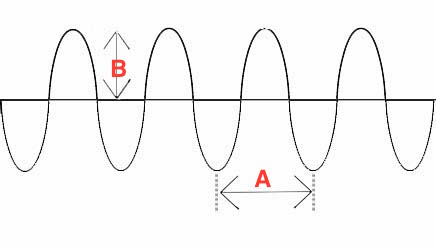
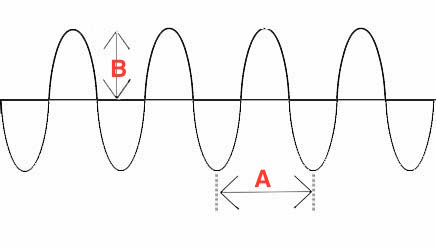
81.

What property of this wave is represented by the letter "A"

a)

amplitude

b)

crest

c)

trough

d)

wavelength

82.
What property of the wave is represented by the letter "B"?
a)
amplitude
b)
crest
c)
trough
d)
wavelength
83.
The highest point on a wave is:
a)
the crest
b)
the trough
c)
the top
d)
the coast 
84.
The lowest point on a wave is the:
a)
Amplitude
b)
Crest
c)
Trough
d)
Wavelength
85.
The number of wavelengths that pass a point each per second is:
a)
frequency
b)
period
c)
longitudinal 
d)
transverse wave 
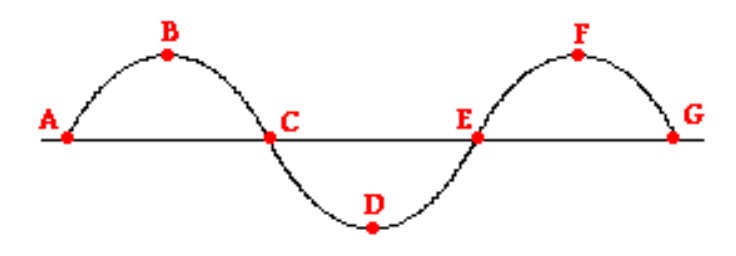
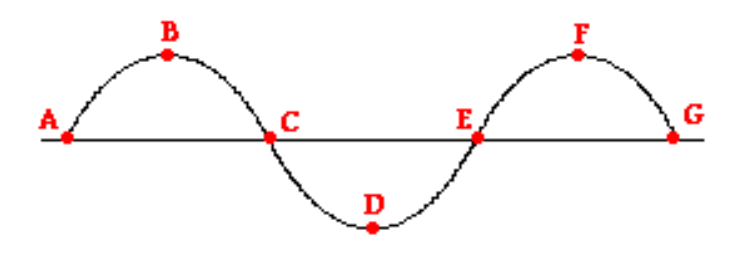
86.
Which vocabulary term is used to identify the distance between points C & G?
a)
Amplitude
b)
Crest
c)
Frequency
d)
Wavelength
87.
When the frequency of a wave increases, what happens to the wavelength?
a)
The wavelength is not directly affected by the frequency of a wave.
b)
The wavelength increases.
c)
The wavelength decreases.
d)
More specific information is needed to form a conclusion about the wavelength.
88.
Which letter(s) represent the trough of the wave?
a)
A
b)
B & D
c)
D
d)
C & G
89.
Which letter(s) represent the crest of the wave?
a)
A
b)
B & D
c)
B & F
d)
F
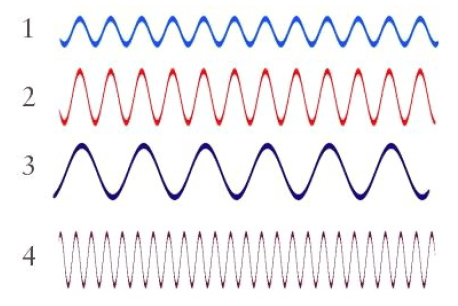
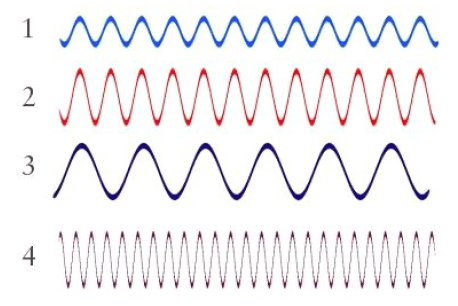
90.
Which wave in the diagram has the greatest frequency?
a)
1
b)
2
c)
3
d)
4
91.
Which wave in the diagram has the greatest wavelength?
a)
1
b)
2
c)
3
d)
4
92.
Which of the following can sound travel through?
a)
solid
b)
liquid
c)
gas
d)
all of the above
93.
crest to crest or trough to trough
a)
crest
b)
trough
c)
amplitude
d)
wavelength
94.
Electromagnetic waves include the following except
a)
radio waves
b)
X-rays
c)
doing the wave at a football game
d)
microwaves
95.
A wave carries...?
a)
energy only
b)
matter only
c)
energy and matter
d)
neither
96.
Amplitude is a measure of how much _________ the wave is carrying
a)
energy
b)
matter
c)
medium
d)
frequency
97.
Which wave has a greater frequency?
a)
A
b)
B
98.
You can't hear sounds in outer space because there is no
a)
matter
b)
light
c)
energy
d)
heat
99.
When a wave's amplitude increases it means
a)
it's carrying more energy
b)
its wavelength gets longer
c)
its frequency increases
d)
its wavelength decreases
100.
What is true about a digital signal?
a)
They are easily distorted or affected by interference
b)
They take up more space
c)
They require more information
d)
They are generally considered more reliable
101.
An analog signal can have...
a)
a binary code
b)
0,1
c)
two values
d)
infinite values
102.
A digital signal takes _________ to convert from analog  to digital 
a)
the entire wave
b)
samples of the wave
103.

The type of waves that require medium to pass:

a)

Matter/Mechanical Waves

b)

Electromagnetic Waves

104.

regular disturbances patterns that carry energy through matter or empty space

a)

crests

b)

energy

c)

waves

d)

troughs

105.

through which material can sound waves travel the fastest?

a)

solid

b)

liquid

c)

gases

106.

When a wave strikes an object and bounces off (example echo):

a)

medium

b)

refraction

c)

reflection

d)

interference

107.

Which of these waves can travel in a vacuum (empty space)/

a)

sound wave

b)

radio (electromagnetic) wave

c)

compressional wave

d)

water wave

108.

How much of the electromagnetic spectrum is visible to human eyes?

a)

All of it

b)

None of it

c)

Most of it

d)

Only a small part

109.

Light is a form of

a)

energy

b)

matter

c)

reflection

110.

Which of the following is NOT a matter/mechanical wave?

a)

sound

b)

light

c)

ocean

d)

seismic (earthquake)

111.

What kind of waves can travel through empty space?

a)

electromagnetic waves

b)

compressional (sound) waves

c)

longitudinal (earthquake) waves

d)

water waves

112.
Poor conductors like wood and plastic are called:
a)
conductors
b)
insulators
c)
burners
113.
What kind of heat transfer happens when the sun is heating your body?
a)
Conduction
b)
Radiation
c)
Convection
d)
Density
114.
Which of the following is needed for convection to happen?
a)
Fluid/s
b)
Light in the form or rays
c)
Electromagnetic waves
d)
Fire
115.
Heat transfers from an area of ____temperature to an area of ___ temperature.
a)
high to low
b)
low to high
c)
high to high
d)
It can travel high to low and low to high. 
116.
Ironing a shirt is an example of...
a)
condensation
b)
conduction
c)
convection
d)
radiation
117.
Transfer of thermal energy through "space"
a)
conduction
b)
convection
c)
radiation
118.
Near the ceiling of a room the air is warmer.  The warm air rises because of
a)
conduction
b)
convection
c)
radiation
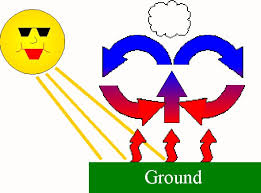
119.
A huge rock at the state park gets so hot during the day because of
a)
conduction
b)
convection
c)
radiation
120.
You get sunburned due to __________ from the sun.
a)
conduction
b)
convection
c)
radiation
121.
A chair is placed several feet from a fireplace.  The fireplace has a glass screen.  The side of the chair facing the fireplace gets warm because of 
a)
conduction
b)
convection
c)
radiation
122.
Conductors are materials that...
a)
Allow heat to pass through
b)
Stop heat from passing through
c)
Allow cold to pass through
d)
Stop cold from passing through
123.
The kind of heat transfer that travels through space in electromagnetic waves is ______________________.
a)
insulation.
b)
Radiation
c)
Conduction
d)
Convection
124.
In heat transfer, heat always flows from the _______________ substance to the _______________ substance.
a)
Hotter to colder
b)
Colder to hotter
c)
Hotter to hotter
d)
Colder to colder
125.
The type of heat transfer that happens through direct contact of molecules or particles with each other is ___________________.
a)
Convection
b)
Conduction
c)
Radiation
d)
insulation.
126.
___________________ is the type of heat transfer that occurs in fluids, such as warm air rising and cold air sinking; creating wind.
a)
Convection
b)
Conduction
c)
Radiation
d)
insulation.
127.
Two objects at different temperatures are in contact. Which of the following happens to their thermal energy?
a)
Their thermal energies remain the same.
b)
Thermal energy passes from the cooler object to the warmer object
c)
Thermal energy passes from the warmer object to the cooler object.
d)
Thermal energy passes back and forth equally between the two objects.
128.
When you use a microwave, what is the main way that heat is transferred?
a)
Convection
b)
Conduction
c)
Radiation
d)
insulation.
129.
The handle of a metal spoon warms up when it is placed in a hot bowl of soup because of
a)
Convection
b)
Conduction
c)
Radiation
d)
insulation.
130.
Which of the following is NOT a conductor?
a)
oven mitt
b)
curling iron
c)
iron skillet
d)
copper pipe
131.
Which of the following is the best example of conduction?
a)
A light bulb warming a lampshade
b)
An egg cooking in a frying pan
c)
Water boiling in a pot
d)
Gases circulating in the atmosphere
132.
Which statement is true about radiation?
a)
Radiation is the transfer of heat through electromagnetic waves
b)
Radiation is the transfer of heat through direct contact.
c)
Radiation is more dangerous than conduction.
d)
Radiation is the transfer of heat through liquids and gases
133.
Which situation best represents conduction?
a)
Heat from a campfire
b)
A hot air balloon taking off
c)
Touching a hot piece of metal
d)
Getting sunburned
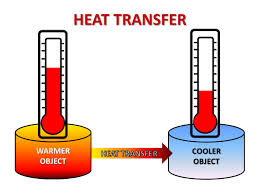
134.
Which direction will the heat flow while this person holds a hot cup of tea?
a)
from the cup to her hand
b)
from her hand to the cup
c)
no heat is transferred
135.

Transfer of thermal energy through "flow" of liquids and gases

a)

conduction

b)

convection

c)

radiation

136.

Marcie played with her friends out in the cold, cloudy weather, wearing her wool hat. After the group had finished building snowmen and having snowball fights, Marcie went back inside to warm up and drink some hot chocolate. When she took her hat off, she realized that it was very warm. What happened?

a)

The radiant energy from the sun warmed up her hat and the hat kept that heat from the sun.

b)

Her hat was warm because wool fabric is warmer than other fabrics.

c)

The humidity outside made her hat warm.

d)

Conduction between Marcie's warm body and the hat occurred and the hat remained warm because it is an insulator.

137.

A large house being heated by heater warms a house when the air is circulating. What type of thermal energy transfer is this?

a)

Convection

b)

Conduction

c)

Radiation

d)

insulation.

138.

The baby chickens kept warm from the heat lamps demonstrates this type of heat transfer.

a)

conduction

b)

convection

c)

radiation

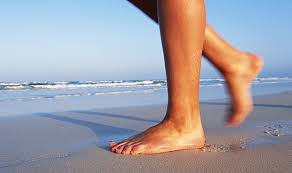
139.

Walking on the warm sand with your bare feet demonstrates this type of heat transfer.

a)

conduction

b)

convection

c)

radiation

140.

Johnny accidentally grabbed the handle of the hot pot. What type of thermal energy transfer is this?

a)

conduction

b)

convection

c)

radiation

141.

A group of friends gather around a fire to stay warm. What type of thermal energy transfer is this?

a)

conduction

b)

convection

c)

radiation

142.

The warm air from this heater creates a current when the warm air rises and the cold air sinks. This illustrates what type of thermal energy transfer?

a)

conduction

b)

convection

c)

radiation

143.

As the movement (kinetic energy) of the molecules in a substance increases, the temperature of the substance __________.

a)

increases

b)

decreases

144.

If an object has particles that are moving very slowly, the object's temperature is probably ______.

a)

high

b)

very high

c)

low

d)

big

145.

A measure of the average kinetic energy of the individual particles in an object is called

a)

thermal energy.

b)

conduction

c)

convection

d)

temperature

146.

Which is the best insulator of the materials listed?

a)

Glass

b)

Metal

c)

Wood

d)

Tile

147.

Heat transfer will continue until what is reached?

a)

Energizers

b)

Equilibrium

c)

Equality

d)

Energy

148.

Warm air rising and the cooler air sinking demonstrates this type of heat transfer.

a)

conduction

b)

convection

c)

radiation

d)

Insulation

149.

The Gulf Stream is a current that brings warm ocean water from the south to the north. What type of heat transfer is this?

a)

conduction

b)

convection

c)

radiation

d)

Insulation

150.

What happens to particles as they lose thermal energy?

a)

They slow down

b)

Nothing

c)

They don't move

d)

They speed up

151.

Synthetic materials can all be traced back to natural sources.

a)

True

b)

False

152.

Makes it a good, cheap, easily made way of storing products and as a material to make many products.

a)

Negative of plastic's durability

b)

Positive of plastic's durability

153.

When humans synthesize plastic molecules from petroleum, we have changed ancient natural materials into something that nature doesn’t have a process or organism to break back down again.  We are stuck with this synthetic material.

a)

Negative of plastic's durability

b)

Positive of plastic's durability

154.

Why is it that plastic is not easily biodegradable?

a)

Plastic is synthetic, so nature does not "recognize" the molecule

b)

Since plastic is synthetic, there are no organisms that break it down

c)

Plastic is all natural, but has no decomposers

d)

Plastic is easily biodegradable

155.

A pencil is a synthetic material, but if you were to trace the atoms back, they all come from natural sources.

a)

TRUE

b)

FALSE