wayground logo

Free Printable Worksheets

Font size

S
M
L
XL
Worksheets

Electromagnetism

Total questions: 146

Worksheet time: 4hrs 12mins

Name
Class
Date
1.
Magnetism is generated by moving
a)
protons.
b)
electrons.
c)
neutrons.
d)
elements.
2.
What do the lines around this magnet represent?
a)
North Pole
b)
South Pole
c)
Magnetic Declination
d)
Magnetic Field
3.
As the distance between two magnets increases (they get farther apart), the force between them:
a)
Increases
b)
Decreases
c)
Stays the Same
4.
If you cut a magnet in half, what happens to the poles?
a)
One half gets the North Pole, the other half gets the South Pole
b)
Both halves get only a North Pole
c)
Both halves get only a South Pole
d)
Both halves get a North pole and a South Pole
5.
What is responsible for the Magnetic Field around Earth?
a)
The Earth's crust
b)
The Earth's molton iron core
c)
The Earth's mantel
d)
The Sun
6.
If the North Pole of a permanent magnet is placed next to a compass as seen in the picture, which direction will the needle move?
a)
Clockwise
b)
Counter-clockwise
c)
It will not move
d)
Need more information
7.
An electromagnet's poles may be reversed by:
a)
decreasing the voltage of the coil
b)
increasing the number of coils
c)
changing the direction of current flow
d)
altering the material used to make the coils
8.
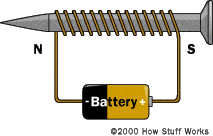
Which direction is the North Pole of this electromagnet?
a)
Right
b)
Left
c)
Up
d)
Down
9.
In un-magnetized materials the domains are __________ aligned.
a)
super
b)
slightly
c)
randomly
d)
always
10.
Electric motors are devices that convert _____ energy into  _____ energy.
a)
electrical; mechanical
b)
mechanical; electrical
c)
chemical; potential
d)
mechanical; kinetic
11.
What kind of magnet can be turned on and off?
a)
refridgerator magnet
b)
electromagnet
c)
magnetite
d)
iron
12.
The strongest part of a magnet is...
a)
the bars.
b)
the force field.
c)
the poles. 
d)
the middle.
13.

If a glass plate is placed over a magnet and iron filings are sprinkled over the glass, a pattern will be visible. What does this pattern indicate?

a)

The magnetic field

b)

The electrostatic field

c)

The piezoelectric effect

d)

The chemical reaction of the magnet and the filings

14.

What causes magnetism?

a)

the sun

b)

moving neutrons

c)

moving charges

d)

friction

15.

What causes magnetism?

a)

the sun

b)

moving neutrons

c)

moving charges

d)

friction

16.

How can a wire become magnetic?

a)

point it north

b)

add a resistor

c)

heat it up

d)

run a current through it

17.

How can a wire become magnetic?

a)

point it north

b)

add a resistor

c)

heat it up

d)

run a current through it

18.

What device takes in mechanical energy and produces electricity?

a)

motor

b)

generator

c)

electromagnet

d)

battery

19.
A north pole and a south pole will attract.
a)
True
b)
False
20.
A magnet cannot not move which of the following objects?
a)
a paper clip
b)
a nail
c)
a toothpick
d)
a staple
21.
How is a permanent magnet DIFFERENT from a temporary magnet?
a)
A permanent magnet attracts materials made of iron.
b)
A permanent magnet has poles.
c)
A permanent magnet has a magnetic field.
d)
A permanent magnet keeps its magnetism for a long time.
22.
Earth acts like a giant magnet because its center is made up MOSTLY of
a)
granite
b)
limestone
c)
iron
d)
nickel
23.
True or False: All metals stick to magnets.
a)
True
b)
False
24.
It is possible for a magnet to have only one pole.
a)
True
b)
False
25.
A device that uses a free-moving magnetic needle to show direction is a:
a)
lodestone
b)
magnet
c)
compass
d)
magnetic field
26.
Where is the force of attraction the strongest on a magnet?
a)
at the poles
b)
in the middle
c)
above the magnet
d)
below the magnet
27.
Earth's magnetic field and a bar magnet attract particles to the same locations. Where are they?
a)
The middle
b)
All around the outside
c)
The north and south poles
d)
First to the middle, then to the ends
28.
Where is Earth's magnetic field strongest?
a)
Along the outside lines
b)
Along the inside lines on either side
c)
Where the lines are close together at the poles
d)
In the space outside of the lines
29.
Why does a compass needle point north?
a)
The compass is a bar magnet
b)
Because north is up
c)
Because it's magic
d)
It lines up with the Earth's magnetic field
30.
When two magnets attract, they ______________
a)
push apart
b)
change color
c)
get colder
d)
pull together
31.
When two magnets repel, they ________________
a)
change color
b)
pull together
c)
push apart
d)
get colder
32.
What will happen when these magnets are brought close together?
a)
They will attract each other.
b)
They will repel each other.
c)
Both magnets will turn to the left
d)
Both magnets will turn to the right
33.
This large crane magnet functions only when the electrical current is ON.  The crane magnet is an example of what type of magnet?
a)
NIB Magnet
b)
Ceramic Magnet
c)
Electromagnet
d)
funnel magnet
34.
Iron, Nickel and cobalt are all __________________ materials
a)
Shiny
b)
poles
c)
magnetic
d)
cold
35.
What characteristics do magnetic substances have?
a)
They can give you a "shock" when you touch them
b)
They can push or pull objects without touching them
c)
They are always black and cold to touch
d)
They fall faster than other objects when you drop them
36.
How is Earth's magnetic field similar to that of a magnet?
a)
It is hundreds of miles long
b)
It has north and south poles
c)
It is made in Earth's core
d)
It is shaped like a horseshoe
37.
Which of the following is true of a bar magnet?
a)
Its magnetic field is strongest near its center.
b)
It is surrounded by a magnetic field.
c)
The north pole is stronger than the south pole.
d)
The south pole is stronger than the north pole.
38.
What happens when two north poles of a magnet are placed together?
a)
they repel
b)
they attract
c)
they cancel each other out
d)
the strength of the magnet is doubled
39.
Magnetism is....
a)
The part of the magnet where the force is the strongest
b)
A force created by magnets that pulls some metals
c)
To Pull towards
d)
An object able to pull some metals towards itself
40.
Poles are ....
a)
The part of the magnet where the force is the strongest
b)
A force created by magnets that pulls some metals
c)
To Pull towards
d)
An object able to pull some metals towards itself
41.
To attract means....
a)
The part of the magnet where the force is the strongest
b)
A force created by magnets that pulls some metals
c)
To Pull towards
d)
An object able to pull some metals towards itself
42.
To repel means....
a)
To push away
b)
A force created by magnets that pulls some metals
c)
To Pull towards
d)
An object able to pull some metals towards itself
43.
A magnet is...
a)
To push away
b)
A force created by magnets that pulls some metals
c)
To Pull towards
d)
An object able to pull some metals towards itself
44.
Coin
a)
Magnetic
b)
Not Magnetic
45.
eraser
a)
Magnetic
b)
Not Magnetic
46.
Metal Tack
a)
Magnetic
b)
Not Magnetic
47.
nail
a)
Magnetic
b)
Not Magnetic
48.
pencil
a)
magnetic
b)
not magnetic 
49.
Do these magnets attract or repel? 
a)
Attract
b)
Repel
50.
Do these magnets attract or repel?
a)
Attrack
b)
Repel
51.
If you place the North pole of a magnet next to the South pole of another magnet, they will:
a)
Attract
b)
Repel
c)
Do nothing
d)
Shatter
52.
On Earth, where is Magnetic North approximately located?
a)
The Equator
b)
The North Pole
c)
The South Pole
d)
New Brighton
53.
As the distance between two magnets increases (they get farther apart), the force between them:
a)
Increases
b)
Decreases
c)
Stays the Same
54.
If you cut a magnet in half, what happens to the poles?
a)
One half gets the North Pole, the other half gets the South Pole
b)
Both halves get only a North Pole
c)
Both halves get only a South Pole
d)
Both halves get a North pole and a South Pole
55.
The distance between geographic north and where a compass needle points is called:
a)
Magnetic Field
b)
Magnetic Declination
c)
Magnetic Distance
d)
Magnetic Force
56.
What is responsible for the Magnetic Field around Earth?
a)
The Earth's crust
b)
The Earth's molton iron core
c)
The Earth's mantel
d)
The Sun
57.
A refrigerator magnet is an example of a:
a)
magnetic material
b)
permanent magnet
c)
horseshoe magnet
d)
temporary magnet
58.
A paper clip is an example of a:
a)
magnetic material
b)
permanent magnet
c)
bar magnet
d)
insulator
59.
Magnetic force can pass through many materials (paper, plastic, etc.)
a)
True
b)
False
60.
If the North Pole of a permanent magnet is placed next to a compass as seen in the picture, which direction will the needle move?
a)
Clockwise
b)
Counter-clockwise
c)
It will not move
d)
Need more information
61.
An electromagnet's poles may be reversed by:
a)
decreasing the voltage of the coil
b)
increasing the number of coils
c)
changing the direction of current flow
d)
altering the material used to make the coils
62.
Which direction is the North Pole of this electromagnet?
a)
Right
b)
Left
c)
Up
d)
Down
63.
Which direction is the North Pole of this electromagnet?
a)
Right
b)
Left
c)
Up
d)
Down
64.
A device that is able to reverse the direction of current in an electromagnet causing a motor to spin the opposite way is known as:
a)
a rotor
b)
a generator
c)
a magnet
d)
a commutator
65.
Where could you hold a south pole of a permanent magnet to get the rotor to move counter-clockwise?
a)
A & B
b)
B & C
c)
A & C
d)
B & D
66.
An example of a renewable energy resource is:
a)
coal.
b)
petroleum.
c)
hydroelectric power.
d)
nuclear power.
67.
Renewable energy that comes from the sun is:
a)
solar power.
b)
hydroelectric power.
c)
wind power.
d)
electromagnetic power.
68.
What percent of the electricity produced in the US in 2007 comes from renewable resources?
a)
1.6%
b)
3.1%
c)
8.9%
d)
51.5%
69.
Which of the following will not attract or repel each other?
a)
two magnets 
b)
a magnet and a stationary charge
c)
a magnet and a current-carrying wire
d)
two current-carrying wires 
70.
Generators can produce only alternating current.
a)
True
b)
False
71.
A magnet moving back and forth in the center of a coil of wire produces a direct current in the wire.
a)
True
b)
False
72.
The strongest part of a magnet is...
a)
the bars.
b)
the force field.
c)
the poles. 
d)
the middle.
73.
Magnets have a north and a south ___________
a)
shape
b)
color
c)
pole
d)
region
74.
What kind of magnet can be turned on and off?
a)
refridgerator magnet
b)
electromagnet
c)
magnetite
d)
iron
75.
Which of the following is NOT part of an electromagnet?
a)
Wire
b)
Iron
c)
Toothpick
d)
Power source
76.
Surrounding every magnet is a __________  __________.
a)
magnetic field
b)
electrical current
c)
another magnet
77.
How many poles does a magnet have?
a)
1
b)
2
c)
3
d)
4
78.
Magnets that are arranged like this will _______. 
a)
move away from each other (repel)
b)
move towards each other (attract)
79.
These magnets will _______.
a)
move away from each other (repel)
b)
move toward each other (attract)
80.
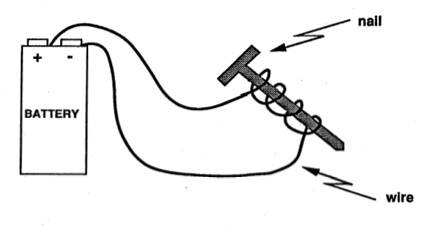
This is a picture of a simple electromagnet. How can the electromagnet be made stronger?
a)
Add more coils of wire to the nail.
b)
Use a smaller battery.
c)
Reverse the poles of the magnet.
d)
Remove all the coils and the nail.
81.
What is the device seen here?
a)
generator
b)
electric motor
c)
electromagnet
d)
magnet
82.
Magnets attract things made of
a)
copper
b)
iron
c)
wood
d)
plastic
83.
What do you call it when two magnets come together?
a)
attract
b)
iron
c)
poles
d)
repel
84.
The magnet's shown will
a)
not move
b)
attract
c)
repel
d)
all of the above
85.
Amy used a magnet to hold one piece of paper on the refrigerator. Later, she tried to use the same magnet to hold a stack of four pieces of paper, and the magnet wouldn't stick to the fridge. Why did this happen?
a)
The magnet needs glue
b)
The magnet couldn't hold due to the thickness of the paper
c)
Paper repels magnets
d)
A magnet isn't attracted to the refrigerator.
86.
Which is NOT a use of magnets?
a)
Generating electricity
b)
Holding cabinet doors closed
c)
Sorting paper from plastic
d)
Storing information on computer hard drives.
87.
Which of these can move a nail lying on the table without touching the nail?
a)
A magnet
b)
String
c)
A wire
d)
A ruler
88.
Magnets will stick to refrigerator doors because the doors are 
a)
Painted with plastic.
b)
Made of metal.
c)
Easy to open. 
d)
Heavy.
89.
Which of these is attracted to a magnet?
a)
iron nail
b)
copper penny
c)
piece of paper
d)
notebook
90.
A magnet will pick up a nail, but not a penny because the nail
a)
has rust on it.
b)
is lighter than the penny.
c)
has a sharp point.
d)
contains iron.
91.

This picture best illustrates the construction of a(n)

a)

magnet

b)

electromagnet

c)

series circuit

d)

parallel circuit

92.
How do you make an electromagnet stronger?
a)
Add a motor and/or lightbulbs
b)
Add more light bulbs and/or wire coils
c)
add more wire coils and/or a switch
d)
add more wire coils and/or batteries
93.
What is true about electricity and magnetic fields?
a)
Electricity is needed to create any magnet.
b)
Electricity always creates a magnetic field.
c)
Electricity is stronger than a magnetic field.
d)
Electricity prevents magnetic fields from occurring.
94.
This is a picture of a simple electromagnet. How can the electromagnet be made stronger?
a)
Add more coils of wire to the nail.
b)
Use a smaller battery.
c)
Reverse the poles of the magnet.
d)
Remove all the coils and the nail.
95.
A compass needle responds to a magnetic field, because the compass needle is a
a)
A. generator.
b)
B. motor.   
c)
C. magnet.
d)
D. transformer.
96.
What kind of magnet can be turned on and off?
a)
refridgerator magnet
b)
electromagnet
c)
magnetite
d)
iron
97.

Which of the following is not a good conductor?

a)

Copper

b)

Silver

c)

Aluminium

d)

Plastic

98.

What is magnetic force?

a)

A force exerted by electrically charged particles

b)

A force exerted by magnets that can be felt by objects near a magnet

c)

A force exerted by magnets that makes an object become electrically charged

d)

A force exerted by a magnet only when it physically touches an object

99.

Particles with opposite charges ____________ and particles with same (or like) charges ____________.

a)

attract, repel

b)

repel, repel

c)

attract, attract

d)

repel, attract

100.

The picture above is an example of what?

a)

Magnetic field

b)

Electric field

c)

Repulsion

d)

Attraction

101.

What would happen with the magnets in the picture above?

a)

They would repel

b)

Nothing

c)

They would attract

d)

They would repel and then attract

102.
The ability of some materials to attract certain metals is called
a)
Electricity
b)
Magnetism
c)
Electromagnetism
d)
Atoms
103.

If the north pole of a magnet is brought close to the south pole of another magnet, what will happen?

a)

They will atrract each other

b)

They will repel each other

c)

They will demagnitize

d)

The south pole will turn around so the north pole is facing the other magnet.

104.

The strongest parts of the magnet are ...

a)

fronts

b)

backs

c)

poles

d)

middle

105.

The area around a magnet is called the .....

a)

attraction zone

b)

work area

c)

magnetic field

d)

hot zone

106.
A north pole and a south pole will attract.
a)
True
b)
False
107.
True or False: All metals stick to magnets.
a)
True
b)
False
108.

Why does the compass needle move at different locations?

a)

Because the needle is attracted to the magnetic field produced by the magnet

b)

Because north is up

c)

Because it is being attracted to the Magnetic North Pole

d)

Because north is down

109.

Every magnet has a:

a)

East and West pole

b)

North and South pole

c)

East and South pole

d)

North and West pole

e)

Chicago and Saint pole

110.

These magnetic domains are:

a)

strongly magnetized

b)

slightly magnetized

c)

unmagnetized

111.
What is true about electricity and magnetic fields?
a)
Electricity is needed to create any magnet.
b)
Electricity always creates a magnetic field.
c)
Electricity is stronger than a magnetic field.
d)
Electricity prevents magnetic fields from occurring.
112.
A compass needle responds to a magnetic field, because the compass needle is a
a)
A. generator.
b)
B. motor.   
c)
C. magnet.
d)
D. transformer.
113.
Are the magnetic field lines in the picture correct?
a)
Yes, because they point from north to south.
b)
No, because they point from north to south (they're supposed to go the other way).
c)
Yes, because the North pole is on the left in all pictures.
d)
No, because the North pole is on the left in all pictures (it's supposed to be on the right).
114.

When running a current through a wire, what do the blue lines represent?

a)

The wire spinning

b)

A magnetic field that was created

c)

Electrons leaving

d)

Electricity

115.

Which one represents the magnetic field lines of magnets repelling?

a)

A

b)

B

116.

Which one represents the magnetic field lines of magnets attracting?

a)

A

b)

B

117.

Magnetic Field lines around a bar magnet:

a)

are perpandicular the the magnet

b)

spread out from north pole and curve to south

c)

Cross back and forth over eachother

d)

are perfectly straight

118.

How do Maglev trains go up to 311 MPH?

a)

a train is pulled by a big magnet at the end of the tracks

b)

electric motors push the train and cause it to levitate

c)

Magnetized coils repel magnets on the train which moves it

d)

a generator creates electricity which fuels the train

119.

a magnetic crane picks up pieces of metal in the picture. the crane magnet is made by electrified current and a coil. Most likely, what element is the metal?

a)

copper

b)

steel

c)

aluminum

d)

iron

120.

A magnetic pole is the part of the magnet where the magnetic field is the..

a)

Strongest

b)

Weakest

c)

Most average

121.

Electromagnetic Induction is a technical way to say that we can create a magnetic field using electricity.

a)

True

b)

False

122.
If you wrap more coils around an electromagnet, it will become...
a)
brighter
b)
stronger
c)
weaker
d)
invisible
123.

What type of materials are needed to create an electromagnet?

a)

battery, light bulb, plastic straw

b)

battery, coil of wire, iron core

c)

generator, iron core, switch

d)

switch, source of electricity, compass

124.

What conclusion can you draw from this graph?

a)

As current increases, magnetic strength decreases.

b)

As current increases, magnetic strength increases.

c)

As current decreases, magnetic strength increases.

d)

There is no relationship between current and magnetic strength.

125.

Which statement about a magnet is correct?

a)

A magnet attracts a gold rod

b)

A magnet does not attract a plastic rod

c)

A magnet never repels another magnet

d)

A magnet sometimes repels an unmagnetised nickel rod

126.
Why does a compass always point north?
a)
The needle is a magnet and it aligns itself with the Earth's magnetic fields
b)
Earth is a magnet and it attracts all metal objects towards the north
c)
Earth's south pole does not have a magnetic pull
d)
All magnets have a north and south pole 
127.
A device that converts electrical energy into mechanical energy
a)
A. electromagnet
b)
B. electromagnetic induction
c)
C. electric motor
d)
D. electromagnetism
128.

A device that converts mechanical energy into electrical energy

a)

A. electric generator

b)

B. electric motor

c)

C. electromagnetic induction

129.
What can demagnetize a magnet?
a)
A. high altitudes
b)
B. high temperatures
c)
C. low altitudes 
d)
D. low temperatures
130.
What is the flow of electricity?
a)
electric motor
b)
Electric current
c)
Electric eel
d)
electric circuit
131.

Which of the following is not a subatomic particle that makes up an atom?

a)

neutron

b)

proton

c)

nucleon

d)

electron

132.

Protons have a ____________ charge.

a)

negative

b)

neutral

c)

positive

133.

Electrons have a ____________ charge.

a)

negative

b)

neutral

c)

positive

134.

A charged atom is called a(n) __________.

a)

proton

b)

neutron

c)

electron

d)

ion

135.

A current is produced when _______________ flow in a circuit.

a)

protons

b)

neutrons

c)

electrons

d)

nucleons

136.

What happens when an electric current flows through a wire?

a)

The wire begins to spin.

b)

Nothing happens.

c)

A field of gravity is created around the wire.

d)

A magnetic field is created around the wire.

137.

What three minerals are attracted to a magnet?

a)

Gold, copper, cobalt

b)

Cobalt, aluminum, silver

c)

Iron, copper, aluminum

d)

Iron, nickel, cobalt

138.

An atom becomes _______ when it gains electrons.

a)

Positive

b)

Neutral

c)

Negative

d)

Invisible

139.
An example of an insulator is:
a)
iron
b)
silver
c)
copper wire
d)
rubber
140.
An example of a conductor is :
a)
a glass paperweight
b)
a plastic cap
c)
a metal screw
d)
a wooden handle
141.

The relationship between electricity and magnetism is called

a)

solenoid

b)

transformer

c)

electromagnetism

d)

electromagnet

142.

What happens if you cut a magnet in half?

a)

Nothing

b)

The magnets repel

c)

There will be two magnets

143.

The picture above is an example of what?

a)

Magnetic field

b)

Electric field

c)

Repulsion

d)

Attraction

144.

What does the magnetic field look like on a straight wire?

a)
b)
c)
d)
145.

What type of device is being shown?

a)

Electromagnet

b)

Electric motor

c)

Electric generator

d)

Electromagnetic Induction

146.

What type of device is shown?

a)

Electromagnet

b)

Electric motor

c)

Electric generator

d)

Electromagnetic induction