
 Worksheets
Unit 1 & 2 Chemistry Reviewer
Total questions: 136
Worksheet time: 5hrs 32mins
Would nitrogen be considered a mixture or a pure substance?
pure substance
mixture
In a _____________, elements are held together by chemical bonds.
Why are water(H2O) and table salt (NaCl) considered compounds?
they are made of 2 of the same atoms
they are made of 2 different atoms
they can be used to make salt water


Which of the pics 1, 2, 3, or 4 best represents H2?
Pic 1
Pic 2
Pic 3
Pic 4
Which of the pics 1, 2, 3, or 4 best represents H2 and N3 mixed together?
Pic 1
Pic 2
Pic 3
Pic 4
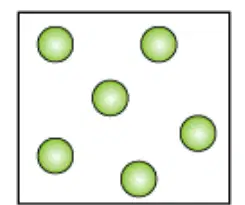
The model shows __________ type of atom.
more than one
only one
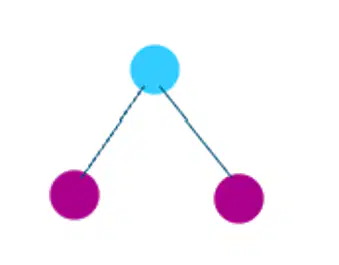
The model shows __________ type of atom.
more than one
only one
Which of the following are examples of elements? (choose 3)
Ozone (O₂)
nitrogen (N)
water (H₂O)
hydrogen (H)
ammonia (NH₃)
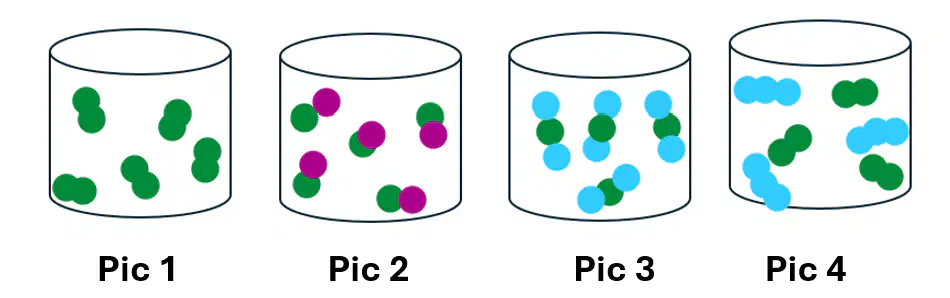
Which pics are considered pure substances? (choose all that apply)
pic 1
pic 2
pic 3
pic 4
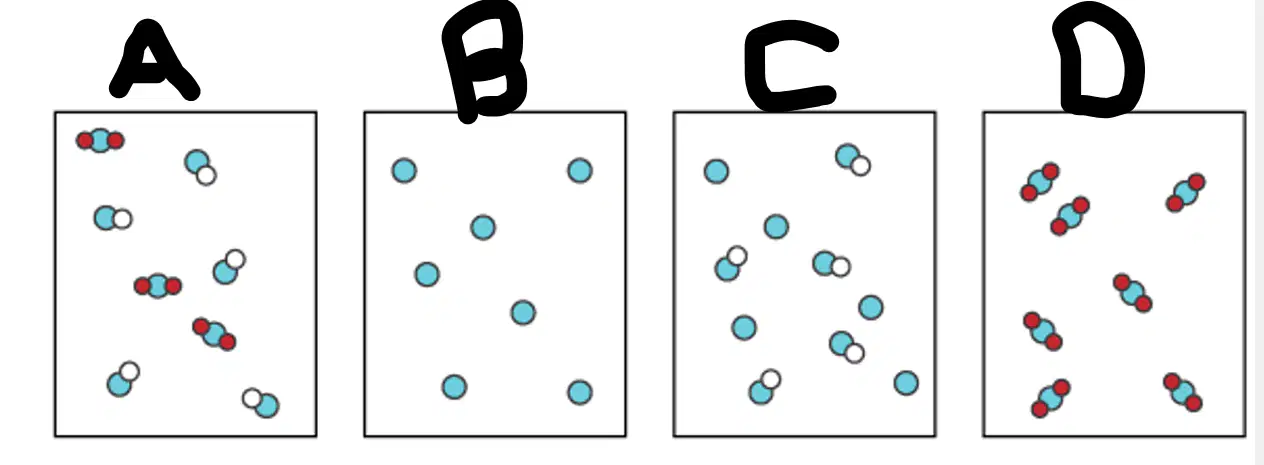
Which pics are considered pure substances? (choose all that apply)
A
B
C
D

Which best identifies the substance in container A
Heterogeneous mixture
Homogeneous mixture
Which of the following describe pure substances? Choose all that apply.
Elements and compounds
Cannot be separated by physical means
Can be separated physically
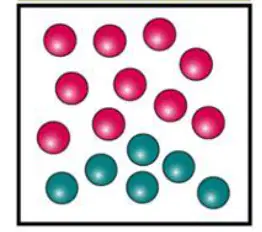
The components in the pic____________ which makes it a ____________.
are uniform, homogeneous mixture
are not uniform, homogeneous mixture
are uniform, heterogeneous mixture
are not uniform, heterogeneous mixture
Select all of the diagrams that show the particles of a heterogeneous mixture.


A pure substance that cannot be separated into simpler substance by chemical or physical means.
element
compound
mixture
chemical
It is a pure substance with more than one type of atom bonded together.

Which pic is considered a mixture?
1
2
3
4
Which best describes a heterogeneous mixture?
the substance consists of one type of atom
all substances in the container are chemically bonded
There is a uniform composition throughout
there is not a uniform composition throughout
Heterogeneous: A mixture in which the substances that make up the mixture are not evenly mixed.
True
False
Table Salt (NaCl)
Heterogeneous
Homogeneous
Compound
Element
Would oxygen be considered a mixture or a pure substance?
mixture
pure substance
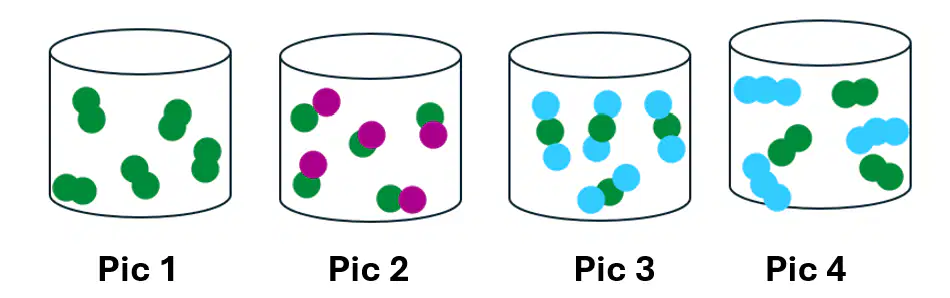
Which 2 pics are made up of compounds only?
1 and 2
2 and 3
3 and 4
4 and 1
It is a pure substance with more than one type of atom bonded together. ______________
Why are water and table salt considered compounds?
because they are on the periodic table
because they are more than 1 element joined together chemically
because they are mixed together

Which of the following models 1, 2, 3, and 4 best represents salt (NaCl). Salt is made of 1 Sodium (Na) atom and 1 Chlorine (Cl) atom.
Model 1
Model 2
Model 3
Model 4
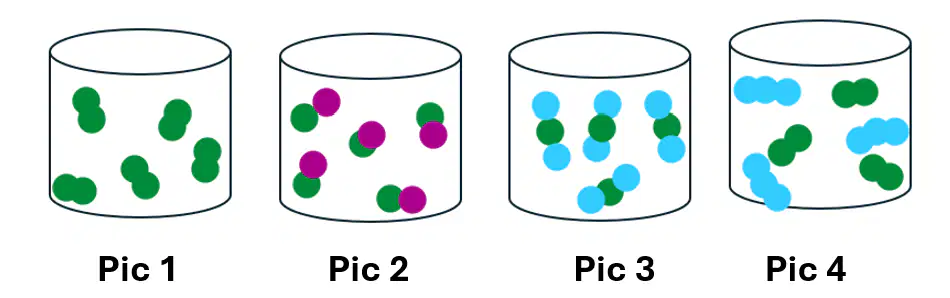
Which 2 pics are made up of compounds only?
1 and 2
2 and 3
3 and 4
4 and 1
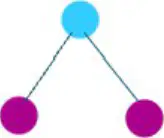
The model shows ________________________ one type of atom.
More than
only
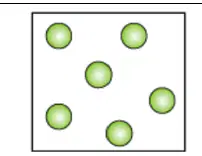
The model is a ________________________.
element
compound
Which of the following are examples of elements? (choose 3)
Ozone (O₂)
nitrogen (N)
water (H₂O)
hydrogen (H)
ammonia (NH₃)
Which pic is considered a mixture?
1
2
3
4
Which best describes a heterogeneous mixture?
the substance consists of one type of atom
all substances in the container are chemically bonded
There is a uniform composition throughout
there is not a uniform composition throughout
Which is the smallest unit of an element?
compound
mixture
atom
a pure substance that cannot be separated into simpler by chemical or physical means
element
compound
mixture
chemical
Heterogeneous: A mixture in which the substances that make up the mixture are not evenly mixed.
True
False
Table Salt (NaCl)
Heterogeneous
Homogeneous
Compound
Element
What is the atomic number of Oxygen?
8
6
7
1
Which element has the symbol 'Ne'?
Neon
Nickel
Nitrogen
Neptunium
What is the atomic number of an element with 15 protons?
15
16
14
17
Which subatomic particles are found in the nucleus of an atom?
Protons and neutrons
Protons and electrons
Neutrons and electrons
Only protons
What is the charge of a proton?
Positive
Negative
Neutral
Variable
Which element is in group 17 and period 2?
Fluorine
Chlorine
Bromine
Iodine
What is the symbol for the element with atomic number 3?
Li
Be
B
C
Which element has the atomic mass of 1.01?
Hydrogen
Helium
Lithium
Beryllium
What is the atomic number of Helium (He)?
1
2
3
4


What is the atomic number of an element?
The number of protons in the nucleus
The number of neutrons in the nucleus
The total number of protons and neutrons in the nucleus
The total number of protons and electrons in an atom

Based on the info in the periodic table, which element is shown in the pic?
Boron (B)
Lithium (Li)
Carbon (C)
Helium (He)
Using the periodic table, which 3 elements are similar to the element in the pic?
platinum
copper
tin
lead
silicon
Courtney draws a picture of a nitrogen atom. He draws a small circle to represent the nucleus and draws dots around the circle to represent the electrons. How many dots does he draw?
5 dots
7 dots
14 dots
16 dots
I I want to draw a model of Oxygen, what would I NOT include?
8 protons in the nucleus
8 neutrons in the nucleus
16 protons in the nucleus
8 electrons outside the nucleus

Which atom is described in the chart?
sulfur
phosphorous
silicon
nitrogen
Which table correctly matches each particle with its location and charge?


Which statement BEST describes a major difference between different types of elements
only some elements have atoms with subatomic particles
only some elements are composed of atoms with electrons
the atoms of different elements have different location for their nucleus
the atoms of different elements have different numbers of protons and electrons
If an atom has an Atomic number of 3, mass of 6 and charge of +1; how many protons does it have?
2
3
4
6
If an atom has an Atomic number of 3, mass of 6 and charge of +1; how many neutrons does it have?
2
3
4
6

Zinc and Hydrochloric Acid
In the experiment, the teacher drops discs of zinc (Zn) into a flask of liquid hydrochloric acid (HCl). The students record that the mass of the substances before the reaction occurs is 262 grams. They also record the temperature of the substances and the fact that both zinc and hydrochloric acid are not flammable. Before the reaction begins, the zinc is placed into a balloon attached to the top of a flask containing the hydrochloric acid. This seals the flask before the reaction takes place. To initiate the reaction, the zinc is dropped into the hydrochloric acid. As soon as the substances combine, bubbles begin to form and the balloon expands. The picture shows the zinc as it is dropped into the flask, and the reaction as it is taking place.
After the reaction takes place, the temperature of the flask is recorded. The students note that the temperature of the flask is higher than before the reaction took place. The teacher then removes the balloon from the flask and carefully ignites the balloon in front of the class. The students record that the substance in the balloon was flammable.
Which statement BEST interprets the temperature change that occurred in the experiment?
All reactions that include zinc discs release heat.
All reactions that include hydrochloric acid release heat.
When the substances were combined, the physical change released heat.
When the substances were combined, the chemical reaction released heat.

Zinc and Hydrochloric Acid
In the experiment, the teacher drops discs of zinc (Zn) into a flask of liquid hydrochloric acid (HCl). The students record that the mass of the substances before the reaction occurs is 262 grams. They also record the temperature of the substances and the fact that both zinc and hydrochloric acid are not flammable. Before the reaction begins, the zinc is placed into a balloon attached to the top of a flask containing the hydrochloric acid. This seals the flask before the reaction takes place. To initiate the reaction, the zinc is dropped into the hydrochloric acid. As soon as the substances combine, bubbles begin to form and the balloon expands. The picture shows the zinc as it is dropped into the flask, and the reaction as it is taking place.
After the reaction takes place, the temperature of the flask is recorded. The students note that the temperature of the flask is higher than before the reaction took place. The teacher then removes the balloon from the flask and carefully ignites the balloon in front of the class. The students record that the substance in the balloon was flammable.
Which statement BEST explains why the gas in the balloon was flammable but the reactants were not?
Atoms were created when the reaction took place, which resulted in the appearance of a flame.
Atoms were destroyed when the reaction took place, which resulted in the appearance of a flame.
Atoms are not destroyed during chemical reactions.
The atoms of the reactants were rearranged into a new substance with new physical properties.

Zinc and Hydrochloric Acid
In the experiment, the teacher drops discs of zinc (Zn) into a flask of liquid hydrochloric acid (HCl). The students record that the mass of the substances before the reaction occurs is 262 grams. They also record the temperature of the substances and the fact that both zinc and hydrochloric acid are not flammable. Before the reaction begins, the zinc is placed into a balloon attached to the top of a flask containing the hydrochloric acid. This seals the flask before the reaction takes place. To initiate the reaction, the zinc is dropped into the hydrochloric acid. As soon as the substances combine, bubbles begin to form and the balloon expands. The picture shows the zinc as it is dropped into the flask, and the reaction as it is taking place.
After the reaction takes place, the temperature of the flask is recorded. The students note that the temperature of the flask is higher than before the reaction took place. The teacher then removes the balloon from the flask and carefully ignites the balloon in front of the class. The students record that the substance in the balloon was flammable.
Did a chemical reaction take place? Explain why or why not.
No, because neither the reactants nor the liquid product were flammable
No, because the mass in the flask appears to change when the reaction takes place
Yes, because the reactants were not flammable, but the gaseous product was flammable
Yes, because the mass in the flask appears to be the same both before and after the reaction took place

Zinc and Hydrochloric Acid
In the experiment, the teacher drops discs of zinc (Zn) into a flask of liquid hydrochloric acid (HCl). The students record that the mass of the substances before the reaction occurs is 262 grams. They also record the temperature of the substances and the fact that both zinc and hydrochloric acid are not flammable. Before the reaction begins, the zinc is placed into a balloon attached to the top of a flask containing the hydrochloric acid. This seals the flask before the reaction takes place. To initiate the reaction, the zinc is dropped into the hydrochloric acid. As soon as the substances combine, bubbles begin to form and the balloon expands. The picture shows the zinc as it is dropped into the flask, and the reaction as it is taking place.
After the reaction takes place, the temperature of the flask is recorded. The students note that the temperature of the flask is higher than before the reaction took place. The teacher then removes the balloon from the flask and carefully ignites the balloon in front of the class. The students record that the substance in the balloon was flammable.
Select the TWO observations that can be used as evidence to support that a chemical change took place.
Bubbles form when the reactants are mixed.
The mass of substances increase during the experiment.
The balloon begins to expand after the reactants are mixed.
The mass of the substances before the experiment is 262 grams.
Bubbles are present in the hydrochloric acid before the experiment.

The students in Ms. Ramirez's science class are classifying different types of reactions. They have divided the reactions into two columns, as shown below.
Why are the reactions listed in Column B classified as physical reactions?
They produced new substances with different properties.
The changes do not affect the materials' characteristics/identity
They released heat during the reactions.
The reactions are irreversible.

The students in Ms. Ramirez's science class are classifying different types of reactions. They have divided the reactions into two columns, as shown below.
Why are the reactions listed in Column A classified as chemical reactions?
The changes do not affect the materials' characteristics/identity
The changes to the materials can be easily reversed.
They created a new substance with different properties.
They changed the shape of the materials.

Making Elephant Toothpaste
Mario is performing a science experiment to make a substance called "elephant toothpaste". The substance is given this name because it looks like a huge squeeze of toothpaste as it forms. The toothpaste looks much too large to be used by people, but is perfect for an elephant! The materials and procedure Mario will use are shown below.
Materials:
· an empty plastic soda bottle (about 16 oz)
· 1/2 cup of liquid hydrogen peroxide (3% concentration)
· 1 package of yeast
· 1/4 cup of warm water
· dish soap
· a cup
· food coloring
Procedure
Place a few drops of food coloring into the soda bottle with the hydrogen peroxide.
Add a squirt of dish soap and swirl the soda bottle to mix.
In the cup, mix the warm water and yeast and stir for a few seconds to combine.
Pour the yeast mixture into the soda bottle with the hydrogen peroxide.
Record observations as you watch the bottle.
The table below shows some of the observations that Mario makes while the elephant toothpaste is forming.
After the experiment, Mario noticed that the plastic bottle felt warm when touched.
If Mario repeats this experiment, what data will BEST provide further proof that a chemical change has occurred?
The temperature should be taken at the start of the reaction and at the end of the reaction to see if a change in temperature has occurred.
The mass of the yeast should be taken to determine if the warmth of the bottle is coming from a loss in mass because of the yeast.
The temperature of the foam should only be taken at the end of the experiment to determine if the warmth of the bottle is coming from the foam.
The mass of the foam should be taken to determine if the warmth of the bottle is coming from a loss in mass because of the foam.

John and Gina completed an investigation on physical and chemical change. During the investigation, they added substances together and recorded their observations. They summarized their data in the table.
Using their data, which combination of substances resulted in a physical change?
vinegar and baking soda
sodium chloride and water
calcium chloride and water
sodium chloride and silver nitrate

Liam explores the decomposition of water. He attaches a battery to the ends of two pencils sharpened at both ends, and places the other ends of the pencils in a beaker of water. His set up is shown below.
Liam notices that bubbles form under the water at each pencil tip. What type of change is happening?
no change
a nuclear change
a chemical change
a physical change

The diagram shows a test tube of copper (II) sulfate solution before and after the addition of iron shavings during an experiment.
The experiment shows a...
physical reaction, because it involved a compound.
physical reaction, because the solution changed color.
chemical reaction, because the solution changed color unexpectedly.
chemical reaction, because it involved a mixture.

Morgan observes changes that occur to substances during four experiments. She records her observations in a table.
Which mistake does Morgan make in her table?
A chemical change occurs when two liquids combine and a precipitate is formed.
A physical change occurs when an egg is cooked because there is a change in phase.
A chemical change occurs when a candle is burned because there is a change in phase.
A physical change occurs when the liquid turns blue because there was no precipitate formed.
An apple reacts with the oxygen in the air after being cut - turning brown. This is an example of a
chemical change.
physical change.
radioactive change.
elemental change.
Which of the following provides proof of a chemical change?
Crushing a can is a chemical change because the form of the can has changed.
Frying an egg is a chemical change because the egg will not turn back into a liquid once it is cool.
Dissolving sugar is a chemical change because the sugar can no longer be seen as separate from the liquid.
Melting flakes of gold is a chemical change because this changes the state of the gold from a solid to a liquid.
Which process of a candle burning does NOT require the rearrangement of atoms to make a new substance?
heat and light being produced as the candle burns
candle wax melting and then solidifying
black smoke rising from the flame of the candle
the candle shrinking in size as it burns
Which of the following are Subscripts in this Chemical Formula: 3Fe2O4
3,4
3,2
2,4
6
The Coefficient (3) in the Chemical Formula, 3H2O, tells you how many _____________ there are.
Atoms of Hydrogen
Atoms of Oxygen
Atoms of Water
Molecules of Water
The Subscript (2) in the Chemical Formula, 3H2O, tells you how many _____________ there are.
Atoms of Hydrogen
Atoms of Oxygen
Atoms of Water
Molecules of Water
Which Chemical Equation is Balanced?
CH₄+O₂------CO₂+2H₂O
H₂+O₂-----2H₂O₄
4Al+3O₂-----2Al₂O₃

How many oxygen atoms are in this chemical formula?
6 oxygen atoms
2 oxygen atoms
3 oxygen atoms
4 oxygen atoms
32 g of Oxygen completely reacts with 8 g of Hydrogen to produce _____ g Water
8
12
24
40
Which Chemical Equation is Balanced?
Fe4+O2------4FeO2+O2
2H2+O2-----2H2O
3Cr+4O₂-----2Cr₂O₃
2Mg + O2 ---> 2MgO
In the chemical formula C12H22O11 , how many elements are there?
1
2
3
4
How does a balanced chemical equation satisfy the Law of Conservation of Mass?
During a chemical reaction, matter is destroyed.
During a chemical reaction, the total number of atoms increases.
During a chemical reaction, one or more new substances are formed.
During a chemical reaction, the total amount of matter stays the same.

Which of the following describes a chemical reaction?
Oxygen interacts with iron to form rust
Ice melts into water
Carbon dioxide freezes to make dry ice
Rocks split apart over many years due to weathering
2Mg + O2 ---> 2MgO
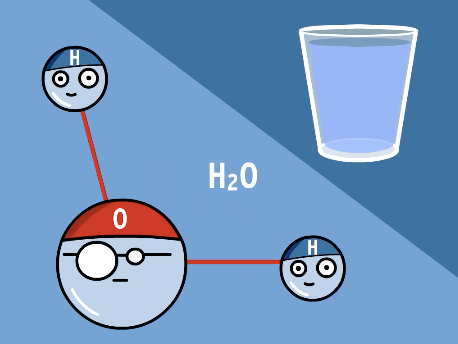
4 grams of hydrogen and 32 grams of oxygen will combine to form:
36 grams of water
28 grams of hydroxide
32 grams of oxygen
36 grams of deuterium

Which of the models of a chemical reaction best represents the Law of Conservation of Mass?
A
B
C
D

According to the law of conservation of mass, how much zinc was present in the zinc carbonate?
256 g
88 g
104 g
40 g


Why does this picture demonstrate the Law of Conservation of Mass?
the number of atoms of each element are the same on both sides
The number of atoms on the left is more than on the left
The products have a higher mass
It doesn't demonstrate the Law of Conservation of Mass
What is the left part of a chemical equation called?
2H2 + O2 ---> 2H2O
Yields
Products
Chemical equation
Reactants
What is the right part of a chemical equation called?
2H2 + O2 ---> 2H2O
Reactants
Yields
Products
Chemical Equation
How many Mn atoms are found in the following compound?
2MnO4
2
4
6
8
What is the little number after an element in a chemical equation called?
Example: H2
Coefficient
Atom
Subscript
Equation
What is the number before a chemical formula called?
Example: 2H2 + O2 ---> 2H2O
Coefficient
Atom
Subscript
Equation
Which of the following equations are correctly balanced?
CO2 + H2O ---> 3C6H12O6 + O2
12CO2 + H2O ---> C6H12O6 + O2
6CO2 + 6H2O ---> C6H12O6 + 6O2
CO2 + 9H2O ---> C6H12O6 + O2
Balance this equation:
H2 + Cl2 ---> HCl
H2 + Cl2 ---> 2HCl
H2 + 3Cl2 ---> 6HCl
3H2 + Cl2 ---> 6HCl
It is balanced.
Q.
Complete the sentence.
During a chemical reaction, atoms ________.
can disappear
can appear
stop moving and vibrating
get rearranged
What is a coefficient?
The small number on the right of the chemical symbol.
The large number in front of a chemical formula.
The number in between the chemical symbols.
The number behind a chemical formula.
What is the Law of Conservation of Mass?
It states that atom cannot be created or destroyed.
It states that energy cannot be created or destroyed.
It states that atom can be created or destroyed.
It states that sound can be created or destroyed.
What are the numbers that you CANNOT change in a chemical equation?
Coefficient
Products
Reactants
Subscripts
Balance the following equation:
___ H2+ ___ O2→___ H2O
1, 1, 3
2, 2, 2
1, 2, 1
2, 1, 2
What is the right ratio of chemicals for the balanced chemical equation?
__Na + __H2O --> __NaOH + __H2
4,4 --> 4,1
1,2 --> 2,4
1,2 --> 2,1
2,2 --> 2,1
What is the right ratio of chemicals for the balanced chemical equation?
__Ca + __H2O --> __Ca(OH)2 + __H2
2,1 --> 2,1
1,2 --> 1,1
1,2 --> 2,4
1,2 --> 2,1
What is the right ratio of chemicals for the balanced chemical equation?
__CO + __Fe2O3--> __Fe + __CO2
3,2 --> 1,1
3,2 --> 2,4
3,1 --> 2,3
3,2 --> 2,1
What is the right ratio of chemicals for the BCE (Balanced Chemical Equation)?
__CH4 + __O2 --> __CO2+ __H2O
1,2 --> 2,1
1,2 --> 1,1
1,2 --> 1,2
2,1 --> 2,1
What is the right ratio of chemicals for the balanced chemical equation?
__AgNO3 + __H2S --> __Ag2S+ __HNO3
2,1 --> 1,2
1,2 --> 1,1
1,2 --> 1,2
1,2 --> 2,1
What is the right ratio of chemicals for the balanced chemical equation?
__H2SO3 + __KOH--> __H2O+ __K2SO3
2,1 --> 2,1
1,2 --> 1,1
1,2 --> 1,2
1,2 --> 2,1
What is the right ratio of chemicals for the balanced chemical equation?
__FeCl3 + __Ca(OH)2 --> __Fe(OH)3 + __CaCl2
4,3--> 2,1
3,2 --> 3,1
2,3 --> 2,2
2,3 --> 2,3
What is the right ratio of chemicals for the balanced chemical equation?
__MnO2 + __HCl --> __MnCl2 + __H2O __Cl2
4,1 --> 2,1,2
1,2 --> 1,1,4
1,4 --> 1,2,1
1,4 --> 2,2,1
It is the ability of the substance to be pulled into thin wire.
(a)
It is the ability of the substance to be hammered into thin sheets without breaking.
(a)
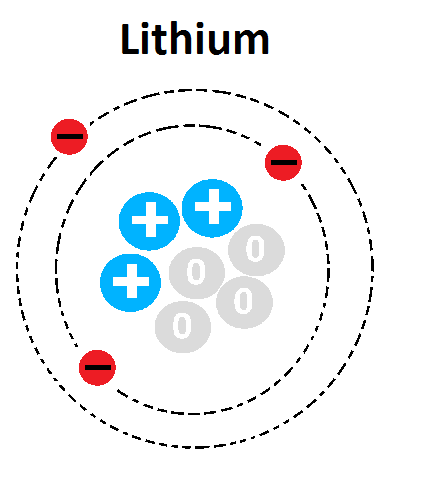
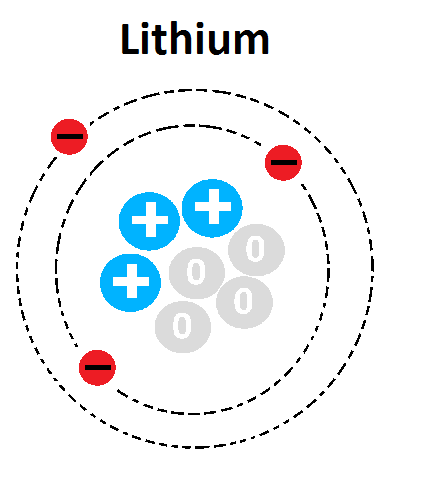
What is the mass number of this atom?
1
3
4
7

What is the number of electrons in chlorine atom ?
35
11
18
17

What is the number of protons in Magnesium atom ?
12
24
23
8
Which two elements have the same atomic mass
K & Ca
Ar & K
Fe & Co
Co & Ni

Elements in the shaded area can best be described as -
Malleable
Brittle
Dull
Insulators

Look at the periodic table that is provided. Where would metalloids be located?
A salad with lettuce, cheese, seeds, tomatoes, broccoli, and other vegetables is a _______ mixture.
Heterogeneous
Homogeneous
Glue is a _______ mixture.
Heterogeneous
Homogeneous

Alkaline Earth Metals

Alkaline Earth Metals

Alkaline Earth Metals

Alkaline Earth Metals

