wayground logo

Free Printable Worksheets

Font size

S
M
L
XL
Worksheets

8th grade final

Total questions: 136

Worksheet time: 3hrs 35mins

Name
Class
Date
1.
What charge does an Electron have?
a)
Negative
b)
Positive
c)
Neutral
d)
Complicated
2.
Electrons are in a cloud, and the outside edge of the cloud is very far away from the nucleus.
a)
True
b)
False
3.
A molecule is________
a)
a glob of gelatinous goo
b)
smaller than an atom
c)
filled with raisons
d)
more than one atom bonded together
4.
What part of the atom tells you what element you have?
a)
Proton
b)
Neutron
c)
Electron
d)
Nucleus
5.

Which atomic particle has a negative charge?

a)

proton

b)

neutron

c)

electron

6.

If an atom has 6 protons and 6 electrons, what is the total or net charge of the atom?

a)

0

b)

+3

c)

+6

d)

-6

7.
What is an atom?
a)
A molecule
b)
The smallest unit of matter
c)
Elements bonded together
d)
Water
8.
What determines an element's atomic number?
a)
The number of protons
b)
The number of neutrons
c)
The mass
d)
The number of molecules
9.
Which of the following is NOT matter
a)
air
b)
heat
c)
steam
d)
cow
10.

Na is the...

a)

Atomic name

b)

Atomic symbol

11.
The amount of matter in an object is a measure of the object's ________________.
a)
volume
b)
density
c)
mass
d)
solubility
12.
Which of the following units provides the best measure for the amount of space that matter occupies?
a)
mL
b)
grams
c)
cm3
d)
Both mL and cm3
13.
What is the volume of the rock? The water level is displaced from 20 mL to 23 mL with the rock.
a)
3 mL
b)
23 mL
c)
20 mL
d)
43 mL
14.
What would be the best way to measure the volume of a small rock?
a)
L x W x H with a ruler
b)
Put on triple beam balance
c)
Mass ÷ Volume
d)
Displacement method using graduated cylinder
15.
Which of the following is not a characteristic property of matter?
a)
Density
b)
Mass
c)
Phase/State
d)
Solubility
16.
What is the formula for calculating density?
a)
Mass ∗ Volume
b)
Volume ∗ Mass
c)
Mass ÷ Volume
d)
Volume ÷ Mass
17.
If you had a sealed bottle of water, how would the mass of the water bottle change after a 5 day period?
a)
Mass would increase. 
b)
Mass would stay the same. 
c)
Mass would decrease. 
d)
None of the above.
18.
What is the density of water?
a)
1 mL
b)
1 gram
c)
1 g/cm3
d)
All of the above
19.
Which statement is true?
a)
Oil is the most dense substance.
b)
Corn syrup is less dense than water.
c)
Oil is less dense than water.
d)
Oil and corn syrup have the same density but different masses.
20.
An object has a density of 3 g/cm3. When submerged in water, the object will ___________.
a)
float
b)
sink
c)
float halfway in the water
d)
float then sink
21.
Which property of matter is a measure of the gravitational force?
a)
Density
b)
Mass
c)
Volume
d)
Weight
22.
Which of the following is a physical change?
a)
evaporating rubbing alcohol 
b)
burning a candle
c)
fireworks exploding
d)
fermentation of sugar into alcohol
23.

According to the table, which substance is most dense?

a)

Oxygen

b)

Hydrogen

c)

Salt

d)

Gold

24.
What physical property of water is responsible ocean water being salty?
a)
Electrical Conductivity
b)
Solubility
c)
Malleability
d)
Reactivity with sodium chloride
25.
What do scientists call an objects resistance to a change in motion?
a)
Inertia
b)
Newton
c)
Kilograms
d)
Density
26.
Iron being pulled into thin wires is an example of what physical property?
a)
malleability
b)
ductility
c)
reactivity
d)
flammability
27.
What is the SI unit for mass?
a)
Kilogram (Kg)
b)
Pound (Lb)
c)
Liter (L)
d)
Newton (N)
28.

How long does it take for plastic items to decompose?

a)

30 to 50 years

b)

200 to 500 years

c)

400 to 1,000 years

d)

800 to 2,000 years

29.
What is the change of state from a gas to a liquid called?
a)
deposition
b)
sublimation
c)
evaporation
d)
condensation
30.
Change of state from a solid directly to a gas is called
a)
deposition
b)
melting
c)
evaporation
d)
sublimation
31.
What term describes a solid changing to a gas?
a)
Melting
b)
Sublimation
c)
Evaporation
d)
Freezing
32.

Which of the following statements describes a liquid water? (click ALL that apply)

a)

It has a fixed shape

b)

It takes the shape of it's container

c)

It's particles slide pass each other

d)

It can be a solid, liquid and gas

33.

How many oxygen atoms are in the following molecule?

a)

1

b)

3

c)

6

d)

9

34.

How many carbon atoms are in the following molecule?

a)

1

b)

2

c)

3

d)

4

e)

5

35.

Which molecules are on the reactant side? (Select all that apply)

a)

H2O

b)

C3H8

c)

CO2

d)

O2

36.

What happens to the molecules in a chemical reaction?

a)

They stay the same

b)

They break apart and are reformed into the same molecule

c)

They break apart and form new molecules

37.

What happens to the total number of atoms in a chemical reaction?

a)

The number stays the same

b)

The number decreases

c)

The number increases

d)

It is random; Sometimes it decreases, sometimes it increases

38.

What happens to the mass in a chemical reaction?

a)

The mass stays the same

b)

The mass decreases

c)

The mass increases

d)

It is random; Sometimes it decreases, sometimes it increases

39.

If the total mass of the reactants is 46g, what is the total mass of the products?

a)

It is impossible to tell

b)

13g

c)

46g

d)

92g

40.

How would you correctly describe the molecule of H2O.

a)

H2O is water.

b)

H2O consists of two hydrogen atoms and one oxygen atom.

c)

H2O consists of one hydrogen atom and two oxygen atoms.

41.

How many molecules are on the reactant side of the equation?

a)

1

b)

7

c)

2

d)

36

42.

How many molecules are on the product side of the equation?

a)

12

b)

7

c)

2

d)

36

43.

How many hydrogens are on the reactant side? The product side?

a)

Reactant = 12 / Product = 12

b)

Reactant = 12 / Product = 6

c)

Reactant = 12 / Product = 1

d)

Reactant = 12 / Product = 2

44.

Which molecules are on the product side? (Select all that apply)

a)

C6H12O6

b)

CO2

c)

O2

d)

H2O

45.

How would you correctly draw the above molecule?

Ca = Red, C = Yellow, O = Blue

a)
b)
c)
46.

How would you correctly draw the above molecule?

H = Pink, O = Blue

a)
b)
c)
47.

How are the reactants and the products of a chemical reaction the same? (Select all that apply)

a)

Same number of molecules

b)

Same number of each type of atom

c)

Same number of total atoms

d)

Same mass

e)

Same type of atom / elements

48.

How are the reactants and the products of a chemical reaction different? (Select all that apply)

a)

Different number of molecules (potentially)

b)

Different number of atoms

c)

Different type of atoms

d)

Different mass

e)

Different type of molecules

49.

Why is the following reaction incorrect? (Select all that apply)

a)

Incorrect number of atoms, missing a Hydrogen

b)

Incorrect number of molecules, missing a H2O

c)

Incorrect mass, product side has less mass

d)

Matter is destroyed which isn't possible

50.

Why is the chemical reaction incorrect? (Select all that apply)

a)

Incorrect number of iron (Fe)

b)

Incorrect number of oxygen (O)

c)

Incorrect number of carbon (C)

d)

Doesn't follow the Law of conservation of matter

51.

How would you draw this if C was blue circles and O was yellow circles?

a)

Two blue circles attached to two yellow circles.

b)

Two blue circles attached to 4 yellow circles.

c)

Two different groups of one blue circle attached to two yellow circles.

d)

Two different groups of two blue circles attached to one yellow circle.

52.

How would you correctly describe this?

a)

2 carbon, 2 oxygen.

b)

Two molecules of one carbon atom attached to two oxygen atoms.

c)

Two groups of carbon and oxygen

d)

Two carbon atoms and four oxygen atoms

53.

Which of the following are indicators of a chemical reaction? (Select all that apply)

a)

Color change

b)

Temperature change

c)

Change in size

d)

Bubbles

54.
Which of the following is NOT an example of potential energy?
a)
A. Gravitational pull 
b)
B. Nuclear energy 
c)
C. Chemical bonds 
d)
D. Electricity
55.
On a roller coaster, where is maximum kinetic energy?
a)
At the bottom of a big hill
b)
When going around a corner
c)
When going upside down
d)
At the top of a big hill
56.
At what position does the rock have the greatest kinetic energy?
a)
A
b)
B
c)
D
d)
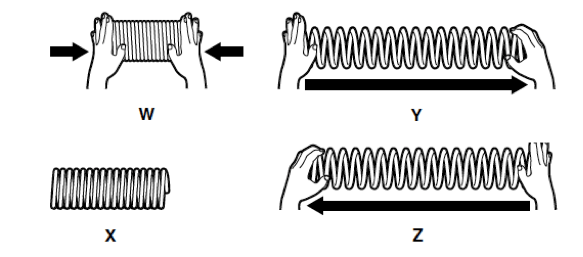
E
57.

Elastic potential energy is energy stored in an object, such as a spring, due to the object being stretched or compressed. In which position is it most likely that the spring has lost its elastic potential energy?

a)

W

b)

Y

c)

X

d)

Z

58.

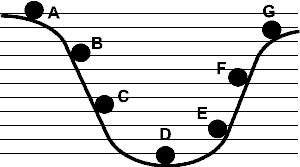
At which point does the ball has the greatest gravitational potential energy (GPE)?

a)

A

b)

G

c)

D

d)

C

e)

G

59.

How could you increase the gravitational potential energy of an object without changing its mass and gravity?

a)

Make the object larger

b)

Lower the object towards the ground

c)

Raise the object farther off the ground

d)

Allow the object to roll on the ground
60.
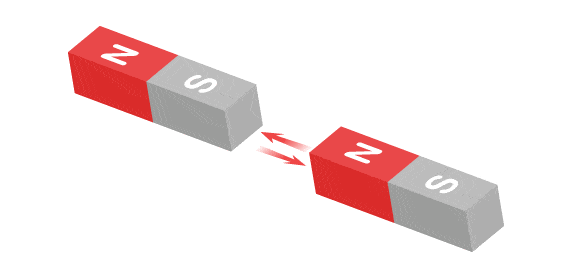
What will happen to the potential energy of the magnets as the N and S get close?
a)
increase
b)
decrease
c)
stay the same
d)
there is none
61.
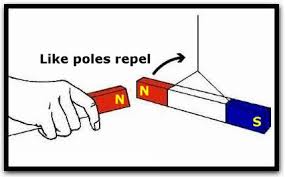
What will happen to the magnetic potential energy of the magnets when the N and N get close?
a)
increases
b)
decreases
c)
stays the same
62.
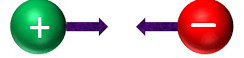
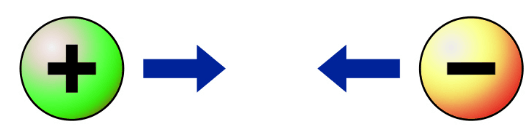
When these opposite charges get closer, what happens to their electrical potential energy?
a)
increases
b)
decreases
c)
stays the same
63.
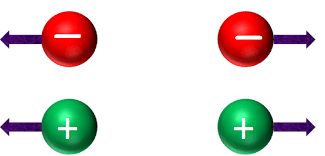
What is the electrical potential energy like when these same charges are far apart?
a)
high
b)
low
c)
the same as when they are close
64.
These opposite charges are far apart. What happens to the electrical potential energy when opposite charges are far apart?
a)
increases
b)
decreases
c)
stays the same
65.

Which picture is NOT an example of Chemical PE?
a)
b)
c)
d)
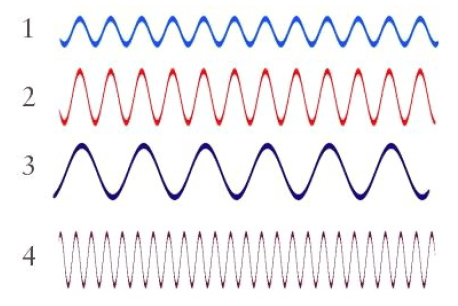
66.
Which wave in the diagram has the greatest frequency?
a)
1
b)
2
c)
3
d)
4
67.

What kind of wave is pictured below?

a)

compressional wave

b)

transverse wave

c)

sound wave

d)

mechanical wave

68.
How would a person measure the wavelength on this sound wave?
a)
dense to less dense
b)
trough to crest
c)
compression to compression
d)
beginning of illustration to the end
69.
A disturbance that travels through a medium as a longitudinal wave
a)
sound
b)
wavelength
c)
pitch
d)
frequency
70.
How high or low a sound is; depends on the frequency (greater frequency= higher pitch)
a)
pitch
b)
frequency
c)
sound
d)
medium
71.
A wave in which the vibration is in the same direction as that in which the wave is traveling; sound waves
a)
longitudinal wave
b)
ocean wave
c)
transverse wave
d)
mechanical wave
72.
A part in a longitudinal wave where the particles are spread apart
a)
compression
b)
rarefaction
c)
crest
d)
trough
73.

A disturbance that transfers energy from one place to another without transferring matter

a)

wave

b)

trough

c)

pitch

d)

sound

74.
A wave that requires a medium through which to travel
a)
mechanical wave
b)
chemical wave
c)
electromagnetic wave
d)
pitch
75.
An object that lets light through it is 
a)
transparent
b)
opaque
c)
translucent
d)
ray
76.
An object that let some light through it is 
a)
opaque
b)
transparent
c)
translucent
d)
rays
77.
Reflection is when light is bent.
a)
true 
b)
false
78.
Electromagnetic waves are transverse waves that transfer
a)
sound energy.
b)
photons.
c)
electrical and magnetic energy.
d)
the particles of a mediu.
79.
The electromagnetic waves with the longest wavelengths and lowest frequencies are
a)
radio waves.
b)
infrared rays.
c)
X-rays.
d)
gammy rays.
80.
Can travel through matter (gas, liquid, solid) but not space. 
a)
light
b)
sound
81.
What kind of waves are being shown when you warm yourself by a fire?
a)
Electromagnetic waves
b)
Mechanical waves
c)
Friction
d)
Gasses in the atmosphere
82.
Smooth and continuous data
a)
analog
b)
digital
c)
pulse
d)
binary
83.

A big disadvantage of digital technology is the recording does degrade over time.

a)

True

b)

False

84.

An analog signal is sent in discrete pulses in two states, on= 1 or off= 0.

a)

True

b)

False

85.
What value (number) can an analog signal have?
a)
1 or 0
b)
Any whole number/value
c)
Any number/value
d)
It always depends on the type
86.
Which of the following is an advantage of analog signals
a)
Less prone to interference
b)
Requires less power
c)
Travels Farther
d)
Carries more detailed information
87.
What process occurs when light energy is captured in autotrophs and converted into sugar?
a)
Photosynthesis
b)
Cellular Respiration
88.
Which of the following is an example of an AUTOTROPH?
a)
Appletree
b)
Dog
c)
Mushroom
d)
Human
89.
Which of the following is an example of a HETEROTROPH?
a)
Grass
b)
Algae
c)
Lemon Tree
d)
Bear
90.
What major energy transformation occurs during photosynthesis?
a)
Thermal --> Chemical
b)
Kinetic --> Radiant
c)
Chemical --> Radiant
d)
Radiant --> Chemical
91.
Which of these conditions would decrease the rate of photosynthesis in a plant?
a)
Above average precipitation
b)
Changing the daylight hours from 14 hrs to 10 hrs
c)
Changing the CO2 concentration from 380 ppm to 410 ppm
d)
All of these choices
92.
All living things do which of the following?
a)
Chemosynthesis
b)
Respiration
c)
photosynthesis
d)
all of the answers
93.
What is the site of cellular respiration in a cell? 
a)
stomata
b)
chloroplast
c)
mitochondria
d)
chlorophyll
94.
True or False:
Both plant cells and animal cells depend on cellular respiration for their energy needs.
a)
True
b)
False
95.
What does cellular respiration make?
a)
Carbon Dioxide, Water, and Energy
b)
Carbon Dioxide, Oxygen, and Water
c)
Oxygen, Water, and Energy
d)
Carbon Dioxide and energy
96.
Which of the following best describes photosynthesis?
a)
Photosynthesis converts radiant energy into chemical energy.
b)
Photosynthesis produces carbohydrates.
c)
Plants need sunlight, carbon dioxide, water, nutrients, and chlorophyll to complete photosynthesis.
d)
Plants use chlorophyll, water, and carbon dioxide to make sugar.
97.

How is carbon returned to the atmosphere? [mark all correct answers]

a)

burning fossil fuels

b)

as a product of cell respiration

c)

as a reactant in photosynthesis

d)

decomposition of dead organisms

98.

The role photosynthesis plays in the energy flow through ecosystems is?

a)

convert sunlight into chemical energy

b)

convert chemical energy into carbon dioxide

c)

use ATP

d)

all of these

99.

The number of atoms can change as they are continuously recycled through the living and nonliving components of an ecosystem.

a)

True

b)

False

100.

Which of the following are ways are used to illustrate the transfer of matter and energy in an ecosystem?

[mark all correct answers]

a)

food webs

b)

food chains

c)

biomass pyramids

d)

energy pyramids

e)

Egyptian pyramids

101.
In Australia the farmers had a problem with beetles eating the sugar cane. So they introduced the cane toad to control that population. Instead of eating the beetles, they ate the source of food and other organisms. What would be a possible consequence of this?
a)
The other organisms attacks the toad population
b)
The ecosystem would be destroyed
c)
The cane toads would get too much food and die
d)
The food web was changed by this one organism
102.
Is the rabbit in the same food chain as the owl?
a)
No
b)
Yes
103.
How many carnivores are shown in this food web?
a)
6
b)
4
c)
5
d)
3
104.
This nonrenewable resource is formed over millions of years. Tiny dead animals are pressed down by mud and rocks. The pressure forms tiny bubbles of gas
a)
Renewable resource
b)
Carbon dioxide
c)
Natural gas
d)
Oil
105.
Besides supplying 95% of the nation’s transportation fuel, this resource is used to make asphalt, aluminum, shampoo, cosmetics and much more
a)
Copper
b)
Petroleum
c)
Coal
d)
Natural gas
106.
This resource supplies the largest share of the United States electricity, at almost 40%. It is also used to make steel, concrete, aspirins, soaps, carbon fiber, and more
a)
Natural gas
b)
Oil
c)
Copper
d)
Coal
107.
Besides generating 27% of America’s electricity, this resource is used to make fertilizer, pharmaceuticals, plastics and fabrics
a)
Iron
b)
Wind
c)
Petroleum (oil)
d)
Natural gas
108.
This resource is formed by tiny animals that died in the ocean millions of years ago. Layers of mud pressed down on the dead animals. The mud eventually turned to rock. This rock put a lot of pressure on the dead animals. Rocks around them also heated them up
a)
Oil
b)
Coal
c)
Iron
d)
Renewable resource
109.
Which region of the United States has a poor groundwater recharge rate? (Look at the map)
a)
North
b)
South
c)
East
d)
West
110.
There are large reserves in this resource in Canada, Saudi Arabia and Russia
a)
Coal
b)
Natural gas
c)
Oil
d)
Copper
111.
The United States, Europe, Russia and Australia have large reserves of this resource
a)
Coal
b)
Oil
c)
Natural Gas
d)
Gold
112.
Reserves will be present longest in these areas for this resource
a)
Coal
b)
Iron
c)
Natural Gas
d)
Oil
113.

Ths graph presents data from a city showing the amount of land used to bury solid waste each year. From 1990 to 1999, the amount of space needed to bury waste increased by 1 to 2 square kilometers per year. In the year 2000, the city started a recycling program to slow the increase of land needed for this burying this solid waste. The city claims that since this recycling program started, the amount of land needed for burying solid waste has decreased.

Which evidence would support this claim?

a)

Data showing that by the year 2010, more than 40% of the citizens were participating in the recycling program

b)

Data showing that the land used for burying solid waste in 2010 was less than 22 square kilometers

c)

Data showing that by the year 2010, there was five times more solid waste being buried than being recycled

d)

Data showing that the land used to build a recycling facility is greater than the amount of land used to bury solid waste

114.

Some factories that burn coal produce smoke with harmful chemicals, such as sulfur. Scrubbers are devices that are attached to the smokestacks to reduce the amount of sulfur put into the atmosphere. To evaluate the effectiveness of these devices, what data would need to be collected?

a)

The average amount of sulfur in a certain amount of coal

b)

The amount of coal a factory burns each year and how much sulfur it emits (produces)

c)

The increase in the use of scrubbers by factories that burn coal

d)

The amount of sulfur emitted (produced) by a smokestack before and after the scrubber is attached

115.

The fertilizers that farmers use to improve the growth of crops can result in excess nitrogen in water that flows into ponds and lakes. This sometimes results in a rapid growth of algae, called an algal bloom, killing fish. What data might be collected to monitor the amount of excess nitrogen in local water systems?

a)

The rate of crop growth

b)

The size of ponds and lakes

c)

The frequency of algal blooms

d)

The kinds of fish that eat algae

116.
Natural Gas is a __________ energy resource.
a)
Renewable
b)
Nonrenewable
117.
Global warming has been linked to a decrease in 
a)
the size of the polar ice caps 
b)
the temperature of Earth 
c)
the rate of species extinction 
d)
the rate of carbon dioxide production
118.
Which human activity would preserve nonrenewable resources?
a)
deforestation
b)
removing carnivores from a forest 
c)
recycling
d)
heating homes with fossil fuels  
119.
Approximately 75 percent of the Earth's surface is covered in water. So why is water considered such a precious resource?
a)
The greenhouse effect is causing most of the world's freshwater to be trapped in the atmosphere
b)
Only a small fraction of the Earth's water is freshwater available for drinking and irrigation
c)
Each year, more freshwater is being trapped in icecaps located at the North and South Poles
d)
Global warming caused by greenhouse gas emissions will likely cause Earth's oceans to evaporate
120.
Many common products, such as wooden furniture, paper, and books, are made from trees. Which of the following is a likely consequence of humans cutting down a forest in order to make use of the natural resources there? 
a)
the decrease of chemical runoff into the oceans
b)
increased acid rain
c)
the increase of light pollution in cities
d)
the destruction of habitats
121.
What causes smog?
a)
The burning of particulates
b)
The formation of ozone
c)
Acid Rain
d)
the interaction of sunlight with pollutants produced by fossil fuels
122.
Human activities that degrade ecosystems result in a loss of diversity of the living and nonliving environment.  Two ways in which humans frequently harm ecosystems and affect other organisms is through land use and pollution.

How does land use cause a reduction in biodiversity? 
a)
It decreases the space and resources available to certain species
b)
It causes herbivores to become carnivorous
c)
It provides a more hospitable living environment
d)
It causes all the natural Earth cycles to stop
123.

What is an effect of global warming?

a)

melting glaciers and rising sea levels

b)

population is increasing

c)

more forest areas

d)

all of the above

124.

The most abundant greenhouse gas is _______________.

a)

oxygen

b)

nitrogen

c)

carbon dioxide

d)

all of the above

125.
Which of the following gases DOES NOT trap heat?
a)
carbon dioxide
b)
nitrogen
c)
water vapor
d)
methane
126.
Where have some of the strongest and earliest impacts of global warming occurred?  
a)
in the tropics
b)
in the northern latitudes
c)
impacts of global warming are distributed equally all over the planet
127.
Which of the following have been linked to climate change?  
a)
droughts
b)
flooding
c)
melting of polar ice caps
d)
all of the above
128.
The average temperature of the surface of Earth has increased approximately 1°C in the past century. Which reason best explains this increase in temperature?
a)
lower levels of ozone in the atmosphere
b)
lower levels of nitrogen in the atmosphere
c)
higher levels of carbon dioxide in the atmosphere
d)
higher levels of oxygen in the atmosphere
129.
Which of the following is the best conclusion that can be made from this graph?
a)
atmospheric carbon dioxide levels have been decreasing since 1960
b)
Hawaii has a lot of carbon dioxide
c)
humans have been working hard to decrease carbon dioxide levels
d)
atmospheric carbon dioxide levels have increased steadily since 1960
130.
In a volcano, _________ energy is converted into __________ energy during an eruption.
a)
Heat, Mechanical
b)
Mechanical, Heat
c)
Nuclear, Mechanical
d)
Heat, Nuclear
131.
Which of the following statements about natural hazards is NOT true?
a)
Hazards are natural processes that CAN be dangerous, but have not yet caused damage.
b)
Hazards become disasters when they harm many people.
c)
Some hazards can be predicted, but usually can't be stopped.
d)
Hazards are natural processes that harm people on a regular basis.
132.
One region of the world that is very exposed to volcanoes, tsunamis, and earthquakes is...
a)
the Ring of Fire.
b)
the North and South Pole.
c)
the United States.
d)
Eastern Europe.
133.
Which of the following would be a potential economic effect of a natural disaster?
a)
spread of disease due to reduced standards of sanitation 
b)
disruption of communication networks
c)
disruption of government and its services
d)
loss of jobs + businesses
134.
What technologies currently exist to mitigate the effect of hurricanes?
a)
There is currently no technology 
b)
Build buildings in circles with surrounding walls 
c)
Build buildings out of renewable resources 
d)
Elevate buildings and cities; build flood walls 
135.
Flooding, property damage, fatalities, and fires are all effects of what natural hazard? 
a)
Tsunamis and Earthquakes
b)
Volcanoes and Tornados
c)
Hurricanes and Earthquakes
d)
Tsunamis and Hurricanes
136.
Reshaping new land, debris avalanches, destroyed forests, and death to many animals are all effects of what natural hazard? 
a)
Hurricane
b)
Earthquake
c)
Volcanic Eruption
d)
Tsunami