
 Worksheets
J6 End-of-Year Exams Revision
Total questions: 135
Worksheet time: 2hrs 18mins
24.1% of all the isotopes of a an element have a mass of 75.23, 48.7% have a mass of 74.61, and 27.2% have a mass of 75.20.
What is the relative atomic mass of this element?
74.92 amu
24.97 amu
75.01 amu
74.51 amu
Calculate the average atomic mass of the element iron (Fe) using the following data:
[Iron 54 / 6% ]
[Iron 56 / 92% ]
[Iron 57 / 2% ]
53.7
54.9
5592.0
55.9

Vaporise,Accelerate, Deflect,Ionise, Detect
Vaporise,Deflect,Ionise, Accelerate, Detect
Vaporise, Ionise, Accelerate, Deflect, Detect
Detect, Accelerate, Deflect, Ionise,Vaporise

14C2+

What are the orbitals for n=4
s
s, p
s, p, d
s, p, d, f
What are the orbitals that make up the n=1 energy level?
s
s, p
s, p, d
s, p, d, f

How many electrons can a d sublevel hold?
14
10
2
6

1. Which orbital is shaped like
s
p
d
f
In order for electrons to occupy the same orbital they must have opposite spins.
Hund’s Rule
Aufbau Principle
Pauli’s Exclusion Principle
Heisenberg’s Uncertainty Principle
Which of the following is the correct electron configuration for sodium?
1s22s22p63s1
1s22s22p6
1s22s22p63s23p64s1
1s22s22p63s23p1
Subatomic particles with a negative charge
Electrons
Neutrons
Protons
Quarks

How many protons does sulfur have?
32
16
48
12
What is the correct name for this polyatomic ion: OH–
hydrogen carbonate
oxonium
hydroxide
acetate
What is the correct name for this polyatomic ion: NO3–
carbonate
hydroxide
nitrite
nitrate
Potassium and Sulfur create...
KS
KS2
K2S
K2S2
How do potassium and nitrogen bond together?
Al3+ O2-
Identify the following compound as ionic or covalent: SO2
ionic
covalent
Identify the following compound as ionic or covalent: Ca(OH)2
ionic
covalent

This is an example of a(n) __________.
Hydrogen Bonding
Dipole
Nonpolar Molecule
Intermolecular Force
Which intermolecular force requires hydrogen and one of the following: nitrogen, oxygen, fluorine?
Dipole-dipole
Hydrogen bonding
London dispersion forces

What kind of force is the arrow pointing to?
Intramolecular Force
Intermolecular Force
Which sample has hydrogen bonding?
H2S
CH4
NH3
HI
Water has an unusually high boiling point for a molecular compound because it has
hydrogen bonding
ion-ion attractions
a high density
a large gram formula mass
Which substance has the weakest intermolecular forces?
Substance A, boiling point of 75 °C
Substance B, boiling point of 105 °C
Substance C, boiling point of 25 °C
Substance d, boiling point of 45 °C
________________________ have the strongest intermolecular forces of attraction.
Dipole- Dipole
Dispersion
Hydrogen Bonds

Intermolecular forces for: CO2
Dispersion Force
Dipole dipole
Hydrogen bonding
covalent bond
London forces
hydrogen bond
dipole-dipole attraction
Which of the following will NOT have hydrogen bonding?


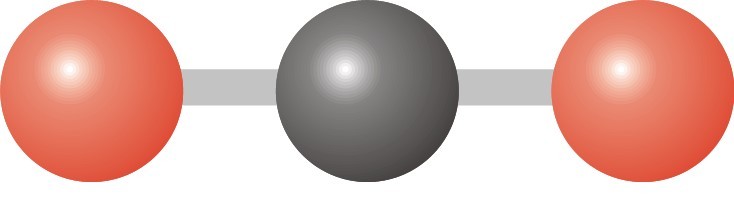
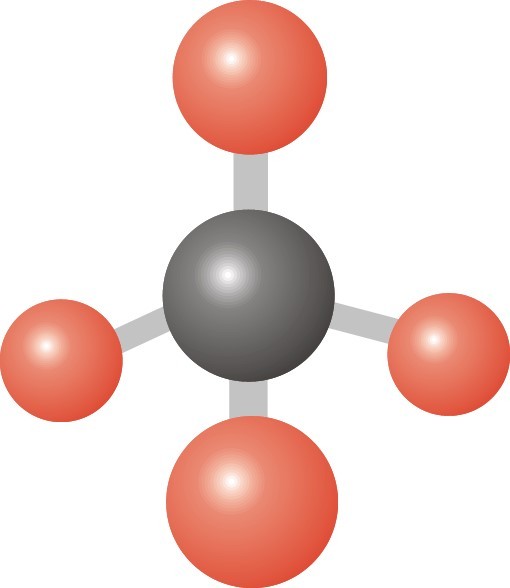
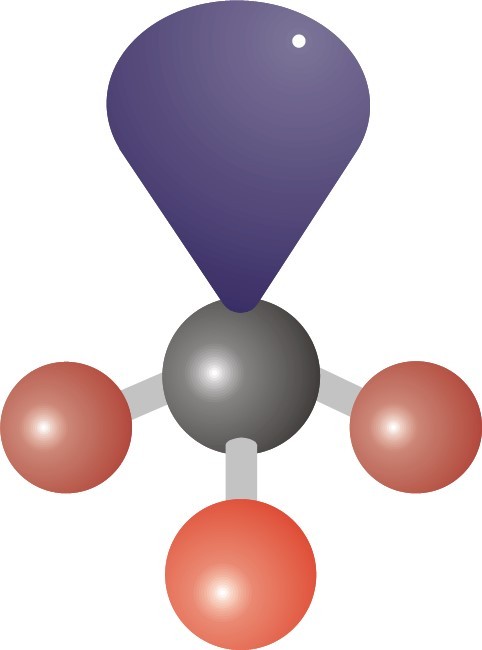
What shape would PH3 have?
Trigonal Planar
Trigonal pyramidal
Bent
Linear
What is the oxidation number of N in NO2-1?
-3
+4
-2
+3
3Mg + N2−−−−> Mg3N2
Which of these is not a redox reaction?
Cu2O + H2SO4 ⟶ CuSO4 + Cu + H2O
MgO + 2HCl ⟶ MgCl2 + H2O
SnCl2 + HgCl2 ⟶ Hg + SnCl4
MnO2 + 4HCl ⟶ MnCl2 + 2H2O + Cl2
sodium nitrate (+heat) →
sodium nitrite + oxygen
sodium nitrate + oxygen
sodium oxide + nitrogen dioxide
sodium oxide + nitrogen dioxide + oxygen
calcium nitrate (+heat) →
calcium oxide + nitrogen dioxide + oxygen
calcium nitrite + oxygen
calcium + nitrogen dioxide + oxygen
calcium oxide + nitrogen dioxide
The nitrates of Group 2 elements are decomposed by heat. Which of these nitrates in Group 2 has the lowest thermal stability?
Beryllium nitrate
Magnesium nitrate
Calcium nitrate
Barium nitrate

The table shows the decomposition temperature of the carbonates of Group 2 elements.
Why is BeCO3 unstable thermally?
The electron cloud of the Be2+ ion is polarised by the CO32– ion.
The electron cloud of the CO32– ion is polarised by the Be2+ ion.
Going down Group 2, the size of the cation increases and the polarisation of the anion by the cation becomes greater.
A small cation absorbs energy more efficiently and can be excited to a higher energy level which is unstable.
Chlorine compounds show oxidation states ranging from –1 to +7. What are the reagent(s) and conditions necessary for the oxidation of elemental chlorine into a compound containing chlorine in the +5 oxidation state?
AgNO3(aq) followed by NH3(aq) at room temperature
concentrated H2SO4 at room temperature
cold dilute NaOH(aq)
hot concentrated NaOH(aq)
which statement is true about halogens?
form covalent compounds with other non-metallic elements
A less reactive halogen will displace a more reactive element form its ionic salt
Form ionic compound with hydrogen
form negative ion of charge -2
which property of halogens increases from fluorine to iodine
electronegativity of elements
oxidizing power of elements
bond length in the halogen molecule
First ionization energy
silver nitrate is added to an aqueous solution containing Br- to give a precipitate X, which is then tested for its solubility in concentrated ammonia. which of the following correctly describes the the colour of X and its solubility in ammonia.
white insoluble
cream slightly soluble
white slightly soluble
yellow insoluble
An excess of aqueous solution of silver nitrate is added to an aqueous solution containing both potassium chloride and potassium bromide. the precipitate formed is the filtered off and washed with distilled water. The precipitate is then shaken with aqueous ammonia and filtered off again.which ion does the final filtrate contain?
chloride
silver
iodide
potassium

IUPAC Name
2,3-dimethyl-1-ene
2,3-dimethyl-2-ene
2,3-dimethyl-4-ene
2,3-methyl-1-ene
3-methylhexan-1-ol


octanal


4-methyl-nonan-5-one


IUPAC Name
2,4-dimethyl hexanoic acid
2,4-dimethyl hexan-1- oic acid
1,3-dimethyl hexanoic acid
1,3-dimethyl hexan-1- oic acid
propanamide


IUPAC Name
decanamine
decanamide
decan-3-amine
1-eyhyl-octan-1-amine
Hydrocarbon?


Give the IUPAC name of the compound above.
(a)

Give the IUPAC name of compound above.
(a)

Give the IUPAC name the compound above.
(a)

Give the IUPAC name of compound above.
(a)

(a)

Give the IUPAC name of the compound above.
(a)

Give the IUPAC name of the compound above.
(a)

(a)

Give the IUPAC name of the compound above.
(a)

Give the IUPAC name of the compound above.
(a)

Give the IUPAC name of compound above.
(a)
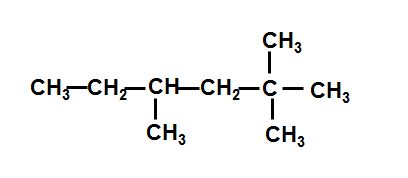
Which is the correct structure of 2,2,4-trimethylpentane
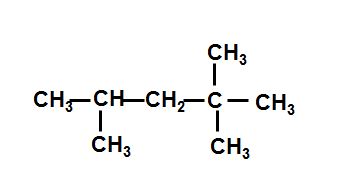
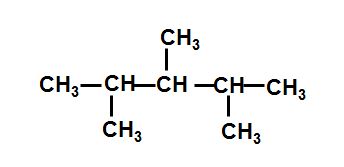
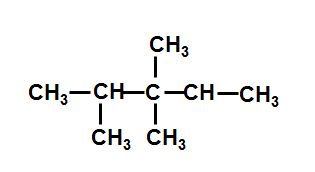
What is a free radical?
An electron donor
An electron acceptor
A species with an unpaired electron
A proton donor
Methane reacts with chlorine in a free radical substitution reaction. Which of these is an essential condition?
An acid catalyst
A low temperature
UV light
A low pressure

C3H8
Which of the following statements concerning the reaction of methane with bromine is/are correct?
(1) It is an addition reaction.
(2) It is a substitution reaction.
(3) A similar reaction will occur if propane is used instead of methane.
(1) only
(2) only
(1) and (3) only
(2) and (3) only
Which correctly represents an incomplete combustion of pentane?
C5H12 + 8O2 ⟶ 5CO2 + 6H2O
C5H12 + 8O2 ⟶ 4CO + CO2 + 6H2O
C5H12 + 6O2 ⟶ 4CO + CO2 + 6H2O
C5H12 + 5O2 ⟶ 4CO + CO2 + 4H2O + 2H2
Which equation represents a termination step?




In the fractionating column, which part is the hottest?
The top
The middle
The bottom
Separates crude oil into similar sized molecules
Fractional Distillation
Cracking
An example of a thermal decomposition reaction
Fractional Distillation
Cracking
Which equation is a propagation step in the conversion of trichloromethane into tetrachloromethane by reaction with chlorine in the presence of ultraviolet light?
CHCl3 + Cl2 ⟶ CCl4 + HCl
●CCl3 + ●Cl ⟶ CCl4
CHCl3 + ●Cl ⟶ CCl4 + ●H
●CCl3 + Cl2 ⟶ CCl4 + ●Cl
Each C–X bond is hydrolysed at a different rate.
Which is the correct order of this rate and explanation?
fastest C–F ... C–I slowest BECAUSE fluorine is the most reactive halogen
fastest C–F ... C–I slowest BECAUSE fluorine is the most electronegative
fastest C–I ... C–F slowest BECAUSE iodine has a larger atomic radius
fastest C–I ... C–F slowest BECAUSE C–I has the lowest bond enthalpy
Which is the best definition of a nucleophile?
...is an electron pair donor
...is attracted to an electrophile
...is where a curly arrow starts
...is a region of electron density
A primary alkyl halide would prefer to undergo _____________.
SN1 reaction
SN2 reaction
α–Elimination
Racemisation
Haloalkane is a polar molecule that undergoes nucleophilic substitution through SN1 and SN2. Arrange the following haloalkanes in order of increasing rate of unimolecular nucleophilic substitution reaction:
I. 2-chloro-2-methylpropane
II. 2-chlorobutane
III. 1-chlorobutane
I< II < III
I< III < II
III< I < II
III< II < I

Name this haloalkane:
1,1-difluoropropane
1-difluoropropane
1-fluorobutane
difluorobutane
In which one of the following reactions is the standard enthalpy change equal to the standard enthalpy of formation of lithium fluoride?
Li(g) + F(g) → LiF(s)
Li+(g) + F−(g) → LiF(s)
Li+(aq) + F−(g) → LiF(s)
Li(s) + 0.5F2(g) → LiF(s)

What is the enthalpy of formation of buta-1,3-diene, C4H6(g)?
+112 kJ mol–1
–112 kJ mol–1
+746 kJ mol–1
–746 kJ mol–1

The table shows the standard enthalpy of formation, ΔfHθ, for some of the substances in the reaction
C2H6(g) + 6F2(g) ⟶ C2F6(g) + 6HF(g) ΔHθ = −2898 kJ mol−1
What is the standard enthalpy of formation, in kJ mol−1, for HF(g)?
−1638
−273
+273
+1638

This question is about the reaction given below.
CO(g) + H2O(g) ⇌ CO2(g) + H2(g)
Enthalpy data for the reacting species are given in the table.
The standard enthalpy change for this reaction of carbon monoxide and steam is
+42 kJ mol−1
−42 kJ mol−1
+262 kJ mol−1
−262 kJ mol−1
The enthalpy change when 1 mole of a compound is formed from its elements in their standard states under standard conditions. This is the enthalpy of.....
Combustion
Formation
Lattice breaking
Ionisation
The enthalpy change when 1 mole of aqueous ions is formed from gaseous ions
Formation
Combustion
Hydration
Lattice breaking
The enthalpy change when 1 mole of 1+ ions is formed from 1 mole of gaseous atoms.
Lattice breaking
Atomisation
Ionisation
Formation
Cl (g) + e- --> Cl- (g)
Ionisation
Electron Affinity
Combustion
Formation
Na+ (g) + Cl- (g) --> Na+ (aq) + Cl- (aq)
Formation
Solution
Combustion
Hydration
½ H2 (g) + ½ Cl2 (g) --> HCl (g)
Formation
Combustion
Atomisation
Ionisation

A sample of N2O4(g) is placed into an evacuated container at 373K and allowed to undergo the reversible reaction N2O4(g) ⇄ 2 NO2(g). The concentration of each species is measured over time, and the data are used to make the graph shown above. Which of the following identifies when equilibrium is first reached and provides a correct explanation?
At 14 seconds, because [N2O4] is twice [NO2], which implies that the forward and reverse reaction rates are equal.
At 23 seconds, because [NO2] equals [N2O4], which shows that equal concentrations are present at equilibrium.
At 40 seconds, because [NO2] is twice [N2O4], which matches the stoichiometry of the balanced chemical equation.
At 60 seconds, because [NO2] and [N2O4] remain constant, indicating that the forward and reverse reaction rates are equal.
What is the concentration equilibrium constant expression?
What is the equilibrium constant expression?
CO2(g) + H2(g) ↔ CO(g) + H2O(l)
Fe3O4(s) + 4H2(g) <--> 3Fe(s) + 4H2O(g)
CaCO3 (s) ⇌ CaO (s) + CO2 (g)
Hydrogen can be produced by this reaction.
CO(g) + H2O(g) ⇌ CO2(g) + H2(g)
In an experiment 4.20 mol of carbon monoxide were mixed with 2.00 mol of steam. When the reaction reached equilibrium, 1.60 mol of hydrogen had been formed.
What is the value of the equilibrium constant, Kc, for this reaction?
0.30
0.41
1.54
2.46
When one mole of ammonia is heated to a given temperature, 50% of the compound dissociates and the following equilibrium is established.
NH3(g) ⇌ 0.5N2(g) + 1.5H2(g)
What is the total number of moles of gas present in this equilibrium mixture?
1.5
2.0
2.5
3.0
A and B react together in this reversible reaction.
A + 3B ⇌ C + 2D
A mixture of 10 mol of A and 10 mol of B were left to reach equilibrium. The equilibrium mixture contained 4 mol of B.
What is the total amount, in moles, of substances in the equilibrium mixture?
14
16
18
20
Ethanoic acid reacts with ethanol in a reversible reaction represented by the equation below.
In an experiment 3.0 mol of ethanoic acid were mixed with 1.0 mol of ethanol and when the reaction had reached equilibrium 0.9 mol of water had been formed.
CH3COOH(l) + C2H5OH(l) ⇌ CH3COOC2H5(l) + H2O(l)
The equilibrium constant for the reaction under these conditions is
0.20
0.23
3.9
4.3
Raising the pressure, by decreasing the volume of the container, will...
Which statement about Kp is correct for this reaction in the gas phase?
W + X + Y2 ⇌ WXY + Y
ΔH = −46 kJ mol−1
The value of Kp is independent of pressure.
The value of Kp increases as pressure increases.
The value of Kp increases as temperature increases.
The value of Kp is independent of temperature.
Which change would alter the value of the equilibrium constant (Kp) for this reaction?
2SO2(g) + O2(g) ⇌ 2SO3(g)
Increasing the total pressure of the system.
Increasing the concentration of sulfur trioxide.
Increasing the concentration of sulfur dioxide.
Increasing the temperature
Which statement is not correct about the industrial preparation of ethanol by the hydration of ethene at 300 °C?
C2H4(g) + H2O(g) ⇌ C2H5OH(g) ∆H = –46 kJ mol–1
The reaction is catalysed by an acid.
The higher the pressure, the higher the equilibrium yield of ethanol.
The higher the temperature, the higher the equilibrium yield of ethanol.
A low equilibrium yield of ethanol is acceptable because unreacted ethene is recycled.
For this reaction at equilibrium, which combination of temperature and pressure would give the greatest equilibrium yield of products?
W(g) + X(g) ⇌ 2Y(g) + Z(g) ∆H = +47 kJ mol–1
High pressure and high temperature
High pressure and low temperature
Low pressure and high temperature
Low pressure and low temperature
The forward reaction in this equilibrium is endothermic
COCl2 (g) ⇌ CO(g) + Cl2 (g)
Which statement is correct?
If the total pressure is increased at constant temperature, the proportion of COCl2 in the equilibrium mixture will decrease
Use of a catalyst will increase the proportion of COCl2 in the equilibrium mixture at constant temperature and pressure
Reducing the equilibrium concentration of CO will increase the value of the equilibrium constant
Raising the temperature from 373 K to 473 K will increase the value of the equilibrium constant

