
 Worksheets
2022 ~ Atomic Structure UNIT TEST PRACTICE
Total questions: 133
Worksheet time: 3hrs 41mins
How many neutrons does the isotope of hydrogen called deuterium (Hydrogen-2) have?
0
1
2
none of these
When two or more atoms differ only in the number of neutrons that each contains, what property or properties change?
mass, only
charge, only
mass and charge
none of these
The isotope oxygen-18 has an atomic number of 8. Which of the following shows the correct number of protons, electrons, and neutrons, respectively, in a neutral oxygen-18 atom?
8, 8, 10
10, 10, 8
8, 10, 10
8, 8, 8
In Rutherford's gold foil experiment, which of the following proved that the nucleus of an atom has a positive charge?
Some of the alpha particles were absorbed by the foil.
Most of the alpha particles passed straight through the foil.
The alpha particles, being positively charged, were deflected by the nucleus
none of these
In Rutherford's gold foil experiment, which of the following proved that the atom must be mostly empty space?
Some of the alpha particles were absorbed by the foil.
Most of the alpha particles passed straight through the foil.
The alpha particles, being positively charged, were deflected by the nucleus
none of these
Based on Rutherford's gold foil experiment, the positive charge and the mass was concentrated in a very large space inside the atom.
true
false
In Thomson’s model of the atom, electrons are embedded throughout a negatively charged sphere.
true
false
One piece of evidence for the Dalton's atomic theory is the observation that
all objects have mass.
all objects have gravity.
light travels as waves or particles.
a compound always has the same proportions of different elements.


The smallest particle of an element that still represents that element.
Nucleus
electron
proton
atom
Which one of the following parts of the atom is the smallest?
neutron
nucleus
atom

Which of the following is/are conclusions based on Rutherford’s gold foil experiment?
Atom is mostly empty space
The nucleus is positively charged
The atom has a small dense nucleus
All answers are correct
Which of the following is NOT a part of Dalton's atomic theory?
All matter is composed of atoms and empty space
Atoms are always in motion.
Atoms of the same element are identical.
Atoms can't be destroyed...merely re-arranged.
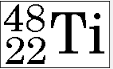

What is the approximate mass of an atom that contains 26 protons, 26 electrons and 19 neutrons?
26 amu
45 amu
52 amu
71 amu
Which two notations represent isotopes of the same element?


Two atoms that are different isotopes of the same element have
the same number of protons and same number of neutrons
the same number of protons but a different number of neutrons
a different number of protons but the same number of neutrons
a different number of protons and a different number of neutrons
Which are isotopes of each other?


Estimate the mass number of the most common isotope of the element INDIUM.
(type the number only into the box)
(a)
Which statement best describes electrons?
They are positive subatomic particles and
are found in the nucleus.
They are positive subatomic particles and
are found surrounding the nucleus.
They are negative subatomic particles and
are found in the nucleus.
They are negative subatomic particles and
are found surrounding the nucleus.
An atom of carbon-12 and an atom of carbon-14 differ in
atomic number
mass number
nuclear charge
number of electrons
The atomic number of an atom is always equal to the number of its
protons, only
neutrons, only
protons plus neutrons
protons plus electrons
Which subatomic particle has no charge?
alpha particle
beta particle
neutron
electron
The region that is the most probable location of an electron in an atom is
the nucleus
an orbital
the excited state
an ion
Which subatomic particles are located in the nucleus of an He-4 atom?
electrons and neutrons
electrons and protons
neutrons and protons
neutrons, protons, and electrons

The total number of protons, electrons, and neutrons in each of four different atoms are shown in the table.
Which two atoms are isotopes of the same element?
A and D
A and Z
X and D
X and Z

The total number of protons, electrons, and neutrons in each of four different atoms are shown in the table.
Identify the element composed of atom Z
carbon
nitrogen
oxygen
fluorine

The total number of protons, electrons, and neutrons in each of four different atoms are shown in the table.
What is the MASS NUMBER of atom X
13 amu
14 amu
15 amu
17 amu
Which subatomic particles are located in the nucleus of a carbon atom?
protons, only
neutrons, only
protons and neutrons
protons and electrons
Which subatomic particle is negatively charged?
electron
neutron
positron
proton
Which conclusion was a direct result of the gold foil experiment?
An atom is mostly empty space with a dense,
positively charged nucleus.
An atom is composed of at least three types
of subatomic particles.
An electron has a positive charge and is
located inside the nucleus.
An electron has properties of both waves
and particles.
A student constructs a model for comparing the masses of subatomic particles. The student selects a small, metal sphere with a mass of 1 gram to represent an electron. A sphere with which mass would be most appropriate to represent a proton?
1 g
1/2 g
1/2000 g
2000 g
Which subatomic particle will be attracted by a positively charged object?
proton
neutron
electron
positron
Which subatomic particle has no charge?
alpha particle
beta particle
neutron
electron
Which of the choices IS NOT a sub-atomic particle?
proton
neutron
neutrino
electron
The nucleus of an atom of K-42 contains
19 protons and 23 neutrons
19 protons and 42 neutrons
20 protons and 19 neutrons
23 protons and 19 neutrons
Which electron transition represents a gain of energy?
when electron moves outward towards a higher orbital
when the electron moves inward towards a lower orbital
An electron has a charge of
–1 and the same mass as a proton
+1 and the same mass as a proton
–1 and a smaller mass than a proton
+1 and a smaller mass than a proton
A neutral atom contains 12 neutrons and 11 electrons. The number of protons in this atom is
1
11
12
23
Which statement is true about the charges assigned to an electron and a proton?
Both an electron and a proton are positive.
An electron is positive and a proton is negative.
An electron is negative and a proton is positive.
Both an electron and a proton are negative.
The modern model of the atom is based on the work of
one scientist over a short period of time
one scientist over a long period of time
many scientists over a short period of time
many scientists over a long period of time
Which of these phrases best describes an atom?
a positive nucleus surrounded by a hard
negative shell
a positive nucleus surrounded by a cloud of
negative charges
a hard sphere with positive particles uniformly
embedded
a hard sphere with negative particles uniformly
embedded
Which statement is true about a proton and an electron?
They have the same masses and the same
charges.
They have the same masses and different
charges.
They have different masses and the same
charges.
They have different masses and different
charges.
The nucleus of an atom of cobalt-58 contains
27 protons and 31 neutrons
27 protons and 32 neutrons
59 protons and 60 neutrons
60 protons and 60 neutrons
As an electron in an atom moves from the
ground state to the excited state, the electron
gains energy as it moves to a higher energy
level
gains energy as it moves to a lower energy level
loses energy as it moves to a higher energy
level
loses energy as it moves to a lower energy level
Which two particles have approximately the same mass?
proton and neutron
proton and electron
neutron and electron
neutron and positron
In the modern wave-mechanical model of the atom, the orbitals are regions of the most probable location of
protons
neutrons
electrons
positrons

Which two notations represent atoms that are isotopes of the same element?
1
2
3
4
Compared to a calcium atom (chemical symbol = Ca), the calcium ion Ca2+ has
more protons
fewer protons
more electrons
fewer electrons


Which one of the following discoveries came first?
electrons
neutrons
quarks
atoms
Bohr determined that electrons are exist in
the nucleus
inside protons
electron cloud
circular orbits around the nucleus
The smallest particle of an element that still represents that element.
Nucleus
electron
proton
atom

Place the following atomic models in order, from earliest to latest:
A) Rutherford B) Thomson C) Dalton
B, C, A
C, A, B
A, C, B
C, B, A
Hydrogen has three isotopes with mass numbers of 1, 2, and 3 and has an average atomic mass of 1.00794 amu. This information indicates that
equal numbers of each isotope are present
more isotopes have an atomic mass of 2 or 3 than of 1
more isotopes have an atomic mass of 1 than of 2 or 3
isotopes have only an atomic mass of 1
The atomic mass of an element is calculated using the
atomic number and the ratios of its naturally occurring isotopes
atomic number and the half-lives of each of its isotopes
masses and the ratios of its naturally occurring isotopes
masses and the half-lives of each of its isotopes
The mass of 12 protons is approximately equal to
1 atomic mass unit
12 atomic mass units
the mass of 1 electron
the mass of 12 electrons
The atomic mass of titanium is 47.88 atomic mass units. This atomic mass represents the
total mass of all the protons and neutrons in an atom of Ti
total mass of all the protons, neutrons, and electrons in an atom of Ti
weighted average mass of the most abundant isotope of Ti
weighted average mass of all the naturally occurring isotopes of Ti
Isotopes of an element must have different
atomic numbers
mass numbers
numbers of protons
numbers of electrons
Which statement concerning elements is true?
Different elements must have different numbers of isotopes.
Different elements must have different numbers of neutrons.
All atoms of a given element must have the same mass number.
All atoms of a given element must have the same atomic number.


What is the total number of electrons in a Cu+ ion?
28
29
30
36
What is the total number of electrons in a Cr3+ ion?
18
21
24
27
When a lithium atom forms an Li+ ion, the lithium atom
gains a proton
gains an electron
loses a proton
loses an electron
How many electrons are in an P 3- ion?
12
15
18
none of these
State whether true or false.
Every element has its own unique atomic spectra.
True
False
Emission lines create ............... spectral lines on a visible light spectra due to the electrons moving into their ........... state.
(a)
A particle of light is called a...
Photoelectron
Photon
Proton
Electron

Which model of the atom said that electrons circle the nucleus in orbits of a fixed radius?
Bohr's model
Thomson's plum pudding
Rutherford's nuclear model
Both Thomson's and Rutherford's model
Flame tests are most useful for
blood testing
watching fireworks
identification of elements
none of the above

The electron moves from position 1 to 2. How does the state of the electron shift during this reaction?
The electron becomes less excited.
The electron returns to the ground state.
The electron becomes more excited.
Light is emitted
Light is emitted when electrons ...
return from high energy state to low energy state
jump from low energy state to high energy state
either of these
none of these
When atoms _____________ energy, their electrons move to higher energy levels. These electrons _____________ energy by emitting light when they return to lower energy levels.
lose, absorb
absorb, lose
lose, lose
absorb, absorb


If an electron moves from n=4 to n=2 it ____
absorbs energy
releases energy
If an electron moves from n=4 to n=2 it ____
absorbs energy
releases energy
The lowest energy configurations for electrons in an atom is called the
neutral state
home state
ground state
base state
When a photon is absorbed by an electron and the electron changes energy level, the electron is described as being (a)
Which particle has the same electron configuration as a potassium ion ~ K+?
fluoride ion
sodium ion
neon atom
argon atom
Which is an electron configuration for an atom of chlorine in the excited state?
2–8–7
2–8–8
2–8–6–1
2–8–7–1
Which electron configuration represents the electrons of an atom in an excited state?
2–8–1
2–8–6
2–8–17–6
2–8–18–5
An atom has an atomic number of 9, a mass number of 19, and an electron configuration of 2–6–1.
What is the total number of neutrons in this atom?
10
9
7
11
An atom has an atomic number of 9, a mass number of 19, and an electron configuration of 2–6–1.
Why do the number of electrons in the second and third shells shows that this atom is in an excited state.
Electrons will tend to fill the lower energy orbitals before the higher energy orbitals.
Electrons will tend to fill the higher energy orbitals before the lower energy orbitals
This atom is NOT in an excited state.
Identify one electron configuration for an atom of silicon-32 in an excited state.
2-8-4
2-7-5
2-8-18-4
2-8-17-5
An atom in an excited state has an electron configuration of 2-7-2.
Identify the electron configuration of this atom in the ground state.
2-7-2
2-8-1
1-7-3
2-7-3
What is the total number of valence electrons in a calcium atom in the ground state?
8
2
18
20
As an electron in an atom moves from the ground state to the excited state, the electron
gains energy as it moves to a higher energy level
gains energy as it moves to a lower energy level
loses energy as it moves to a higher energy level
loses energy as it moves to a lower energy level
An electron in an atom moves from the ground state to an excited state when the energy of the electron
decreases
increases
remains the same
Which statement describes how an atom in the ground state becomes excited?
The atom absorbs energy, and one or more electrons move to a higher electron shell.
The atom absorbs energy, and one or more electrons move to a lower electron shell.
The atom releases energy, and one or more electrons move to a higher electron shell.
The atom releases energy, and one or more electrons move to a lower electron shell.

the diagram show
the formation of continous spectrum
the formation of line spectrum
State whether true or false.
Every element has its own unique atomic spectra.
True
False
Emission lines create ............... spectral lines on a visible light spectra due to the electrons moving into their ........... state.
(a)
A particle of light is called a...
Photoelectron
Photon
Proton
Electron
Which model of the atom said that electrons circle the nucleus in orbits of a fixed radius?
Bohr's model
Thomson's plum pudding
Rutherford's nuclear model
Both Thomson's and Rutherford's model
Flame tests are most useful for
blood testing
watching fireworks
identification of elements
none of the above

The color of emitted light with the SHORTEST wavelength is
violet
green
red
indigo
The electron moves from position 1 to 2. How does the state of the electron shift during this reaction?
The electron becomes less excited.
The electron returns to the ground state.
The electron becomes more excited.
Light is emitted
Light is emitted when electrons ...
return from high energy state to low energy state
jump from low energy state to high energy state
either of these
none of these
When atoms _____________ energy, their electrons move to higher energy levels. These electrons _____________ energy by emitting light when they return to lower energy levels.
lose, absorb
absorb, lose
lose, lose
absorb, absorb
If an electron moves from n=4 to n=2 it ____
absorbs energy
releases energy
The lowest energy configurations for electrons in an atom is called the
neutral state
home state
ground state
base state
When a photon is absorbed by an electron and the electron changes energy level, the electron is described as being (a)

