
 Worksheets
Grade 10Elite Chapter 8 Periodic Relationships Among the Element
Total questions: 136
Worksheet time: 2hrs 9mins
The atoms of elements belonging to the same group of periodic table have same number of_____.
protons
electrons
neutrons
electrons in outermost
The atoms of elements belonging to the same group of periodic table have same number of_____.
protons
electrons
neutrons
electrons in outermost
All the elements in a period in the periodic table have the same _______
atomic number
electronic configuration
atomic weight
valence shell
All the members in a group of a long form of periodic table have the same ________.
valency
number of valence electrons
chemical properties
All of the above
Which has the maximum atomic radius ?
Al
Si
P
Mg
In modern periodic table, arrange the third row elements Na, Mg, Al and Si in the increasing order of their atomic size ______.
Na > Mg > Al > Si
Al > Si > Na > Mg
Si > Al > Mg > Na
Na > Al > Si > Mg
In the third period of the periodic table, the element having smallest size is _____.
Na
Ar
Cl
Si
In the periodic table, the metallic character of elements ______.
decreases from left to right and down the group
decreases from left to right and increases down the group
increases from left to right and down the group
increases from left to right and decreases down the group
From top to bottom in a group of the periodic table electropositive character of the element ______.
increases
decreases
remains unchanged
changes irregularly
Which of the following increases along the period ?
Number of valence electrons
Atomic size
Electropositive character
All of these
The total number of elements found in 4th period of modern periodic table is _____.
8
18
32
12
Which of the following element loses an electron most easily?
Na
Mg
K
Ca
For 52X24 , number of electrons is _______.
52
24
76
28
To complete the octate, outer most shell of Aluminium ______.
looses two electrons
gains three electrons
looses three electrons
shares four electrons
Each of the following element forms univalent ions except _____
Li
Na
Mg
K
The elements with atomic numbers 3, 11, 19, 37 and 55 are all termed as____.
Noble metals
Alkali metals
Noble gases
Alkaline Earth metals
Why are the elements lithium, sodium and potassium called alkali metals ?
Because they reacts with water to form alkali
Because they form acidic oxides
Because they are present in first group
Because they are less reactive in nature
Alkali metals in each period have ______.
Smallest size
Lowest I.E.
Highest E.A
Highest electronegativity
Which of the following statements is not a correct statement about the trends when going from left to right across the periods of the periodic table ?
The elements become less metallic in nature
The number of valence electrons increases
The atoms lose their electrons more easily
The oxides become more acidic
Considering the elements B, Al, Mg and K, the correct order of their metallic character is _____.
B > Al > Mg > K
AI > Mg > B > K
Mg > Al > K > B
K > Mg > Al > B
Which of the following elements has maximum metallic character ?
Li
N
Na
P
On moving left to right in a period, in the periodic table, metallic character _____.
decrease
increases
remains same
first increase, then decreases
On moving from top to bottom in a group, in the periodic table, size of an atom______.
increases
decreases
remains same
first increases, then decreases
On moving from top to bottom in a group, in the periodic table, valency ______.
increase
decreases
remains same
first increases, then decreases
Which element in Period 2 has the greatest atomic radius?
Be
C
Na
Li
Of the halogens, which has the smallest radius?
F
Br
He
At
Of the halogens, which has the smallest electronegativity?
F
Cl
At
Ne

The polarity of a bond is determined by...
The sum of the electronegativities of the two atoms
The difference in the electronegativities of the two atoms
The charges of the atoms
None of the Above
What must the difference in electronegativity between two atoms be in order for the bond between them to be polar covalent?
less than 0.4
greater than 1.7
between 0.4 and 1.7
exactly 0

The electronegativity difference in the bonds of CH4 is:
0.4
5.9
-0.4
1.7
The amount of energy released when an electron is added to a neutral atom to form a negative ion
Atomic Radii
Ionization Energy
Electronegativity
Electron Afinity
Oxidation Number
Ionization energy trends is . . . .
becomes greater up and to the right of the periodic table.
becomes greater down and to the right of the periodic table.
becomes greater up and to the left of the periodic table.
becomes greater down and to the left of the periodic table.
Electron affinity trends is . . . .
generally increases across a period, and a trend of decreasing electron affinity going down groups would be expected.
generally decreases across a period, and a trend of decreasing electron affinity going down groups would be expected.
generally increases across a period, and a trend of increasing electron affinity going down groups would be expected.
generally decreases across a period, and a trend of increasing electron affinity going down groups would be expected.
Metallic character trends is . . . .
decrease going across a period and tends to increase going down a group.
increase going across a period and tends to increase going down a group.
decrease going across a period and tends to decrease going down a group.
increase going across a period and tends to decrease going down a group.
Which element is less metallic?
Sodium is less metallic than Aluminium
Beryllium is less metallic than Fluorine
Lithium is less metallic than Potassium
Chlorine is less metallic than Silicon
Which types of elements from anions?
metals
nonmetals
metalloids
noble gases
How many electrons would a Nitrogen ion gain/lose?
lose 5
gain 5
lose 3
gain 3

What is the term for the rows of periodic table?
periods
groups
blocks
configurations
trends
Who is the founder of current periodic table system?
Dmitri Mendeleev
Antonie Lavoisier
John Dalton
Erwin Schrodinger
Johann Dobereiner

Which element has the highest electronegativity?
Metallic character is based on...
how shiny something is.
the density of a material.
an atom's ability to lose electrons.
the ability to conduct electricity.
This results in decreased attraction of electrons for the nucleus of an atom due to inner electrons blocking the attraction of valence electrons.
Periodic Trends
Shielding Effect
Octet Rule
Hund's Rule
Which of the following is the best metal?
Na
K
Mg
Ca
Which of the following is the best nonmetal?
O
F
S
Cl
Which of the following is NOT a metal?
Ca
Cu
Ge
Zn
Which of the following is a complete list of metalloids?
B, Si, Ge, As, Sb
B, Si, Ge, As, Sb, Te
B, Si, Ge, As, Sb, Te, Po
B, Si, Ge, As, Sb, Te. Po, At
Which atom has the largest atomic radius?
potassium
rubidium
francium
cesium
Which statement correctly and completely identifies a trend?
Atomic radius decreases across a period and increases down a group.
Electronegativity decreases across a period and decreases down a group.
Ionization energy increases across a period and increases down a group.
Ionic radius increases across a period and increases down a group.
Which atom has the largest atomic radius?
potassium
rubidium
francium
cesium

Which element's atom is larger? Nitrogen or Phosphorus?
Nitrogen
Phosphorus
As you move ______ a group, more energy levels are added, which increases the size of the atom
down
up
diagonal
away
Within periods on the periodic table: Size decreases as you go down a group
Flase
True

Which element's atom is the smallest?
Rhodium
Silver
Cadmium
Tin
Which of these best explains the reasoning behind the trend that as you go across a period, size decreases?
As you go across a period, more energy levels are added, which shrinks the atom.
The added electrons in the nucleus give the atom a negative charge, which shrinks the atom.
The added protons in the nucleus pull the electrons closer to them, which shrinks the atom.
All of the above

Which order is correct from largest to smallest atomic radius?
Thallium, Indium, Gallium, Boron
Boron, Thallium, Indium, Gallium
Boron, Gallium, Indium, Thallium
Thallium, Gallium, Indium, Boron


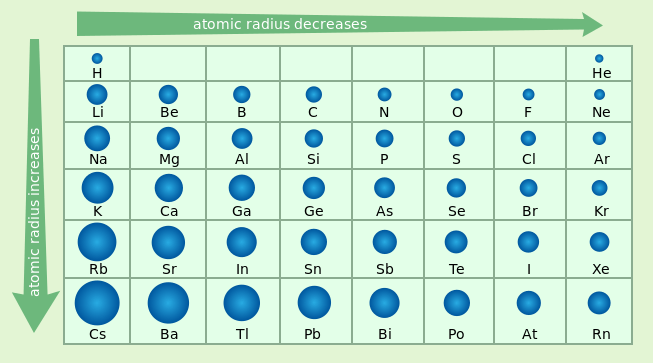


Atomic size generally increases as we move __________.
down a group and from right to left across a period
up a group and from left to right across a period
down a group and from left to right across a period
up a group and from right to left across a period
As you move from left to right on the periodic table, the number of valence electrons.......
Increases
Decreases
Remains the same
As you move down a group on the periodic table, the number of valence electrons....
Increases
Decreases
Remains the same
Which of the following would be most similar to Phosphorus? (select all that apply)
Nitrogen
Sulfur
Silicon
Germanium
Antimony
An electron that resides in the outermost energy level of an atom
periodic trend
electron shell
ionic radius
valence electron
What makes a valence electron less attracted to the nucleus?
less distance between the nucleus and having less protons
less distance between the nucleus and having more protons
more distance between the nucleus and having less protons
more distance between the nucleus and having more protons
The period that an element is in on the periodic table, tells you what?
Number of protons
Number of electrons
Number of valence electrons
Number of energy levels
When across a period, the atomic size decreases so the first IE ___________.
increases
decreases
constant
i am not sure
When going down a group, the atomic size increases so the first IE __________.
increases
decreases
constant
I am not sure
Factors affecting the ionisation energy:
Atomic radius
Effective nuclear charge
Shielding effect
All of the above
In general ionization energy ____ as you go down a group,
and ____ as you go across the periodic table.
decreases, decreases
decreases, increases
increases, decreases
increases, increases
Which of the following will have a lower ionization energy than Scandium (Sc)?
Helium (He)
Titanium (Ti)
Calcium (Ca)
Magnesium (Mg)

Which group of elements has the lowest ionization energies?
Alkali Metals (Group 1)
Alkaline Earth Metals (Group 2)
Halogens (Group 17)
Noble Gases (Group 18)

What is the amount of energy required to remove an electron from an atom?
atomic energy
ionization energy
ionic energy
electron energy

What is a positively-charged ion which forms when an atom loses electrons?
atom
ion
cation
anion

What is a negatively-charged ion which forms when an atom gains electrons?
cation
anion
electron
ion

Which has the highest ionization energy?
Arsenic
Iron
ZInc
Cobalt

Which has a lower ionization energy?
Lithium
Cesium
Sodium
Explain why ionization energy decreases as you go down a group.
Outer electrons are further away from the nucleus you go down a group
Electrons feel less pull from the nucleus as you go down a group
Electrons are easier to remove as you go down a group
All of the above

Which of the following lists the atoms in order of increasing Ionization energy?
calcium, iron, copper
copper, iron, calcium
calcium, copper, iron
iron, copper, calcium
Which element has the lowest electron affinity?
Na
K
Rb
Ar
Which element has the highest electron affinity?
Oxygen
Sulfur
Gallium
He
What group contains elements with 7 valence electrons
Noble Gasses
Alkali Earth Metals
Halogens
Transition Metals
Which element is most likely to lose an electron?
Zinc
Arsenic
Bromine
Potassium

Which of these will have the highest electron affinity: Na, Al, Mg, or S?
Na
Al
Mg
S
Which of these has the electron affinity: I, Cl, Br, At
I
Cl
Br
At

Which of these has the lowest electron affinity: Cl, As, K, or Cs?
Cl
As
K
Cs

Which of these has the lowest electron affinity: Ge, As, Se, or Br?
Ge
As
Se
Br

Which of the following has the lowest electron affinity: Sb, Sr, Ag, I
Sb
Sr
Ag
I

Which one of these has the highest ionization energy: Ba, Mg, Ca, or Sr?
Ba
Mg
Ca
Sr

Which of these has the highest ionization energy: P, Bi, Sb, or As?
P
Bi
Sb
As

Which one of these has the highest electron affinity: Li, Al, C, or O?
Li
Al
C
O
True or False: The Periodic trend for first ionization energy and electron affinity Is the same.
True
False

