
 Worksheets
Chemistry Midterm Review
Total questions: 152
Worksheet time: 1hrs 29mins
Charge of an electron
Positive
Negative
Neutral
Charge of an proton
Positive
Negative
Neutral
Charge of a neutron
Positive
Negative
Neutral
How do you know the number of protons
Atomic Number
Mass Number
Overall charge of an atom
Positive
Negative
Neutral
An atom with a charge.
Ion
Electrolyte
Neutral
How do you find the number of electrons in an atom
Same as Mass
8
0
Same as Atomic #
How do you find the number of neutrons?
0
Same as protons
Mass-Protons
Protons - Electrons
Isotopes have... (CHECK ALL THAT APPLY)
Same number of protons
Different number of neutrons
Different number of electrons
Different Masses
Different Atomic Numbers
Rutherford's Gold Foil...(Check all the apply)
Atom is mostly empty space
Small, dense, positively charged nucleus
Electrons are surrounding the nucleus
Some particles deflected (bounced back)
Most particles passed through
Have a mass of 1 amu... (check all that apply)
Protons
Neutrons
Electrons
Area of probability of finding an electron
Orbit
Orbital
Nucleus
Core
Modern model of atom with electrons in orbitals
Hard Sphere
Rutherford
Bohr
Wave-Mechanical
Which electrons have more energy?
Shells closer to nucleus
Shells further from nucleus
Ground State --> Excited State
Absorb Energy
Release Energy
Excited State --> Ground State
Absorb Energy
Release Energy (Light)
Periodic Table organized in order of increasing...
Atomic Mass
Electronegativity
Atomic Number
Oxidation States
Affinity (attraction) towards electron
Electronegativity
Ionization Energy
Atomic Radius
Atomic Mass
Size of the atom
Electronegativity
Ionization Energy
Atomic Radius
Atomic Mass
Amount of energy required to remove an electron
Electronegativity
Ionization Energy
Atomic Radius
Atomic Mass
Where can you look up trends in Electronegativity, Ionization Energy, and Atomic Radius?
Table A
Table S
Periodic Table
Table I
Left of Staircase (not H)
Metal
Nonmetal
Metalloid
Staircase
Metal
Nonmetal
Metalloid
Rightt of Staircase (plus H)
Metal
Nonmetal
Metalloid
Liquid at STP... (check all that apply)
Hg
H
Si
Br
O
Noble Gas
Group 1
Group 2
Group 17
Group 18
Noble Gases have _____ valence electrons so they are ______.
0, reactive
8, reactive
0, unreactive
8, unreactive
The # of Electrons SHARED in a single bond
1
2
4
6
The # of Electrons SHARED in a double bond
1
2
4
6
The # of Electrons SHARED in a triple bond
1
2
4
6
The # of PAIRS of Electrons in a single bond
1
2
4
6
Break Bonds...
Absorb Energy
Release Energy
Form Bonds...
Absorb Energy
Release Energy
CANNOT be broken down by a chemical change
Element
Compound
Mixture
Solution
Atoms are chemically combined in a fixed proportion that cannot be changed.
Element
Compound
Mixture
Solution
Heterogeneous mixture
Evenly mixed
Unevenly mixed (has layers)
Homogeneous mixture
Evenly mixed
Unevenly mixed (has layers)
Solutions are...
homogeneous mixtures
heterogeneous mixtures
Similar chemical properties
Same number of neutrons
Same number of valence electrons
Same mass
Same color
Phase (solid/liquid/gas), Melting/Boiling point, Density
Physical Properties
Chemical Properties
Phase Changes are...
Physical Changes
Chemical Changes
Rusting, Oxidized, Reacts, Synthesized, Decomposed, Combusts
Physical Changes
Chemical Changes
Metal/Nonmetal
Ionic Bond
Covalent Bond
Two Nonmetals
Ionic Bond
Covalent Bond
Electrons Shared
Ionic Bond
Covalent Bond
Electrons Transfered
Ionic Bond
Covalent Bond
Electrons shared equally
Ionic Bond
Nonpolar Covalent Bond
Polar Covalent Bond
Hydrogen Bond
Electrons shared unequally
Ionic Bond
Nonpolar Covalent Bond
Polar Covalent Bond
Hydrogen Bond
Bond polarity is determined by difference in...
Ionization Energy
Electronegativity
Atomic Number
Atomic Mass
Which are forms of ENERGY? (CHECK ALL THAT APPLY!)
Nuclear
Electromagentic
Thermal
Temperature
Chemical
Real Gases are most like Ideal Gases at...
Low Temperature & Low Pressure
Low Temperature & High Pressure
High Temperature & Low Pressure
High Temperature & High Pressure
Which phase is a mixture?
s
l
g
aq
Temperature
Average Potential Energy
Average Kinetic Energy
Average Atomic Mass
Average Ionization Energy
Separation based on particle size
Distillation
Evaporation
Filtration
Chromatography
Electrolysis
Separation based on boiling points
Distillation
Evaporation
Filtration
Chromatography
Electrolysis
Which is a property of a gas according to Kinetic Molecular Theory? (CHECK ALL THAT APPLY)
Particles move in random straight line motion
No attraction between gas particles
Gas particles have negligible volume
No loss of energy during collisions
Definite shape and definite volume
Solid
Liquid
Gas
Indefinite shape and definite volume
Solid
Liquid
Gas
Indefinite shape and indefinite volume
Solid
Liquid
Gas
Melting/Fusion, Vaporization/Boiling, and Sublimation
Endothermic with increasing entropy.
Exothermic with increasing entropy.
Endothermic with decreasing entropy.
Exothermic with decreasing entropy.
Condensation, Freezing, and Deposition
Endothermic with increasing entropy.
Exothermic with increasing entropy.
Endothermic with decreasing entropy.
Exothermic with decreasing entropy.
Disorder of molecules / Randomness
Heat of Reaction
Activation Energy
Entropy
Electronegativity
Which phase has the greatest disorder?
s
l
g
aq
During a phase change, temperature...
increases, always.
decreases, always.
remains constant.
increases or decreases depending on the change.
"Substance" refers to... (CHECK ALL THAT APPLY)
Element
Compound
Mixture
Solution
Strongest IMF
van der Waals
Dipole-Dipole
Hydrogen Bonding
Higher Boiling Point = _____ IMFs
Stronger
Weaker
Isomers have...
same molecular and structural formulas.
different molecular and structural formulas.
same molecular formula with different structural formulas.
same structural formula with different molecular formulas.
Symmetrical molecules are...
Polar
Nonpolar
Asymmetrical molecules are...
Polar
Nonpolar
Water molecules are...
Polar
Nonpolar

What line segment represents when the substance is only in the solid state?
A-B
B-C
C-D
D-E

Which segment(s) represent when a phase change is taking place? (Check all that apply)
A-B
B-C
C-D
D-E
E-F

In which segment(s) is the kinetic energy of the particles remaining constant?
A-B
B-C
C-D
E-F
D-E

What state(s) of matter are present at segment C-D?
Solid-liquid
Liquid
Liquid-gas
Gas-Solid
Gas

In a solid, the particles
have a rigid shape
slide past one another
overcome their strong attractions to each other
move freely in any direction
When solid changes to liquid, it is
endothermic because energy is absorbed by the molecules
exothermic because energy is absorbed by the molecules
endothermic because energy is released by the molecules
exothermic because energy is released by the molecules
Which substance has the weakest intermolecular forces?
Substance A, boiling point of 75 °C
Substance B, boiling point of 105 °C
Substance C, boiling point of 25 °C
Substance d, boiling point of 45 °C

According to the reference table, what is the boiling point of ethanoic acid at 80 kPa?
28 oC
100oC
111oC
125oC
A student finds the density of an aluminum block to be 2.873 g/cm³. Using the information on Table S, calculate the student’s percent error. (Round to 2 decimal places.)
(a)
Which of the following statement(s) is/are true.
The molecules in a gas take up a negligible amount of space in relation to the container they occupy.
Collisions are elastaic, so energy is gained or lost when molecules collide.
The molecules are in constant, linear motion.
All are true
Which of the following are ways in which a REAL gas deviates from an IDEAL gas?
(CHECK ALL THAT APPLY)
Real Gases have weak intermolecular forces
Real Gases are not compressible.
Real Gases do occupy some volume.
Real Gases do not travel in random straight line motion.
Which of the following would behave most like an Ideal Gas?
Ar (g)
Ne (g)
H2 (g)
O2 (g)
For all gas law problems, temperature MUST be converted into...
Fahrenheit
Just use the unit from the problem.

Which gas law is represented by the graph?
Boyle's Law
Charles's Law
Lussac's Law
Combined Gas Law

Which gas law is represented by the graph?
Boyle's Law
Charles's Law
Lussac's Law
Combined Gas Law

Which gas law is represented by the graph?
Boyle's Law
Charles's Law
Lussac's Law
Combined Gas Law
Standard Pressure (include unit)
(a)
Standard Pressure (include unit)
(a)
Standard Temperature
(a)
Standard Temperature
(a)
Which of the following are "subatomic particles?" (CHECK ALL THAT APPLY)
Protons
Electrons
Cations
Neutrons
Anions
What is the overall charge of the NUCLEUS ofan atom?
Neutral
Positive
Negative
It depends.
What is the overall charge of an ATOM?
Positive
Negative
Neutral
It depends
Where are protons found?
In the Nucleus
Orbiting the Nucleus
Where are neutrons found?
In the Nucleus
Orbiting the Nucleus
Where are electrons found?
In the Nucleus
Orbiting the Nucleus
Decide if each of the following is true of CATIONS or ANIONS.
Positively charged
Lost Electrons
Negatively charged
Gained Electrons
Larger than the atom of that element.
Smaller than the atom of that element.
More protons than electrons.
More electrons than protons.
The weighted average of all naturally occurring isotopes of a given element.
Average Atomic Mass
Atomic Number
Atomic Mass Number
Which of the following is MOST ABUNDANT?
A = 24%
B = 47%
C = 13%
D = 16%
A
B
C
D
The outermost shell of electrons is called the (a) shell.

Match the number with its value.
Ground state electron configuration.
2-8-18-7
Atomic Number
35
Average Atomic Mass
79.904

How many valence electrons does Bromine have in its ground state?
2
8
18
7
How many shells of electrons does Bromine have in the ground state?
2
4
1
7
Which of the following was a conclusion of Rutherford's Gold Foil Experiment? (CHECK ALL THAT APPLY!)
Nucleus is small and dense.
Electrons are negatively charged.
Neutrons are inside the nucleus.
The atom is mostly empty space.
Nucleus is positively charged.
What happened to the particles that the nucleus was bombarded with in the Gold Foil Experiment?
All bounced back.
All passed through.
Some passed through, but most bounce back.
Some bounced back, but most passed through.
Area of probability of finding an electron.
(a)
How do electrons move away from the nucleus into higher energy levels?
Absorb energy.
Release energy.
How do electrons move toward the nucleus to lower energy levels?
Absorb energy.
Release energy.
Electron configuration when electrons have absorbed energy and electrons have moved into higher energy levels.
Excited State
Ionized State
Ground State
Unstable State
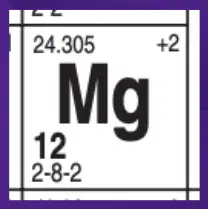
Which could be a possible excited state of the Magnesium atom? (CHECK ALL THAT APPLY!)
2-8-2
1-9-2
2-7-3
2-8-1-1
What form of energy do electrons give off as they fall from the excited state back down to the ground state?
(a)
The unique set of colors/wavelengths given off by each element as the electrons fall back down to the ground state.
Absorption Spectra
Reflection Spectra
Transmission Spectra
Bright Line Spectra
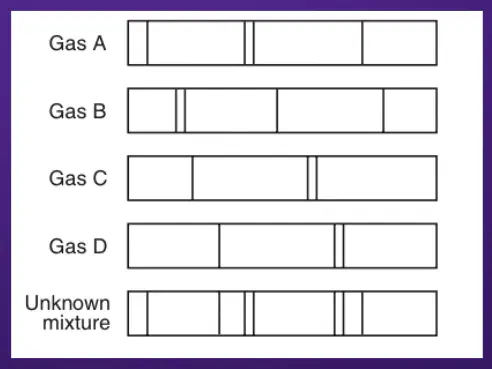
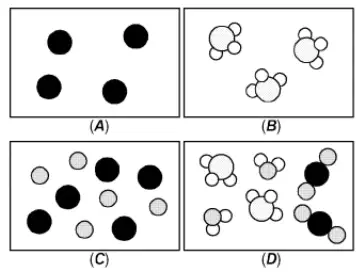
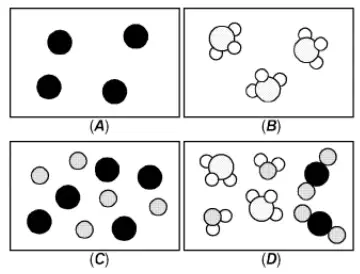
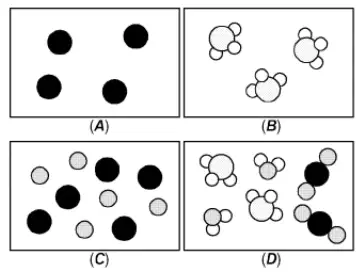
Which gases are present in the mixture? (CHECK ALL THAT APPLY!)
A
B
C
D
Alkali Metals
Group 1
Alkaline Earth Metals
Group 2
Transition Metals
Group 3-12
Halogens
Group 17
Noble Gases
Group 18
Good Conductor
Metal
Nonmetal
Ductile and Malleable
Metal
Nonmetal
Brittle
Metal
Nonmetal
Luster (Shiny)
Metal
Nonmetal
Good Insulator
Metal
Nonmetal
Number of Valence Electrons in Group 16 elements.
2
4
6
8
Which element has properties most similar to those of Nitrogen?
Lithium
Oxygen
Arsenic
Hydrogen
Which element has properties most similar to those of Potassium?
Lithium
Oxygen
Arsenic
Magnesium
Cl2
Solid
Liquid
Gas
P
Solid
Liquid
Gas
H2
Solid
Liquid
Gas
Hg
Solid
Liquid
Gas
Hg
Metal
Nonmetal
Metalloid
O2
Metal
Nonmetal
Metalloid
Ge
Metal
Nonmetal
Metalloid
As
Metal
Nonmetal
Metalloid
Which group has the most reactive metals?
Group 1
Group 2
Group 17
Group 18

As the temperature of a liquid increases, its vapor pressure...
increases.
decreases.
remains the same.
must be 0.
Identify the classification of the element based on its properties.
High conductivity and low electronegativity.
Metal
Low Conductivity and high electronically.
Nonmetal
Both metallic and nonmetallic properties.
Metalloid
Identify the bond type based on elemental classification.
Metal ONLY
Metallic
Metal/Nonmetal
Ionic
Two Different Nonmetals
Polar Covalent
Two of the Same Nonmetals
Nonpolar Covalent

