
 Worksheets
Electron Configuration, Bohr Models, Trends, Octet Rule, Ions
Total questions: 147
Worksheet time: 4hrs 35mins

Match the parts of the electron configuration to what it represents.
1
period (energy level)
s
block (orbital)
2
number of electrons in the orbital
This element's electron configuration got mixed up! What element is this?
x6 x2 x10 x6 x6 x2 x2 x2 x9 x2
(a)
Match the element to it's noble gas notation:
krypton
[Kr]
silicon
[Ne] 3s2 3p2
strontium
[Kr] 5s2
copper
[Ar] 4s2 3d9

Put in order from biggest to smallest (decreasing size)
Calcium
Iron
Zinc
Bromine
Krypton
Which of the following atoms would have the largest radius?
chlorine
silicon
sodium
argon
Put in order from biggest to smallest (decreasing size)
Calcium
Iron
Zinc
Bromine
Krypton
Which of the following has the largest electronegativity value?
neon
fluorine
carbon
lithium
Which has the greater electronegativity Cl or Al?
Which element in Period 3 has the highest electronegativity?
Sodium (Na)
Chlorine (Cl)
Aluminum (Al)
Argon (Ar)
Which of the following elements has the smallest atomic radius in Group 1?
Hydrogen (H)
Lithium (Li)
Sodium (Na)
Potassium (K)
N or C?


Which of the following will have a lower ionization energy than Scandium (Sc)?
Helium (He)
Titanium (Ti)
Calcium (Ca)
Magnesium (Mg)

Which of the following halogens has the greatest electronegativity?
Chlorine (Cl)
Bromine (Br)
Iodine (I)
Astatine (At)

Which group of elements has the lowest ionization energies?
Alkali Metals (Group 1)
Alkaline Earth Metals (Group 2)
Halogens (Group 17)
Noble Gases (Group 18)
Which element has the weakest ionization energy?
beryllium
oxygen
calcium
bromine
Which element has the largest atomic radius?
barium
magnesium
carbon
helium
Barium
Nitrogen

The blue elements (left side) are called
The yellow elements (right side) are called
What do the periods (rows) represent?
an additional energy ring
an additional proton
an additional group
an additional electron

This atom has an atomic number of (a) .
This atom has a mass number of (b) .
This atom has an atomic mass of (c) .
This atom has (d) valence electrons.
Match the following

potassium

lithium

magnesium

titanium

sodium
Label the following elements:
group 2, period 4
period 3, group 17
4 valence electrons, 2 energy rings
charge of +1, 3 energy rings
charge of -2, 7 energy rings
neutral charge
protons = electrons
positive charge balances out negative charge
overall positive or negative charge
protons ≠ electrons
positive charge does not balance out the negative charge
uneven # of protons and electrons
have a charge
do not have a charge
even number of protons and electrons
All elements start out as (a) atoms. This means their number of protons and (b) is equal. When they gain or lose electrons, they become (c) ions and are no longer neutral. There are 2 types of ions: (d) which have a positive charge and (e) which have a negative charge.
Match the following element to their number of valence electrons:
lithium
1
magnesium
2
phosphorus
5
fluorine
7
neon
8
Which group has 8 valence electrons?
Which group has 5 valence electrons?
Why do atoms bond with other atoms? (a)
Determine whether these atoms will gain or lose electrons to become stable:
Si
N
S
Cl
Na
Be
Ga
Sn
He
Ar
SELECT ALL groups that will gain electrons when becoming an ion:
SELECT ALL groups that will lose electrons when becoming an ion:
Which group will not gain or lose electrons when becoming an ion:
Which group has some elements that will gain electrons and some elements that will lose electrons when becoming an ion:
Match the following elements to the charge it will have when it becomes charged:
Li
+1
Sr
+2
Ga
+3
C
-4
Ge
+4
Match the following elements to the charge it will have when it becomes charged:
As
-3
O
-2
Br
-1
Kr
0
B
+3
Metals (a) valence electrons to become (b) charged (c) . They have (d) protons than electrons.
Nonmetals (a) valence electrons to become (b) charged (c) . They have (d) protons than electrons.
K+1 has (a) protons and (b) electrons.
C4- has (c) protons and (d) electrons
Sr2+ has 38 protons and (e) electrons.
What is the ion symbol for an ion that has 12 protons and 10 electrons? Give the letters and the charge (you can't make the charge in superscript so just type it as a regular number. For example: H+1)
(a)
What is the ion symbol for an ion that has 29 protons and 28 electrons? Give the letters and the charge (you can't make the charge in superscript so just type it as a regular number. For example: H+1)
(a)
What is the ion symbol for an ion that has 15 protons and 18 electrons? Give the letters and the charge (you can't make the charge in superscript so just type it as a regular number. For example: H+1)
(a)
What is the ion symbol for an ion that has 9 protons and 10 electrons? Give the letters and the charge (you can't make the charge in superscript so just type it as a regular number. For example: H+1)
(a)
Label the parts of the atom:
neutrons
nucleus
electrons
electron cloud
protons
(a) are in the (b) and contribute to the overall mass of an atom. They are the (c) particles inside the atom. the (d) are in the (e) and DO NOT contribute to the overall mass of an atom.
Match the element to the correct place on the periodic table:
group 1, period 2
lithium - Li
group 2, period 4
calcium - Ca
group 6, period 6
tungsten - W
group 14, period 3
silicon - Si
group 15, period 5
antimony - Sb
Match the description to the particle:
Mass = 1 AMU
location = nucleus
charge = +1
protons
Mass = 1 AMU
location = nucleus
charge = 0
neutron
Mass = 0 AMU
location = rings
charge = -1
electrons
The atomic mass is the total number of
Protons and Electrons
Protons and Neutrons
Electrons and Neutrons
Protons, Neutrons and Electrons
An atomic number of 8 means the atom has ________ protons.
7
8
16
88
What is the mass number?
the number of protons
the number of protons + neutrons
the number of neutrons + electrons
the number of protons + electrons
Match the description to the correct mass number (mass # = P + n):
11 protons, 12 neutrons
23
10 protons,10 neutrons
20
30 protons, 35 neutrons
65
13 protons, 14 neutrons
27
36 protons, 49 neutrons
85
Label the groups and periods
The protons and neutrons contribute to all of the atom's (a)
Match the element to the correct location
group 1, period 4
K
group 2, period 3
Mg
group 5, period 7
Db
group 15, period 6
Bi
group 18, period 5
Xe
What is the mass number?
the number of protons
the number of protons + neutrons
the number of neutrons + electrons
the number of protons + electrons
If an atom has 12 positively charged particles, which of the following must it also have to be considered a neutral atom?
12 neutrons
12 electrons
12 protons
24 protons and neutrons
Identify the atoms based on their nulceus:
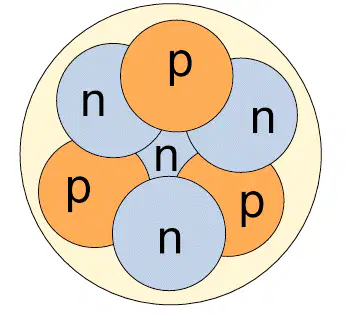
lithium

boron

nitrogen

neon
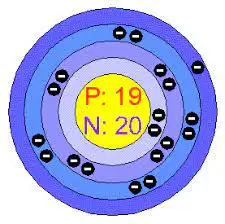
potassium
Match the description to the correct mass number:
11 protons, 11, electrons, 12 neutrons
23
10 protons, 10 electrons, 10 neutrons
20
30 protons, 30 electrons, 35 neutrons
65
13 protons, 13 electrons, 14 neutrons
27
36 protons, 36 electrons, 49 neutrons
85

How many protons does this element have?
20
40
8
2

How many electrons does this element have?
11
23
12
1

How many neutrons does this element have?
45
80
35
7

How many valence electrons does this element have?
17
35
13
7
How many valence electrons does this element have?
11
23
12
1

What element does this bohr model represent?
Si
S
Ni
H

What element does this bohr model represent?
Si
S
Ni
H
Which Bohr model represents Be?


What atom does this Bohr Model represent?
(a)

How many valence (outer) electrons does an Oxygen atom have?
2
6
8
16

What is the atomic number of this element?
17
18
35
35.453

What is the mass number of this atom of Chlorine?
17
18
35
35.453

Which element is this?
Calcium
Chlorine
Silicon
Potassium

What element is this?
Nitrogen
Chlorine
Argon
Phosphorous

What element is represented in this Bohr Model?
Carbon
Hydrogen
Aluminum
Lithium
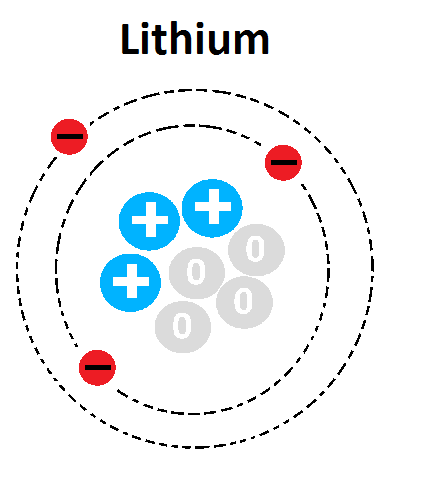


How many energy levels in this element?
2
5
6
3

What period is this element located in?
2
20
4
3
Which Bohr model represents Neon?


Horizontal (SIDE TO SIDE) rows on the periodic table are
groups
periods
How many energy levels does Au have? Just give me the number.
(a)
How many energy levels does O have? Just give me the number.
(a)
How many energy levels does Rb have? Just give me the number.
(a)
How many energy levels does He have? Just give me the number.
(a)
How many energy levels does Mg have? Just give me the number.
(a)

what period would this element be in?
6
8
3
16

what period would this element be in?
8
3
4
7

what period would this element be in?
2
3
4
5

what period would this element be in?
2
3
5
7
Which atoms are the same element?
Label the blocks of the periodic table. You can reuse any of them if needed.
Which of the following elements will have similar properties to 1s2 2s2 2p6 3s2 3p2?
carbon
calcium
chlorine
cesium
What is the electron configuration for potassium?
1s2 2s2 2p6 3s2 3p6 4s1
1s2 2s2 2p6 3s2 3p6 4s2
1s2 2s1 2p6 3s2 3p5 4s1
1s2 2s2 2p6 3s1
What electron configuration matches an oxygen atom?
1s22s22p63s2, 3p64s23d104p5
1s22s22p4
1s22s22p6
1s22s22p63s23p64s23d1
Identify the Electron Configuration for Aluminum (Al)
1s2 2s2 2p6 3s2 3p1
1s2 2s2 2p6 3s2 3p3
1s2 2s2 2p6 3s2 4p1
What is the position of an element in the periodic table if its electron configuration is 1s2 2s2 2p6 3s2 3p5?
Group 1
Group 2
Group 15
Group 17
Group 18
What is the noble gas notation for Sulfur?
[Ne] 3p4
[He] 3s2 3p4
[Ne] 3s2 3p4
[Na] 3s2 3p4
Whta is the noble gas notation for V?
[Ar] 4s2 4d2
[Kr] 4s2 3d3
[Ar] 4s2 4d3
[Ar] 4s2 3d3
What is the noble gas configuration for silicon?
[Ne] 3s2 3p1
[Ar] 4s1
[Kr] 5s1
[Ne] 3s2 3p2
Match the parts of the electron configuration to what it represents.
1
period (energy level)
s
block (orbital)
2
number of electrons in the orbital
Finish the electron configuration for chlorine:
1s2 2s2 (a) 3s2 3p6
Match the group to the configuration that it ends with.
s1
alkali metals
s2
alkaline earth metals
p5
halogens
p6
noble gases
This element's electron configuration got mixed up! What element is this?
x6 x2 x10 x6 x6 x2 x2 x2 x9 x2
(a)
What is the missing piece?
1s2 2s2 ___ 3s1
2p6
2p4
3p6
3s2
What are the missing pieces?
1s2 2s2 2p6 ___ 3p6 4s2 ___ 4p2
3s2 , 4d10
2p4 , 3d10
3p6 , 3d10
3s2 , 3d10
Match the element to it's noble gas notation:
krypton
[Kr]
silicon
[Ne] 3s2 3p2
strontium
[Kr] 5s2
copper
[Ar] 4s2 3d9
Reorder these from shortest electron configuration to the longest:
hydrogen
boron
argon
calcium
xenon
The complete electron configuration for aluminum: (a) (b) (c) (d) (e)
Click all the places you would stop and write on your way to sodium:
Select all configurations that show an atom in the excited state:
An electron configuration is like an element's address. It tells you 3 things about the element: the (a) tells you what period its in, (b) tells you what block its in, and (c) tells you how many (d) are in the orbital. Every configuration starts the same, with (e) .
Label the three parts of an electron configuration:
protons
section
family
period (row)
block (orbital)
electrons
group

Match the following
a
d
b
f
c
e
Organize these options into the right categories. Be careful, there's a tricky one!
3s1
2s1
7s1
4p5
6p5
1s2
5p6
2p6
2s2
6s2
Match the element to the configuration that will be SIMILAR to it's configuration:
magnesium
1s2 2s2 2p6 3s2 3p6 4s2
lithium
1s2 2s2 2p6 3s1
boron
1s2 2s2 2p6 3s2 3p1
nitrogen
1s2 2s2 2p6 3s2 3p6 4s2 3d10 4p3
iodine
1s2 2s2 2p6 3s2 3p5
Which shows the correct orbital diagram for Cobalt?


What is the noble gas configuration for Cobalt?
[Kr] 4s2 3d7
[Kr] 4s2 4d7
[Ar] 4s2 3d7
[Ar] 4s2 4d7
Which of the following is the electron configuration for Fluorine


Whta is the noble gas notation for V?
[Ar] 4s2 4d2
[Kr] 4s2 3d3
[Ar] 4s2 4d3
[Ar] 4s2 3d3
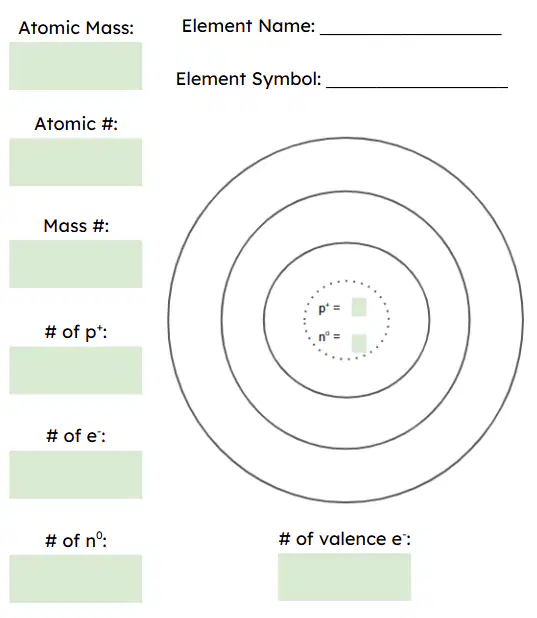
Element is phosphorus:
Atomic Mass = (a)
Atomic # = (b)
Mass Number = (c)
#of protons & electrons = (d)
#of neutrons: (e)

