
 Worksheets
Chemistry Honors Final Exam
Total questions: 145
Worksheet time: 1hrs 28mins
Which of the following states of matter is characterized by having definite shape?
liquid
gas
solid
plasma
Matter in the liquid form _____.
is easily compressed
is generally denser than matter in the solid form
has a definite shape
has an indefinite volume
can flow
A hypothesis is ___________.
A proposed explanation that has not yet been tested.
An observation recorded from an experiment.
A thoroughly tested model.
An analysis of data collected from an experiment.
A mixture of sand and water is known as a
heterogeneous mixture
heterozygous mixture
isometric mixture
homogeneous mixture
solution
A chemical change occurs when a piece of wood _____.
is split
decays
is painted
is cut
All of the following changes to a metal are physical changes EXCEPT _______.
bending
rusting
melting
cutting
polishing
Convert 3.57×10⁻⁶ into standard (long) form.
0.0000357
0.000357
357000
0.00000357
357000
Which of the following is a chemical property?
color
density
reactivity with oxygen
freezing point
The closeness of a measurement to its true value is a measure of its _____.
precision
usefulness
reproducibility
accuracy
The diameter of a carbon atom is 0.000 000 000 154 m. What is this number expressed in scientific notation?
1.54×10⁻¹⁰ m
1.54×10⁻¹² m
1.54×10¹⁰ m
1.54×10¹² m
1.54×10⁻⁹ m
What is the result of multiplying these two numbers: (2.5×1010)×(3.5×10−7) ?
8.75×10⁻³
8.75×10¹⁷
8.75×10⁻¹⁷
8.75×10³
8.75×1070
Calculate the following and express the answer to the correct number of significant figures: (4.0×10−2)×(8.1×102)
3×101
3.2×101
3.0×101
3.24×101
3.3×101
Which of the following is a compound
C
CO
Co
O
What is the quantity 15,300 mg expressed in kg?
153 kg
15.3 kg
0.0153 kg
1.53 kg
0.153 kg
What is the quantity 0.0075 meters expressed in centimeters?
0.075 cm
7.5 cm
70.5 cm
75.0 cm
0.75 cm
How many feet is equal to 47.3 cm? (1 inch = 2.54 cm)
1.55 ft
1440 ft
10.0 ft
223 ft
18.6 ft
Dalton’s atomic theory included which idea?
Atoms of the same element are always identical.
All atoms of all elements are the same size.
Atoms of different elements always combine in one-to-one ratios.
Individual atoms can be seen with a microscope.
When an atom of an element changes into another element, a chemical reaction takes place.
What is the smallest particle of an element that retains the properties of that element?
An electron
A proton
A neutron
A molecule
An atom
The nucleus of an atom _____.
Has no charge
Is composed of protons and electrons
Occupies a large part of the atom
Is the lightest part of the atom
Is composed of protons and neutrons
Select the correct statement about subatomic particles.
Electrons are negatively-charged and are the heaviest subatomic particle
The mass of a neutron nearly equals the mass of a proton
Neutrons have no charge and are the lightest subatomic particle
Protons are positively-charged and the lightest subatomic particle
Electrons, protons, and neutrons all have the same mass.
When an atom is neutral, it has the same number of _________________________.
Protons & neutrons
Neutrons & electrons
Protons & electrons
Protons, neutrons & electrons
The atomic number of an element is the total number of which particles in the nucleus?
neutrons
protons
electrons
protons and electrons
protons and electrons and neutrons
The atomic mass of an element is equal to _____.
The total number of subatomic particles in its nucleus
The average of the number of protons, neutrons, and electrons in its nucleus
The weighted average of the masses of the isotopes of the element
The average of the mass number and the atomic number for the element
The total mass of the isotopes of the element
When Oxygen has a -2 charge, it has two more ______________________.
Electrons
Protons
Neutrons
All of the above
The sum of the protons and neutrons in an atom equals the _____.
Atomic number
Nucleus number
Mass number
Atomic mass
Isotopes of the same element have different _____.
Numbers of protons
Numbers of neutrons
Numbers of electrons
Atomic numbers
Symbols
Using the periodic table, determine the number of neutrons in Pb-207.
125
82
206
207.2
288
The number of electrons in a Ca 2+ ion is:
40
22
20
18
42
In which of the following sets are the charges given correctly for all the ions?
Na +1 , Mg +1 ,
Al +1
Rb +1 , Ba 2− ,
P 3−
K +1 , Sr 2+ ,
O 2−
N −1 , O 2− ,
F 3−
H 2− , Li +1 ,
Ne −1
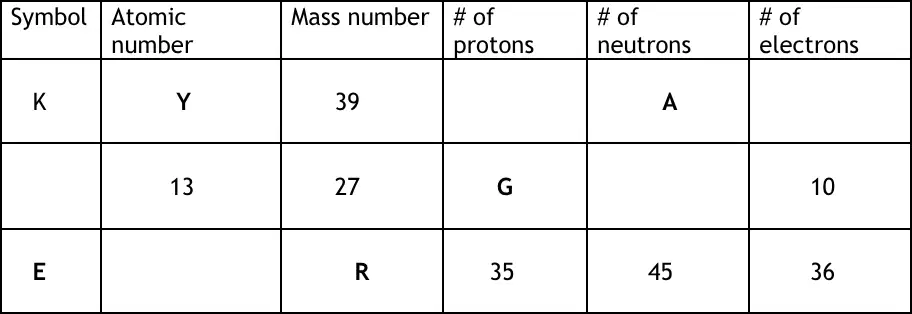
Use the information in the chart to answer. The symbol for the element that belongs in the box labeled “E” is
Hg
Kr
Rh
Br
Tl
Ions form when atoms gain or lose _____
electrons
protons
neutrons
atomic number
mass number
When Group 2 (IIA) elements form ions, they _____.
Lose two protons
Gain two protons
Gain two electrons
Lose two electrons
Become electrically neutral
An element has 3 naturally occurring isotopes. The relative masses and abundances are: 35.978 amu (0.337%), 37.963 amu (0.063%), and 39.962 amu (99.600%). Calculate the atomic mass of the element.
113.90
37.97
39.95
36.62
54.32
As a consequence of the discovery of the nucleus by Rutherford, which model of the atom is believed to be true?
A model in which the protons, electrons, and neutrons are evenly distributed throughout the volume of the atom
A model in which the nucleus is made of protons and neutrons and the region outside the nucleus is largely empty space in which the electrons are situated
A model in which the nucleus is made of neutrons only
A model in which the nucleus is made of electrons and protons
A model in which the nucleus is made of protons, electrons, and neutrons
A column of elements in the periodic table is known as a _____.
row
group
list
transition
A cation is any atom or group of atoms with _____.
No charge
A positive charge
A negative charge
More electrons than the corresponding atoms
When metals can be drawn into thin wires, they are ____________________.
Dense
Lustrous
Malleable
Ductile
Brittle
Which of the following is a nonmetal?
Fe
P
Ca
K
Li
Which of the following elements does NOT have similar chemical properties to sodium (Na)?
Potassium (K)
Cesium (Cs)
Lithium (Li)
Magnesium (Mg)
Which of the following elements has the smallest atomic size?
Na
Cl
Mg
Al
Which of the following elements has the largest atomic size?
Li
Na
K
Al
Rb
Which of the following elements has the largest ionization energy?
Kr
K
Ca
As
Br
What is the name of group 18 and can they chemically combine with other elements?
Halogens, no
Halogens, yes
Noble gases, yes
Noble gases, no
Metalloids, no
The atomic size of the elements within a group will generally
decrease as you go down the group
increase as you go down the group
remain the same
Electronegativity is defined as:
The attraction of an atom for electrons when it is chemically combined with another atom
The energy required for an atom to gain an electron
The energy required for an atom to lose its most loosely held electron
The charge an atom would have when it becomes isoelectronic with a noble gas
Which of the following formulas represents an ionic compound?
CS2
N2O4
BaI2
PCl
Kr
Molecular (covalent) compounds are usually _____.
Composed of two or more nonmetallic elements
Composed of two or more transition elements
Composed of positive and negative ions
Exceptions to the law of definite proportions
Solids at room temperature
Which of the following statements is true concerning molecular (covalent) compounds?
They have much higher boiling points than ionic compounds.
They have much lower melting points than ionic compounds.
They are good conductors in the solid state.
They are made from a metal and a non metal transferring electrons.
When sulfur bonds covalently it will always make ________ bond(s).
1
2
3
4
6
A molecule which consists of a central atom covalently bonded to 4 other atoms and no unshared electrons on the central atom would have a ________ shape
tetrahedral
linear
bent
trigonal bipyramidal
pyramidal
Use the VSEPR theory to determine the shape of the molecule OCl2
linear
pyramidal
tetrahedral
bent
trigonal planar
The electron dot structure for the molecule N2 is:
:N - N:
:N = N:
:N ≡ N:
It is not possible to draw the electron dot structure for this molecule
Use the VSEPR theory to determine the shape of the molecule PF3 .
linear
bent
tetrahedral
trigonal planar
pyramidal
The VSEPR theory is a theory used to predict:
the formula for ionic compounds
the shape of molecular compounds
the formula for molecular compounds
the electron configuration of neutral atoms
all of the above
Which of the following molecules would have a linear shape?
H2O
CH4
F2
NH3
PF5
The molecule HCN would have an electron dot structure:
C≡H–N:
H–C≡N:
H–C–N:
H≡C≡N:
H≡C=N:
Ionic bonding involves:
a metal and a nonmetal transferring electrons
a metal and a nonmetal sharing electrons
two metals sharing electrons
two nonmetals sharing electrons
two nonmetals transferring electrons
The correct formula for barium chlorate is _____.
Ba(ClO)2
Ba(ClO2)2
Ba(ClO4)2
Ba(ClO3)2
BaCl2
Which of the following correctly shows a prefix used in naming molecular compounds, with its corresponding number?
deca-, 7
tri-, 7
penta-, 5
hexa-, 8
octa-, 4
The compound Fe2(CO3)3 is named
Iron(III) carbonate
Iron carbonate
Iron(II) carbonate
Diiron tricarbonate
Triiron dicarbonate
The correct name for H2SO4 is:
Hydrosulfuric acid
Sulfurous acid
Hydrogen sulfite
Sulfuric acid
Hydrogen sulfide
The correct name for Sn3(PO4)2 is _____.
tritin diphosphate
tin(III) phosphate
tin(IV) phosphate
tin phosphate
tin(II) phosphate
The compound PF3 is named
Phosphorous trifluoride
Potassium fluoride
Potassium trifluoride
Phosphorous fluoride
Phosphorous (III) fluoride
The correct formula for dinitrogen tetraoxide is _____.
N2O4
N2O3
NO2
N2O
N4O2
The correct formula for hexaiodine nonachloride is:
I6Cl9
I7Cl
I9Cl6
I6Cl9
ICl7
The correct formula for nitrous acid is:
HN
HNO2
H3N
HNO3
H2NO2
What is the chemical formula for Magnesium Oxide?
Mg2O2
MgO2
MgO
Mg2O
What is the correct name for the formula, KCl ?
Potassium Chlorine
Potassium Chloride
Potassium Chlorate
Potassium Perchlorate
1 mole is equivalent to ______________________.
the molar mass of an element or compound
22.4 Liters
6.02×10²³ particles
all of the above
What is the molar mass of (NH4)2CO3 ?
96.11 g
94.09 g
80.08 g
78.06 g
43.03 g
The molar volume of a gas at STP occupies _____.
a volume that depends upon the nature of the gas
22.4L
0°C
1 kilopascal
12 grams
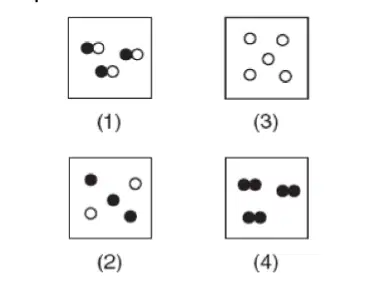
Which of the diagrams below represents a mixture?
Diagram 1
Diagram 2
Diagram 3
Diagram 4
Who was the scientist who theorized that the atom is made up of mostly empty space, using the Gold Foil experiment?
Einstein
Thompson
Rutherford
Bohr
Which of the following is an example of a polyatomic ion?
P 3−
ClO 3−1
S 2−
Ca 2+

Choose the scientific measurement with the correct number of significant figures for the graduated cylinder below.
36 mL
35.50 mL
35.4 mL
36.5 mL
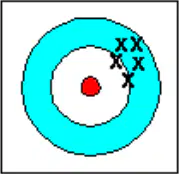
Choose the correct description of the following diagram.
Both accurate and precise
Neither accurate nor precise
Accurate but not precise
Precise but not accurate
Which of the following is true concerning the noble gases?
They belong to group 17
They have a full outer energy level and do not accept electrons
They are sometimes referred to as the halogens
none of above
This element has less protons than argon (Ar), but more than Magnesium (Mg) and has only 7 valence electrons.
Fluorine
Chlorine
Nitrogen
none of the above
Which of the following pairs of atoms would likely be joined by a covalent bond?
magnesium and aluminum
sodium and sulfur
oxygen and chlorine
magnesium and chlorine
argon and nitrogen
The coefficients are missing from the equation below. ____ Cr + ____ Fe(NO 3 ) 2 ⟶ ____ Fe + ____ Cr(NO 3 ) 3 . The correct order of the missing coefficients used to balance the equation above is:
4,6,6,2
2,3,2,3
2,3,3,2
1,3,3,1
2,3,1,2
The coefficients are missing from the equation below. ____ NH 3 + ____ O 2 ⟶ ____ N 2 + ____ H 2 O. The correct order of the missing coefficients used to balance the equation above is:
4,3,2,6
2,1,2,3
1,3,1,3
2,3,2,3
3,4,6,2
In the chemical reaction: H 2 O 2 (aq) ⟶ H 2 O(l) + O 2 (g), the H 2 O 2 is a ________.
product
reactant
catalyst
solid
gas
When the following equation is balanced: ____ KClO 3 ⟶ ____ KCl + ____ O 2 . The coefficient for KClO 3 is ________.
1
2
3
4
6
When the following equation is balanced: ____ Fe + ____ Cl 2 ⟶ ____ FeCl 3 . The coefficient for Cl 2 is ________.
1
2
3
4
6
Predict the product(s) for the following reaction: Magnesium + Chlorine ⟶
magnesium chlorate
magnesium chlorite
magnesium chloride
magnesium chloride + oxygen
magnesium chloride + carbon dioxide
The following equation represents what type of reaction? sodium + calcium fluoride ⟶ calcium + sodium fluoride
synthesis
decomposition
single replacement
double replacement
combustion
Predict the products for the following reaction: Lithium + nitric acid ⟶
Lithium acid + nitrate
Lithium nitride + hydrogen
no reaction
Lithium nitrate + hydrogen
Lithium nitrate + water
Predict the products for the following reaction: Calcium sulfide + aluminum oxide ⟶
calcium aluminum + sulfur oxide
aluminum oxide + calcium sulfide
calcium oxide + aluminum sulfide
calcium oxide + aluminum sulfate
no reaction
In a chemical reaction the mass of the products _____________________.
is less than the mass of the reactants
is greater than the mass of the reactants
is equal to the mass of the reactants
could be greater or less than the reactants, depending on the reaction
The calculation of molar quantities in chemical equations is called __________.
accuracy and precision
dimensional analysis
percent composition
percent yield
stoichiometry
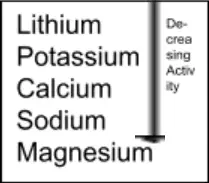
Observe the following reactions and use the activity series to determine which will occur.
I. Li + Mg(OH)2 → LiOH + Mg
II. CaCl2 + K → KCl + Ca
III. Na + K2O → Na2O + K
only I
only II
only III
only I and II
I, II, and III
Which type of stoichiometric calculation does not require the use of the molar mass of a substance?
mass-mass problems
mass-volume problems
mass-particle problems
volume-volume problems
When two substances react to form products, the reactant which is used up is called the:
determining reactant
excess reactant
limiting reactant
catalytic reactant
A process that produces heat is a(n) ____________ process.
exothermic
endothermic
isothermic
ectothermic
When energy is changed from one form to another, ____________.
Some of the energy is lost entirely
all of the energy can be accounted for
a physical change occurs
all of the energy is changed to a useful form
Which of the following best describes the motion of iron atoms in a piece of steel?
all are at rest
a few are moving
all are moving
As the temperature of a sample of matter is decreased, what happens to the average kinetic energy of the particles in the sample?
It decreases
It increases
It does not change
What volume does 1 mole of a gas occupy at STP?
1 L
20.4 L
22.4 L
760 L
The first particles to evaporate from a liquid are ____________.
those with the highest kinetic energy
those with the lowest kinetic energy
those farthest from the surface of the liquid
An increase in the temperature of a contained liquid ____________.
has no effect on the kinetic energy of the liquid
decreases the vapor pressure of the liquid
causes fewer particles to escape the surface of the liquid
causes the vapor pressure above the liquid to increase
During a phase change, the temperature of a substance
increases
decreases
may increase or decrease
remains constant
The direct change of a substance from a solid to a gas is called ____________.
evaporation
sublimation
condensation
boiling
The one temperature-pressure combination in which all three states of matter are in equilibrium with each other is referred to as the ____________.
critical point
specific point
kinetic point
double point
triple point

Looking at the phase diagram below, which state of matter is the most dense?
solid
liquid
gas
plasma
What happens to the pressure of a gas inside a container if the amount of the gas is increased?
the pressure increases
the pressure does not change
the pressure decreases
As the temperature of the gas in a balloon decreases ____________.
the volume increases
the pressure increases
the average kinetic energy of the gas decreases
all of the above
The substance that is being dissolved is called the
material
solute
solvent
medium
Which of the following operations usually makes a substance dissolve faster in a solvent?
stirring
raising the temperature
crushing the substance to a powder
all of the above
If 2 liquids separate when they are mixed, they are said to be ____________.
miscible
soluble
indicators
immiscible
supersaturated
If a crystal added to an aqueous solution dissolves, the original solution was ____________.
saturated
unsaturated
supersaturated
What happens to the average kinetic energy if the temperature is increased?
It decreases
It increases
It remains the same
In general, as the temperature of a solution is increased, the solubility of a solid solute will:
increase
decrease
remain the same
What is the molarity of a solution that contains 4 moles of solute in 2 liters of solution?
4 M
2 M
0.5 M
8 M
What is the name of H2SO4?
hyposulfuric acid
hydrosulfuric acid
sulfuric acid
sulfurous acid
What is the formula for phosphorous acid?
H2PO3
H3PO4
HPO2
H3PO3
H3P
Bases always contain which of the following ions?
H+
H2O
OH−
H3O+
Which type of solution is one with a pH of 4?
acidic
basic
neutral
a buffer
The following equation represents what type of reaction? Sodium hydroxide + hydrochloric acid → water + sodium chloride
synthesis
decomposition
single replacement
double replacement
combustion
In a neutralization reaction, what will the products always be?
an acid & a base
an acid & water
water & a salt
water & a base
transition state
What is the name of Li(OH)?
hydrolithic acid
hydrogen lithium
lithium hydroxide
lithium acid
Which of the following elements is an alkali metal?
Al
Ne
Cl
Mg
Na
What is the number of neutrons in an atom of 23Na?
23
22
12
11
13
Which of the following is a chemical change?
Burning paper
Melting ice
Boiling water
Dissolving sugar in water
Breaking glass
Which ion is this an electron configuration of: 1s22s22p63s23p6
Na+
O2-
P3-
Rb+

This orbital diagram represents
Nitrogen
Oxygen
Carbon
Neon

An aluminium ion would have which electron configuration?
1s2 2s2 2p6 3s2
1s2 2s2 2p6 3s2 3p1
1s2 2s2 2p6 3s2 3p6
1s2 2s2 2p6
TRUE or FALSE: valence electrons are in the last s or s and p orbitals.
true
false

Which of the following is written correctly?
A
B
C
D


Which atom matches this shorthand electron configuration?
[Xe] 6s24f145d9
Mercury
Gold
Platinum
Thallium
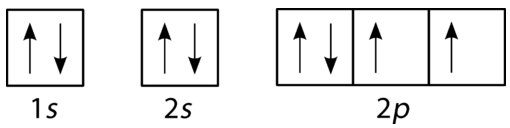
This orbital diagram represents:
Carbon
Boron
Nitrogen
Oxygen

What is the configuration for Carbon?
1s2 2p2
1s2 2s2 2p2
1s1 1s2 2s2 2p2
1s2 2s2 is which element?
Lithium
Beryllium
Helium
Boron
Iron (Fe) configuration is
1s2 2s2 2p6 3s2 3p3
1s2 2s2 2p6 3s2 3p6 4s2
1s2 2s2 2p6 3s2 3p6 4s2 3d6
1s2 2s2 2p6 3s2 3p6 4s2 4d6
Which element is 1s2 2s2 2p6 3s2 3p6 4s2 3d7?
Cobalt
Nickel
Manganese
Chromium
Write the configuration for Oxygen
1s2 2s2 1p4
2s2 2p4
1s2 2s2 3p4
1s2 2s2 2p4
Write the configuration for Phosphorus
2s2 2p6 3s2 3p3
1s2 2s3 2p6 3p3
1s2 2s2 2p6 3s2 3p3
1s2 2s2 2p5 3s2 3p3
Which element is 1s2 2s2 2p6 3s2 3p6 4s1?
Sodium (Na)
Lithium (Li)
Potassium (K)
Calcium (Ca)
Choose the correct configuration for Zinc
1s2 2s2 2p6 3s2 3p6 4s2 3d10
1s2 2s2 2p6 3s2 3p6 4s2 3d9
1s2 2s2 2p6 3s2 3p6 3s2 3d10
1s2 2s2 2p6 3s2 3p6 4s2 3d8
Choose the correct element for 1s2 2s2 2p6 3s2 3p6 4s2 3d10 4p5
Chlorine
Bromine
Krypton
Sulfur
Choose the correct configuration for Neon (Ne).
1s2 2s2 2p6 3s2 3p6
1s2 2s2 2p6 3s2
1s2 2s2 2p6
1s2 2s1 2p6

