wayground logo

Free Printable Worksheets

Font size

S
M
L
XL
Worksheets

Unit 3 Review

Total questions: 150

Worksheet time: 3hrs 58mins

Name
Class
Date
1.
Why are macromolecules also known as "polymers?"
a)
They are large molecules made up of many monomers. 
b)
They are large molecules added together. 
c)
There are many types of macromolecules. 
d)
Many organisms have macromolecules.
2.
Which of the following is NOT a biological macromolecule?
a)
Water
b)
Lipid
c)
Carbohydrate
d)
Nucleic Acid
3.
All biological macromolecules are organic, meaning they have ________ and hydrogen bonds.
a)
Carbon
b)
Hydrogen
c)
Nitrogen
d)
Oxygen
4.
True or False: The building blocks of macromolecules are also known as "monomers".
a)
True
b)
False
5.
What are the monomers (building blocks) of CARBOHYDRATES?
a)

Monosaccharides/Glucose (simple sugars)

b)
Amino Acids
c)
Nucleotides
d)
Triglycerides/No true monomer
6.
What are the monomers (building blocks) of PROTEINS?
a)
Monosaccharides (simple sugars)
b)
Amino Acids
c)
Nucleotides
d)
Triglycerides/No true monomer
7.
What are the monomers (building blocks) of NUCLEIC ACIDS?
a)
Monosaccharides (simple sugars)
b)
Amino Acids
c)
Nucleotides
d)
Triglycerides/No true monomer
8.
What are the monomers (building blocks) of LIPIDS?
a)
Monosaccharides (simple sugars)
b)
Amino Acids
c)
Nucleotides
d)

Triglycerides(made of 3 fatty acids)/No true monomer

9.
What is the primary function of CARBOHYDRATES?
a)
Source of energy
b)
Long term storage of energy
c)
Transmitting genetic information
d)
Cell processes and cell signaling
10.
What is the primary function of PROTEINS?
a)
Source of energy
b)
Long term storage of energy
c)
Transmitting genetic information
d)
Cell processes and cell signaling
11.
What is the primary function of LIPIDS?
a)
Source of energy
b)
Long term storage of energy
c)
Transmitting genetic information
d)
Cell processes and cell signaling
12.
What is the primary function of NUCLEIC ACIDS?
a)
Source of energy
b)
Long term storage of energy
c)
Transmitting genetic information
d)
Cell processes and cell signaling
13.
The food in the image is full of which macromolecule?
a)
Carbohydrates
b)
Lipids
c)
Proteins
14.
The food in the image is full of which macromolecule?
a)
Carbohydrates
b)
Lipids
c)
Proteins
15.
The food in the image is full of which macromolecule?
a)
Carbohydrates
b)
Lipids
c)
Proteins
16.
The food in the image is full of which macromolecule?
a)
Carbohydrates
b)
Lipids
c)
Proteins
17.

What are the building blocks (or monomers) of carbohydrates?

a)

Nucleotides

b)

Monosaccharides (Glucose)

c)

Amino Acids

d)

Glycerols

18.
Why are the four biological macromolecules essential for life?
a)
They all provide an organism with oxygen.
b)
They do many important jobs to keep an organism functioning.
c)
They provide an organism with food.
d)
They are all broken down for energy.
19.
Examples of which biological macromolecule include glucose, fructose, starch, and glycogen?
a)
Lipids
b)
Carbohydrates
c)
Nucleic Acids
d)
Proteins
20.

Which type of food would you choose for a quick energy boost?

a)

apple

b)

steak

c)

cheese sticks

d)

pizza

21.

What macromolecule is classified as an enzyme?

a)

Carbohydrate

b)

Protein

c)

Nucleic Acid

d)

Lipids

22.

What is an example of a nucleic acid?

a)

b)

c)

d)

23.

What is the monomer of Carbohydrates?

a)

Amino Acid

b)

Monosacharrides

c)

Fatty Acids

d)

DNA/RNA

24.

What is the monomer of lipids?

a)

Amino Acids

b)

Monosaccharides

c)

Fatty Acids

d)

DNA/RNA

25.

What is the monomer of proteins?

a)

Amino Acids

b)

Monosaccharides

c)

Fatty Acids

d)

DNA/RNA

26.

What is the monomer of nucleic acids?

a)

Amino Acids

b)

Monosaccharides

c)

Fatty Acids

d)

Nucleotides

27.

What is the function of a carbohydrate?

a)

Control rates of reactions, form muscle and bones

b)

Provide long term energy, protection, waterproofing, and insulation.

c)

Main source of energy and is quick.

d)

Store and transmit genetic information.

28.

What is the function of lipids?

a)

Control rates of reactions and forms muscle and bones.

b)

Main source of energy.

c)

Energy storage, protection, waterproofing and insulation.

d)

Store and transmit genetic information.

29.

What is the function of proteins?

a)

Main source of energy.

b)

Energy storage, protection, waterproofing and insulation

c)

Store and transmit genetic information.

d)

Control rates of reactions and form muscles and bones.

30.

What is the function of nucleic acids?

a)

Main source of energy.

b)

Energy storage, protection, water proofing, and insulation.

c)

Control rates of reactions and form muscles and bones.

d)

Store and transmit genetic information.

31.

What is an example of a lipid?

a)
b)

c)

d)

32.

What is an example of a carbohydrate?

a)

b)

c)

d)

33.

What is an example of a protein?

a)

b)

c)

d)

34.

What is an example of a nucleic acid?

a)

b)

c)

d)

35.

What macromolecule is classified as an enzyme?

a)

Carbohydrate

b)

Protein

c)

Nucleic Acid

d)

Lipids

36.

What does an enzyme do for reactions?

a)

Act as catalysts to speed up reactions.

b)

Act as catalysts to slow down reactions.

c)

Act as catalysts to keep reactions stable.

37.

What are examples of carbohydrates?

a)

triglycerides, waxes, fat, and oils

b)

form polypeptides such as antibodies, enzymes, and hormones

c)

glucose, fructose, cellulose, and lactose

d)

DNA and RNA

38.

What are examples of proteins?

a)

triglycerides, waxes, fats, and oils

b)

form polypeptides such as antibodies, enzymes, and hormones

c)

glucose, fructose, cellulose, and lactose

d)

DNA and RNA

39.

What are examples of lipids?

a)

triglycerides, waxes, fats, and oils

b)

form polypeptides such as antibodies, enzymes, and hormones

c)

glucose, fructose, cellulose, and lactose

d)

DNA and RNA

40.

What are examples of nucleic acids?

a)

triglycerides, waxes, fats, and oils

b)

form polypeptides such as antibodies, enzymes, and hormones.

c)

glucose, fructose, cellulose, and lactose

d)

DNA and RNA

41.

The cell membrane of a cell consists of

a)

protein molecules arranged around 2 layers

b)

two layers of lipids with embedded proteins built in

c)

lipid molecules positioned between two carbohydrate layers

d)

protein molecules which are made of sugar

42.

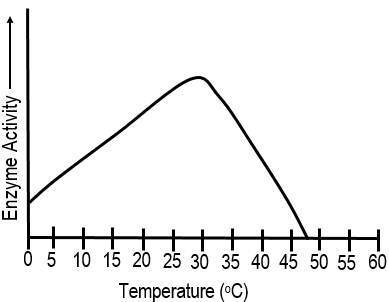
Which of the following conclusions can be drawn from the graph?

a)

The optimum temperature is 20C

b)

The optimum temperature is 38C

c)

The enzyme's activity continually increases as temperature increases.

d)

The enzyme's activity continually decreases as temperature increases.

43.
Proteins are made of monomers called ___________
a)
Nucleotides
b)
Monosaccharides
c)
Amino Acids
d)
Glycerol and fatty acids
44.
DNA and RNA are examples of 
a)
Carbohydrates
b)
Lipids
c)
Proteins
d)
Nucleic Acids
45.
Nucleotides are monomers of
a)
Carbohydrates
b)
Lipids
c)
Proteins
d)
Nucleic Acids
46.
Monosaccharides are monomers of
a)
Carbohydrates
b)
Lipids
c)
Proteins
d)
Nucleic Acids
47.
Waxes, oils and fats are examples of
a)
Carbohydrates
b)
Lipids
c)
Proteins
d)
Nucleic Acids
48.
What is the function of nucleic acids?
a)
store genetic information
b)
store energy (long-term)
c)
store energy (short-term)
d)
build skin, hair, nails, muscles
49.
Which of the following organic compounds is the main source of energy for living things?
a)
carbohydrates
b)
lipids
c)
nucleic acids
d)
proteins
50.
Which macromolecule stores energy, insulates us, and makes up the cell membrane?
a)
lipids
b)
proteins
c)
carbohydrates
d)
nucleic acids
51.
What are the monomers of DNA?
a)
glycerols
b)
amino acids
c)
fatty acids
d)
nucleotides
52.
Lipids can be digested into what smaller subunits?
a)
nucleic acids
b)
amino acids
c)
fatty acids
d)
glucose
53.
All polymers are made up of...
a)
monosaccharides
b)
monomers
c)
proteins
d)
None of these
54.
All organic compounds contain the element
a)
carbon
b)
nitrogen
c)
phosphorus
d)
sulfur
55.

Enzymes belong to which class of macromolecules?

a)

lipids

b)

carbohydrates

c)

proteins

d)

nucleic acids

56.

DNA belongs to which class of macromolecules?

a)

proteins

b)

nucleic acids

c)

carbohydrates

d)

lipids

57.

Sugar belongs to which class of macromolecules?

a)

proteins

b)

lipids

c)

nucleic acids

d)

carbohydrates

58.
Proteins are made of monomers called ___________
a)
Nucleotides
b)
Monosaccharides
c)
Amino Acids
d)
Glycerol and fatty acids
59.
DNA and RNA are examples of 
a)
Carbohydrates
b)
Lipids
c)
Proteins
d)
Nucleic Acids
60.
Nucleotides are monomers of
a)
Carbohydrates
b)
Lipids
c)
Proteins
d)
Nucleic Acids
61.
Monosaccharides are monomers of
a)
Carbohydrates
b)
Lipids
c)
Proteins
d)
Nucleic Acids
62.
Waxes, oils and fats are examples of
a)
Carbohydrates
b)
Lipids
c)
Proteins
d)
Nucleic Acids
63.
What is the function of nucleic acids?
a)
store genetic information
b)
store energy (long-term)
c)
store energy (short-term)
d)
build skin, hair, nails, muscles
64.
Which of the following organic compounds is the main source of energy for living things?
a)
carbohydrates
b)
lipids
c)
nucleic acids
d)
proteins
65.
Which macromolecule stores energy, insulates us, and makes up the cell membrane?
a)
lipids
b)
proteins
c)
carbohydrates
d)
nucleic acids
66.
All polymers are made up of...
a)
monosaccharides
b)
monomers
c)
proteins
d)
None of these
67.
Lipids can be digested into what smaller subunits?
a)
nucleic acids
b)
amino acids
c)
fatty acids
d)
glucose
68.
What are the monomers of DNA?
a)
glycerols
b)
amino acids
c)
fatty acids
d)
nucleotides
69.

Enzymes belong to which class of macromolecules?

a)

lipids

b)

carbohydrates

c)

proteins

d)

nucleic acids

70.

DNA belongs to which class of macromolecules?

a)

proteins

b)

nucleic acids

c)

carbohydrates

d)

lipids

71.

Sugar belongs to which class of macromolecules?

a)

proteins

b)

lipids

c)

nucleic acids

d)

carbohydrates

72.

Which macromolecule is shown?

a)

lipid

b)

protein

c)

nucleic acid

d)

carbohydrate

73.
Is found in the cell membrane as a bilayer. 
a)
lipids
b)
protein
c)
nucleic acid
d)
carbohydrate
74.
What type of macromolecule is being represented in this image? 
a)
carbohydrate
b)
lipid
c)
protein
d)
nucleic acid
75.
Which major macromolecule is being represented in this image? 
a)
carbohydrate
b)
lipid
c)
protein
d)
nucleic acid
76.
What is the smallest unit of a macromolecule?
a)
polymer
b)
monomer
c)
dimer
d)
trimer
77.
Many monomers put together make a
a)
dimer
b)
trimer
c)
polymer
d)
monosaccharide
78.
Which of the following macromolecules is nonpolar and hydrophobic?
a)
carbohydrates
b)
lipids
c)
proteins
d)
nucleic acids
79.
Which of the following macromolecules is also known as fats?
a)
carbohydrates
b)
lipids
c)
proteins
d)
nucleic acids
80.
Which of the following macromolecules is used for short term energy storage?
a)
carbohydrates
b)
lipids
c)
proteins
d)
nucleic acids
81.
Which of the following macromolecules is used for long term energy storage?
a)
carbohydrates
b)
lipids
c)
proteins
d)
nucleic acids
82.
Which of the following macromolecules is used in skin and muscle?
a)
carbohydrates
b)
lipids
c)
proteins
d)
nucleic acids
83.
Which of the following macromolecules is used for giving directions to make other macromolecules?
a)
carbohydrates
b)
lipids
c)
proteins
d)
nucleic acids
84.
Which of the following macromolecules has a fatty acid as a monomer?
a)
carbohydrates
b)
lipids
c)
proteins
d)
nucleic acids
85.
Which of the following macromolecules has a fatty acid as a monomer?
a)
carbohydrates
b)
lipids
c)
proteins
d)
nucleic acids
86.
Which of the following macromolecules has an amino acid as a monomer?
a)
carbohydrates
b)
lipids
c)
proteins
d)
nucleic acids
87.
Which of the following macromolecules has an monosaccharide as a monomer?
a)
carbohydrates
b)
lipids
c)
proteins
d)
nucleic acids
88.
Which of the following macromolecules has an nucleotide as a monomer?
a)
carbohydrates
b)
lipids
c)
proteins
d)
nucleic acids
89.
Which of the following macromolecules has an nucleotide as a monomer?
a)
carbohydrates
b)
lipids
c)
proteins
d)
nucleic acids
90.
DNA is an example of a(an)
a)
lipid
b)
protein
c)
carbohydrate
d)
nucleic acid
91.
Earwax is an example of a(an)
a)
lipid
b)
protein
c)
carbohydrate
d)
nucleic acid
92.
Chicken is an example of a(an)
a)
lipid
b)
protein
c)
carbohydrate
d)
nucleic acid
93.
Rice is an example of a(an)
a)
lipid
b)
protein
c)
carbohydrate
d)
nucleic acid
94.
Rice is an example of a(an)
a)
lipid
b)
protein
c)
carbohydrate
d)
nucleic acid
95.
Which of the following would give you more energy?
a)
fat that is 12 carbons long
b)
fat that is 6 carbons long
c)
fat that is 2 carbons long
d)
fat that is 20 carbons long
96.
What is a substance called if it speeds up a chemical reaction?
a)
reusable
b)
catalyst
c)
specific
d)
fragile
97.
With what 3 letters do enzymes typically end?
a)
-ose
b)
-ase
c)
-ese
d)
-tic
98.

Enzymes are an example of

a)

Lipids

b)

Carbohydrate

c)

Protein

d)

Nucleic Acid

99.
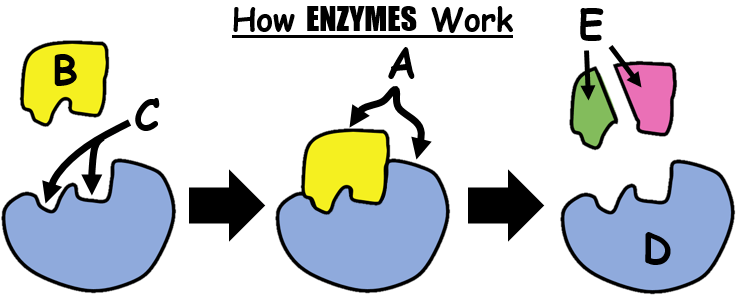
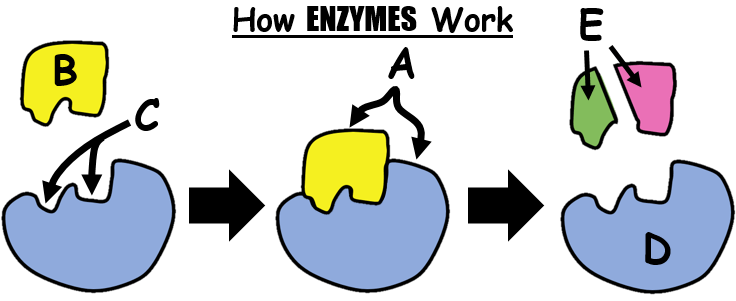
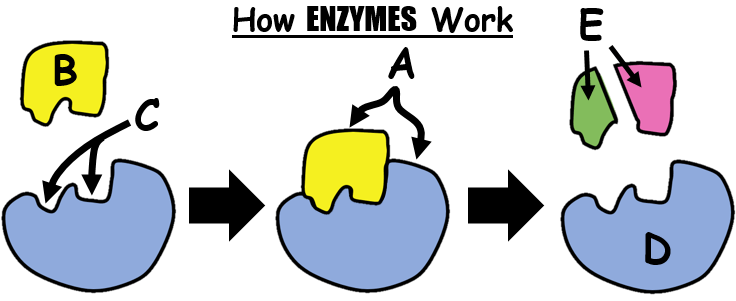
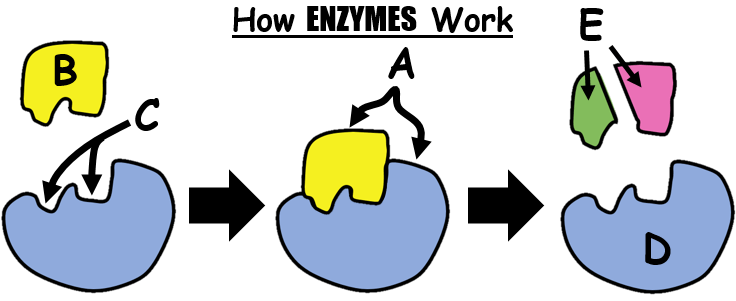
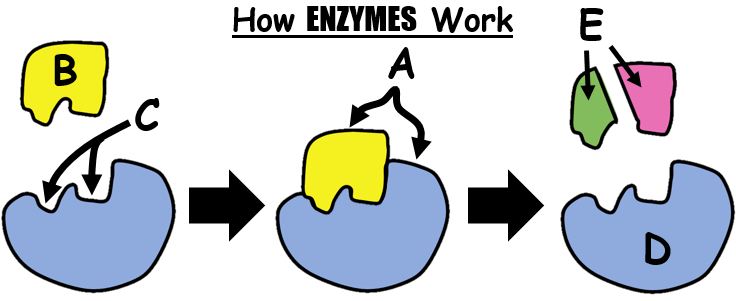
Letter D...
a)
active site
b)
enzyme
c)
substrate
d)
products
100.
Letter B...
a)
active site
b)
enzyme
c)
substrate
d)
products
101.
Letter C...
a)
active site
b)
enzymes
c)
substrate
d)
products
102.
Letter E...
a)
active site
b)
enzyme
c)
substrate
d)
products
103.
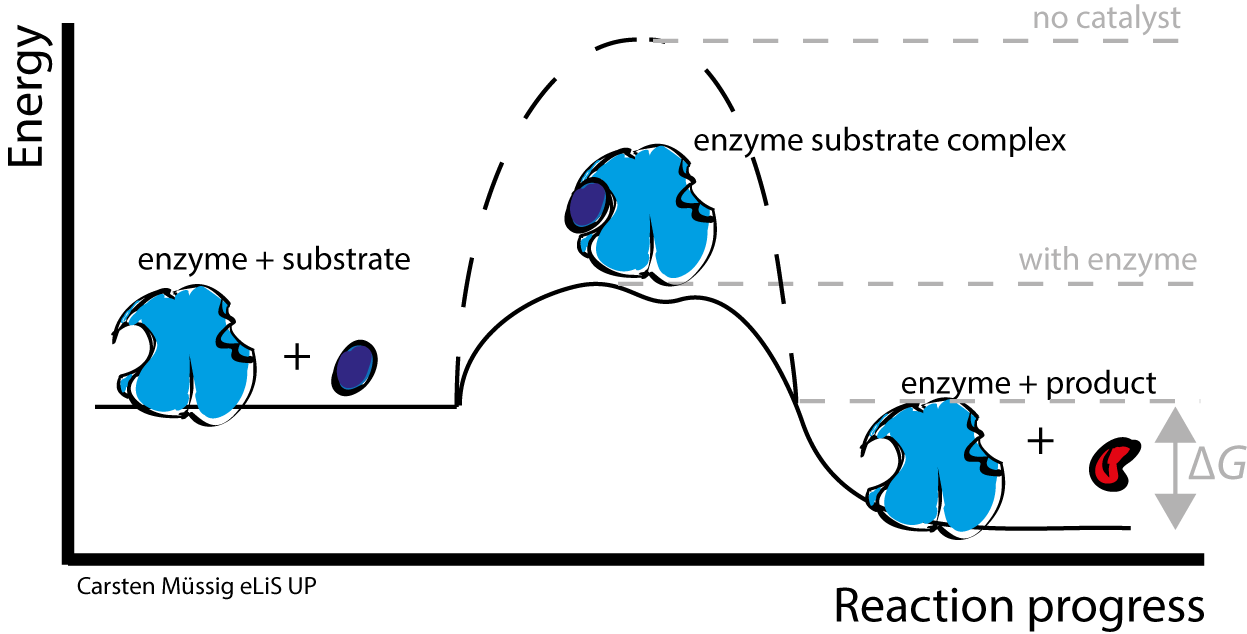
An enzyme speeds up a reaction by
a)
lowering the activation energy.
b)
raising the activation energy.
c)
releasing energy.
d)
absorbing energy.
104.

What happens when enzymes are heated to a high temperature?

a)

The enzymes die.

b)

The shape of the enzyme are changed and it denatures

c)

The enzymes' amino acid sequence changes.

d)

The enzymes remain the same

105.

Which of these is most likely an enzyme?  

a)

Sucrose

b)

Galactose

c)

Fructose

d)

Amylase

106.

What is the optimum temperature for this enzyme?

a)

20 degrees Celsius

b)

45 degrees Celsius

c)

52 degrees Celsius

d)

64 degrees Celsius

107.

What can be inferred using the graph?

a)

Cells can function equally as well at all pH values.

b)

Cells do not function well at pH values that are too high or too low.

c)

Cells function best at high pH values.

d)

Cells function best at low pH values.

108.

In the enzymatic reaction, the __________ is on the left of the arrow, while the products are to the right of the arrow.

a)

enzyme

b)

filtrate

c)

pre-product

d)

reactant

109.

Which of the following two factors affect an enzyme's operation the most?

a)

amount of light and temperature

b)

blood glucose and pH

c)

temperature and pH

d)

amount of light and pressure

110.

What is activation energy?

a)

the energy from the sun

b)

the energy produced by an enzyme

c)

the energy needed to get a reaction going

d)

none of these

111.

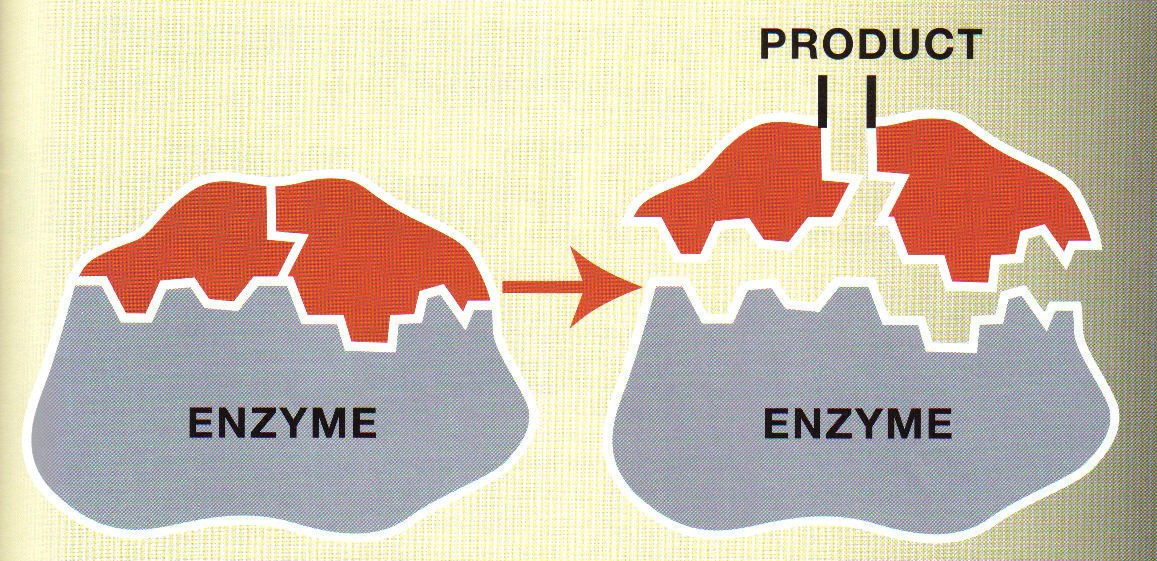
In the lock-and-key model of enzyme action, the __________ fits into the __________ of the enzyme.

a)

product; substrate

b)

active site; product

c)

substrate; active site

d)

active site; substrate

112.
With what 3 letters do enzymes typically end?
a)
-ose
b)
-ase
c)
-ese
d)
-tic
113.

Enzymes are an example of

a)

Lipids

b)

Carbohydrate

c)

Protein

d)

Nucleic Acid

114.
In the diagram, what is letter A? 
a)
product
b)
substrate
c)
enzyme-substrate complex
d)
active site
115.
Letter D...
a)
active site
b)
enzyme
c)
substrate
d)
products
116.
Letter B...
a)
active site
b)
enzyme
c)
substrate
d)
products
117.
Letter C...
a)
active site
b)
enzymes
c)
substrate
d)
products
118.
An enzyme speeds up a reaction by
a)
lowering the activation energy.
b)
raising the activation energy.
c)
releasing energy.
d)
absorbing energy.
119.

What happens when enzymes are heated to a high temperature?

a)

The enzymes die.

b)

The shape of the enzyme are changed and it denatures

c)

The enzymes' amino acid sequence changes.

d)

The enzymes remain the same

120.
The molecule an enzyme is working on is called the:
a)
Substrate
b)
Solvent
c)
Allosteric Inhibitor
d)
CoEnzyme
121.
Which of these is NOT true?
a)
Enzymes can denature (change shape) when the temperature gets too high.
b)
Enzymes can only be used once in a chemical reaction. 
c)
Extreme pH can denature enzymes.
d)
Enzymes speed up chemical reactions. 
122.
Based on the graph, what temperature does this enzyme work best? 
a)
15 C
b)
40 C
c)
30 C
d)
47 C
123.
What is the function of an enzyme?
a)
enzymes break themselves into small pieces
b)
enzymes slow down chemical reactions
c)
enzymes speed up chemical reactions
d)
enzymes combine products to form reactants 
124.
Enzymes will make a reaction go _______ and use ______ energy.
a)
faster, less
b)
faster, more
c)
slower, less
d)
slower, more
125.
Every enzyme has a optimal temperature and pH. True or False?
a)
True 
b)
False
126.
Enzymes are composed of which of the following monomers? 
a)
amino acids
b)
carbohydrates
c)
nucleotides
d)
monosaccharides
127.

Enzymes are specific. This means that an enzyme only works with molecules that are....

a)

the right size and shape

b)

broken down already

c)

present in water

d)

too big for the body to handle

128.

What happens to an enzyme when it is denatured?

a)

Activation energy is lowered

b)

It becomes stronger

c)

It loses its shape

d)

Activation energy is raised

129.
Negative Feedback Loops:
a)
amplify processes
b)
prevent small changes from getting larger
c)
are initiated during childbirth
d)
are found only in plants
130.
The two types of feedback systems that help organisms maintain homeostasis are:
a)
positive and negative 
b)
receptor and effector
c)
static and dynamic
d)
minor and major
131.

A organization posts an advertisement with a very "click-baity" title and image on a social media platform. The title and image draw in people to click on the ad. As the ad receives more views, the algorithm shows the ad to more people.

a)

Positive Feedback Loop

b)

Negative Feedback Loop

132.

In a positive feedback loop, each action creates a consequence that _____________________ the other action.

a)

decreases

b)

has no effect on

c)

amplifies

133.

In a negative feedback loop, each action creates a consequence that _____________________ the other action.

a)

decreases

b)

has no effect on

c)

amplifies

134.

If the anterior pituitary does not release TSH, what will happen?

a)

Thyroid follicles will not release T3 and T4

b)

The hypothalamus will release TRH

135.

What is the difference between what will happen if their is too much Glucose or too little Glucose? SELECT ALL THAT APPLY

a)

With too much Glucose, Insulin is released. With too little Glucose, Glucagon is released.

b)

With too much Glucose, the pancreas produces insulin. With too little Glucose, the pancreas produces glucagon.

c)

With too much Glucose, Glucagon is released. With too little Glucose, Insulin is released.

d)

There is no difference.

136.

What is the point of a feedback loop?

a)

To provide the body with more energy.

b)

To provide the body with more food.

c)

To make sure the conditions in the body are always changing.

d)

To make sure the conditions in the body remain stable.

137.

When you get cut, your skin cells release hormones that signal platelets to come and stop the bleeding. Platelets then release more hormones that signal even more platelets to help stop bleeding. The hormone signals continue until the cut is closed. This is an example of what type of feedback?

a)

Positive Feedback Response

b)

Negative Feedback Loop

138.
Humans have ___ for body temperature, blood glucose concentrations, electrolyte concentrations, pH levels, tendon tension and variables.
a)
positive feedback mechanisms
b)
set points
c)
a wide internal range
d)
no regulation
139.

Detects change and sends a message to the control center

a)

receptor

b)

control center

c)

effector

d)

regulation

140.

Receives the message from the receptor and coordinates a response

a)

control center

b)

effector

c)

glucagon

d)

homeostasis

141.

responds to the output from the control center

a)

control center

b)

receptor

c)

thermoregulation

d)

effector

142.

increases or speeds up original change

a)

negative feedback

b)

positive feedback

c)

endotherm

d)

ectotherm

143.

As you get dehydrated, your blood becomes thicker and harder to pump. Your kidneys will respond by stopping urine production, sending the water from urine into your bloodstream to thin your blood back to normal level. This is an example of what type of feedback?

a)

Positive Feedback Response

b)

Negative Feedback Loop

144.

Identify the STIMULUS.

Scenario: A person begins to exercise which causes their body temperature to increase. The temperature change is noticed and the person begins to sweat and their body temperature decreases.

a)

temperature change is noticed

b)

person begins to sweat

c)

body temperature decreases

d)

person begins to exercise

145.

According to the model, what is the response to LOW blood glucose (sugar)?

a)

Pancreas releases insulin into blood

b)

Pancreas releases glucagon into blood

146.
The "cause" for something to happen is the
a)
response
b)
effect
c)
stimulus
d)
homeostasis
147.
Negative Feedback Loops:
a)
amplify processes
b)
prevent small changes from getting larger
c)
are initiated during childbirth
d)
are found only in plants
148.

According to the feedback loop, what does high blood sugar promote?

a)

Insulin Release

b)

Glucagon Release

c)

Insulin Uptake

d)

Glycogen Uptake

149.

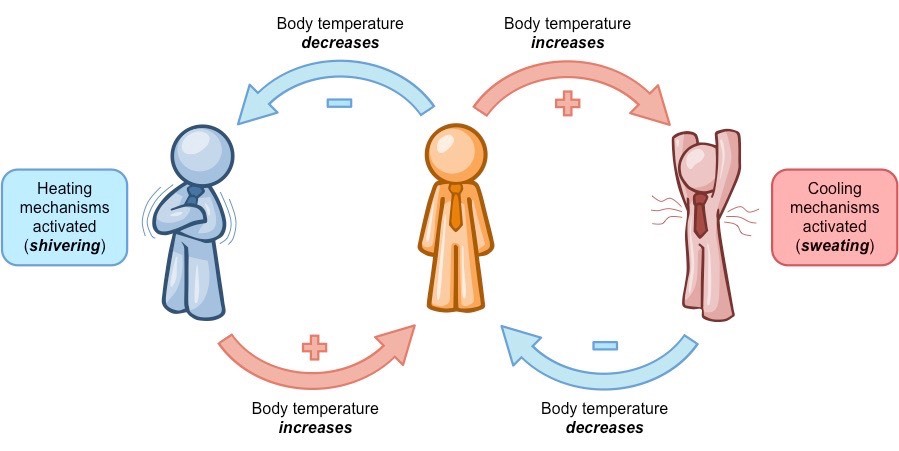
In this body temperature feedback loop, predict what would happen if cooling mechanisms were NOT activated?

a)

The body would not warm up.

b)

The body would not cool down.

c)

Your body would get colder and colder.

d)

Your body would release lots of heat.

150.
The "effect" of a given stimulus is the...
a)
response
b)
stimulus
c)
cause
d)
result