
 Worksheets
Chemistry Fall Final Review
Total questions: 149
Worksheet time: 1hrs 16mins
Name
Class
Date
1.
Multiply 2.3 x 10^2 and 5.4 x 10^4.
a)
1.242 x 10^7
b)
1.242 x 10^6
c)
1.242 x 10^-6
d)
1.242 x 10^-7
2.
The study of chemical processes in living organisms is called
a)
pure chemistry.
b)
biochemistry.
c)
inorganic chemistry.
d)
living thing chemistry.
3.
A sample of water's volume is measured to be 9 mL. The true volume is 8.5 mL. What's the percent error?
a)
About 5.88%
b)
About 5.56%
c)
About 50%
d)
About 8.33%
4.
Divide 8.9 x 10^-3 and 1.0 x 10^-2
a)
8.9 x 10^-1
b)
8.9 x 10^-2
c)
8.9 x 10^1
d)
8.9 x 10^2
5.
Express 5.6 x 10^-2 as a "normal" number.
a)
0.056
b)
0.56
c)
0.0056
d)
560
6.
The closeness to the true value of a measured object is
a)
accuracy
b)
precision
c)
significant figure
d)
weight
7.
The kelvin is the SI base unit for
a)
mass
b)
temperature
c)
time
d)
weight
8.
The diameter of a carbon atom is 0.000 000 000 154 m. What is this number expressed in scientific notation?
a)
1.54 x 10^12 m
b)
1.54 x 10^-12 m
c)
1.54 x 10^10 m
d)
1.54 x 10^-10 m
9.
Which of the following measurements contains 2 significant figures?
a)
0.00400 L
b)
0.00404 L
c)
0.00044 L
d)
0.00440 L
10.
A conversion factor that shows the relationship between grams and kilograms is
a)
1000 g / 1 kg
b)
/ 1000
c)
x 1000
d)
1 g / 1000 kg
11.
Which of the following equalities is correct?
a)
100 cg = 1g
b)
1000 mm = 100 m
c)
10 kg = 1 g
d)
10 A = 1 daA
12.
Density, often expressed in g/mL or g/cm^3, is found by dividing mass by
a)
volume.
b)
area.
c)
time.
d)
temperature.
13.
Convert 15 m to mm.
a)
15000 mm
b)
1500 mm
c)
0.0015 mm
d)
0.15 mm
14.
A train travels at a speed of 30 km/hr. Approximately how fast is the train moving in m/s?
a)
8.33 m/s
b)
30000 m/s
c)
8.33 x 10^-3 m/s
d)
108 m/s
15.
When multiplying and dividing measured quantities, the number of significant figures in the result should be equal to the number of significant figures in the least precise measurement.
a)
True
b)
False
16.
What is the SI unit of mass?
a)
mole
b)
kilogram
c)
kelvin
d)
candela
17.
What type of chemist would a geologist contact if they wanted to identify the minerals in a rock?
a)
Analytical chemist
b)
Pure chemist
c)
Physical chemist
d)
Organic chemist
18.
The branch of chemistry that studies chemicals containing carbon is
a)
physical chemistry.
b)
inorganic chemistry.
c)
organic chemistry.
d)
analytical chemistry.
19.
Why do scientists make models?
a)
Models make it easier to understand things that might be too difficult to observe directly.
b)
The scientists need to communicate their results with other people in a physical way.
c)
The scientists need to spend all the money they got for research.
d)
Models make it easy for scientists to do experiments.
20.
Should a hypothesis be developed before an experiment takes place?
a)
Yes
b)
No
21.
Why do all samples of a given substance have the same intensive properties?
a)
Every sample of a given substance has the same chemical composition.
b)
Every sample of a given substance also have the same extensive properties.
c)
This is false; not all samples of a given substance have the same intensive properties.
d)
This is false; not all samples of a given substance have the same chemical composition.
22.
How are mixtures mainly classified?
a)
Based on the distribution of their components.
b)
Based on the types of components.
c)
Based on the whims of scientists.
d)
Based on the amounts of their components.
23.
What type of properties can be used to separate mixtures?
a)
Differences in physical properties
b)
Differences in chemical properties
c)
Differences in scientific properties
d)
Differences in matter's change in state properties
24.
If you wanted to separate out the caffeine, sugar, coffee grounds, and water, what would be the easiest method of separation to use?
a)
Filtration
b)
Distillation
c)
Separating it out, molecule by molecule
d)
Other
25.
Is brewed coffee without grounds in it a homogeneous or heterogeneous mixture?
a)
Homogeneous
b)
Heterogeneous
26.
How are liquids and gases similar?
a)
Both have an indefinite shape.
b)
Both have a definite shape.
c)
Both have a definite volume.
d)
Both have an indefinite volume.
27.
Is it possible that samples of platinum and copper can have the same extensive properties but not the same intensive properties? Why?
a)
No, if they have the same extensive properties, they will have the same intensive properties, too.
b)
Yes, since platinum and copper have different chemical compositions, they cannot have the same set of intensive properties.
c)
Yes, since platinum and copper have different physical properties, they cannot have the same set of intensive properties.
d)
No, since samples of platinum and copper are both metals, they can have the same set of intensive properties.
28.
Freezing mercury is a reversible physical change.
a)
True
b)
False
29.
How is a compound different from an element?
a)
Compounds contain multiple types of atoms; elements contain one.
b)
Compounds contain one type of atom; elements contain multiple.
c)
Compounds have variable compositions; elements have fixed compositions.
d)
Compounds have fixed compositions; elements have variable compositions.
30.
What are chemical symbols used for?
a)
To make students' lives difficult
b)
To represent elements
c)
To represent molecules
d)
To represent mixtures
31.
Cough syrup is a(n)
a)
element.
b)
compound.
c)
mixture.
32.
Identify elements that have properties similar to helium (He).
a)
Neon (Ne)
b)
Argon (Ar)
c)
Krypton (Kr)
d)
Hydrogen (H)
e)
Chlorine (Cl)
33.
How does a chemical change affect the composition of matter?
a)
It always changes during a chemical change.
b)
It sometimes changes during a chemical change.
c)
It doesn't change during a chemical change
34.
Identify the possible clues that a chemical change has taken place.
a)
Production of a gas
b)
Change in color
c)
Formation of a precipitate
d)
Transfer of energy
e)
A sample has changed state
35.
Identify all true statements.
a)
During a physical change, the composition of a substance does not change.
b)
During a chemical change, the composition of a reactant does change as the products form.
c)
During a physical change, the composition of a substance does change.
d)
During a chemical change, the composition of a product does change as the reactants form.
e)
During a chemical change, the composition of a substance does not change.
36.
When a penny turns green after being exposed to air and water for a long time, is that a physical change or a chemical change?
a)
Physical
b)
Chemical
37.
Which element is paired with the wrong symbol?
a)
sulfur, S
b)
potassium, P
c)
nitrogen, N
d)
calcium, Ca
38.
Which of the following properties could not be used to distinguish between table salt and table sugar?
a)
Boiling point
b)
Melting point
c)
Density
d)
Color
39.
The state of matter characterized by a definite volume and an indefinite shape is a
a)
solid.
b)
liquid.
c)
gas.
d)
mixture.
40.
Which of the following is an example of a physical change, despite the sign for a chemical change?
a)
Iron glows red when heated.
b)
A mixture of baking soda and vinegar will bubble.
c)
Milk separates into solid curds and liquid whey during the cheese-making process.
d)
A pH test strip dipped in a solution changes color.
41.
How did Democritus characterize atoms?
a)
As divisible and destructible
b)
As indivisible and indestructible
c)
As indivisible but destructible
d)
As divisible but indestructible
42.
How did Dalton advance the atomic philosophy of Democritus?
a)
By reiterating Democritus' ideas
b)
By using experimental methods
c)
By using mathematical proofs
d)
By publishing his own critique of Democritus' ideas
43.
Why were Dalton's ideas a theory while Democritus' were not?
a)
Dalton's ideas were not based on experimental results and did not explain chemical behavior; Democritus' were based on experimental results and did explain chemical behavior.
b)
Dalton's ideas were based on experimental results and explained chemical behavior; Democritus' were not based on experimental results and did not explain chemical behavior.
c)
Dalton's ideas were based on experimental results but did not explain chemical behavior; Democritus' were not based on experimental results but did explain chemical behavior.
d)
Dalton's ideas were not based on experimental results but did explain chemical behavior; Democritus' were based on experimental results but did not explain chemical behavior.
44.
Under Dalton's theory, is it possible to convert atoms of one element to another?
a)
Yes
b)
No
45.
Are atoms truly indivisible?
a)
Yes
b)
No
46.
Identify the three main subatomic particles that make atoms.
a)
Proton
b)
Electron
c)
Neutron
d)
Lepton
e)
Photon
47.
Who is credited with the discovery of the electron?
a)
Robert Millikan
b)
Ernest Rutherford
c)
J.J. Thomson
d)
John Dalton
48.
How does the Rutherford model describe the structure of atoms?
a)
A positively charged nucleus surrounded by electrons, which occupy most of the volume.
b)
A negatively charged nucleus surrounded by electrons, which occupy most of the volume.
c)
A positively charged nucleus surrounded by protons, which occupy most of the volume.
d)
A positively charged nucleus surrounded by electron, which occupy most of the mass.
49.
What is the relative mass of a neutron, where u = mass of a proton?
a)
1/1840 u
b)
1u
c)
1.1u
d)
0.9u
50.
How did Millikan contribute to atomic theory?
a)
He discovered the quantity of a proton's charge.
b)
He discovered the neutron.
c)
He discovered the quantity of an electron's charge.
d)
He discovered the electron.
51.
What distinguishes the atoms of one element from another?
a)
The number of electrons
b)
The number of neutrons
c)
The number of protons
d)
The mass number
52.
How do isotopes of a given element differ?
a)
The number of protons
b)
The number of electrons
c)
The number of neutrons
d)
The electric charge
53.
What is the number of neutrons in argon-40?
a)
18
b)
40
c)
22
d)
58
54.
Select all true statements about helium-4.
a)
It has 2 protons
b)
It has 2 neutrons
c)
It has 2 electrons
d)
It has 4 protons
e)
It has 4 neutrons
55.
What is the atomic number of iridium?
a)
53
b)
77
c)
115
d)
192
56.
What part of the atom occupies almost all the volume of an atom?
a)
Proton
b)
Neutron
c)
Electron
d)
Nucleus
57.
How did Millikan contribute to atomic theory?
a)
He discovered the quantity of a proton's charge.
b)
He discovered the neutron.
c)
He discovered the quantity of an electron's charge.
d)
He discovered the electron.
58.
What did Rutherford expect during the gold-foil experiment?
a)
The alpha particles should have passed through the gold foil unobstructed.
b)
The alpha particles should have been deflected in all directions.
c)
Most of the alpha particles should pass through with minor deflections with a small number being deflected at very large angles.
d)
The alpha particles should have passed through the gold foil with only minor deflections.
59.
What is the definition of an amu?
a)
1/14 of the mass of a carbon-12 atom
b)
1/12 of the mass of a carbon-12 atom
c)
1/12 of the mass of a carbon-14 atom
d)
1/12 of the mass of an oxygen-12 atom
60.
Why are the atomic masses of elements on the periodic table not whole numbers?
a)
The atomic mass is the weighted average of the masses of its isotopes.
b)
The atomic mass is the weighted average of the masses of its subatomic particles.
c)
There are not whole number masses for an individual atom.
d)
The electron's impact on atomic mass is significant enough for chemists to account for it.
61.
What was the basic proposal in the Bohr model of the atom?
a)
Electrons are only found in specific orbits around the nucleus.
b)
Protons are only found in specific orbits around the nucleus.
c)
Electrons act as both waves and particles.
d)
Atomic nuclei are positively charged.
62.
How do two sublevels of the same principal energy level differ from each other?
a)
They have different shapes.
b)
They have different orientations.
c)
They have different numbers of electrons per orbital.
63.
How can electron move from one energy level to another?
a)
By absorbing or releasing exact amounts of energy.
b)
By absorbing exact amounts of energy.
c)
By releasing exact amounts of energy.
d)
Whenever they want to.
64.
How many orbitals are in the 3d sublevel?
a)
1
b)
3
c)
5
d)
7
65.
What does the aufbau principle say about electrons?
a)
Electrons will occupy the orbitals of lowest energy first.
b)
Electrons will occupy the orbitals of highest energy first.
c)
Only two electrons can occupy a given orbital at a time.
d)
Electrons occupy orbitals that makes the number of electrons with the same spin direction as large as possible.
66.
What does the Pauli exclusion principle say about atomic orbitals?
a)
Only two electrons can occupy a given orbital at a time.
b)
Electrons will occupy the orbitals of lowest energy first.
c)
An orbital can carry as many electrons as it wants at any time.
d)
Electrons occupy orbitals that makes the number of electrons with the same spin direction as large as possible.
67.
What does Hund's rule say about electrons?
a)
Electrons occupy orbitals that makes the number of electrons with the same spin direction as large as possible.
b)
Only two electrons can occupy a given orbital at a time.
c)
Electrons will occupy the orbitals of lowest energy first.
d)
Electrons occupy orbitals that makes the number of electrons with the same spin direction as low as possible.
68.
Why do some elements have slightly different electron configurations than what the aufbau principle would predict?
a)
Half-filled sublevels and filled sublevels are more stable than other incomplete configurations.
b)
Some atoms just want to be exceptions to our rules.
c)
Half-filled sublevels and filled sublevels are less stable than other incomplete configurations.
d)
The electrical attractions with the atom force exceptions to the aufbau principle.
69.
Which of the following elements have an electron configuration that is an exception to the general electron configuration rules?
a)
Copper
b)
Iron
c)
Cobalt
d)
Cadmium
70.
What is the origin of the atomic emission spectrum of an element?
a)
When electrons emit light as they drop down energy levels
b)
When electrons emit light as they raise energy energy levels
c)
When electrons absorb light as they drop down energy levels
d)
When electron emit light as they move from atom to atom
71.
What was Einstein's explanation for the photoelectric effect?
a)
Light behaves as a wave and thus able to force atoms to eject electrons.
b)
Light carries a positive electric charge and thus able to force electrons to move towards light.
c)
Light behaves as a stream of particles and thus able to force atoms to eject electrons.
d)
Light carries a negative electric charge and thus able to force electrons to move away from light.
72.
How is the change in electron energy related to the color of light emitted in electronic transitions (when electrons move energy levels)?
a)
The light emitted has a frequency that is directly proportional to the energy change of the electron.
b)
The light emitted has a frequency that is inversely proportional to the energy change of the electron.
c)
The light emitted has a frequency that is exponentially related to the energy change of the electron.
d)
The light emitted has a frequency that is logarithmically related to the energy change of the electron.
73.
How does quantum mechanics differ from classical mechanics?
a)
Classical mechanics describe the motions of atoms and subatomic particles; quantum mechanics describes the motion of larger bodies.
b)
Quantum mechanics uses calculus to describe motion; classical mechanics does not.
c)
Quantum mechanics describe the motions of atoms and subatomic particles; classical mechanics describes the motion of larger bodies.
d)
Classical mechanics assumes that all objects and energies are particles; quantum mechanics treats them as both waves and particles.
74.
Can we know both the position and velocity of a particle at the same time?
a)
Yes
b)
No
75.
Strontium produces a vivid red flame when heated, and barium produces a strong yellow-green color when heated. A compound was burned that is known to contain one of the two elements. The color of the flame is red with some pink and blue notes. Which of the two elements should we expect in the compound?
a)
Strontium
b)
Barium
76.
How many sublevels does the principal energy level
n = 4 have?
a)
1 sublevel
b)
2 sublevels
c)
3 sublevels
d)
4 sublevels
77.
What is the electron configuration for aluminum?
a)
[Ne] 3s² 3p¹
b)
[Ne] 3s² 3p²
c)
[Ne] 3s² 3p⁵
d)
[Ne] 3s² 3p⁴
e)
[Ne] 3s² 3p³
78.
The following electron configuration is for which element? 1s² 2s² 2p⁶ 3s² 3p⁶ 4s² 3d⁶
a)
Iron
b)
Ruthenium
c)
Krypton
d)
Manganese
79.
What is the energy of a photon with a frequency of
5 x 10^11 Hz?
a)
3.313 x 10^-22 J
b)
3.313 x 10^-21 J
c)
7.546 x 10^44 J
d)
1.325 x 10^-45 J
80.
What is the frequency of a photon with a wavelength of 7.125 x 10^-10 m?
a)
2.377 x 10^-18 Hz
b)
2.788 x 10^-16 Hz
c)
4.208 x 10^17 Hz
d)
2.136 x 10^-1 Hz
81.
How did chemists begin the process of organizing the elements?
a)
They used the properties of elements to sort them into groups.
b)
They used the properties of elements to sort them into periods.
c)
They used the atomic masses to sort them into groups.
d)
They used the atomic masses to sort them into periods.
82.
What property did Mendeleev use to organize his periodic table?
a)
Atomic mass
b)
Atomic number
c)
Atomic radius
d)
First ionization energy
83.
How are elements arranged in the modern periodic table?
a)
In order of increasing atomic number
b)
In order of increasing atomic weight
c)
In order of increasing atomic radius
d)
In order of increasing density
84.
Which of the following is NOT one of the three broad classes of the elements?
a)
Metals
b)
Nonmetals
c)
Transitional metals
d)
Metalloids
85.
Krypton is a
a)
Metal
b)
Metalloid
c)
Nonmetal
d)
Real planet
86.
How do the electron configurations of all alkali metals end? (Recall that "n" refers to the period that the element is in.)
a)
ns^1
b)
ns^2
c)
np^5
d)
np^6
87.
Which group of elements rarely take part in chemical reactions?
a)
Noble gases
b)
Alkali metals
c)
Alkaline earth metals
d)
Halogens
e)
Pnictogens
88.
Which block can osmium be found?
a)
s
b)
p
c)
d
d)
f
89.
Which of the following is a halogen?
a)
Sulfur
b)
Bromine
c)
Helium
d)
Copper
e)
Radium
90.
Magnesium is a(n)
a)
Alkaline earth metal
b)
Alkali metal
c)
Halogen
d)
Noble gas
e)
Transition metal
91.
The energy required to remove an electron from an atom is called
a)
Ionization energy
b)
Electronegativity
c)
Atomic radius
d)
Removal energy
92.
Which element has the highest electronegativity with a Pauling unit of 3.98 (often rounded to 4.0)?
a)
Cesium
b)
Lithium
c)
Fluorine
d)
Astatine
93.
What type of ion forms when an atom loses an electron?
a)
Cations
b)
Anions
c)
Dogions
d)
Posi-ions
94.
What type of ion forms when an atom gains an electron?
a)
Cations
b)
Anions
c)
Nega-ions
d)
Onions
95.
Which element would you expect to have a larger atomic radius: sodium or magnesium?
a)
Sodium
b)
Magnesium
96.
Group 2 is referred to as the
a)
alkali metals.
b)
alkaline earth metals.
c)
acidic earth metals.
d)
halogens.
97.
Which element would you expect to have a higher first ionization energy: chlorine or fluorine?
a)
Chlorine
b)
Fluorine
98.
Oxygen would typically form what type of ion?
a)
Cation
b)
Anion
99.
Is the carbide ion larger or smaller than a carbon atom?
a)
Smaller
b)
Larger
100.
Antimony typically will gain three electrons to form an ion. What is the charge on that ion?
a)
3+
b)
+3
c)
3-
d)
-3
101.
What on the periodic table can we use to determine the number of valence electrons in an atom of a representative element?
a)
Group number
b)
Period
c)
Block
d)
State
e)
Atomic mass
102.
How do cations form?
a)
When atoms lose electrons.
b)
When atoms gain electrons.
c)
When atoms lose protons.
d)
When atoms gain protons.
103.
How do anions form?
a)
When atoms lose electrons.
b)
When atoms gain electrons.
c)
When atoms lose protons.
d)
When atoms gain protons.
104.
Atoms of what type of element tend to gain electrons?
a)
Metals
b)
Metalloids
c)
Nonmetals
105.
Atoms of what type of element tend to lose electrons?
a)
Metals
b)
Metalloids
c)
Nonmetals
106.
What is the charge on the carbide ion?
a)
4-
b)
4+
c)
6-
d)
6+
107.
How many electrons will bromine gain or lose when forming the bromide ion?
a)
Gain 1
b)
Lose 1
c)
Gain 7
d)
Lose 7
108.
What is the electric charge for an ionic compound?
a)
1+
b)
0
c)
1-
d)
It varies from compound to compound.
109.
Which property is NOT true of ionic compounds?
a)
They are usually solids at room temperature.
b)
They tend to have high melting points.
c)
They conduct an electric current when melted or dissolved in water.
d)
They never form crystals.
110.
How do chemists model the valence electrons within a pure metal?
a)
Metal cations surrounded by a sea of mobile valence electrons.
b)
Metal anions surrounded by a sea of mobile valence electrons.
c)
Metal cations surrounded by a sea of mobile valence protons.
d)
Metal anions surrounded by a sea of mobile valence protons.
111.
Which of the following is not likely to be an ionic compound?
a)
Potassium bromide
b)
Sulfur dioxide
c)
Indium oxide
d)
Ferric chloride
112.
What will the ratio of ions be in any compound formed from metals in Group 2 and nonmetals in Group 17?
Answers are in the format of Group 2 ions : Group 17 ions
a)
1:2
b)
2:1
c)
2:17
d)
7:2
e)
2:7
113.
Why are alloys more useful than pure metals?
a)
The properties of alloys are often superior to their component elements.
b)
They are cheaper to obtain than pure metals.
c)
They can come in a variety of colors, making them easier to distinguish.
d)
Alloys don't oxidize and become weaker unlike pure metals.
114.
When a material is able to be drawn into wires, the material is called
a)
ductile.
b)
malleable.
c)
brittle.
d)
wiry.
115.
Select the TWO reasons to explain why is it possible to bend metals but not ionic crystals.
a)
Under enough pressure, the cations within a metal will slide past one another.
b)
The like-charged ions in an ionic crystal will be too close to one another, repelling each other until the crystal breaks.
c)
Under enough pressure, the anions within a metal will slide past one another.
d)
The oppositely-charged ions in an ionic crystal will be too close to one another, repelling each other until the crystal breaks.
e)
Under enough pressure, the valence electrons within a metal will slide past one another.
116.
Potassium and sulfur
a)
K2S
b)
KS2
c)
K2S2
d)
KS
117.
Sodium and nitrogen
a)
Na2N
b)
Na3N
c)
NaN2
d)
NaN3
e)
Na3N2
118.
Calcium and fluorine
a)
CaF2
b)
CaF3
c)
Ca2F
d)
Ca3F
119.
Aluminum and oxygen
a)
Al2O3
b)
Al3O2
c)
AlO3
d)
Al3O
120.
Beryllium and carbon
a)
Be2C
b)
BeC2
c)
Be2C4
d)
Be4C2
121.
What information does a molecular formula provide?
a)
How many atoms of each element a molecule contains
b)
How many ions of each element a molecule contains
c)
The ratio of atoms of each element a molecule contains
d)
The ratio of ions of each element a molecule contains
122.
How is the representative unit of a molecular compound different from the representative unit of an ionic compound?
a)
The representative unit of a molecular compound is a molecule.
b)
The representative unit of an ionic compound is a formula unit.
c)
The representative unit of a molecular compound is a formula unit.
d)
The representative unit of an ionic compound is a molecule.
e)
The representative unit of a molecular compound is an atom.
123.
What are the only elements that exist out in nature in pure form as single atoms?
a)
The noble gases
b)
Group 1
c)
Group 17
d)
H, N, O, F, Cl, Br, I, S, and P
124.
What do structural formulas tell us about molecules?
a)
How the atoms are arranged in a molecule
b)
How the ions are arranged in a molecule
c)
How the protons are arranged in a molecule
d)
How the electrons tend to move in the molecule
125.
The representative unit for a molecular compound is a (a) .
126.
The formula unit for an ionic compound is a __________ ____.
(a)
127.
Which of the following elements do not exist as diatomic molecules out in nature?
a)
Hydrogen
b)
Sulfur
c)
Oxygen
d)
Iodine
128.
What electron configurations do atoms usually achieve by making covalent bonds?
a)
Noble gases' configurations
b)
Hydrogen's configuration
c)
Group 2's configurations
d)
Group 17's configurations
e)
Group 16's configurations
129.
What is a coordinate covalent bond?
a)
A covalent bond where a shared pair of electrons come exclusively from one atom
b)
A covalent bond where a shared pair of electrons come from different atoms
c)
A covalent bond where electrons are completely transferred over without being shared
d)
A covalent bond where electrons are shared unequally amongst the atoms
130.
Which of the following would not cause a violation of the octet rule?
a)
The total number of valence electrons is odd.
b)
An atom has fewer than 8 electrons after all bonding is complete.
c)
An atom has more than 8 electrons after all bonding is complete.
d)
An atom has formed a triple bond with another.
131.
How is the strength of a covalent bond related to its bond dissociation energy?
a)
The larger the bond dissociation energy, the stronger the covalent bond.
b)
The larger the bond dissociation energy, the weaker the covalent bond.
c)
Regardless of bond dissociation energy, the strength of covalent bonds is constant.
132.
How are resonance structures used?
a)
They are used to visualize the bonding in molecules that cannot be adequately described by a single structural formula.
b)
They are used to visualize the bonding in molecules that cannot be adequately described by multiple structural formulas.
c)
They are used to visualize the electrons in molecules that cannot be adequately described by a single structural formula.
d)
The are used to visualize the bonding in crystals that cannot be adequately described by a single structural formula.
133.
In H2, the bond dissociation energy is 435 kJ/mol, and a typical carbon-carbon single bond's dissociation energy is 347 kJ/mol. Which bond is stronger?
a)
Hydrogen-hydrogen
b)
Carbon-carbon
134.
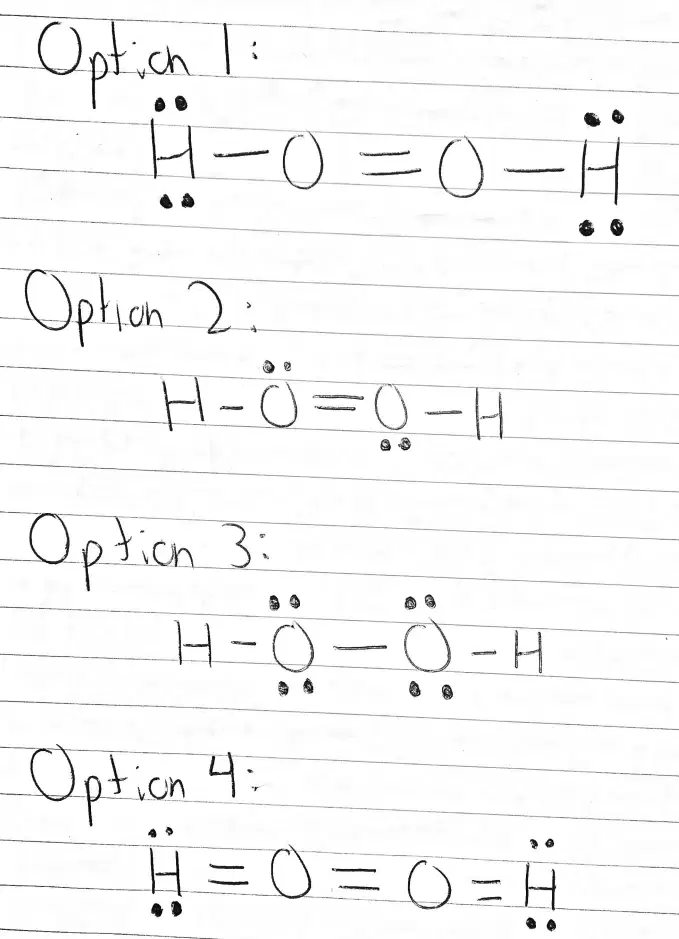
Which of the following is the correct structural formula of H2O2?
a)
Option 1
b)
Option 2
c)
Option 3
d)
Option 4
135.
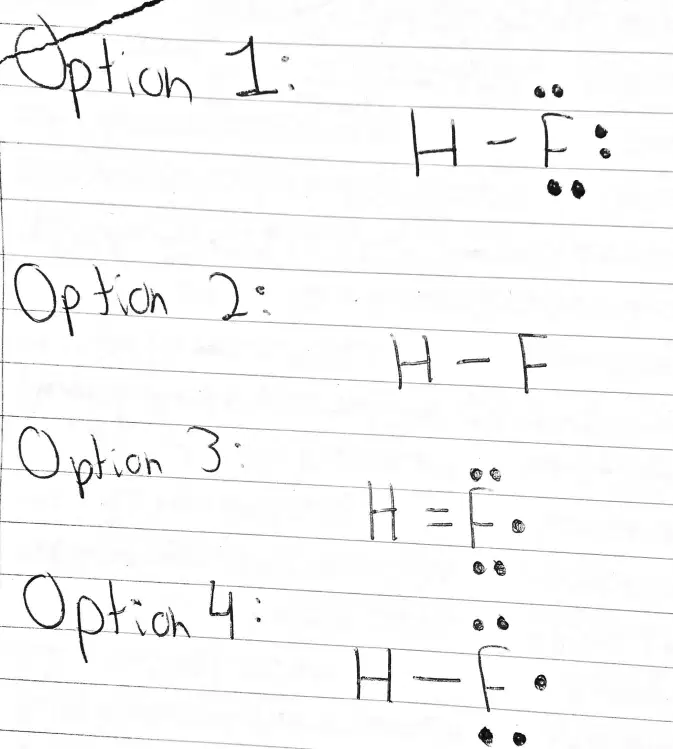
Which of the following is the correct structural formula of HF?
a)
Option 1
b)
Option 2
c)
Option 3
d)
Option 4
136.
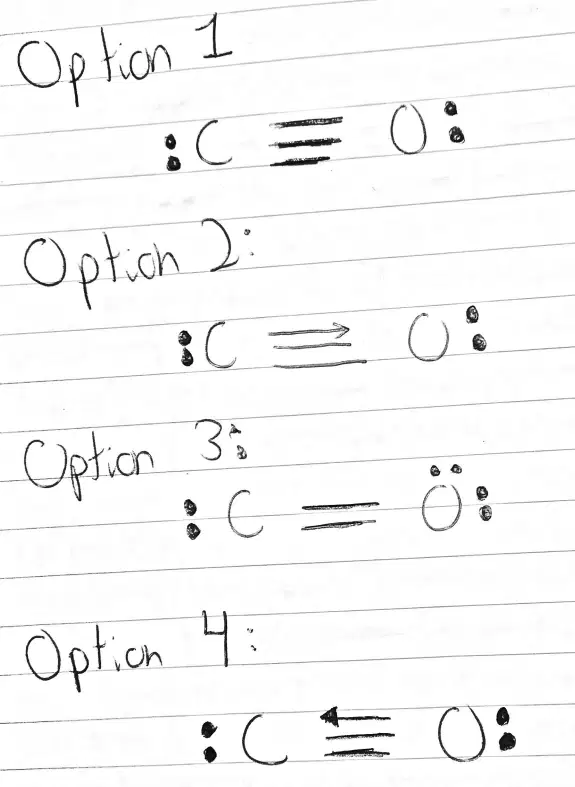
Which of the following is the correct structural formula of carbon monoxide?
a)
Option 1
b)
Option 2
c)
Option 3
d)
Option 4
137.
How are molecular orbitals formed?
a)
When two atoms combine, their atomic orbitals overlap to form molecular orbitals.
b)
When two atoms combine, their molecular orbitals overlap to form atomic orbitals.
c)
When two atoms separate, their atomic orbitals break apart to form molecular orbitals.
d)
When two atoms separate, their atomic orbitals overlap to form molecular orbitals.
138.
What do scientists use VSEPR theory for?
a)
To predict the 3D shapes of molecules
b)
To predict the 2D shapes of molecules
c)
To predict the arrangements of electrons
d)
To predict the arrangements of protons
139.
When two atomic orbitals combine to form a molecular orbital that is symmetric around the axis connecting the two atomic nuclei, what type of bond is formed?
a)
Sigma bond
b)
Pi bond
c)
Alpha bond
d)
Omega bond
e)
Beta bond
140.
According to VESPR theory, what shape does methane have?
(a)
141.
According to VESPR theory, what shape does ammonia have?
(a)
142.
According to VESPR theory, what shape does boron trichloride have?
(a)
143.
Sulfur has an electronegativity of 2.58, and oxygen has an electronegativity of 3.44. In sulfur dioxide, which atom will have a partial negative charge?
a)
Sulfur
b)
Oxygen
144.
Carbon has an electronegativity of 2.55, and oxygen has an electronegativity of 3.44. Carbon monoxide is a(n)
a)
polar molecule.
b)
nonpolar molecule.
c)
ionic compound.
145.
Carbon has an electronegativity of 2.55, and oxygen has an electronegativity of 3.44. Carbon dioxide is a(n)
a)
polar molecule.
b)
nonpolar molecule.
c)
ionic compound.
146.

In hydrogen peroxide, H2O2, which which get "delta minus" symbols?
a)
H
b)
O
147.
Which are stronger, intermolecular attractions or chemical bonds, including covalent and ionic bonds?
a)
Intermolecular attractions
b)
Chemical bonds
148.
Will all compounds with polar covalent bonds be polar?
a)
Yes
b)
No
149.
What would happen if we put a polar molecule between two oppositely charged plates?
a)
It would align where the positive end of the molecule would point towards the negatively charged plate and vice versa.
b)
It would align where the negative end of the molecule would point towards the negatively charged plate and vice versa.
c)
It would align where the positive end of the molecule would point towards the positively charged plate and vice versa.
d)
The molecule wouldn't react to the created electric field.
100 %

