wayground logo

Free Printable Worksheets

Font size

S
M
L
XL
Worksheets

Newton's Laws

Total questions: 150

Worksheet time: 2hrs 38mins

Name
Class
Date
1.
What are balanced forces?
a)
Forces in the same direction
b)
Forces of the same size
c)
forces of the same size in opposite directions
2.
How could you make an object increase its speed?
a)
use less force
b)
use more force
c)
use no force
3.
for every action there is...
a)
An equal and opposite reaction
b)
An equal and different reaction
c)
a different force
d)
two more forces
4.
In a tug of war the left team pulls with a force of 200N. The right team pulls with a force of 150N.What is the resultant force?
a)
50N to the left.
b)
350N to the left.
c)
350N to the right.
d)
50N to the right.
5.
The force that opposes the motion of two surfaces sliding past each other is called ___________.
a)
acceleration
b)
inertia
c)
friction
d)
unbalanced
6.
What is the unit of force?
a)
Kilogram
b)
Meter
c)
Pascal
d)
Newton
7.
What is it called when the force of gravity is acting on an object?
a)
Weight
b)
Sliding Friction
c)
Momentum
d)
Projectile Motion
8.
What is the attraction between two objects because of their mass?
a)
Inertia
b)
Gravity
c)
Gravitational Force
d)
Weight
9.
Imagine you travel to another planets. What will change as you walk around the surface of the planet- your mass or your weight?
a)
Mass
b)
Weight 
c)
Both 
d)
Neither 
10.

This is a rocket.The rocket pushes the fuel down.What is the other force in this interaction pair?

a)

The fuel pulls the rocket up.

b)

The reaction to the burning fuel leaving the engine creates the thrust pushing the rocket upward.

c)

The rocket pulls the earth up.

d)

The earth pulls the rocket down.

11.
On the Picture the balloon pushes the air right and the balloon goes left. Which of Newton's Laws is this?
a)
Newton's 1st Law
b)
Newton's 2nd Law
c)
Newton's 3rd Law
12.
One object has twice as much mass as another object. The first object also has twice as much...
a)
velocity
b)
gravitational acceleration
c)
inertia
d)
all of these
13.
Which has more mass, a kilogram of feathers or a kilogram of iron? 
a)
feathers 
b)
iron
c)
neither
14.
How much does a 6.0 kg bag of bolts weigh? (w = m*g) (g = 9.81 m/s2)
a)
6.0N
b)
12.0N
c)
58.8N
d)
600N
15.
A book rests on a table.  The force of gravity pulls down on the book with a force of 20 newtons. What prevents the books from accelerating downward at 9.8 m/sec2    
a)
The table presses back up on the book with an equal and opposite force of 20 newtons.
b)
The table presses back up on the book with a force greater than 20 newtons.
c)
The table and the book together are accelerating downwards at  9.8 m/sec2
d)
The inertia of the book holds it up
16.
Suppose two carts, one twice as massive as the other, fly apart when the compressed spring that joins them is released.  How fast does the heavier cart roll compared with the lighter cart?
a)
twice as fast
b)
the same
c)
half as fast
17.
You push on a tree with 20 N of force. If the tree doesn't move, the tree is pushing back on you with _____of force.
a)
20N 
b)
40N 
c)
10N 
d)
70N
18.
In a normal environment, why does a bowling ball and feather hit the ground at different times when dropped from the same height?
a)
They don't; they hit the ground at the same time.
b)
One is more dense than the other.
c)
One is heavier than the other.
d)
Air resistance 
19.
Inertia is the tendency of an object to resist a change in its ___________. 
a)
temperature
b)
shape
c)
size
d)
motion
20.

Which is Newtons second law

a)

Force is equal to an objects mass times its acceleration.

b)

an object in motion stays in motion or an object at rest stays at rest unless acted on by an outside force.

c)

law of inertia

d)

For every action there is an equal and opposite reaction

21.
What type of force?
a)
Magnetic
b)
Gravitational
c)
Applied
d)
Normal
22.

What type of force is holding this balloon to the wall?

a)

Applied

b)

Gravitational

c)

Magnetic

d)

Electro-static

23.
What force holds the planets in motion around the sun?
a)
Magnetic
b)
Electrical
c)
Gravitational
d)
Air Resistance
24.

What type of force causes these balloons to move toward or away from each other?

a)

Gravitational

b)

Applied

c)

Magnetic

d)

Electro-static

25.
What does the strength of gravity between two objects depend upon?
a)
Mass & distance
b)
Mass & weight
c)
Gravity & inertia
d)
Inertia & mass
26.
All objects in the universe have a gravitational attraction to each other. 
a)
True
b)
False
27.
What force brings the pencil down?
a)
Applied
b)
Magnetic
c)
Normal
d)
Gravitational
28.
Which has more gravitational force acting upon it?
a)
a bus
b)
a train
c)
a car
d)
a person
29.
What force ultimately slows the roller coaster to a stop?
a)
Applied
b)
Normal
c)
Friction
d)
Magnetic
30.
An _______ force must act on an object for it to CHANGE it's motion
a)
balanced
b)
unbalanced
c)
gravitational
d)
electrical
31.

What is defined as a push or pull?

a)

force

b)

motion

c)

vector

d)

speed

32.

This type of force is when one object pushes or pulls on another object by touching it

a)

contact

b)

gravity

c)

Action at a distance

33.

True or False: All forces occur in interaction pairs.

a)

True

b)

False

34.

The term for a correspondence of parts on opposite sides of a dividing line.

a)

Asymmetric

b)

Symmetric

35.

Which of Newton's laws states that all forces come in pairs?

a)

1st

b)

2nd

c)

3rd

d)

4th

36.

Tension is a specific name for the force that a ____ exerts.

a)

Rope

b)

String

c)

Chain

d)

all of these

37.
When mass increases then gravity
a)
Decreases
b)
Increases
c)
Stays the same
38.
What type of force is Spiderman using to hold himself off the ground?
a)
friction
b)
tension
c)
gravity
d)
normal
39.
There is very little friction between ____________ or slippery surfaces.
a)
smooth
b)
rough
c)
hard
d)
soft
40.
Which of the following shows the direction of the friction force?
a)
A
b)
B
c)
C
d)
D
41.
friction is a force that acts 
a)
in the same direction as the motion
b)
opposite to the direction of the motion
c)
opposite to the applied forces
d)
the same direction as the applied force
42.
A force that occurs when the ends of an object are pulled away from its center.
a)
Compression
b)
Tension
c)
Bending
d)
Torsion
43.
A force that occurs when the ends of an object are being pushed towards each other.
a)
Shear
b)
Compression
c)
Tension
d)
Bending
44.

The closer two objects are to each other

a)

the harder they will land

b)

they will have no gravitational force

c)

the stronger the gravitational force

d)

huh?

45.
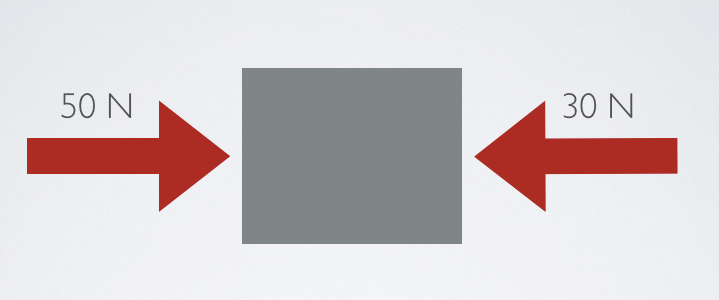
What is the net force?
a)
40 N left
b)
0 N Balalnced
c)
400 N right
d)
40 N right
46.
How will this object move? 
a)
It won't move. 
b)
It will move to the right. 
c)
It will move to the left. 
d)
It will move in both directions. 
47.

How will this object's motion change?

a)

It won't change

b)

It will move to the right.

c)

It will move to the left.

d)

It will move up.

48.
What kind of force is friction?
a)
noncontact
b)
contact
c)
gravity
d)
push and pull
49.
The easiest way to open a heavy door  is by applying the force
a)
Near the hinges
b)
In the middle of the door
c)
At the edge of the door far from the hinges
d)
At the top of the door
50.
When an object is experiencing a net torque
a)
it is in dynamic equilibrium.
b)
it is in static equilibrium.
c)
it is rotating.
d)
it is translating.
51.
Will an object with a density of 1.01 g/cm3 float or sink?
a)
float
b)
sink
52.
Why do ice cubes float in a  glass of water?
a)
the ice cubes are more dense than the water
b)
the water is more dense than the ice cubes
c)
the water is more dense than the glass
d)
the ice is more dense than the glass
53.
... the ability of an object to float...
a)
bouyancy
b)
sink
c)
water
54.
What is the force of squeezing together?
a)
compression
b)
tension
c)
bending
d)
torsion
55.
What is the force of stretching and pulling apart?
a)
compression
b)
tension
c)
bending
d)
torsion
56.
What is a force that causes parts of a material to slide past one another in opposite directions?
a)
shearing
b)
tension
c)
bending
d)
torsion
57.
What is the force of action that twists material?
a)
shearing
b)
tension
c)
bending
d)
torsion
58.
Which force is pictured?
a)
shearing
b)
tension
c)
bending
d)
torsion
59.
Which force is pictured?
a)
compression
b)
tension
c)
bending
d)
torsion
60.

During Compression, a material may become . . .

a)

Longer

b)

Shorter

c)

moves in opposite directionsThis is a wrong answer

d)

worthless

61.

During Tension, a materia may become

a)

Longer

b)

Shorter

c)

Twisted

d)

Expensive

62.

Bending of material combines which two forces?

a)

Compression & Tension

b)

Wind & Rain

c)

Shear & Torsion

d)

Dead & Live Loads

63.

When a material is loaded with a force, it produces a....

a)

Seperation

b)

Stall

c)

Stress

d)

Scream

64.

The amount of deformation of a material due to applied force & stress.

a)

Pressure

b)

Contorsion

c)

Strain

d)

Buckle

65.
What law is best described by inertia?
a)
1st
b)
2nd
c)
3rd
66.
a)
1st
b)
2nd
c)
3rd
67.
a)
1st
b)
2nd
c)
3rd
68.
Object at rest stays at rest.
a)
1st
b)
2nd
c)
3rd
69.
F = MxA
a)
1st
b)
2nd
c)
3rd
70.
Acceleration is due to a force put on an objects mass. 
a)
1st
b)
2nd
c)
3rd
71.
Action/Reaction
a)
1st
b)
2nd
c)
3rd
72.
Force exerted between the surfaces of two objects. 
a)
Friction
b)
Inertia
c)
Force
d)
Gravity
73.
"For every action, there is an equal and opposite reaction."
a)
Newton's 1st Law
b)
Newton's 2nd Law
c)
Newton's 3rd Law
d)
Newton's 4th Law
74.
Force = Mass x Acceleration
a)
Newton's 1st Law
b)
Newton's 2nd Law
c)
Newton's 3rd Law
d)
Newton's 4th Law
75.
"An object in motion (or at rest) will to stay in motion (or at rest) until an outside force acts upon it."
a)
Newton's 1st Law
b)
Newton's 2nd Law
c)
Newton's 3rd Law
d)
Newton's 4th Law
76.
The tendency of an object to resist changes in its motion is...
a)
inertia
b)
force
c)
acceleration
d)
velocity
77.
The force that opposes motion between two surfaces in contact with each other.
a)
inertia
b)
friction
c)
momentum
d)
gravity
78.
The force of attraction between all matter.
a)
inertia
b)
friction
c)
net force
d)
gravity
79.
A force that opposes motion between a surface in contact with the atmosphere.
a)
air resistance
b)
gravity
c)
momentum
d)
terminal velocity
80.
Which of the following is the same as a Newton?
a)
kg*m/sec/sec
b)
kg*m/sec
c)
m/sec/sec
d)
m/sec
81.
Which of the following is the units for acceleration?
a)
kg*m/sec/sec
b)
kg*m/sec
c)
m/sec/sec
d)
m/sec
82.
A Newton is a unit of...
a)
force
b)
inertia
c)
acceleration
d)
velocity
83.
When all the forces on an object are equal and opposite, & the net force is zero, that's...
a)
balanced forces
b)
unbalanced forces
c)
terminal velocity
d)
reaction forces
84.
The combination of all the forces acting on an object is the...
a)
net force
b)
action force
c)
reaction force
d)
balance force
85.
A cannonball with a mass of 10 kg is flying at an acceleration of 5 m/sec/sec. What is it's force?
a)
50 Newtons
b)
5 Newtons
c)
20 Newtons
d)
9.5 Newtons
86.
Gravity is increased with...
a)
greater mass & shorter distance
b)
greater mass & farther distance
c)
lower mass & shorter distance
d)
lower mass & farther distance
87.
Mass x acceleration = ?
a)
force
b)
inertia
c)
momentum
d)
velocity
88.
In the picture, the vehicle will move because of...
a)
Newton's 1st Law
b)
Newton's 2nd Law
c)
Newton's 3rd Law
d)
Newton's 9th Law
89.
What is the net force?
a)
10 N
b)
0 N
c)
25 N
d)
1 N
90.
Balanced or Unbalanced?
a)
Balanced 
b)
Unbalanced
91.
What is the net force?
a)
400 N Up
b)
400 N Down
c)
- 400 N Down
d)
800 N Down
92.
Unit of mass
a)
m/s 2
b)
m/s
c)
newtons
d)
kg
93.
45 m/s2 is the... 
a)
Mass
b)
Force 
c)
Acceleration
d)
weight
94.
What is the formula for force?
a)
F=M/A
b)
F=A/M
c)
F=M*A
d)
F=M*F
95.
Which law explains why you need to wear a seat belt? 
a)
First 
b)
Second
c)
Third
d)
Gravity
96.
A rocket with less ________ will have a greater acceleration.
a)
Mass
b)
At Rest
c)
Reaction
d)
Resist
97.
Which type of force(s) will cause a change in an object's motion?
a)
gravity
b)
zero net force
c)
balanced forces
d)
unbalanced forces
98.
A stationary bumper car is set in motion by the outside force of another bumper car colliding with it.
a)
Newton's
1st
Law of Motion
b)
Newton's
2nd
Law of Motion
c)
Newton's
3rd
Law of Motion
99.
When the force on a car is doubled, the acceleration is doubled.
a)
Newton's
1st
Law of Motion
b)
Newton's
2nd
Law of Motion
c)
Newton's
3rd
Law of Motion
100.
A rocket in outer space continues to move.
a)
Newton's
1st
Law of Motion
b)
Newton's
2nd
Law of Motion
c)
Newton's
3rd
Law of Motion
101.
A skater pushes another skater forward, but the one pushing moves backwards.
a)
Newton's
1st
Law of Motion
b)
Newton's
2nd
Law of Motion
c)
Newton's
3rd
Law of Motion
102.
The harder you hit a baseball, the faster it accelerates.
a)
Newton's
1st
Law of Motion
b)
Newton's
2nd
Law of Motion
c)
Newton's
3rd
Law of Motion
103.
You push against a wall and the wall is pushing back on you.
a)
Newton's
1st
Law of Motion
b)
Newton's
2nd
Law of Motion
c)
Newton's
3rd
Law of Motion
104.
As the fuel in a rocket ignites, the force of gas expansion and explosion pushes out the back of the rocket and pushes the rocket forward.
a)
Newton's
1st
Law of Motion
b)
Newton's
2nd
Law of Motion
c)
Newton's
3rd
Law of Motion
105.
You step from a boat to a dock.  The boat moves backwards as you move forwards and you fall in the water.
a)
Newton's
1st
Law of Motion
b)
Newton's
2nd
Law of Motion
c)
Newton's
3rd
Law of Motion
106.
You push against the floor when you walk and the floor pushes back on you.
a)
Newton's
1st
Law of Motion
b)
Newton's
2nd
Law of Motion
c)
Newton's
3rd
Law of Motion
107.
A swimmer pushes water back with her arms but her body moves forward.
a)
Newton's
1st
Law of Motion
b)
Newton's
2nd
Law of Motion
c)
Newton's
3rd
Law of Motion
108.

Determine the accelerations that result when a 12-N net force is applied to a 3-kg object.

a)

3 m/s

b)

4 ft/s

c)

13 m/s

d)

4 m/s/s

109.
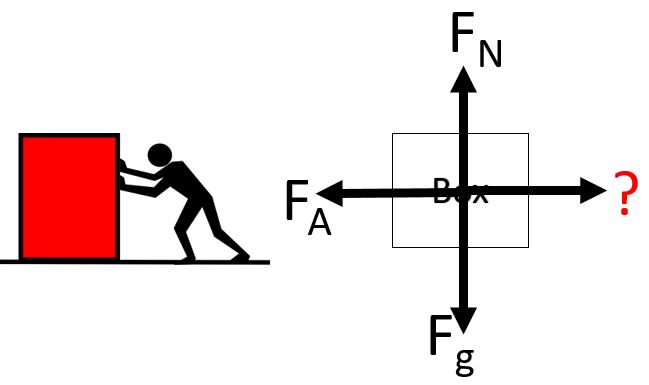
Name the missing force....
a)
weight force
b)
normal force
c)
frictional force
d)
tension force
110.
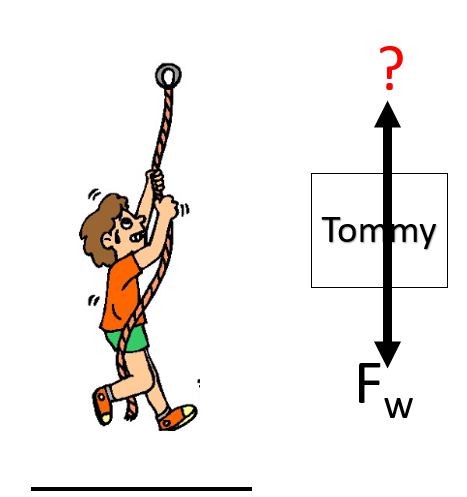
Name the missing force...
a)
spring force
b)
weight force
c)
normal force
d)
buoyant force
111.
Name the missing force...
a)
frictional force
b)
weight force
c)
thrust
d)
buoyant force
112.
Name the missing force...
a)
tension force
b)
gravitational force
c)
normal force
d)
applied force
113.

What is the net force of an object that is not changing its motion?

a)

0N

b)

100N

c)

Upward force

114.
Name the missing force...
a)
thrust
b)
frictional force
c)
normal force
d)
weight force
115.
Name the missing force...
a)
lift
b)
frictional force
c)
normal force
d)
buoyant force
116.
Match description with free-body diagram.
a)
A book is at rest on a tabletop.
b)
A gymnast holding onto a bar, is suspended motionless in mid-air. The bar is supported by two ropes that attach to the ceiling. Diagram the forces acting on the combination of gymnast and bar.
c)
An egg is free-falling from a nest in a tree. Neglect air resistance.
d)
A flying squirrel is gliding (no wing flaps) from a tree to the ground at constant velocity. Consider air resistance.
117.
Match description with free-body diagram.
a)
A book is at rest on a tabletop.
b)
A gymnast holding onto a bar, is suspended motionless in mid-air. The bar is supported by two ropes that attach to the ceiling. Diagram the forces acting on the combination of gymnast and bar.
c)
An egg is free-falling from a nest in a tree. Neglect air resistance.
d)
A flying squirrel is gliding (no wing flaps) from a tree to the ground at constant velocity. Consider air resistance.
118.
Match description with free-body diagram.
a)
A book is at rest on a tabletop.
b)
A gymnast holding onto a bar, is suspended motionless in mid-air. The bar is supported by two ropes that attach to the ceiling. Diagram the forces acting on the combination of gymnast and bar.
c)
An egg is free-falling from a nest in a tree. Neglect air resistance.
d)
A flying squirrel is gliding (no wing flaps) from a tree to the ground at constant velocity. Consider air resistance.
119.
Match description with free-body diagram.
a)
A rightward force is applied to a book in order to move it across a desk with a rightward acceleration. Consider frictional forces. Neglect air resistance. 
b)
A rightward force is applied to a book in order to move it across a desk at constant velocity. Consider frictional forces. Neglect air resistance. 
c)
A college student rests a backpack upon his shoulder. The pack is suspended motionless by one strap from one shoulder. 
d)
A skydiver is descending with a constant velocity. Consider air resistance.
120.
What makes a rolling ball stop moving?
a)
gravity
b)
friction
c)
a balanced force
121.
Calculate the net force acting upon the object.
a)
10 N north
b)
20 N south
c)
10 N south
d)
22.4 N north
122.
The SI Unit of force is
a)
Pascal
b)
Meter/second
c)
Newton
d)
kg
123.

What is the appropriate way to indicate Gravity in a diagram?

a)
b)
c)
d)
124.

The best way to label a push or a pull on a diagram is to use

a)
b)
c)
d)
125.

Which of the following best describes the object in this diagram.

a)

A box sitting on the floor.

b)

A hockey puck gliding to the right.

c)

An athlete running to the right.

d)

A skateboarding gliding to the left.

126.
Wheels on a skateboard most likely experiences-
a)
Rolling Friction
b)
Sliding Friction
c)
Fluid Friction
d)
Static Friction
127.
Sally experiences-
a)
Rolling Friction
b)
Sliding Friction
c)
Fluid Friction
d)
Static Friction
128.
Wheels of a shopping cart experience-
a)
Rolling Friction
b)
Sliding Friction
c)
Fluid Friction
d)
Static Friction
129.
Swimming fish experience-
a)
Rolling Friction
b)
Sliding Friction
c)
Fluid Friction
d)
Static Friction
130.
Which type of friction occurs when an object rolls over or rotates on a surface?
a)
sliding
b)
static
c)
fluid
d)
rolling
131.
What happens to the object when the forces are not balanced? 
a)
Accelerates
b)
Stays
c)
Nothing
d)
None of the above
132.
What is Sliding Friction?
a)
Opposes submarines in the water and airplanes in the air
b)
Opposes the dirrection of an 0bject as it slides over a surface
c)
None of the above
d)
Change in shape the point of rolling contrast because of friction
133.
Define Static Friction
a)
Friction caused by two objects sliding against each other
b)
Friction that occurs when a solid rolls across a surface
c)
The friction of stationary objects. You must use more force to move an object experiencing this kind of friction
d)
Friction that occurs when a solid pushes a liquid aside
134.
Frictions acts in the direction _____to the direction of the object's motion.
a)
Perpendicular
b)
Parallel
c)
Opposite
d)
Diagonal
135.
How can friction be reduced?
a)
reduce the force acting between the 2 surfaces
b)
reduce the roughness of the 2 surfaces coming in contact
c)
use wax, grease or oil
d)
all of the above are ways of reducing friction
136.
Which would NOT be a way of reducing friction?
a)
making the surfaces smoother
b)
using lubricants such as waxes, oils, or grease
c)
changing from sliding friction to rolling friction using ball bearings
d)
Using kitty litter on snow and ice to help your car gain traction
137.
What type of friction is not moving?
a)
static
b)
dynamic
c)
kinetic
d)
rolling
138.
Rougher surfaces have ...
a)
greater friction
b)
less friction
c)
the same level of friction
139.
What does friction produce?
a)
light
b)
sound
c)
heat
d)
gravity
140.

What is acceleration?

a)

transfer of energy to an object

b)

going faster

c)

a change in velocity (speed, direction, or both)

d)

an object remaining in motion or at rest until something changes it

141.
The parachuter is slowing down because of ___________ friction.
a)
Static
b)
Fluid
c)
Rolling
d)
Sliding
142.
A puck slides along an icy surface. What makes it slow down?
a)
It runs out of push
b)
It rubs against the ice
c)
It runs out of electricity
143.
A boy sits halfway down a grassy slope. What force stops him sliding down?
a)
Weight 
b)
Gravity 
c)
Friction
144.
On which surface will a toy car travel the furthest?
a)
Carpet
b)
Polished Wood
c)
Ice
145.
On which surface will a toy sledge travel the least distance?
a)
Carpet
b)
Polished Wood
c)
Ice
146.
Rougher surfaces have ...
a)
greater friction
b)
less friction
c)
the same level of friction
147.
If you poured oil onto a wooden surface, the friction would ..
a)
be reduced
b)
be increased
c)
remain the same
148.

What are the 2 general types of friction that other can be categorized into?

a)

Static and Dynamic Friction

b)

Kinetic and Static Friction

c)

Kinetic and Dynamic Friction

d)

Dynamic and Moving Friction

149.
Which of the following is an example of rolling kinetic friction?
a)
box sliding across the floor
b)
bike rolling along the road
c)
car skidding to a stop
d)
soccer player making a slide tackle 
150.
What is force measured with?
a)
F=force
b)
N=Newtons
c)
M=Mass
d)
S=Speed