
 Worksheets
Y9 CHEMISTRY REVISION
Total questions: 150
Worksheet time: 2hrs 54mins
Ionic bonding is between a
nonmetal and nonmetal
metal and nonmetal
metal and metal
Depends on the situation
Covalent bonding is between a
nonmetal and nonmetal
metal and nonmetal
metal and metal
It depends on the situation
An atom that gains or loses an electron becomes
an isotope
a new element
an ion
a molecule
Valence electrons are
neutral (no charge)
found in the outer most energy level of the atom
equal to the number of protons
How many different elements are in the C6H12O6
3
6
12
24


The chemical bond between a non-metal and another non-metal will be a ________ bond.
metal
ionic
covalent
polar
The chemical bond between a metal and a non-metal will be a _____ bond.
metal
ionic
covalent
polar
Beryllium and sulfur will form a ______ bond
ionic
covalent
metalloid
Sodium and Bromine will make a _____ bond.
ionic
covalent
metallic
Carbon and Oxygen will make a ___________ bond.
ionic
covalent
metallic
Nitrogen and Oxygen will make a ____________ bond
ionic
covalent
metallic
MgO
ionic
covalent
metallic
NaCl
ionic
covalent
metallic
If two fluorine atoms bond they will make a _____ bond.
ionic
covalent
metallic
Hydrogen and Chlorine will from a _________ bond
ionic
covalent
metallic
Which of these element pairs would bond covalently?
Fr and K
Sc and O
F and Cl
He and Pt
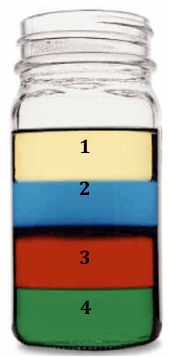


What is the formula for Volume?
Mass/Volume
Density x Volume
Mass/Density
What is the formula for Mass?
Mass/Volume
Density x Volume
Mass/Density

What is mass?
The amount of space an object takes up
The amount of matter in a given space
The amount of matter in an object
What is volume?
The amount of space an object takes up
The amount of matter in a given space
The amount of matter in an object
What is density?
The amount of space an object takes up
The amount of matter in a given space
The amount of matter in an object
List four factors that affects the rate of a reaction
temperature
concentration
surface area
volume
catalysts
A temperature increase causes the particles ......
to slow down
move faster
collide higher
in the right order

Why does a higher concentration increase the rate of reaction?
it increases the amount of reactants
it lowers the activation energy
it increases the energy of particle collisions
it increases the frequency of particle collisions
The ______________is required to break the bonds of the reactants.
Carbonic energy
Activation energy
Plutonic energy
Energi Gaib
A temperature increase causes the particles ......
to slow down
move faster
collide higher
in the right order
Subatomic particles with a negative charge
Electrons
Neutrons
Protons
Quarks

The smallest particle of an element.
Element
Molecule
Atom

What is one way Neutrons are different from electrons?
they both are negative
neutrons have no charge, while electrons have a negative charge
Both are in the nucleus( center of atom)
Electrons are inside nucleus and neutrons are outside the nucleus.

What is the atomic number?
35
18
17
52

How many protons and electrons does this element have?
35
18
17
52

How many neutrons does Chlorine have?
18
17
35
52

What is the atomic mass of Neon?
10
20
30

How many neutrons does calcium have?
20
40
60
0

What is the atomic mass of Arsenic?
33
107
75

Jay combines water, sugar, and lemon juice to form lemonade. What type of substance was made?
Element
Molecule
Mixture
Which of the following does not describe elements?
All particles are alike
Can be broken down into simpler substances
Have unique sets of properties
Join together to form compounds
What is the chemical formula for water?
NaCl
CO2
NH3
H2O
What is a mixture?
an atom
2 or more substances that are together in the same place, but their atoms are not chemically bonded
a substance that cannot be broken down into any other substances by physical or chemical means
A substance made of 2 or more elements that are chemically
combined in a set ratio
The smallest unit of an element that has all the basic properties of the element is called what?
compound
mixture
element
atom
How would you separate sand and water?
boil
filter
magnetic
put it in the fridge
made up of?
Atom are the ______ units of all matter.
air
solid
main
basic
Atom cause matter to exist in three states which are gases, liduids and _____________ .
main
basic
solid
air
The position of a metal in the reactivity series of metals depends on the reactivity of the metal when reacting with ....
Carbon
Hydrogen
Oxygen
Sulphur
Aluminium is more reactive than ....
Calcium and Zinc
Sodium and Gold
Magnesium and Copper
Lead and Iron

Based on the following diagram, what is the function of potassium manganate (VII) crystals in this experiment?
To supply oxygen
To avoid the metals to mix with each other
To release heat
To give out water vapour
Complete the word equation below.
Magnesium + oxygen --> .....
Magnesium
Magnesium oxide
Oxides
Magnesium oxide + water

The diagram shows a setup apparatus for an experiment. What is the aim of the experiment?
To determine the position of carbon in the reactivity series of metals
To determine the position of hydrogen in the reactivity series of metals
To observe the reactivity of metals with carbon dioxide
To observe the reactivity of metals with water
What is the observation when aluminium oxide react with carbon?
The mixture burns vigorously
The mixture glows dimly
The combustion is extinguish
No change
When aluminium oxide react with carbon, there is no change that will occur. What is your inference for this observation?
Carbon cannot remove the oxygen from the aluminium oxide
Carbon is less reactive than aluminium
Aluminium is more reactive than carbon
All of the above
Complete the word equation below.
Zinc oxide + carbon --> ..........
Zinc + carbon
Zinc oxide + carbon
Zinc + carbon dioxide
No change

Based on the diagram, what is the function of anhydrous calcium chloride in the experiment?
To absorb water vapour so that dry hydrogen will be produced
To supply hydrogen gas
To separate the metals
To release heat for combustion
Hydrogen is more reactive than the following metals except .....
Lead
Copper
Aluminium
Mercury
What will happened when lead oxide react with hydrogen?
Lead oxide burns brightly
Yellow powder turns shiny grey
Lead is produced
All of the above
Choose the correct sequence.
.............. , ............ , .........
----------------------------------->
Reactivity towards oxygen increases
Silver , Copper , Tin
Iron , Lead , Mercury
Magnesium , Aluminium , Calcium
Iron , Carbon , Lead
The reactivity series of metals is applied in the ............. of the metals from their ore.
Melting
Extraction
Freezing
Crystalization
Metal oxides that more reactive than carbon can be extracted through ......
Electrolysis
Fractional distillation
Evaporation
Photosynthesis
What are the two non-metals that are include in the reactivity series of metals?
Hydrogen and iron
Oxygen and lead
Tin and carbon
Carbon and hydrogen
a less reactive metal displaces a more reactive metal from its compound
metals are reacted together
metals above iron react with other metals in the reactivity series
What will the products of this reaction be?
calcium + zinc nitrate --------->
zinc nitrate + calcium
calcium nitrate + zinc
there will be no reaction
zinc + calcium chloride
magnesium + magnesium oxide
iron + copper(II) oxide
magnesium + iron(II) oxide
calcium + iron(II) oxide
What will NOT be observed in the reaction below?
zinc (s) + copper sulfate (aq) ==> copper (s) + zinc sulfate (aq)
a change in the colour of the solution
formation of a reddish brown solid
metal decreasing in size
effervescence (bubbles of gas)
iron + copper(II) oxide -->
iron + copper(II) oxide
iron(II) oxide + copper(II) oxide
iron(II) oxide + copper
iron tetraoxide + copper(II) oxide
Which metal is more reactive than calcium?
magnesium
potassium
silver
aluminum
Magnesium powder is added into copper nitrate solution to form a brown solid and a solution. Brown solid refers to ____
copper
magnesium
magnesium nitrate
Which one of the following combinations result in a displacement reaction?
Iron with magnesium chloride
magnesium with iron chloride
Iron with Zinc Sulphate
gold with silver nitrate
What will the products of this reaction be?
calcium + zinc nitrate --------->
Calcium + zinc nitrate
Zinc + calcium nitrate
there will be no reaction
Zinc + calcium chloride
What are the products when magnesium reacts with hydrochloric acid?
magnesium nitrate and hydrogen gas
magnesium sulfate and hydrogen gas
magnesium oxide and oxygen gas
magnesium chloride and hydrogen gas
Complete the following word equation:
Metal + Acid -->
Salt + water
Salt + hydrogen
Salt + Water + Carbon dioxide
Complete the following word equation:
Metalcarbonate + acid -->
Salt + Hydrogen
Salt + Water + Carbon Dioxide
Salt + Water
How do you remove the water to leave solid copper sulfate crystals?
Filter
Evaporate
Distill
What is the symbol for Copper?
C
co
Cu
CU
What is the symbol for carbonate?
CO
CO2
CO3
What is the name of the practical technique to neutralise an alkali?
Neutralisation
Titration
Using a burette
Telestration
What does the word insoluble mean?
Does dissolve
Doesn't dissolve
Is part of a solid
What colour does the solution turn when sulfuric acid is added to copper carbonate?
Blue
Green
Clear
Purple
How do you separate an excess insoluble reactant from a solution?
Filtration
Precipitation
Crystalisation
Evaporation
Which two chemicals could you react to make only potassium chloride and water?
Potassium and hydrochloric acid
Potassium hydroxide and hydrochloric acid
Potassium oxide and sulfuric acid
Potassium and sulfuric acid
_________________ + nitric acid --> calcium nitrate + water
calcium sulfate
calcium oxide
calcium carbonate
calcium
Which is the correct definition for an element?
A substance made up of only one type of atom that can be broken down
Two or more substances that are not chemically combined
Two or more different atoms that are chemically combined
A substance made up of only one type of atom that cannot be broken down
C is the correct chemical symbol for which element?
calcium
copper
carbon
caesium
The smallest part of an element is called...
a compound
a mixture
an element
an atom
Which is the correct definition for a compound?
A substance made up of only one type of atom that can be broken down
Two or more substances that are not chemically combined
Two or more different atoms that are chemically combined
A substance made up of only one type of atom that cannot be broken down
What is the missing word? The properties of a compound are __________ the elements it is made up of.
the same as
different to
Which is correct?
iron and sulfur are both metals
iron and sulfur are both non metals
iron is a non metal and sulfur is a metal
iron is a metal and sulfur is a non metal
What is the correct name for CO?
carbon dioxide
carbon monoxide
cobalt
carbon oxide
Which elements are present in H2SO4?
hydrogen and oxygen
hydrogen, oxygen and sodium
hydrogen, oxygen and sulfur
hydrogen, oxygen and silicon
How many atoms of aluminium are there in the chemical formula for aluminium oxide: Al2O3
2
3
5
1
Which element has the chemical symbol Ni?
nitrogen
nickel
sodium
neon
What is the chemical symbol for copper?
C
Co
Cp
Cu
What is the chemical symbol for gold?
Ag
Go
Gu
Au
Is water an element or a compound?
compound
element
How many different elements are there in Mg(OH)2
2
3
4
5
True or false: Hydrogen atoms go around in pairs called molecules
True
False
What is the name of the compound formed from sodium and chlorine?
sodium chlorine
schloride
sodium chloride
chloride sodium
Water molecules exist as liquid at room temperature. How do molecules of hydrogen and oxygen exist at room temperature?
solid
liquid
gas
A property of sodium is that it fizzes when it reacts with water. What is a property of chlorine?
It is an orange liquid at room temperature
It is a green gas at room temperature
It is a black solid at room temperature
It is a colourless gas at room temperature
What is the correct chemical symbol for iron?
Ir
I
Fe
Fr
The forces that hold molecules of water together are stronger than the forces that hold molecules of oxygen together. This means that water has...
a lower boiling point than oxygen
a higher boiling point than oxygen
the same boiling point as oxygen

